What Is Time Table Management in a Restaurant
What is time table management in a restaurant? Learn how reservations, seating, pacing and service flow fit together, with numbers to check.
It's 19:40 on a busy Friday. The door is full, the kitchen pass has three tickets waiting, and two guests are using a six-seat table. By 21:15, half the room is empty, and two cooks are cleaning down early.
The bookings were real. The timing was wrong. Table management coordinates who sits where, how long each party uses a table, and when the next party can be seated. Done well, it helps a restaurant use its capacity without sending more orders to the kitchen than it can handle.
Table management is live coordination of seating, table availability, and service capacity, so the room can keep turning without overloading the kitchen.
A booking diary records who plans to arrive. Table management also helps staff respond when guests arrive early, a party stays longer than expected, or a walk-in needs a place. The difference is like comparing a calendar with a live map: one records the plan, while the other helps staff manage what is happening now.
Better allocation can help restaurants capture more revenue when the room is busy. Deposits and card holds can also reduce no-shows, but that is a reservation-policy effect, not a result of table allocation alone. Both choices shape the service: one matches parties to tables and timings, while the other gives guests a reason to honor their booking.
The work breaks down into five parts. Each can be checked against a real service, from the first arrival to the last table cleared.
Table of Contents
- Time Table Management Defined for Restaurants
- How a Booking Becomes a Seated and Cleared Table
- Seating and Pacing Rules That Protect the Kitchen
- What Better Table Allocation Adds to Revenue
- Reservations, No-Shows and Late Cancellations
- Misconceptions and Limits of Table Management
- Start Managing Your Tables This Week
Time Table Management Defined for Restaurants
A dining room has a fixed number of seats, a kitchen that can only produce so fast, and guests who arrive in waves. Table management fits those three realities together, booking by booking, so the room fills without the pass falling behind.
Take a Friday with eight bookings at 19:00 and nothing at 21:00. The covers exist. They're stacked into the wrong hour. Every one of those bookings was legitimate, and the evening still lost money because the arrival pattern was never shaped.
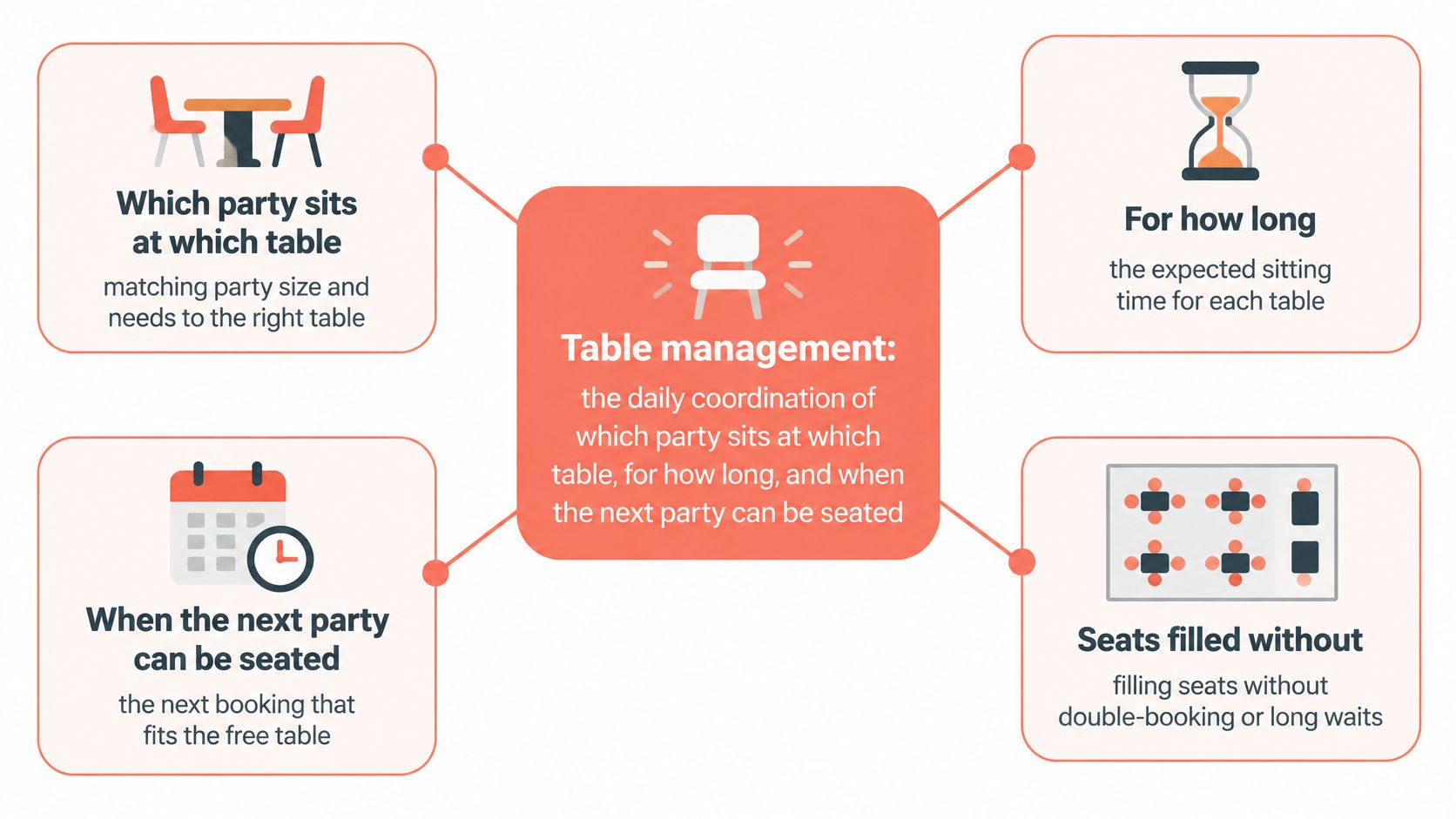
Search for what is time table management and most results describe a staff roster or a shared calendar. A restaurant needs something narrower and harder: live capacity coordination while service is running and plans keep changing.
The Five Parts, in Order
| Part | What it controls | What goes wrong without it |
|---|---|---|
| Reservations | How many parties are booked into each time slot | Early slots overbooked while later slots sit empty |
| Table assignment | Which party sits at which table, matched by size | Two guests at a six-seat table while larger parties are turned away |
| Seating duration | Expected time each party uses a table | Tables held too long or cleared too early for the next guests |
| Pacing | How many guests arrive in each interval | Kitchen overload and long waits when too many guests land together |
| Walk-ins and changes | How late arrivals, cancellations and no-shows are slotted | Gaps left unsold and queues forming at the door |
Most owners treat these five as one job and blame the kitchen when it goes wrong. They're separate controls with separate failure modes. A 40-minute walk-in quote at 19:30 isn't a booking problem, it's a pacing problem, and the fix belongs in the slot structure, not in the kitchen.
Run this test tonight: count the empty seats you can see while guests are waiting at the door, then trace each gap to one of the five parts. The cause is usually a missing rule, not a busy night.
How a Booking Becomes a Seated and Cleared Table
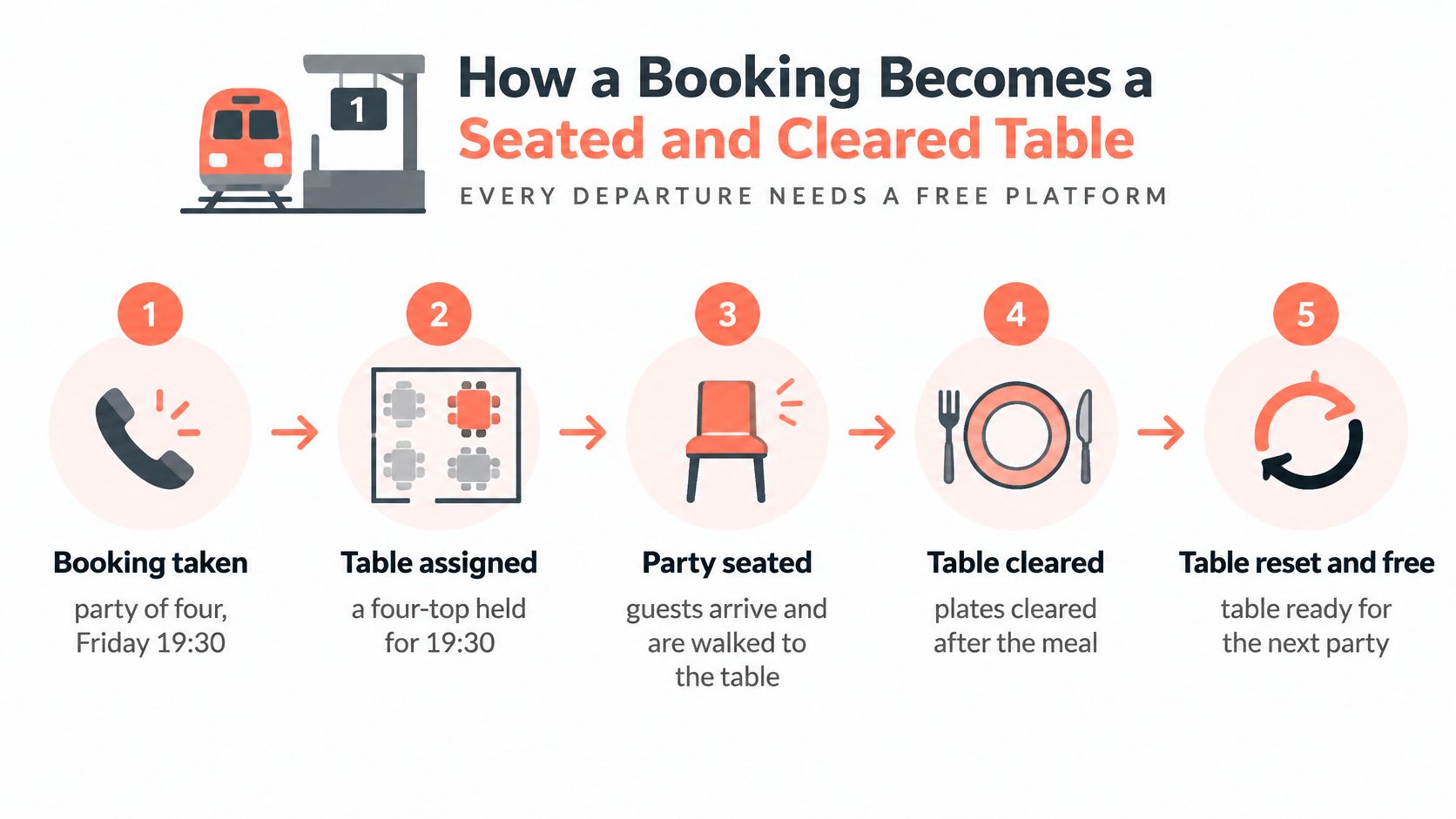
At 19:30 on Friday, a party of four arrives. Their booking has to fit the room's timing as well as its table layout. From the first request to a reset table, seven steps keep that capacity visible.
- The request arrives. A guest books online or by phone. The system checks capacity for the requested interval, rather than treating the whole evening as one block.
- The booking is accepted and matched. Party size guides the table assignment. If tables can be combined, the layout must allow the group to sit together.
- The duration is set. The expected sitting time determines when the table may be available again.
- The party is seated. The host guides guests to their table and updates its status.
- The order reaches the kitchen. Pacing helps spread incoming covers across the service instead of sending too many guests to the pass at once.
- The table is cleared and reset. Once ready, its seats can be offered to a waitlisted guest or walk-in. Restaurant table turnover depends on tracking when tables are ready, not just when a booking was due to end.
- The bill closes. Recording covers and actual sitting times gives the restaurant a useful reference for future planning.
A shared timeline helps the host and managers make decisions from the same picture of service. It works like a railway timetable: each arrival has a place in a wider sequence, and a delay can affect what follows. The history of Bradshaw's railway timetables describes the early use of a shared reference for railway journeys.
Table combinations need the same practical check. A plan for a large party only works if the room can fit the joined tables without blocking the service. Venue managers use layout planning to compare hall layouts before booking; restaurants likewise need to confirm that the proposed configuration fits their floor.
Here is the sequence in motion, from booking to reset floor.
Seating and Pacing Rules That Protect the Kitchen
Pacing is a number, not a feeling. If two cooks run the line and the pass can absorb twelve covers of work in half an hour, then twelve covers per 30 minutes is the cap, and the booking page should enforce it whether or not the room looks empty at 18:00.
Match the Party to the Table
Two guests at a six-top cost you the four-cover party you'll turn away at 20:00, and that party is worth more than the extra elbow room. Keep two-tops for two-tops, hold large tables for parties of six or more, and join tables only when the layout allows it and the guests want to sit together.
Set Durations You Can Defend
Roughly 90 minutes covers a lunch for two. A dinner tasting menu needs closer to 120. Duration drives availability, turnover and the arrival slots you can sell, so a duration pulled from thin air breaks every rule built on top of it.
On a fully booked night, leave 10 to 15 minutes between seatings so the table resets properly. That buffer isn't lost revenue. It's the difference between a table that turns three times and one that turns twice while a guest waits for clean glasses.
The balance rule: a slow kitchen needs wider spacing, a quiet bar can take tighter arrivals. Copying another restaurant's pacing is how you overload your own pass.
Spacing also matters more when the team is thin. The National Restaurant Association's 2024 industry forecast reported that 45% of U.S. restaurant operators needed more employees to support existing customer demand, and a short-staffed kitchen turns out fewer covers per hour, not more.
Pacing rules only hold if the data behind them is clean, which is why reliable POS support for busy restaurants matters as much as the booking screen. The cap itself comes from your own records, and restaurant demand forecasting is where you find the covers your kitchen serves per slot. Write that number down this week and use it as the limit on every slot.
What Better Table Allocation Adds to Revenue
A better table assignment makes the biggest difference when the room is busy. At quiet times, there are fewer competing demands for each table. On a packed Saturday, seating the right party at the right table can reduce idle gaps and avoid sending more guests to the door than the kitchen can serve.
| Load level | Study range over first-come, first-served |
|---|---|
| Low load | Not reported |
| Medium load | 0.16% to 2.96% |
| High load | 7.65% to 13.13% |
A computational study of restaurant revenue management reported the medium- and high-load ranges shown above. Its figures compare revenue-management methods with first-come, first-served seating. The study does not report a low-load range in the cited findings.
Where the Gain Comes From
During a busy service, one poor assignment can leave a table empty while a suitable party waits. Matching party sizes to available tables helps the restaurant serve more guests with the floor it already has.
For example, applying the lower end of the study's high-load range to a 60-cover Saturday gives about 4.6 additional covers. At a €50 average spend, that is roughly €230 in revenue before food and labour costs. This is an illustration, not a forecast. Use your own cover count and average spend to estimate the potential for your restaurant.
Restaurants using 10Seat see 30% more reservations, 40% fewer no-shows and 10-15% more covers per shift.
Two practical habits support better allocation: keep larger tables available for parties that need them, and compare expected demand in each slot with the seats available. The goal is to serve more guests without creating a rush that overwhelms the kitchen later in the evening.
Reservations, No-Shows and Late Cancellations
Dividing no-shows by advance reservations gives the no-show rate. Across 3.77 million reservations at 2,417 restaurants, the average was 2.33%, according to ResOS's analysis of restaurant no-show rates.
| Reservation type | No-show rate | Empty bookings per 100 reservations |
|---|---|---|
| All reservations (average) | 2.33% | 2.33 |
| With deposit or card hold | 0.80% | 0.80 |
| Without a payment requirement | 2.47% | 2.47 |
What the Gap Means for a Normal Service
A restaurant taking 100 advance bookings a day expects about 2.33 empty bookings at the average rate. Bookings with a deposit or card hold recorded 0.80%, so the same 100 bookings would leave roughly 0.80 unseated parties, a difference of about 1.53 per day. Treat it as an observed association rather than proof, because restaurants that ask for deposits may differ from those that don't in plenty of other ways.
Late Cancellations Do the Same Damage, Later
In the same dataset, 56% of cancellations arrived within 24 hours of the booking or after the reservation had started, as Dimension Labs' analysis of deposits and no-show fees reports. A night can look sold out at 18:00 and still leak seats at 19:15, too late to resell them.
The money is real. Reporting on no-show costs put a failed two-person booking at an average of £55.70 in lost sales, which is the figure behind Restaurant Online's no-show reporting. Ten of those in a week is roughly £557 gone before you count wasted labour and prep.
Three controls cover most of it: a defined cancellation deadline, a waitlist that can refill a released seat within minutes, and a reminder the day before. If you want to go further with card holds, this guide to the restaurant reservation deposit explains how to set one without scaring off regulars.
Calculate your own no-show rate for the last 30 days before you change anything. That single number tells you which bookings deserve protection.
Misconceptions and Limits of Table Management
A full room means good management. Filling every minute compresses arrivals into the same window, and the kitchen absorbs the damage. Slack is insurance. A table held back at 20:15 takes the party that's 25 minutes late and the table that runs long, and both happen most weekends.
A timetable is just a calendar. Hospitality guidance describes scheduling as four linked activities, forecasting demand, translating that into staffing needs, building a workable schedule, and adjusting it when actual demand differs from the forecast, as EHL's restaurant staff scheduling guidance sets out. A calendar that can't be revised at 20:40 covers only the first two.
Software replaces the manager. It doesn't, and the confidence gap shows why. Only 31% of surveyed multi-unit operators were extremely confident that managers could build efficient schedules without over- or understaffing, according to Crunchtime's restaurant operations research. Availability, preferences, legal rest rules and cross-training stay visible in any automated plan, and a manager still overrides it when the room says so.
Only large restaurants need this. A 30-seat bistro with one Friday rush runs the same five parts at a smaller scale. The difference is margin for error, and a bistro has less of it.
The biggest limit is data. If seating times aren't recorded, durations are guesses, and every rule built on them wobbles.
Judge the system on kitchen ticket times, wait times, covers per shift and guest feedback. Not on how full the room looked at nine.
Start Managing Your Tables This Week
On a busy Friday, a booking can arrive just as one table is running late and another party is waiting at the door. Start by tracking where those moments happen, then adjust the rules that shape your service.
- Record two weeks of service. Note party sizes, seating times, no-shows, and empty seats while guests are waiting. This gives you a starting picture of where capacity is being lost.
- Set a pacing limit for each time slot. Write down how many covers the kitchen can handle in a 30-minute window. Use that figure to set a cap, then adjust it if service shows the limit is too high or too low.
- Protect prime-time bookings. Consider deposits or card holds for the slots most affected by cancellations. Apply the policy consistently and explain it when guests book.
- Set a cancellation deadline and keep a waitlist. When a booking is released, offer the table to waiting guests while there is still time to seat them.
- Review the results each Monday. Compare covers per shift, no-shows, and average waits. Change one rule at a time so you can see what affected service.
A GKS Check for Belgian Venues
Belgian operators also need to keep their cash-register requirements in view. A VAT-taxable business providing restaurant or catering services must use a registered cash register system once annual turnover from those services exceeds EUR 25,000, excluding drinks, as Moore's summary of the GKS circular explains. The threshold is assessed per establishment, even when several locations share one VAT number. Keep reservation, seating, and receipt records aligned with the venue that served the meal.
A paper diary records bookings, while a reservation and table management system can help staff coordinate capacity during service. 10Seat shows tables live so staff can seat guests, handle changes, and manage walk-ins. Its Smart Auto Seating locks online bookings into an efficient table configuration, and staff apps support table and booking management. The onboarding team helps import existing data, configure the table layout, and train staff.
Tonight, open last weekend's diary. Count the empty seats guests waited beside, then use that count to decide what to track first. 10Seat is a restaurant reservation and table management system that can be set up in minutes, with a free plan for up to 50 covers. Visit 10Seat to see how its tools fit your service.