Restaurant Reservation Deposit: A Complete Guide
Learn how to implement a restaurant reservation deposit policy that reduces no-shows and protects your revenue. Build a fair system that works.

At 8:40 on a fully booked Saturday, the damage is already done.
An eight-top hasn't arrived. The host has stopped smiling at the door and started glancing at the clock. Menus are folded back into a stack. The kitchen has prepped for the turn. The bar has already front-loaded mise en place for covers that may never sit down. Service staff can feel the table sitting there, dead in the middle of the room, pulling the energy down with it.
That's the moment most operators start thinking seriously about a restaurant reservation deposit.
The point isn't to punish guests. The point is to filter demand. A good deposit policy separates committed bookings from casual holds, protects prime inventory, and gives your team a fairer shot at running the room you planned for. A bad policy does the opposite. It creates friction, scares off genuine diners, and leaves your team arguing about exceptions at the host stand.
That trade-off gets ignored in most deposit guides. They focus on no-shows, which matter. They talk less about the booking funnel, which matters just as much. If the policy protects Saturday night but hollows out Thursday through Sunday conversion, it hasn't solved the problem.
For Belgian restaurants, there's another layer. The policy has to work operationally, it has to be explainable by staff in one sentence, and it has to hold up when a guest disputes the charge. That means clear written terms, clean payment handling, and records that fit the way your restaurant operates.
Table of Contents
- The Saturday Night That Started This Whole Deposit Question
- What the Numbers Say About Deposits and No-Shows
- Choosing the Right Deposit Amount and Trigger Conditions
- Building the Booking Flow So Guests Do Not Drop Off
- How 10seat Compares to Commission Platforms on Deposit Policy
- Legal and Compliance Basics for Belgian Restaurants
- A One-Page Deposit Policy Checklist You Can Use Today
The Saturday Night That Started This Whole Deposit Question
A no-show table doesn't just cost revenue. It wastes prep, disrupts pacing, and dents morale.
An eight-cover gap on a peak service hits three times. First, there's the obvious lost spend. Second, there's labour already committed to a room planned around a full book. Third, there's the opportunity cost of the table that could have gone to guests who wanted it. The bigger the party, the harder it is to refill late.
What the room feels like when the table never arrives
The host sees the hole first. Then the kitchen feels it. Then the servers do.
A missing large party throws off sequence. Courses that were timed around a full section now land unevenly. A bartender has stocked for demand that never materialised. A server who expected a strong section closes lighter than planned. None of that shows up neatly in a reservation report, but every operator knows it's real.
Practical rule: Deposits work best when they protect inventory that's hard to resell in real time.
That's why the debate shouldn't start with “Should every booking pay a deposit?” It should start with “Which bookings create operational risk if they disappear?”
Deposits are a demand filter, not a penalty
The healthiest way to frame a restaurant reservation deposit is simple. It's a commitment device for high-risk bookings.
That language matters because guests can feel the difference between a policy that protects scarce capacity and one that feels punitive. A Saturday tasting menu, a six-top at 20:00, or a holiday service has real replacement risk. A weekday lunch for two usually doesn't.
There's a second problem that shows up when the policy is clumsy. Guests get to the booking page, choose the slot they want, then only discover the deposit at the payment step. That's where trust drops. The issue isn't the amount alone. It's the surprise.
A workable policy protects the room without damaging the flow that fills it. That's the balance worth getting right.
What the Numbers Say About Deposits and No-Shows
Operators usually do not need a study to know deposits cut no-shows. They need the numbers to decide where the policy pays for itself and where it starts costing covers.
A large 2026 dataset from Resos, covering 3,768,761 reservations across 2,417 restaurants, found an average no-show rate of 2.33% overall, 0.80% for reservations with no-show protection, and 2.47% for bookings without a payment requirement, according to the Resos No-Show Index.
That gap matters. On a busy room, the difference between roughly 1 no-show in 125 protected bookings and closer to 1 in 40 unprotected bookings changes staffing, prep, and revenue planning.
A second source points in the same direction. One benchmark reported an average 57% reduction in no-shows when deposits were used, and another showed a drop from 12.8% to 5.4%, according to industry reporting on restaurant no-shows, fees, and holds.
Where deposits actually pay off
The practical split is not by principle. It is by resale risk.
| Booking Type | Typical No-Show Rate | Deposit Justified? | Notes |
|---|---|---|---|
| Protected bookings with payment requirement | 0.80% | Usually yes | Best fit for inventory that is hard to resell at short notice |
| Bookings without payment requirement | 2.47% | Sometimes | Works for lower-risk periods where replacement demand is steady |
| All reservations in the Resos sample | 2.33% | Case by case | Useful as a benchmark, not a universal rule |
| Large bookings in the UK market | Qualitative only | Usually yes | Group tables create the biggest revenue hole when they vanish |
| High-commitment formats such as tasting menus and ticketed events | Qualitative only | Yes | Prep costs and fixed timing make these the easiest cases to defend |
From an operations view, deposits earn their keep on bookings that distort the whole service if they disappear. A six-top at 20:00 on Saturday is one thing. A two-top at 12:30 on Tuesday is another. Treating both the same is where policy gets lazy.
The number many operators miss
The no-show rate is only half the math. Conversion loss matters too.
A 2025 UK dining study found 44% of diners are put off when asked for a deposit, 57% are less likely to reserve when asked for card details, and 66% are put off if asked to pay a deposit, according to the UK Restaurant Report 2025.
This is the part many deposit guides skip. The protected booking is not free if three good bookings dropped out before checkout.
In practice, that means a restaurant can improve attendance and still hurt total covers if the rule is too broad, too high, or introduced too late in the flow. I have seen that trade-off firsthand. A targeted deposit on peak group bookings usually improves net revenue. A blanket policy on every table often trims demand, especially in markets where guests have easy alternatives and no patience for clumsy payment steps.
That trade-off is even more relevant in Belgium, where many independents rely on repeat local trade, multilingual guest communication, and direct bookings they do not want to push toward commission platforms. The right policy protects Friday and Saturday inventory without making an ordinary neighbourhood booking feel like an airline transaction.
The strongest setup asks for commitment only where the commercial risk is real, explains the rule before the guest enters payment details, and keeps cancellation terms easy to understand.
The same principle shows up outside hospitality. Teams trying to stop demo cancellations with Captiwate add a commitment step early enough to filter weak intent, but not so awkwardly that qualified people quit halfway through.
If you want a broader operating playbook, not just deposit tactics, this guide on reducing restaurant no-show rates without adding unnecessary booking friction is a useful companion.
Choosing the Right Deposit Amount and Trigger Conditions
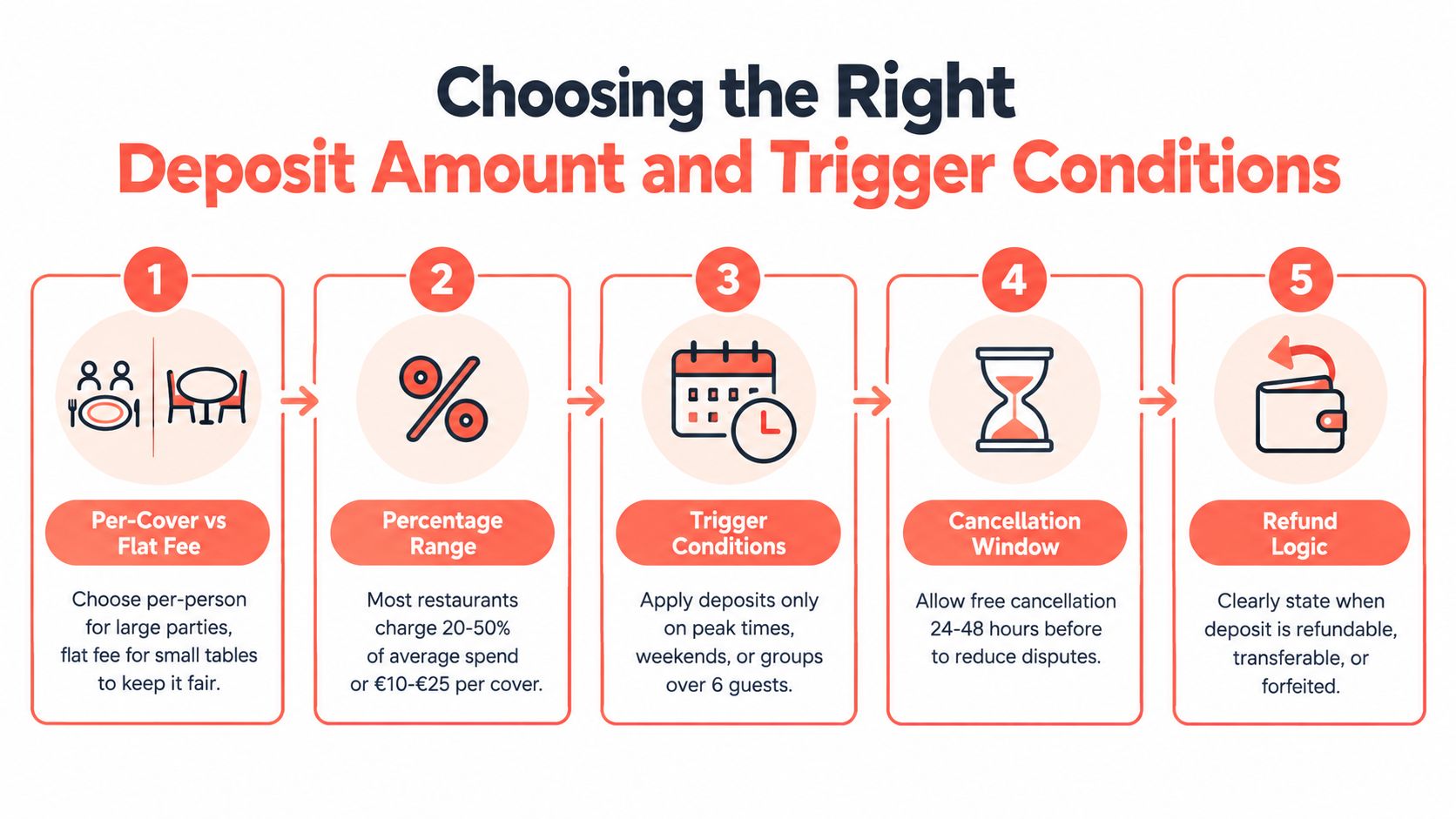
Set the amount and the trigger together, or the policy will drift out of proportion fast.
I have seen operators copy a €20 per-head deposit from a fine-dining place and apply it to an ordinary brasserie booking. The result is predictable. Fewer risky bookings, yes. Fewer good bookings too.
The better starting point is replacement risk. If a cancelled table can be resold in ten minutes, the deposit can stay light or disappear entirely. If it is an eight-top at 20:00 on Saturday, or a tasting-menu slot you prep for hours in advance, the guest needs more skin in the game.
The UK market gives a useful benchmark. One industry report found that many restaurants using deposits stayed within a relatively modest range, with larger bookings as the most common trigger, and also estimated that confirmed bookings no-showed often enough to cost the average restaurant £1,325 over the measured period, with a 5% no-show rate in the same research, according to the OpenTable industry report.
Match the amount to the booking economics
For most independents, a sensible deposit is high enough to change behaviour and low enough that guests do not abandon the booking.
That usually means using different rules for different types of demand:
- Large-party dinner bookings: Use a per-cover amount because the revenue risk rises with each seat.
- High-demand small tables: A flat fee often reads more cleanly to guests than charging per person.
- Set-menu, event, or chef's-counter bookings: A higher upfront commitment is easier to defend because purchasing and staffing decisions happen earlier.
- Standard weekday bookings: In many cases, no deposit is the right answer.
In Belgium, I usually advise clients to test deposits first on tables that are hard to replace, not on the whole book. A neighbourhood restaurant in Gent or Antwerpen lives on repeat local trade. If a couple booking Tuesday dinner hits a payment wall for no clear reason, some of that demand will go elsewhere and not come back.
Trigger conditions do more work than the headline price
The amount gets attention. The trigger decides whether the policy feels fair.
Good trigger conditions are easy for staff to explain and easy for guests to predict:
- Party size: Start where the table becomes commercially awkward to refill.
- Service period: Friday and Saturday dinner deserve tighter protection than a quiet lunch.
- Booking format: Private rooms, menu packages, and special events justify firmer terms.
- Lead time: Reservations made well in advance often carry more speculative demand.
This is also where many restaurants choose between a cash deposit and a card hold. If the commercial risk is moderate rather than severe, a credit card guarantee for restaurant bookings can protect the reservation with less friction at checkout.
Keep the cancellation rule blunt and clear
A host should be able to say the policy in one breath.
“€15 per guest. Full refund up to 24 hours before arrival. After that, we keep the deposit if the table cancels late or does not show.” That is the level of clarity you want. If staff need to interpret exceptions table by table, disputes go up and enforcement gets inconsistent.
Published terms matter operationally as much as legally. The terms need to be visible before payment, easy to repeat in Dutch, French, and English if needed, and simple enough that your team applies them the same way every shift, as outlined in this restaurant booking deposits guide.
A workable deposit policy is one your host can explain without opening a PDF or calling a manager.
The practical target is not the highest possible deposit. It is the lowest-friction rule that still protects your most expensive inventory.
Building the Booking Flow So Guests Do Not Drop Off
Most drop-off doesn't happen because guests hate deposits. It happens because the policy appears too late or reads like legal copy.
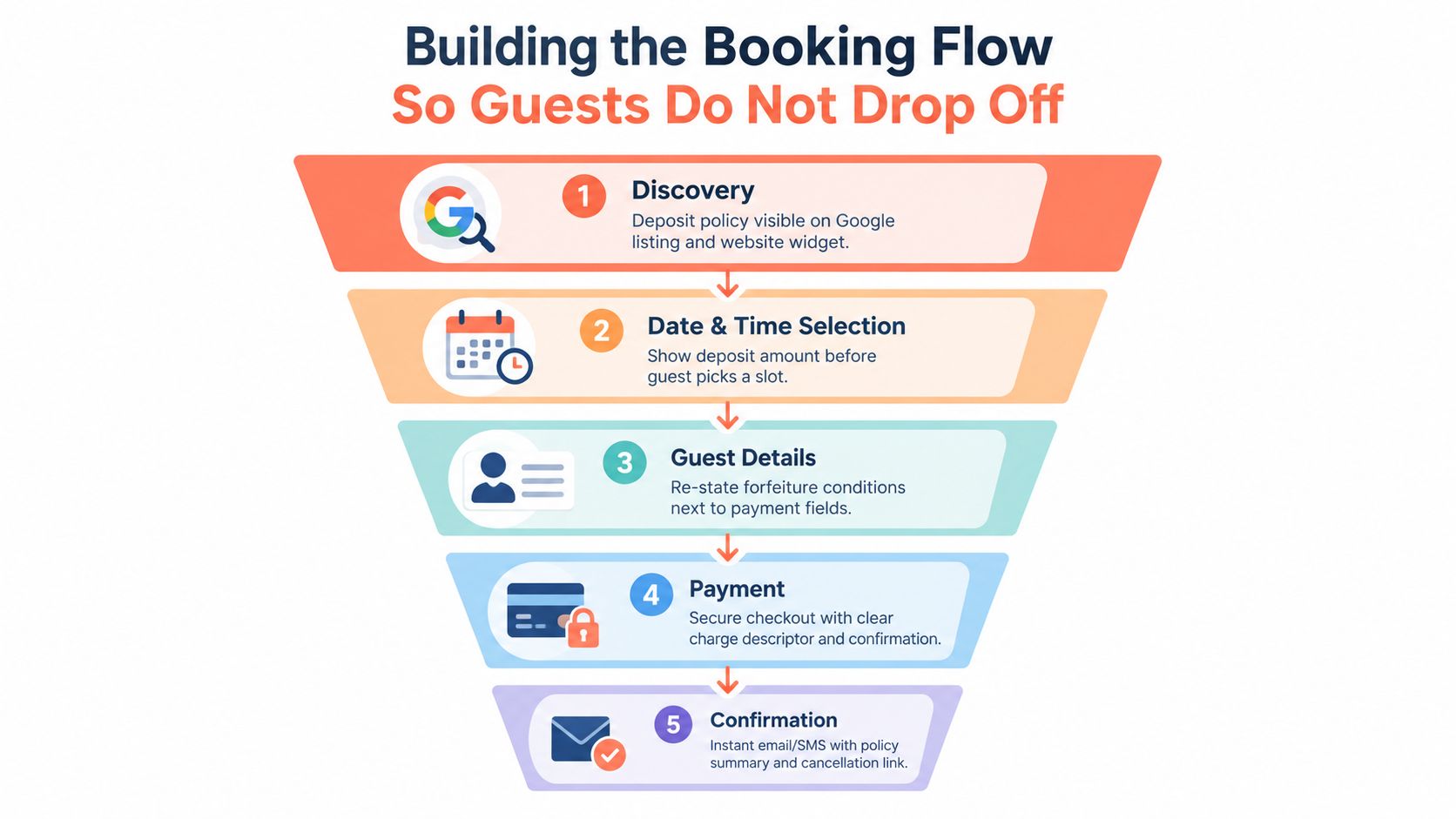
The booking flow needs to surface the same three things at every key point, the amount, the cancellation deadline, and what happens if the guest no-shows. If any one of those is hidden until the payment screen, abandonment goes up and disputes follow later.
Show the policy before the guest commits time
The first visibility point is the listing or widget, not the payment page.
If a deposit applies only to certain tables, times, or party sizes, that rule should appear as soon as the guest selects a qualifying option. The goal is simple. No surprises after they've mentally booked the evening.
Useful copy is short and direct:
- Slot label: “Deposit required for this booking”
- Detail line: “€15 per guest, refunded if cancelled up to 24 hours before arrival”
- Consent line: “By confirming, you accept the booking and cancellation terms”
That isn't elegant writing. It isn't supposed to be. It's operational writing.
Fix the two drop-off cliffs
The first cliff is between time selection and payment disclosure. A guest picks 20:00, gets excited, then sees a charge with no warning. That's where trust breaks.
The second cliff is after payment. Too many systems collect the deposit, show a thin confirmation page, and leave the guest wondering what happens next. That uncertainty creates inbound calls, staff admin, and chargeback risk.
A stronger flow includes:
- Immediate confirmation: Repeat the amount paid and the cancellation deadline.
- Written terms in the email: Keep them near the top, not hidden below the fold.
- A working cancellation path: Guests should be able to cancel without phoning three times.
- Reminder cadence: Send a reminder with the policy summary and cancellation link before the deadline closes.
For operators refining the page itself, this review of deposit and availability page design is useful because it focuses on where disclosure belongs in the user journey, not just how the page looks.
Guests usually dispute surprise, not clarity.
A booking system should support that clarity in the actual flow, not force you to patch it together with manual follow-ups. On the product side, 10seat.com/product is one example of a reservation setup that supports operator-controlled booking rules and payments without layering a marketplace commission on top.
How 10seat Compares to Commission Platforms on Deposit Policy
The platform model changes more than cost. It changes who controls the deposit conversation.
With commission platforms, the commercial structure often sits between the restaurant and the guest relationship. With a commission-free setup, the economics and policy control stay closer to the operator. That matters when a cancellation becomes a complaint and the team needs clear ownership of the rules.
Deposit Handling, Commission Platforms vs 10seat
| Policy Element | Commission Platforms | 10seat |
|---|---|---|
| Commercial model | Platform commission may sit alongside reservation flow | Commission-free reservation management |
| Deposit framing | Often shaped by marketplace flow and standard platform logic | Set inside the restaurant's own booking policy |
| Funds and policy control | Can feel platform-mediated from the guest side | Kept closer to the operator's own process |
| Guest relationship | Marketplace layer may sit between booking and follow-up | First-party guest relationship stays with the restaurant |
| Refund conversation | Staff may need to work within platform defaults | Restaurant keeps direct control over its stated rules |
This isn't about saying TheFork, OpenTable, Zenchef, or Formitable are wrong. They solve different problems, especially for discovery and demand generation. But pricing model affects policy behaviour. When every cover already carries a commercial cost, operators can end up adjusting the way they price, explain, or recover deposit-related losses.
For independent restaurants that want to review the economics clearly, the real cost of per-cover commission is worth reading before choosing how deposit policy should sit inside the reservation stack.
The operational takeaway
When a guest challenges a retained deposit, three questions come up fast. Who took the payment. Who set the terms. Who owns the guest communication.
If those answers are fuzzy, the team loses time. If they're clear, resolution is usually faster.
That's where the platform choice stops being a software decision and becomes a service decision.
Legal and Compliance Basics for Belgian Restaurants
A deposit policy only works if it can survive scrutiny. In Belgium, that starts with disclosure, records, and consistent handling.
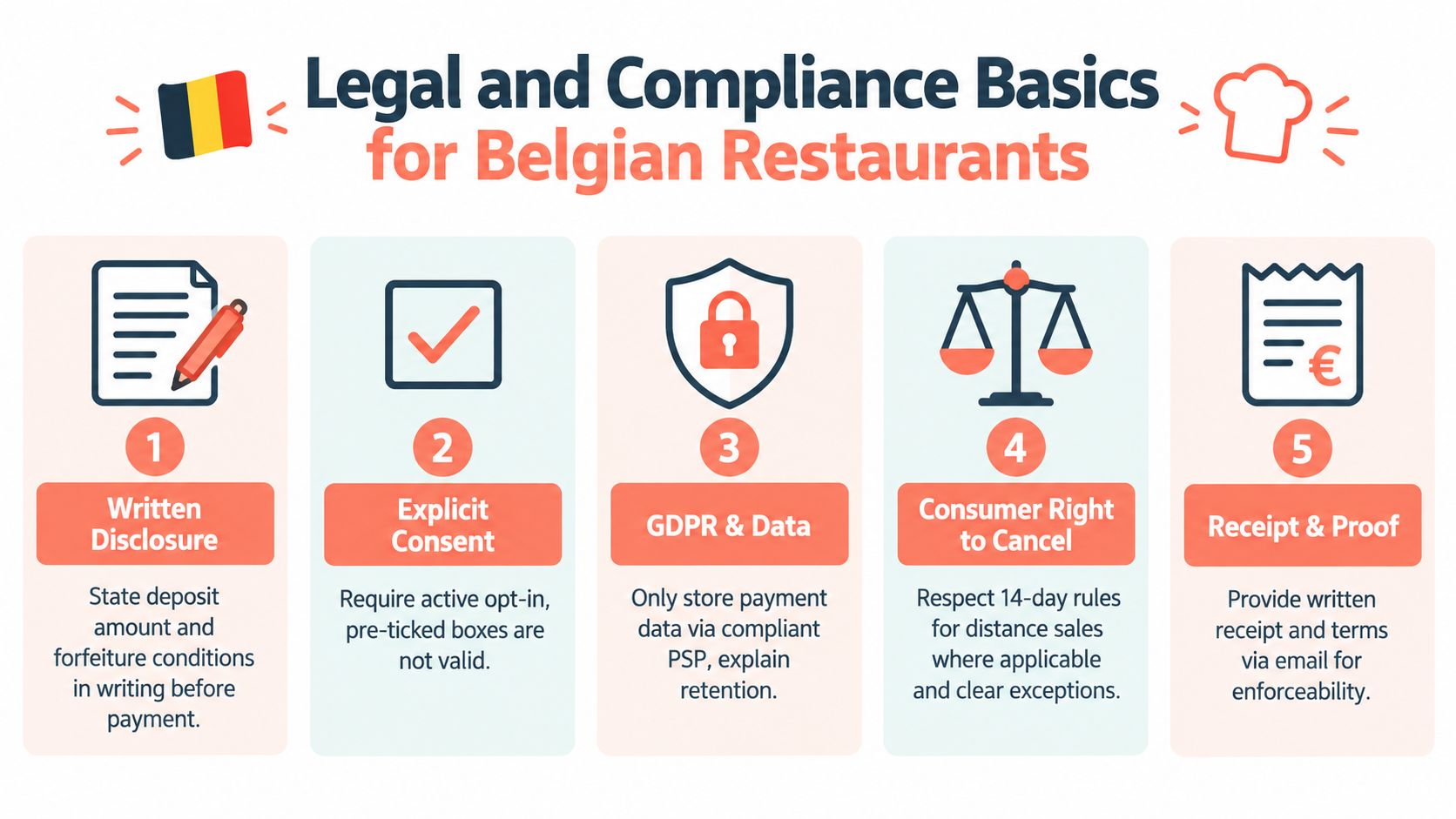
The basic standard is simple. The deposit amount, the cancellation deadline, and the forfeiture conditions need to be stated in writing before payment. A guest shouldn't have to dig through hidden terms after the card has already been charged.
What needs to be visible and provable
A restaurant reservation deposit becomes hard to enforce when the policy was unclear, inconsistent, or impossible to retrieve after booking.
At minimum, keep these records tied to the reservation:
- Written terms accepted at booking: Amount, deadline, refund rule.
- Confirmation message: Email or SMS with the same terms.
- Change log: If the booking time, menu, or service conditions changed later.
- Refund trail: What was returned, when, and why.
Consumer-rights analysis in other jurisdictions points to the same weak spot. Disputes often centre on proving what was disclosed and whether forfeiture was enforceable, as discussed in consumer guidance on restaurant deposits and rights.
GKS compliance in Belgian operations
For Belgian operators, GKS matters because reservation payments and later bill settlement need to line up cleanly with the way revenue is recorded in the business.
The practical checklist for the accountant and manager is straightforward:
- Map the deposit correctly: Know whether it's being held, applied to the bill, or refunded.
- Match written terms to the transaction trail: The confirmation, payment reference, and final bill should tell the same story.
- Keep the receipt wording consistent: Staff shouldn't improvise explanations at the desk.
- Document exceptions: VIP overrides and goodwill refunds need a visible reason.
- Use a compliant payment setup: Don't store card data outside approved providers.
A hospitality terms document from Booking.com makes one general point that applies beyond hotels. In no-show or charged-cancellation cases, the accommodation is responsible for charging the guest and remitting applicable taxes, and Booking.com may still charge commission on room price collected in those cases, according to the Booking.com terms and conditions. The operational lesson is simple. Responsibility for the charge and the accounting treatment must be clear.
For owners who want a plain-language starting point before sending terms to counsel, tools such as this AI legal assistant for business owners can help organise questions, but a restaurant shouldn't treat a generic template as final legal advice.
Clear disclosure prevents more disputes than tough wording ever will.
A One-Page Deposit Policy Checklist You Can Use Today
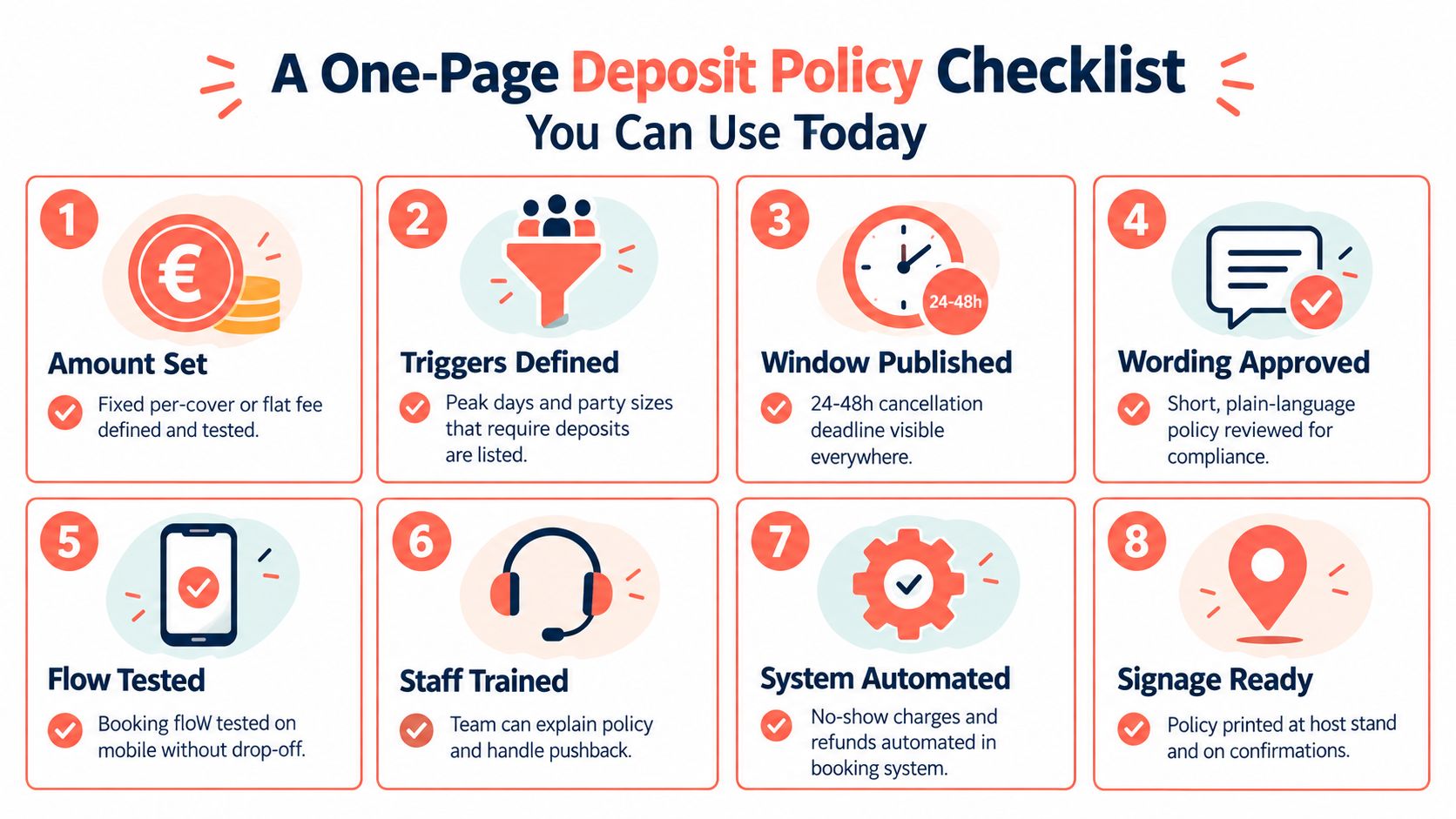
A workable deposit policy fits on one page because managers need to apply it fast, and staff need to explain it the same way every time.
The aim is simple. Cut avoidable no-show loss without adding enough friction to depress good bookings. Earlier figures in this article already show why that trade-off matters. The mistake is treating deposits as pure protection and ignoring the conversion cost.
Pin this next to the POS
- Set one deposit amount for each booking type.
- Use deposits only on slots that carry no-show risk.
- Take payment during booking confirmation, not later by phone or email.
- Show the cancellation deadline in the booking flow, confirmation, and reminder.
- Write refund and forfeiture terms in plain language.
- Give staff a short exception rule, including who can approve overrides.
- Match GKS wording and receipts to the booking terms the guest accepted.
- Check no-shows, covers sold, and booking drop-off every month.
What to watch in the first month
Track three things together. Attendance on protected services. Booking completion on the steps where the deposit appears. Admin time spent on calls, refund requests, and disputes.
That last point gets missed.
I have seen restaurants reduce no-shows and still hurt revenue because the deposit trigger was too broad or the amount was too high for the market. A Saturday 8 pm table for six is one thing. A Wednesday 6:30 pm table for two is another. Good policy follows demand patterns, average spend, and guest expectations in your local market, not a generic template.
For Belgian operators, the practical test is tighter. The guest-facing terms, payment record, and GKS output need to tell the same story. If the team says a deposit is refundable, the written policy and final bill cannot suggest something else. Clear wording does more to prevent disputes than stricter wording.
A sound restaurant reservation deposit policy protects revenue, keeps the booking flow easy enough to convert, and holds up operationally on the floor.
10Seat gives independent restaurants a commission-free way to manage reservations, deposits, and table flow under their own policy terms instead of a marketplace default. If you want tighter control over high-risk bookings without adding more manual admin, visit 10Seat.