Restaurant Table Turnover: The Operator's Playbook
A practical guide to restaurant table turnover for owners and GMs, covering measurement, common causes of slow service, and safe strategies
Restaurant table turnover is not about seating people faster. The focus is to cut avoidable dwell time while protecting the meal experience, because 2.8 turns per night can still be the right number for one room and the wrong number for another, and a casual-dining floor averaging 2.2 seat turns per hour will not behave like a tasting-menu room (industry benchmark data).
Chasing the highest possible turn count is a misleading KPI. A smarter operator asks one question every shift, where is the bottleneck tonight?
Table of Contents
- Why Faster Turns Are Not Always Better
- What Table Turnover Means for Your Floor
- How to Measure Turnover on Your Own Floor
- Where Service Time Actually Disappears
- Four Levers That Safely Lift Covers
- Walk-Ins and No-Shows Are Capacity Decisions
- Table Turnover and Belgian GKS Compliance
- A 30-Day Plan and the Questions You Will Ask Next
Why Faster Turns Are Not Always Better
The old advice says a faster dining room is always a better dining room. That's too crude for real service. If you push every table to move faster, you can hurt check size, shorten conversation, rush dessert and wine, and make the room feel brittle instead of polished.
The better goal is simple, and it's two-track. Cut avoidable dwell time, the minutes nobody is enjoying, while protecting the meal itself. That means dealing with the dead air before ordering, the lag after plates hit the pass, the wait for the check, and the reset gap after departure. It does not mean stripping hospitality out of the room.
A useful operator mindset is to stop asking, “How fast can these guests leave?” and start asking, “Which minute can be removed without damaging the visit?” That shift matters because service model, meal format, kitchen pacing, party size, and table mix all change what a good number looks like.
Practical rule: if a change makes the room feel rushed, it's the wrong change, even if the turnover looks better on paper.
There's another reason to be cautious. A lower-turn environment can still perform well when average check size and guest experience compensate for fewer seatings. So the job is not to win a vanity race on seat count. It's to protect profitable, repeatable capacity.
The simplest field test is this, where does time disappear without adding value? That's the question that should drive every choice from host stand to payment terminal. If a manager can answer that truthfully, the floor usually gets better fast.
What Table Turnover Means for Your Floor
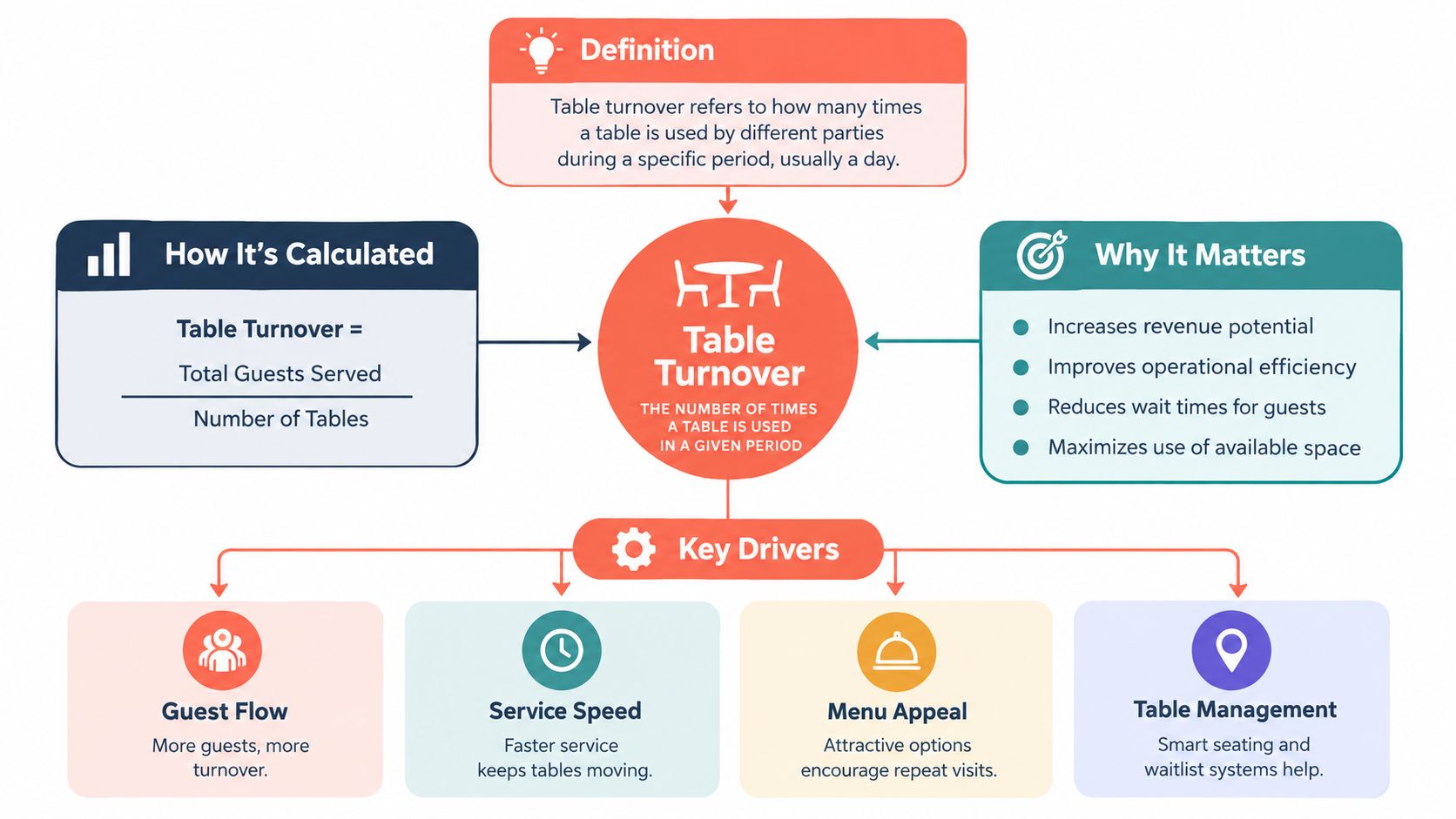
Restaurant table turnover is the number of times a table serves different parties during a set service period. That number matters, but only when you read it beside the rest of the room's performance, like covers, revenue per available seat, average spend, occupancy by time block, and meal duration (benchmark context).
The terms that matter
A cover is one guest served. Seat occupancy shows how often a seat is in use. Meal duration is the time a party holds the table. Revenue per available seat shows what each seat earns over the service window. Turnover ties those measures together, but it does not replace them.
A simple floor example makes the point. Four tables with four seats each can turn three times during service. That does not just mean the room was busy. It shows how much seating capacity was used, and whether the room earned through volume, check size, or both.
Benchmark context helps you sanity-check the floor. Recent industry data places average full-service turnover at approximately 2.8 turns per night in 2023, while casual-dining venues averaged about 2.2 seat turns per hour during peak periods (benchmark data). Those figures are reference points, not targets to copy by instinct.
A good turnover number is the one that fits the concept, the menu, the daypart, and the check.
What the floor should compare, not guess
| Metric | Source in POS | Segmentation | Why it matters |
|---|---|---|---|
| Seating time | Table open timestamp | Daypart, party size, reservation type | Starts the capacity clock |
| Order time | Order sent timestamp | Server, party size, meal period | Shows front-of-house speed |
| Check drop | Check opened or presented time | Lunch, dinner, walk-in, booked | Reveals end-of-meal lag |
| Payment completion | Payment close timestamp | Table size, payment method | Shows where the exit stalls |
| Table-ready time | Reset or reopen time | Zone, runner, bussing pattern | Measures usable capacity |
For operators building cleaner tracking, a guide to Meta conversions for dining is useful because it reinforces clean event timing, even though the channel is different.
The operating rule is simple. Track turnover beside check size and occupancy, never alone. A room can turn slowly and still perform well. A room can turn fast and still miss profit. The number only matters inside the service model.
How to Measure Turnover on Your Own Floor
Start with the timestamps your POS already has. Export seating time, order time, food delivery, check drop, payment completion, and table-ready time. If one of those events is missing, the manager should add a manual note for a week instead of pretending the data is complete.
Segment the data before you argue about the numbers
The biggest mistake is averaging everything together. That hides what happened. Break the data down by daypart, party size, reservation type, and table configuration, then compare like with like. A two-top at lunch is not the same as a six-top on a Saturday night.
The benchmark numbers give you a rough frame. A peak-hour table-turn time of about 45 minutes for full-service restaurants sits very differently from an overall U.S. restaurant average near 82 minutes (benchmark data). Those figures don't mean every room should hit 45 minutes. They mean the service model changes the math.
A healthy baseline is venue-specific. Record a month of actual timing, then look for patterns by shift and party mix. If the average is acceptable but the spread is wide, the room is leaking capacity in a few repeatable places.
Don't fix the average first. Fix the delay that keeps showing up at the same point in the cycle.
A useful Monday-morning checklist looks like this:
- Pull the timestamps from the POS for seating, order send, check drop, payment close, and reset.
- Slice by daypart so lunch doesn't get mixed with dinner.
- Group by party size because a two-top and a four-top don't turn the same way.
- Separate reservations from walk-ins since the pressure on the floor is different.
- Review by table zone to spot one dead corner that's dragging the average.
If the team wants a practical reference for revenue-tracking logic around floor decisions, the cleanest way to think about it is the same way a manager would think about booking data, event timing, and conversion. The point is not fancy reporting. The point is knowing where the room loses minutes.
Where Service Time Actually Disappears
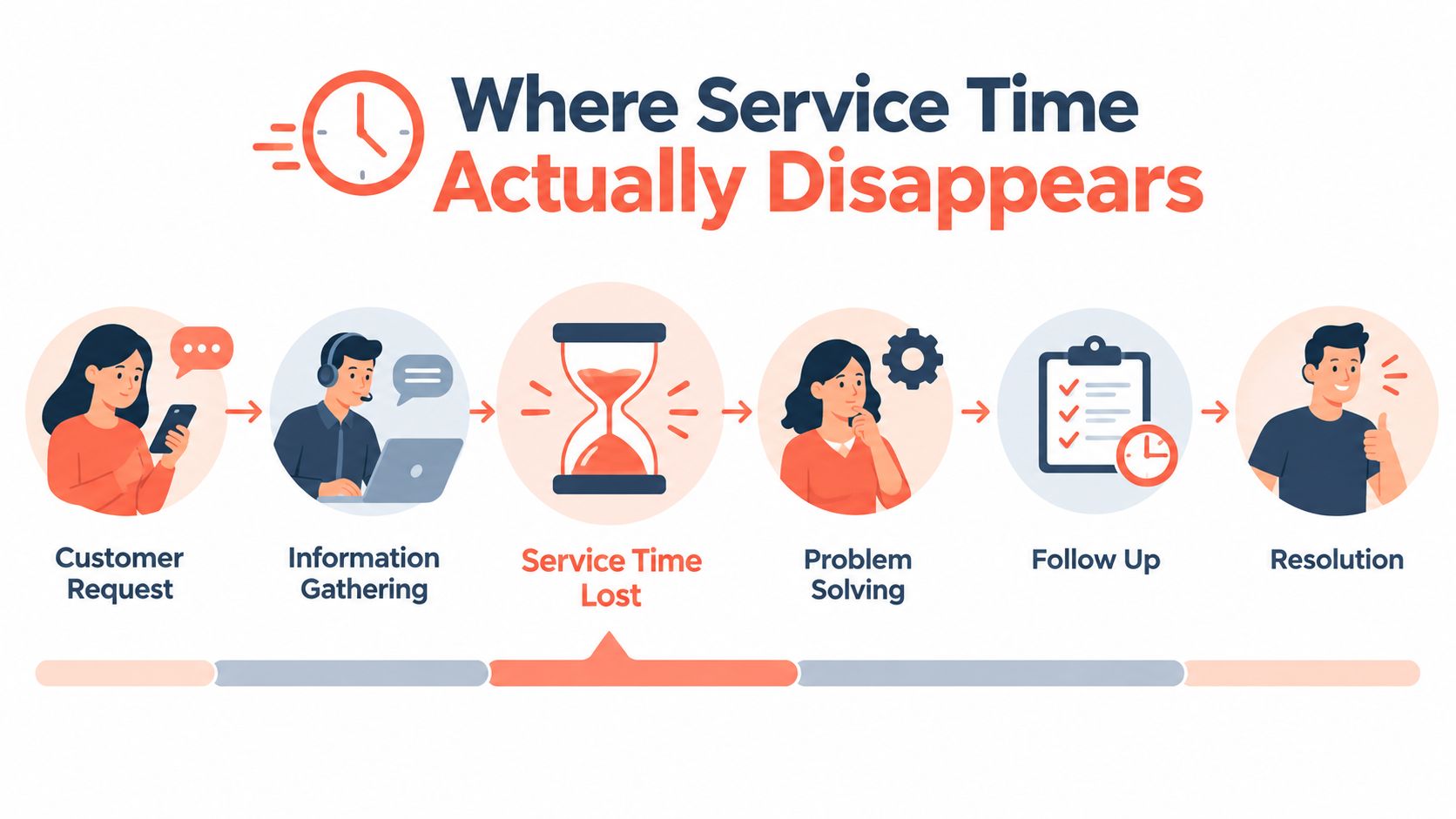
The room usually loses time in four places, and none of them are mysterious. Seating delay. Front-of-house to first-bite time. Mid-meal stagnation. Payment and reset. If one of those stretches, the table stops earning without the guest getting anything better in return.
A Cornell-affiliated study found dining duration of 46.8 minutes at anchored tables versus 46.5 minutes at unanchored tables, and 47.4 minutes for both diagonal and side-by-side configurations, with no statistically significant difference (study). That's the useful lesson, table geometry alone is a weak lever. The drag usually lives in execution, not furniture.
Look for the spread, not just the average
Another Cornell-linked restaurant revenue management study timed 100 parties across the full service sequence and found an average dinner meal duration of 50 minutes with a 20-minute standard deviation (study). That spread matters more than the average, because capacity dies when a chunk of tables drifts far above the norm.
If the slowest 20% of tables match the median plus one standard deviation, the fix usually sits in how the night is planned, not in pushing staff harder. That's the point most managers miss. The problem is rarely one dramatic failure. It's repeated small stalls.
The manager's job is to attack the bottleneck, not the symptom. If payment is the lag, fix payment. If food delivery is the lag, fix firing discipline. If reset is the lag, fix table handoff. Don't waste energy on the whole room when one stage is doing the damage.
For teams looking at production flow, a KDS software for restaurants resource is useful because it frames the kitchen as a timed sequence, not a black box.
The 5-minute rule
Saving five minutes across seating, ordering, check settlement, and reset is worth more than obsessing over one giant change. Five minutes is a small number. Across a busy shift, it's the difference between a table cycling cleanly and a table sitting dead while the room is full.
Four Levers That Safely Lift Covers
The right changes are structural, not theatrical. Floorplan and table mix, host workflow, kitchen pacing, and payment and reset are the four levers that usually move covers without making the room feel cramped. Pick the lever that matches the problem, not the one that sounds impressive.
Compare impact, cost, and guest risk
Floorplan changes are powerful when the room is full and the table mix is wrong. They cost little money, but they carry guest-risk if the layout starts feeling cramped. Host workflow is cheaper still, and it often pays off quickly because the host controls the first decision of the service.
Kitchen pacing is harder to change, but it matters when the pass is backing up. That lever costs more attention than cash, and it affects the guest only if the team starts rushing plates. Payment and reset are usually the fastest wins. They often require better habits more than new spend.
Spend your next euro where the bottleneck actually lives, not where the floor looks busiest.
For reservation control, a commission-free option like 10Seat can be used as a table-management tool alongside other systems, especially when the goal is pacing rather than per-cover fees. If cost is the deciding factor, the pricing model is laid out clearly at 10seat.com/pricing, and the product overview is at 10seat.com/product. Independent operators comparing different reservation models should also look at TheFork, OpenTable, Zenchef, and Formitable, then decide whether a commission-based or commission-free structure fits the room.
The cleanest operational move is often not new tables. It's better sequencing. The host seats the right party at the right table, the kitchen fires in a controlled wave, the server drops the check at the right moment, and the busser resets without confusion.
Where the money usually shows up
A shift that picks up 5 to 10 extra covers without damaging the guest experience can create meaningful weekly upside. At a 45 euro average check, that roughly translates to 1,000 to 2,000 euros per week if the pattern holds across busy services. That's the kind of ROI that justifies a serious look at the floor.
For a deeper operating reference, this table management guide is useful because it focuses on workflow, not theory.
Walk-Ins and No-Shows Are Capacity Decisions
Walk-ins and reservations belong in the same capacity decision, because both consume live seats. If the door is managed badly, the room can look full on paper and still leave money on the floor.
Consumer data shows 42% of diners would be discouraged from visiting a restaurant again if the wait exceeded 30 minutes, while another 2025 survey reported 72% would not wait longer than 30 minutes for a table (consumer data). That is a front-door rule, not a soft preference. Promise only the wait you can keep.
Posted wait times should be treated as commitments. Tolerance for an unreserved wait has been creeping upward, so the job is not to guess what guests might accept, it is to set a time you can honor.
The front door needs three rules. Forecast table release times instead of guessing. Protect high-value future reservations when a walk-in party would block them. Offer realistic seating windows instead of vague promises.
Reservation no-shows belong in the same capacity conversation. A 2025 study in the International Journal of Consumer Studies cites data showing that 28% of restaurant reservations in the United States were not honored during the preceding year (study). On a book of 100 reserved covers, that leaves 28 seats exposed unless confirmations, deposits, cancellation rules, or a controlled waitlist close the gap.
A table that goes empty at the wrong time is not just one lost booking. It is a lost seating cycle.
Policy matters. A clear reservation deposit policy reduces casual no-shows, makes late changes more expensive, and gives the host stand a firm rule instead of a debate. That matters most when the room is already tight and every seat has another use waiting behind it.
Use the door to protect the live map. Seat the party if it fits the current wave, hold it if the release time is credible, or turn it away if it would jam the floor. That is the capacity decision.
Table Turnover and Belgian GKS Compliance
In Belgium, turnover gains have to sit inside the fiscal rules. A registered cash register, the GKS, becomes required for an establishment serving meals when annual turnover from meals, excluding drinks and VAT, exceeds €25,000 (official threshold). That matters because more covers can lift revenue, but they also can trigger a compliance obligation.
The GKS is not just ordinary POS software. Official documentation describes three core components, the cash-register system, the Fiscal Data Module, and the VAT Signing Card (official documentation). For a restaurant manager, the operational rule is straightforward, every completed sale has to flow through the certified fiscal workflow.
Keep the floor and the fiscal record separate
The floor manager should optimize seating, pacing, and table release. The cash system should record sales cleanly and completely. Those are different jobs. Mixing them up creates confusion, especially when the room is busy and the team is trying to move people without breaking the record trail.
That separation is why better turnover should never mean loose checkout habits. If the host gets a table seated faster but the sale is not captured correctly, the business gains nothing. The extra cover is only useful if the transaction is properly registered.
A Belgian operator who wants to tighten booking flow and fiscal discipline in one place should look at 10Seat's booking management overview. The point is not more speed for its own sake. The point is cleaner capacity control with the fiscal workflow intact.
The rule is simple, seat smarter, record cleanly, and keep the compliance path untouched. That's how extra covers stay a net win instead of becoming a headache.
A 30-Day Plan and the Questions You Will Ask Next
The first week should be pure data. Export the POS timestamps, split them by daypart and party size, and stop arguing about the floor until the numbers are visible. A manager can't fix what the team hasn't measured.
The second week is for diagnosis. Find the dominant bottleneck, not every weakness in the room. If seating is the drag, fix seating. If payment is the drag, fix payment. If resets are the drag, fix reset ownership. The wrong move is to touch six things and learn nothing.
The third week should be one controlled change. Add the terminal where payment stalls. Tighten host pacing if the door is overbooked. Rework table assignment if the wrong combinations keep blocking future covers. Don't run a kitchen-wide overhaul when one part of the service sequence is clearly leaking time.
The fourth week is for review and lock-in. Compare the new baseline with the old one, then keep the change if the room stayed calm and capacity improved. If it made guests feel rushed, reverse it. Good turnover is measured in usable covers, not in nervous staff.
For a practical reference when translating website or booking changes into operations, the SiteSelf guide library is useful because it keeps the focus on fixing real friction instead of decorating the problem.
Two questions usually come next.
How many extra covers are realistic without changing the experience? Enough to matter, not enough to break the room. A shift that adds a handful of clean, on-time covers is a win if the meal still feels like a meal.
How should longer dwell times be handled on special nights? By design, not by accident. Tasting-menu nights, anniversaries, and high-spend celebrations can deserve longer stays if the floor is paced for them. The rest of the week still needs hard discipline.
10Seat fits this approach as a capacity tool, not a speed tool. It helps operators control pacing, table combinations, and live availability without turning the room into a race. For a closer look, visit 10Seat and evaluate whether the floor management model matches the way the restaurant serves.