Table Booking Restaurant: How It Works in 2026
A table booking restaurant guide for owners: channels, no-show risk, floor pacing, Belgian GKS dates, and how to choose a system.
No-shows can cost a restaurant significant revenue over a year. An empty reserved table can also mean wasted preparation and staff time.
A full booking calendar can still leave the floor underused. Early sittings may crowd the pass, small parties may occupy tables better suited to larger groups, and deposits can deter guests when the booking carries little risk. Good restaurant table booking means selling usable seating capacity, not just filling the calendar.
Table of Contents
- What Table Booking Means on a Busy Floor
- Party Size, Early Sittings and the Floor Plan
- Which Bookings Need a Deposit
- What an Extra Cover Is Worth
- A Saturday Service From Book to Last Walk-in
- GKS Rules for Belgian Dining Rooms
- Choose a Booking System and Start This Week
What Table Booking Means on a Busy Floor
Every booking fixes three working assumptions: arrival time, party size and table duration. Together, they determine whether a dining room can serve another party later, whether tables need joining and when the kitchen will receive orders. A reservation isn't a completed sale, but it is a commitment of space and service time.
Nearly half of consumers consider reservation availability important when choosing a restaurant, according to the National Restaurant Association's 2025 industry report, which also found that more than 90% of operators accepting reservations still take telephone bookings. A digital-only view of the book therefore misses an important part of how guests reserve.
Where a table booking restaurant actually takes demand
| Channel | Guest experience | What the restaurant controls | Typical cost model |
|---|---|---|---|
| Phone | Speaks to a person and can change same day | Availability and notes, only if staff log them | Staff time, no per-cover fee |
| Own booking page | Picks a slot without calling | Party size, times, pacing, deposits | Flat software cost |
| Marketplace | Finds the restaurant on a platform such as TheFork or OpenTable | Less of the flow, platform rules apply | Commission or per-cover fee |
| Walk-in | Sits only if a table is free | Which tables were left open | No booking fee, opportunity lost if the book is full |
| Waitlist | Joins when the restaurant is full and gets a wait quote | Quote accuracy and who gets notified | Staff time |
The practical difference between these channels isn't just acquisition cost. It's how quickly each booking becomes visible to the person assigning tables. A phone reservation left on a paper pad can conflict with an online booking even when both staff members acted correctly.
The host should enter phone bookings immediately, including any promised seating arrangement. A request for a quiet table is different from a confirmed private corner. Staff need to distinguish a preference from a promise before the guest arrives.
Make the book usable during service
A workable booking record contains the guest's contact details, confirmed party size, arrival time, allocated duration and relevant service notes. Dietary requirements belong beside the booking, not buried in an inbox. Changes should update the same record rather than create a second version.
Practical rule: Every channel can bring demand, but only a shared, current book can prevent conflicting promises.
Walk-ins need deliberate space rather than whatever happens to remain. A waitlist needs an honest estimate rather than an optimistic answer intended to stop a guest leaving.
The useful review starts with last Saturday: identify which channel supplied the most seated tables, not merely the most booking requests. Then check which channel created the most corrections at the host stand.
Party Size, Early Sittings and the Floor Plan
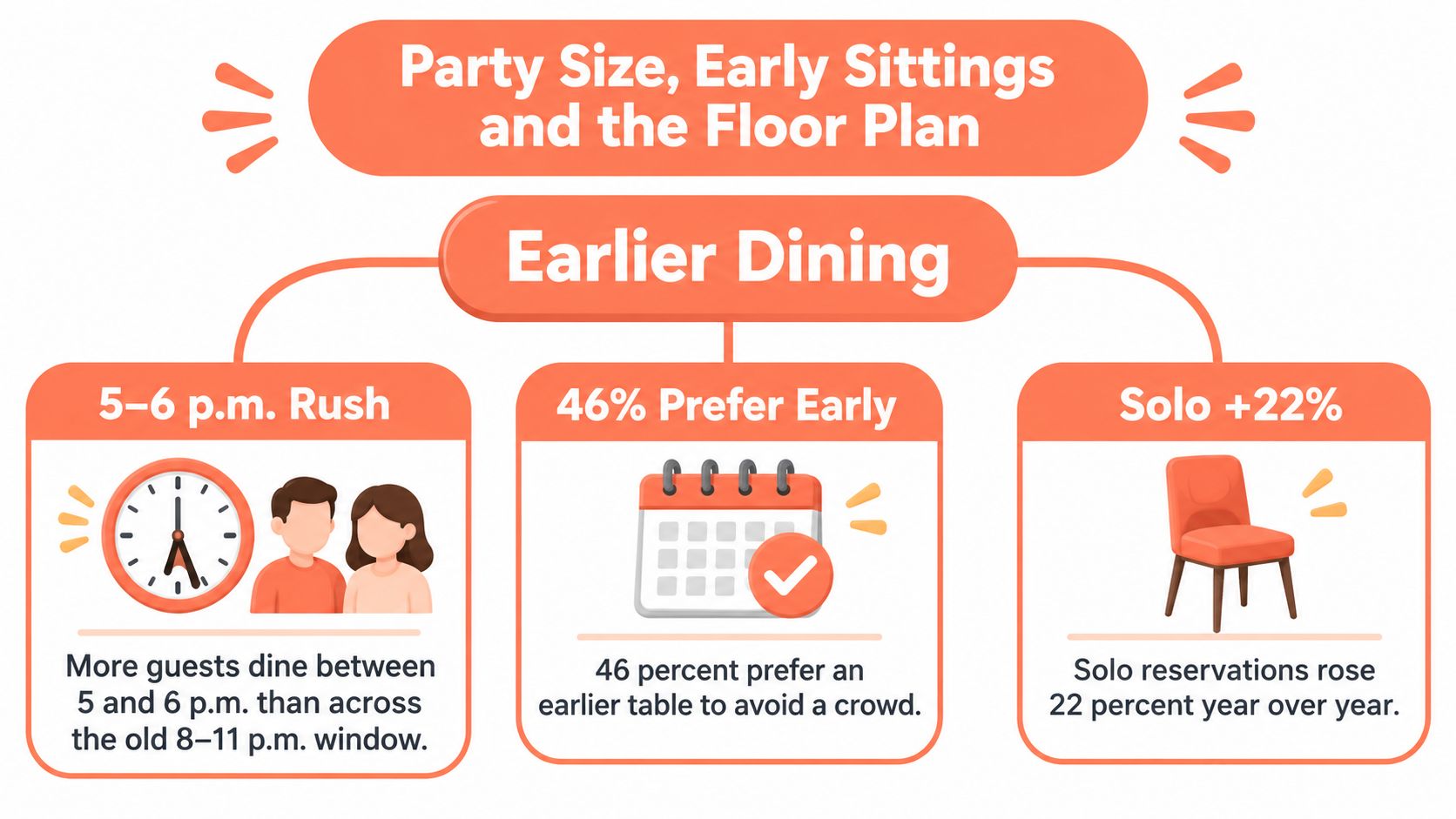
Recent U.S. restaurant findings reported by ABC News show more guests dining between 5 p.m. and 6 p.m. than across the traditional 8 p.m. to 11 p.m. window, with 46% preferring earlier reservations to avoid crowds and solo reservations increasing 22% year over year in Q3 2025. Those findings aren't a forecast for every Benelux dining room. They are a reason to check actual arrival patterns before copying last season's availability.
Earlier demand changes more than opening time. A room can appear comfortably occupied while the chef faces a compressed run of starters, mains and dietary substitutions.
The relationship between arrival patterns and seating mix is shown below.
Treat table combinations as inventory
A four-top isn't automatically interchangeable with separate smaller tables. Its usefulness depends on furniture, circulation space and whether staff can recombine it after neighbouring guests have settled. The restaurant seating chart guide is a useful starting point for mapping those constraints.
Consider a hypothetical release rule: hold a joinable table combination for a larger party until 30 to 45 minutes before the slot, then release the smaller tables if demand hasn't materialised. That isn't a universal benchmark. It is a testable operating choice for a room where late smaller bookings regularly arrive.
A physical four-top must never be sold to a larger party unless an approved neighbouring table can be joined. Extra covers aren't useful if staff have to block an aisle or move seated guests to accommodate them.
- Protect combinations: Hold only the tables that form a larger arrangement.
- Offer solo choices: Make counter or communal seating explicit during booking, rather than surprising guests at arrival.
- Keep pairs together: Avoid assigning a couple to an oversized table when a suitable smaller one is available.
- Check reset time: A cleared table still needs cleaning, resetting and a ready server before the next arrival.
Pace arrivals around the pass
For a small kitchen, a hypothetical starting test is 15 minutes between seating batches. The chef should adjust that interval to menu complexity, ordering behaviour and actual ticket times. Staggering arrivals won't help if the host then seats every late guest together.
Solo guests shouldn't be treated as spare pieces in a seating puzzle. A counter can be excellent hospitality when it is comfortable, clearly offered and suited to the meal. An unwanted communal seat is a service failure, even if the floor plan looks efficient.
Mark last Friday's party sizes directly on the floor plan. Circle oversized allocations, stranded seats and combinations that couldn't be reused. Those marks show where availability rules need changing.
Which Bookings Need a Deposit
Saturday and Thursday don't carry identical booking risk. A peer-reviewed study published by Wiley, covering 749 lunches and 749 dinners across 107 weeks, estimated a 9.07% to 12.95% probability of a no-show or late cancellation, lowest on Thursdays and highest on Saturdays.
That combined measure shouldn't be presented as a pure no-show rate. For an operator, however, both outcomes matter when the remaining time isn't enough to resell the table.
Deposit and hold rules by booking risk
The following bands are practical starting policies, not claims that every restaurant has the same risk profile.
| Risk band | Which bookings | What to require | What to skip |
|---|---|---|---|
| High | Parties of 6 or more, Saturday prime, tastings and chef's tables, long lead times | Card or deposit, reminder, written cancellation window | A silent hold with no stated rule |
| Medium | First-time weekend tables for two | Reminder, and a card on file after a prior miss | A full deposit on a modest spend |
| Low | Weekday short-lead tables and known regulars | Confirmation message only | A deposit that blocks the booking |
A deposit makes most sense when a cancellation leaves expensive preparation or difficult-to-replace inventory. Tasting menus, scarce prime-time tables and large joined arrangements deserve closer protection than an ordinary short-lead weekday booking.
A card guarantee and a prepaid deposit aren't the same intervention. The former supports an agreed cancellation charge; the latter takes money before service. Staff need to understand which policy applies before explaining it to guests.
Make the policy clear before confirmation
The booking page should state the amount, cancellation deadline, treatment of party-size reductions and whether the deposit comes off the bill. Guests should also know how to cancel without having to find someone by telephone during a closed period.
The restaurant reservation deposit guide provides useful context for setting those terms. The strongest policy is one the host can explain calmly in a short conversation.
Protect the table without treating every guest as a likely no-show.
A reminder should make attendance easy to confirm and cancellation easy to communicate. A complicated cancellation route can leave staff discovering an empty table only when service is already underway.
For arrivals that don't appear, the host should check the agreed grace period, attempt contact and record the decision to release the table. Reassignment should follow the communicated rule, not an improvised judgement about whether a guest seems important.
Review exceptions without making them arbitrary
Regulars can miss bookings too. A repeat missed reservation should trigger a documented review, while genuine emergencies deserve a clear route for manager discretion.
The useful operating record separates no-shows, timely cancellations, late cancellations and party-size reductions. Combining them hides whether the problem is guest behaviour, unclear communication or an unrealistic cancellation window. Deposit policy should respond to that distinction rather than become a permanent blanket charge.
What an Extra Cover Is Worth
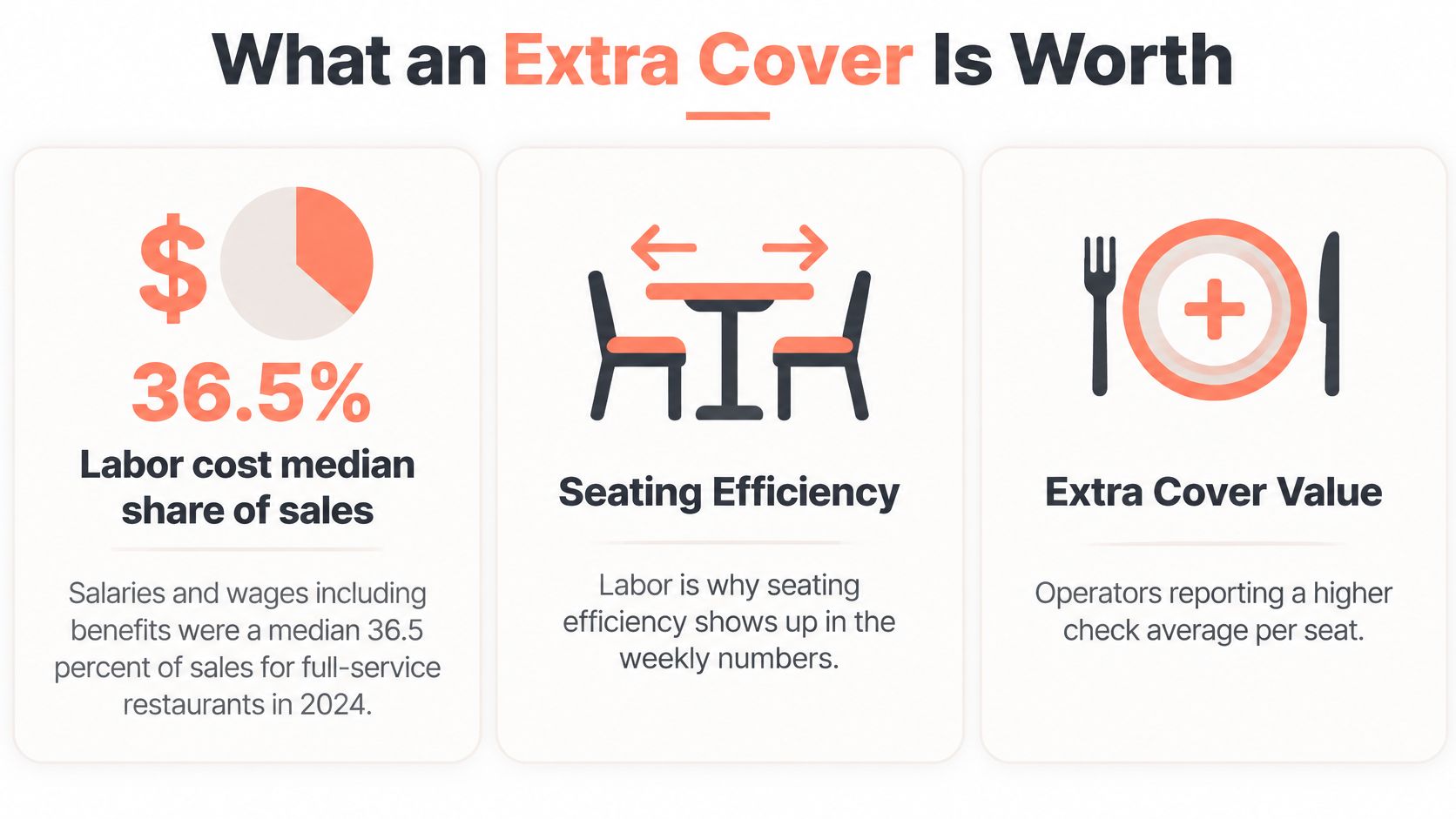
Labour makes seating efficiency financially material. Salaries and wages including benefits represented a median 36.5% of sales for full-service restaurants in a 2024 survey reported by the National Restaurant Association.
A hypothetical 40-seat restaurant illustrates the opportunity. If avoidable gaps leave 10% of its seats unused across two staffed waves, that represents eight potential covers; at an assumed €45 average spend, recovering them would add €360 in sales before extra food, payment and other variable costs. This is worked arithmetic, not a promised return.
Calculate contribution, not just sales
That additional revenue isn't automatically profit. More guests consume ingredients, increase washing-up and may extend paid hours. A manager needs to subtract those incremental costs before deciding whether a seating change was worthwhile.
The labour and seating relationship is summarised below.
The best extra cover uses capacity already available without degrading the meal. A booking that requires overtime, delays neighbouring tables or forces a rushed reset may contribute less than its bill suggests.
A restaurant should also distinguish an extra cover from a displaced cover. Seating a walk-in early isn't an improvement if it prevents a more valuable confirmed party from sitting later.
Measure the shift properly
- Covers per labour hour: Divide guests served by the recorded labour hours, keeping the staff scope consistent between comparisons.
- Revenue per available seat hour: Divide dining revenue by seats available multiplied by service hours.
- Incremental contribution: Subtract the additional costs caused by recovered covers from their revenue.
- Service condition: Check ticket times, complaints and overtime alongside the financial result.
Booked covers aren't the right numerator. Start with reservations that arrived, add walk-ins seated, and reconcile the total against completed service records.
Financial check: A busier dining room is useful only when the kitchen can deliver it and the extra revenue exceeds the extra cost.
Comparisons need similar trading conditions. A tasting event shouldn't be judged against an ordinary à la carte evening without accounting for menu, staffing and duration.
The decision should remain concrete: did a different release rule, seating allocation or arrival pattern produce more contribution with an acceptable service? If not, filling additional slots merely created more work.
A Saturday Service From Book to Last Walk-in
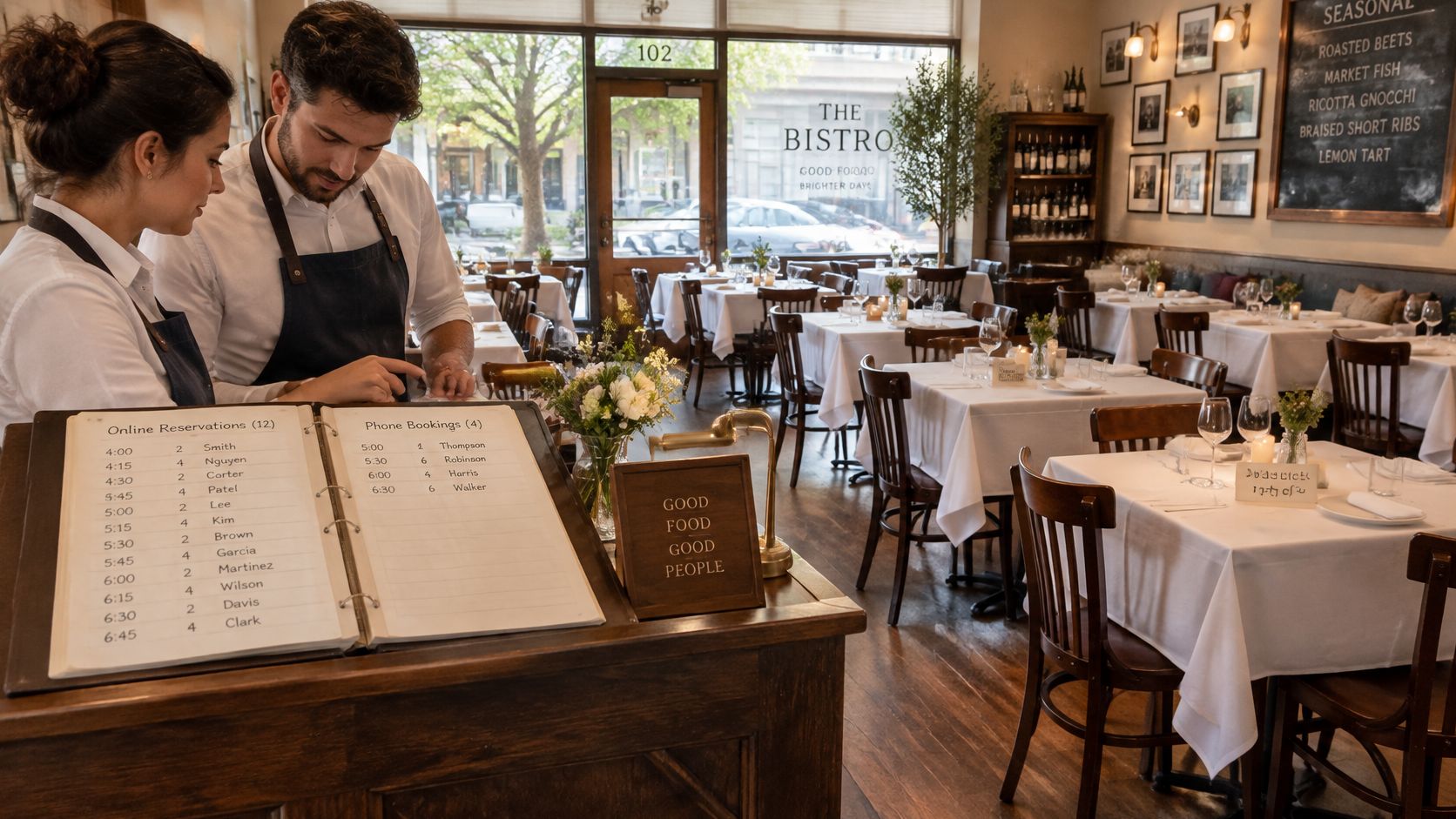
Consider a hypothetical 48-seat bistro preparing for Saturday. At 4 p.m., the host checks 12 online table bookings and four phone bookings, then verifies that every party has a workable allocation.
The host stand needs a shared view before guests arrive.
Before the first arrival
In this scenario, two four-tops have adjacent tables available, allowing each arrangement to accommodate a potential party of six. The hold expires at 5:30 p.m. If the larger parties haven't confirmed, the host releases the component tables under the restaurant's stated policy.
The early wave starts at 5:15 p.m., with subsequent arrivals paced 15 minutes apart. A solo guest who selected counter seating takes that place, leaving a window deuce available for a couple whose phone booking includes that allocation.
- Before opening: The host checks contact details and unresolved seating requests.
- At the briefing: The chef receives dietary requirements and expected arrival batches.
- During seating: Staff mark actual arrivals rather than leaving every booking in a confirmed state.
When the evening changes
At 7:10 p.m., a four-person party hasn't arrived. Its communicated grace period has expired, and the host's contact attempt is unanswered, so the table becomes available. The next suitable waitlist party receives an offer with a 20-minute arrival quote that the team can honour.
A separate walk-in pair takes the deuce expected to clear at 7:25 p.m. They aren't placed at a table committed to an 8 p.m. tasting. The restaurant waiting list guide explains the operational value of matching waiting parties to usable tables.
This video provides another service-management reference.
Experience bookings deserve their own preparation: experience-dining reservations increased 72% year over year in 2024, according to OpenTable's restaurant-industry trends. In the bistro scenario, the tasting party's allergies, occasion and intended pace are already recorded before arrival.
The host isn't searching messages while guests wait. The chef isn't discovering a dietary restriction when the first course is due.
By the end of service, each seated party has an accurate status, each released table has a recorded outcome, and the manager can distinguish lost bookings from recovered capacity. The useful result is a traceable shift, not a screen showing a full room.
GKS Rules for Belgian Dining Rooms
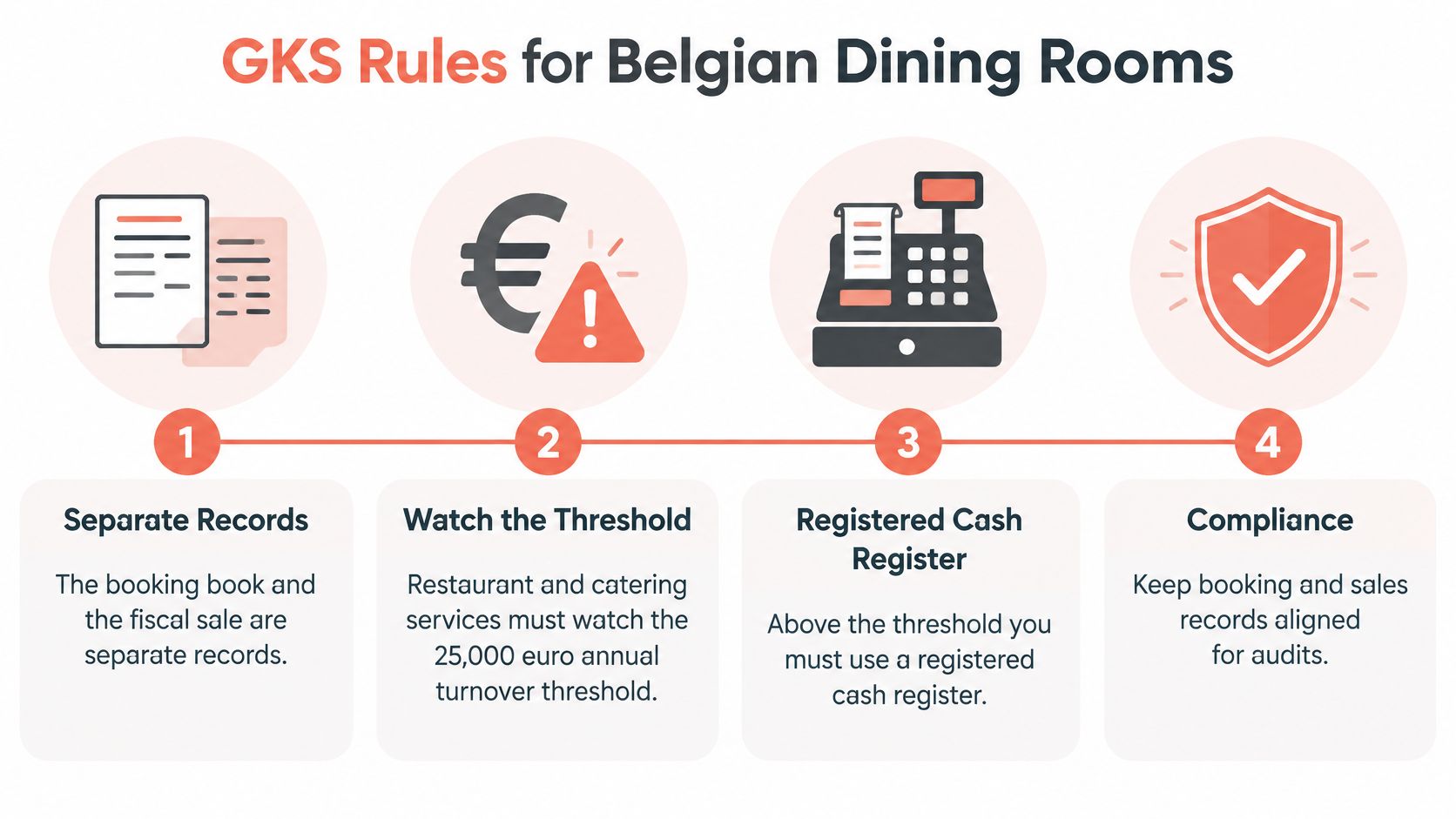
In Belgium, a reservation record and a fiscal sale are separate records. Restaurants covered by the registered cash register rules must monitor the €25,000 annual turnover threshold for restaurant and catering services. Above it, the registered cash register framework, Fiscal Data Module and VAT-receipt obligations apply, as outlined in efsta's Belgian compliance overview.
The Geregistreerd Kassasysteem, or GKS, records sales. A reservation platform records expected guests. Keep the two systems distinct: a booking confirmation is not a VAT receipt.
GKS 2.0 deadlines by register purchase date
The Belgian Federal Public Service Finance notice sets out the transition deadlines below and requires certification of both the register and Fiscal Data Module.
| Register situation | GKS 2.0 deadline |
|---|---|
| New eligible horeca business | 1 July 2026 |
| Bought before 1 January 2018 | 1 July 2027 |
| Bought 1 January 2018 through 31 December 2021 | 1 July 2028 |
| Bought from 1 January 2022 onward | 1 January 2029 |
Check the register's purchase date and confirm certification with the fiscal-system supplier before changing connected front-of-house software. A working integration does not establish fiscal compliance.
Close service against the register
Follow the Belgian Federal Public Service Finance notice for the applicable cash-register closing requirements, including recording tips and cash rounding separately, retaining applicable cash-control functionality, producing a Z report at least daily, and using the prescribed Copy event when reproducing a signed VAT receipt or invoice.
Keep the end-of-service routine in order:
- Count completed parties from the floor record.
- Match completed sales in the certified register and investigate differences.
- Check separate entries for tips and rounding.
- Produce and retain the required Z report.
A reservation tool can support the operational count. The certified fiscal workflow remains the record of sale.
Choose a Booking System and Start This Week
A booking system should make decisions easier during service, not add steps. Test each shortlisted system against the jobs your team handles on a busy floor. Score each from zero to two: unavailable, workable with friction, or workable during service.
- One book: Keep phone notes, online bookings and walk-ins visible together. Check that the host can amend a party without searching through screens.
- Real tables: Confirm that capacity reflects the actual furniture, including legitimate splits and joins.
- Honest waits: Check that staff can identify suitable tables as they clear and notify waiting guests.
- Risk-based protection: Look for booking conditions that can reflect party size, service period and cancellation exposure.
- Clean fiscal separation: Keep the certified register as the sale record. Reservation software can support reconciliation, but cannot replace the fiscal workflow.
Compare operating cost and guest effort
For TheFork, OpenTable, Zenchef and Formitable, compare the quoted contract line by line. Separate marketplace acquisition charges, per-cover charges, subscriptions and optional services. A subscription charges for access; commission or per-cover pricing ties at least part of the bill to booking volume. Calculate the expected cost against your own service volume before choosing.
Guest effort matters too. For restaurants serving international visitors, Jasumo's guide to booking izakaya and kaiseki provides context for explaining specialised dining formats before guests arrive.
10Seat provides an instant booking page that restaurants can share through social media, QR codes or messages, even without a website. Restaurants using 10Seat see 30% more reservations, 40% fewer no-shows and 10-15% more covers per shift. 10Seat also migrates a restaurant's entire reservation system in 15 minutes, with no third-party platform and no lost reservations.
Choose a trial period with clear measures: seated covers, pressure on the floor and time spent on administration. Booking notifications alone do not show whether the system is helping service.
10Seat offers online reservations and live table management, with availability, timing and party sizes controlled by the restaurant. Visit 10Seat to assess your busiest seating, set practical booking rules and manage online, phone and walk-in demand in one working book.