Restaurant Waiting List: How to Set Up and Run One
Learn how to set up a restaurant waiting list, quote accurate waits, handle walk-ins and no-shows, and measure covers. Practical steps for busy owners.
A Friday service is filling up, reservations are arriving on schedule, and walk-ins are gathering by the entrance. The host is trying to protect booked tables while estimating how long each waiting party can tolerate. Without clear rules and live updates, a full restaurant can still lose covers to guests who leave before they're seated.
A restaurant waiting list works best as a live capacity and pacing tool, not just a record of who arrived first. Clear rules, realistic quotes, and accurate table matching help the team keep the queue moving without putting the kitchen or upcoming reservations under pressure.
Table of Contents
- Set Your Waiting List Rules Before Service
- How to Run the List Step by Step
- Quoting Waits Guests Will Believe
- Handling Walk-ins and No-Shows Without Losing Covers
- Fixing Common Waiting List Problems
- Choose Software That Joins Reservations and the List
- Start Your Waiting List This Week
Set Your Waiting List Rules Before Service
The host stand arguments usually start with three questions: who gets on the list, who gets priority, and how long a party will hold its place. Settle those questions before service. On a Friday when reservations fill most of the room, walk-ins can't be promised tables that are needed for arriving bookings, and booked guests who are delayed need a clear rule for how their table is handled.
Start with the largest party your floor can seat without disrupting the room. If a group can be divided across smaller tables, spell out when that's allowed and confirm the arrangement with the guests before they join. For table plans that make those choices easier, use a restaurant seating chart.
| Policy decision | Options | Recommended default |
|---|---|---|
| Who joins the list | Walk-ins only, booked guests only, or both | Both, with booked guests ranked first |
| Maximum party size | Largest table, or a split-table rule | Largest table you can turn within 90 minutes |
| Wait quote method | Fixed number, live estimate, or range | Range updated at each table turn |
| Contact method | Host desk, QR code, or text alert | QR code plus text alert |
| Hold time for a ready table | 5, 10 or 15 minutes | 10 minutes |
| Priority rule | First come first served, or best fit by party size | Best fit within the first 10 entries |
First-come, first-served sounds fair, but it can leave a table empty while the next party in line doesn't fit it. A 2008 restaurant simulation, which ran each policy 1,000 times over a five-hour operating window, found significant differences in average customer waiting time between table-assignment policies. The best-performing approach cut waits by about 10% to 15% compared with the least efficient approach, without adding seats, according to the 2008 study on restaurant table-assignment policies. The practical lesson is to test a sensible best-fit rule against your own party mix, rather than assume the order of names should dictate every seating decision.
Write the policy in language guests can understand: who can join, how the estimate is given, how long the table is held, and when a party loses its place. A visible, consistent rule gives hosts something more useful than improvisation when the entrance gets busy.
How to Run the List Step by Step
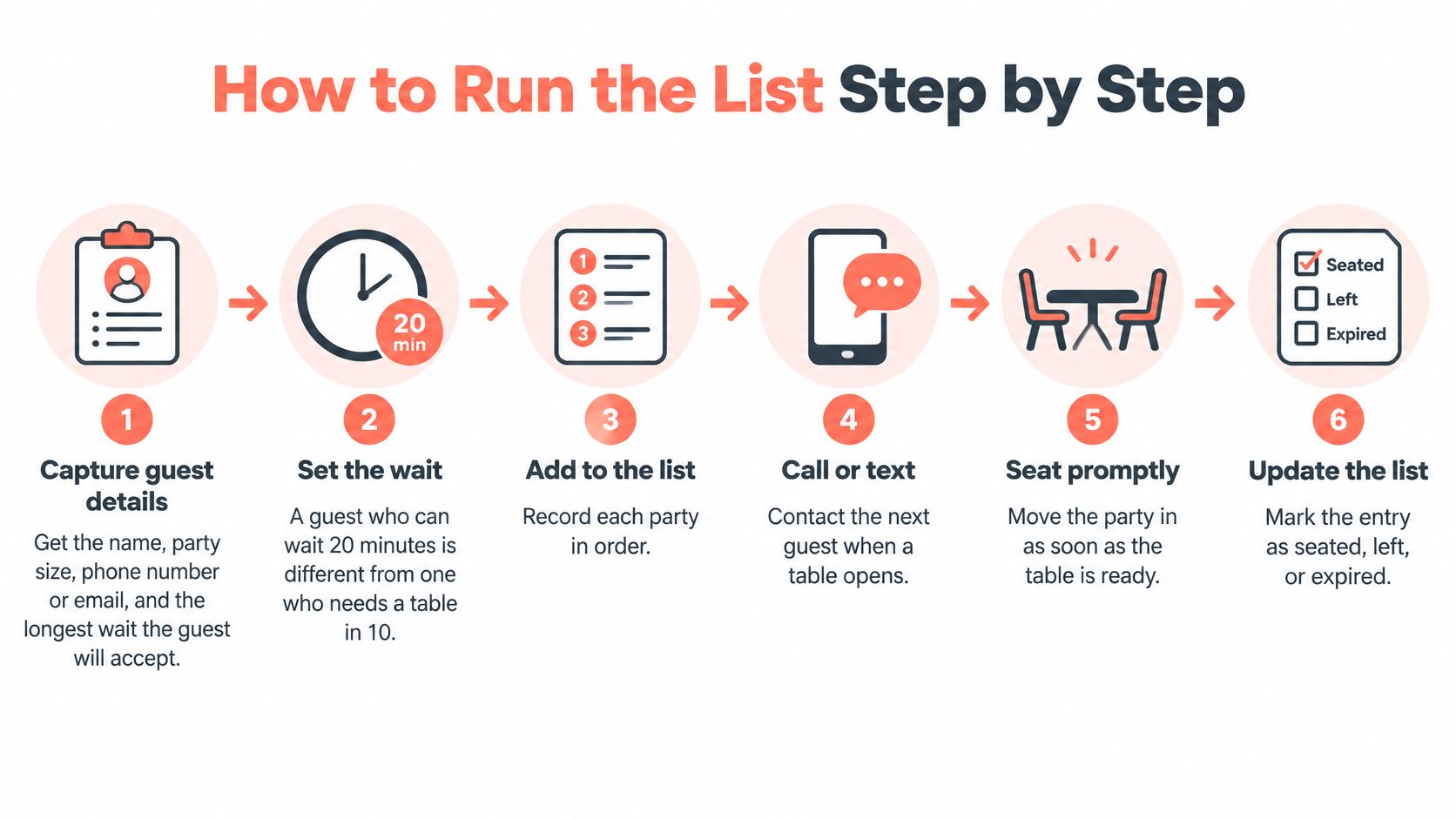
A working list needs enough information to contact each party, match them to a table, and learn from the outcome. Keep the process quick enough that the host can follow it during a rush.
-
Capture the essentials. Record the guest's name, party size, phone number or email, and longest acceptable wait. Someone willing to wait 20 minutes isn't the same entry as someone who needs a table in 10.
-
Give a range. Base the quote on turn times for the party size and table type, not a guess from memory. A range gives the host room to update the estimate as service changes.
-
Add the party to the list. Record the entry in order and note any seating preference that affects table fit. This gives the next host a usable queue if the person who took the name steps away.
-
Send an update. Use a confirmation text or live status page so guests don't need to wait beside the host stand or keep asking for an update. In a Toast-commissioned survey, 59% of diners aged 18 to 34 preferred a mobile waitlist or text option, and 45% of all respondents said they were more likely to dine at a restaurant offering a waitlist that could be joined online or through an app, according to Toast's restaurant wait-time and reservation survey. Those are stated preferences, not a guarantee that every guest will use the feature.
-
Re-quote when service changes. Update the guest when a table turns, a party arrives early, or kitchen delays push seating back. Keep the explanation short and specific, such as, “Your estimate has moved to 20 to 25 minutes because the table needs a reset.”
-
Offer the table and start the timer. Contact the best-fit party, confirm that the table is ready, and make the hold time clear. If the hold expires, move to the next suitable party and mark the original entry as expired.
-
Log the outcome. Mark each entry as seated, left, or expired. That record shows whether estimates and seating choices are working, rather than leaving the manager to rely on memory after a demanding shift.
Quoting Waits Guests Will Believe
“About 15 minutes” becomes a problem when the guest is still waiting at 30. A host can't make an accurate estimate from a visual glance at the queue alone. The team needs its own seating history, separated by daypart, party size, and table type.
Use a range, then narrow it as the room changes. A two-top and a six-top may be waiting for different tables, while a party that needs a reset or a particular seating area can't be treated like every other entry. Queue-estimation research also found that people at the back of a line tended to overestimate waits, while people at the front tended to underestimate them, according to the queue-estimation study. That's one reason a host's quick impression can drift from the actual wait.
Waiting tolerance varies by guest and situation. A 2024 survey of 1,500 U.S. diners found that 42% said a wait longer than 30 minutes would keep them away from a restaurant, according to TouchBistro and The Harris Poll's waitlist benchmark summary. Diners also said they would wait up to 26 minutes for a table without a reservation, compared with about 20 minutes in 2023, according to the Auguste Escoffier School of Culinary Arts' consumer dining trends report. These figures aren't a promise that a particular guest will wait that long. Use them as context, then rely on your own service data.
| Metric | How to calculate it | Act when |
|---|---|---|
| Quoted versus actual wait | Average actual seating time minus quoted time, per entry | Average gap is more than 5 minutes two days in a row |
| 90th percentile wait | The wait that 9 in 10 seated guests beat | Above your service standard, such as 20 minutes |
| Walk-away rate | Guests who leave before seating, divided by all entries | Above 10% in any daypart |
| Table utilization | Seated time divided by open time for each table | Repeatedly near full use while waits lengthen |
| Party-size fit | Share of seats filled within one seat of party size | Falling while empty seats remain at tables |
| Kitchen load | Covers in the kitchen queue at each table turn | Rising while waits lengthen, so slow down new seating |
A 12-month study of 94,404 customer visits to one Indian restaurant linked longer waits with more queue abandonment, longer delays before return visits, and shorter dining times after seating. Its revenue model estimated that eliminating waits could increase total revenue by nearly 15% relative to the observed operating situation. That's a model estimate from one restaurant, not a guaranteed result for another venue, as reported in the Journal of Operations Management study.
For a practical explanation of the calculations behind queue estimates, see how estimated wait time is calculated. Use your own seating records to decide when a quote needs adjustment.
Handling Walk-ins and No-Shows Without Losing Covers
At 19:30 on a Friday, two four-tops cancel, and a six-top walk-in is facing a 25-minute wait. The first response shouldn't be to give the six-top a cancelled table that doesn't fit. Offer the two tables to the first suitable waitlisted parties, then seat the six-top from a later turn if a compatible table becomes available.
Make reservation confirmation part of capacity planning. Ask guests to confirm a day ahead, and set a clear deadline for releasing an unconfirmed table. For large parties, peak nights, and special menus, a deposit can protect a booking, but explain the cancellation terms when the reservation is made. Keep a late guest on the list if their table has been released, rather than losing their place entirely.
A 2025 peer-reviewed study on reservation no-shows reported that 28% of restaurant reservations made in the United States during the previous year weren't honored, citing OpenTable data. The study also found that stricter cancellation rules and more complicated cancellation procedures reduced stated intentions to no-show, but also reduced booking intentions. That U.S. figure isn't a universal no-show rate, as explained in the 2025 study on restaurant reservation no-shows. The trade-off is straightforward: firmer rules may discourage some no-shows, but can also deter some guests from booking.
Service rule: Release a cancelled table promptly, but don't mark a booking as a no-show until the deadline in the restaurant's policy has passed.
When a reservation is late, follow the policy consistently, contact the guest if possible, and offer the table to a waiting party that fits. Track repeat no-shows in the guest profile so the team can apply the same booking rules on future visits. For practical ways to tighten that process, see how to reduce no-show rates.
A clear recovery process matters more than an informal promise that the host will “keep an eye on things.” This short video about managing restaurant bookings can help prompt a team discussion about how reservations, late arrivals, and walk-ins interact during service.
Fixing Common Waiting List Problems
“How much longer?” is often the question that reaches the host stand most. If guests keep asking, they may not know whether their place is secure or when they should return. Match the symptom to the cause before changing several policies at once.
| Symptom | Likely cause | Fix |
|---|---|---|
| Guests leave before being seated | Quoted waits too short | Quote a range and re-quote at every table turn |
| Quoted wait keeps rising | Large parties ahead of smaller ones | Split large parties or seat small parties at the bar |
| Tables sit empty while the list grows | Holds too long or poor party-size match | Shorten the hold to 10 minutes and offer to the best-fit party |
| Host desk overwhelmed by questions | No status page or text alerts | Send text alerts and show live status on a screen |
| Covers fall while waits look fine | Walk-away rate not tracked | Track walk-away rate weekly and act above 10% |
Change one thing at a time. A more honest quote can improve during the same service, while a change to seating priority needs a week of logged outcomes to judge fairly. If large groups keep blocking the queue, test whether splitting them is practical without compromising the experience or the floor plan.
Empty tables alongside a growing list usually point to a matching or hold problem, not a shortage of demand. A table that has been offered but is still waiting on a guest shouldn't remain unavailable indefinitely. Set the expiry rule, apply it consistently, and make sure the next party receives a clear offer.
Check the result against both guest loss and covers. A fix that reduces walk-aways but leaves compatible tables unused may be solving the wrong problem. Ask whether the change lowered walk-aways while keeping covers steady. If not, reverse it and test a different cause.
Choose Software That Joins Reservations and the List
The first software test is simple: can the host see bookings, walk-ins, and table status in one floor view? If the list sits apart from reservations, a host may seat a walk-in at a table promised to an arriving booking. During a rush, staff shouldn't have to move between screens or reconcile duplicate records by hand.
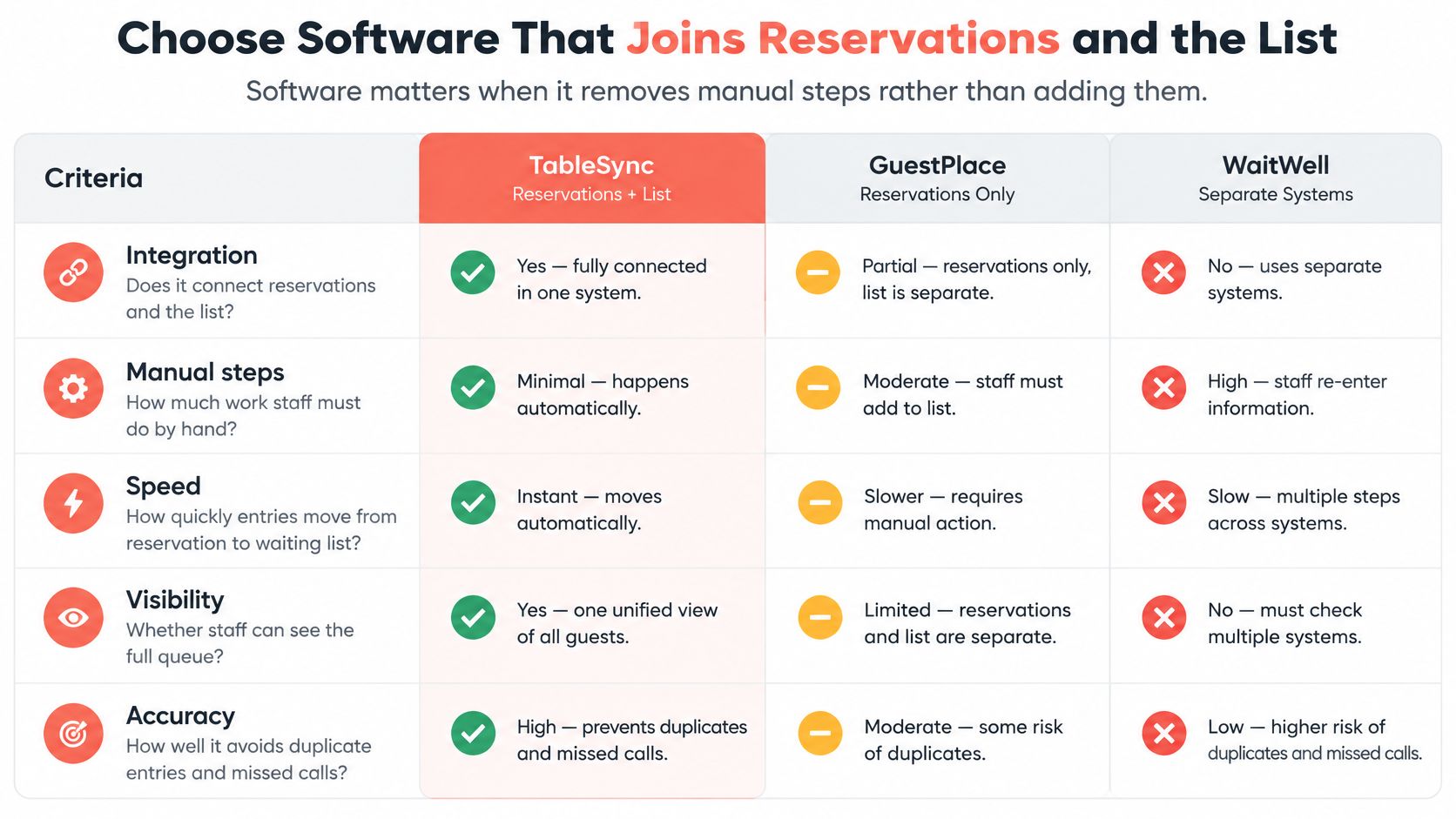
| Criterion | Why it matters | What to check |
|---|---|---|
| Reservation integration | One view of bookings and walk-ins | Walk-ins can be added without moving booked parties |
| Live wait estimate | Accurate quotes reduce walk-aways | Quote updates at each table turn, not a fixed number |
| Guest contact | Reduces host desk calls | Text alert or QR join, with a hold timer |
| Live floor view | Seats ready parties faster | Table status visible during service |
| Guest profile | Remembers regulars and preferences | Notes stored per guest across visits |
| Pricing model | Predicts total monthly cost | Per cover, per table or flat fee, and the free-tier limit |
| Language support | Staff can work at speed | Interface and guest messages in your guests' languages |
A live demo should use the restaurant's real floor plan and a busy-service scenario. Test what happens when a reservation runs late, a table clears early, or a walk-in party changes size. Check the full cost against the restaurant's volume, including any charge tied to covers, tables, or messages. If online booking introduces extra steps for guests, this guide to reducing friction in appointment booking offers useful principles for simplifying the path.
For restaurants in Belgium, check the registered cash-register obligation separately from the waiting-list choice. Under the cited Belgian guidance, food-service turnover above €25,000 per year, excluding VAT and drinks, requires a certified registered cash-register system with a fiscal data module. New hospitality businesses must use GKS 2.0 from 1 July 2026, while existing businesses follow the applicable transition schedule, according to the Belgian tax administration's GKS 2.0 guidance. A booking or waitlist tool doesn't replace those till and fiscal-recording obligations. Ask an accountant or the Belgian tax administration to confirm the restaurant's situation.
10Seat combines reservations, walk-ins, and the waiting list in one floor view, with guest details and messages available alongside service information. Compare that approach with separate queue-only tools using the criteria above, and see how it fits a restaurant's online table booking system.
Start Your Waiting List This Week
Pick a quiet service and write down the start date for a two-week test. Same entry fields, same rules, every night. Mark each party as seated, left, or expired, and read the weekly numbers every Friday. Change one policy at a time, otherwise you cannot tell which decision filled the extra table.
Measure host time alongside covers. A list that answers "how long?" and "is our table ready?" by text gives back the minutes your host currently spends on repeated questions and phone calls. Count those minutes yourself for one shift before you believe any saving.
Then compare covers and walk-aways against the same weekday before the test. Hold the walk-away rate under 10% while covers stay level. If the queue gets easier but covers drop, check two things: a party-fit rule that leaves two-tops empty all night, or walk-ins added too late in the service to be seated before the kitchen closes.
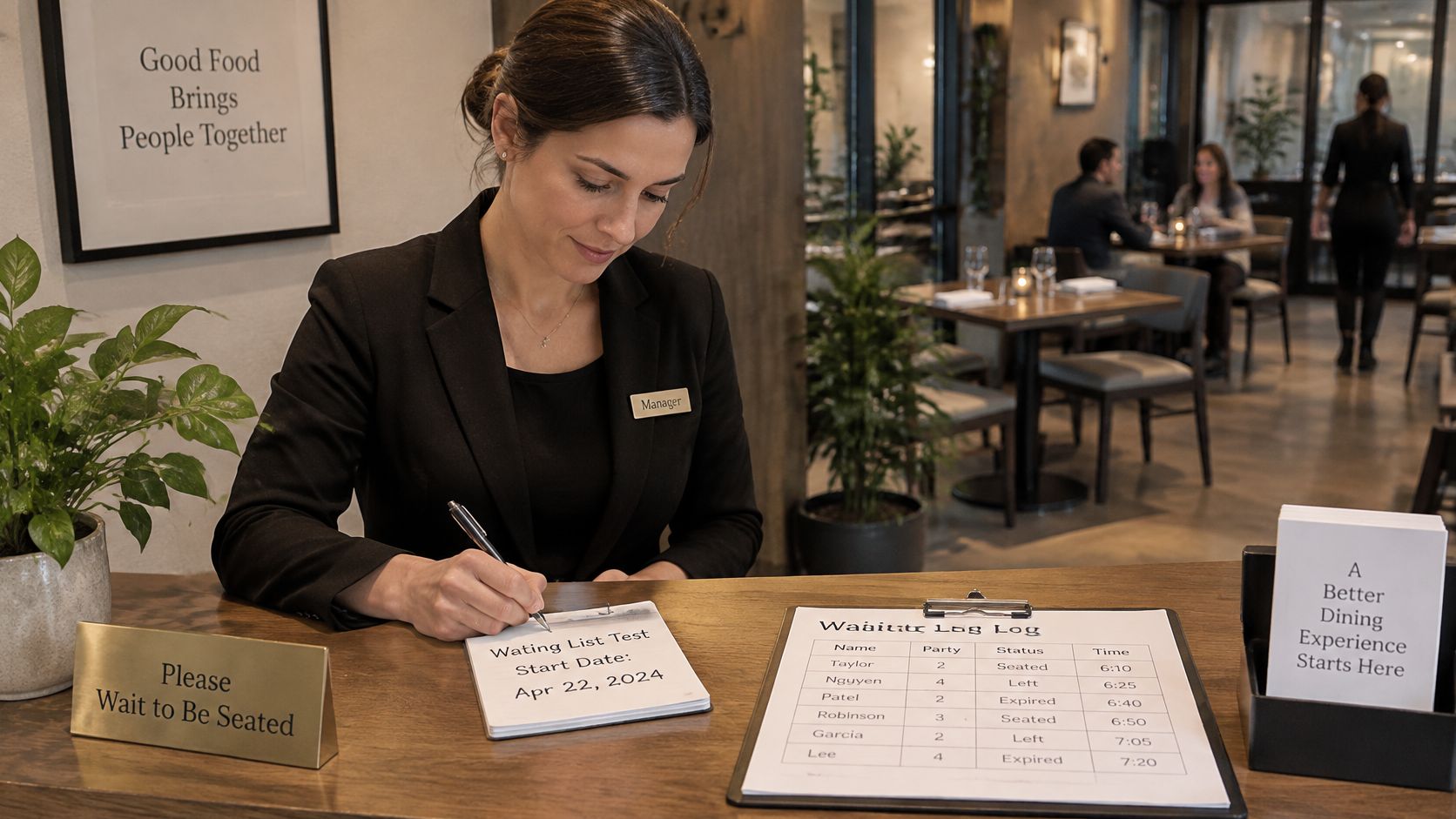
A digital list cuts manual handling. Policy decides whether it earns its keep. Restaurants using 10Seat see 30% more reservations, 40% fewer no-shows, and 10% to 15% more covers per shift. Treat those figures as a benchmark to match or fall short of in your own two weeks, not as a replacement for them.
At the end of the test, read two numbers first: walk-away rate and covers served. If reservations and walk-ins still sit in separate tools, weigh a single floor view against your pacing and party-size requirements before you commit.
10Seat handles reservations, walk-ins and waiting lists in one floor view, with guest details and messages sitting alongside the service information. Visit 10Seat to see whether a joined-up floor view makes your restaurant's waiting list easier to run.