Restaurant No Shows: Causes, Costs and How to Reduce Them
Restaurant no shows cost more than one empty table. Learn typical rates, recovery steps and policies that cut no-shows without losing bookings.
60% of restaurant workers had seen no-shows cause venues to turn away other customers, according to a 2026 survey reported by FoodBible. That's the problem with restaurant no shows: the table isn't empty. Someone else wanted it, but the restaurant couldn't confidently sell it.
Reducing missed bookings helps, but recovering usable capacity matters more. A good operating policy gives guests an easy way to cancel, tells hosts when to release a table, and protects the kitchen from badly paced replacement covers.
Table of Contents
- What Restaurant No Shows Are and How Often They Happen
- The Hidden Cost of One Empty Table
- Which Bookings Are Most Likely to Go Missing
- Confirmations, Deposits and Cancellation Rules That Work
- How to Recover a Table When Guests Do Not Arrive
- Measure No Shows by Service Before Changing Policy
What Restaurant No Shows Are and How Often They Happen
A restaurant no show is a confirmed booking where the party neither arrives nor cancels in time, leaving the table empty through its service window. In a 2008 Journal of Service Research study, restaurant owners and employees reported that 10.7% of reservations became no-shows, across 425 usable responses. Restaurants also waited an average of 28 minutes before classifying a reservation as missing.
Separate that outcome from a late cancellation, when a guest gives notice but leaves too little time to refill the table. A partial no show means fewer guests arrive than booked, potentially leaving paid-for preparation and seating capacity unused.
Reported no-show rates by context
These figures describe different populations and operating conditions. They aren't interchangeable benchmarks.
| Context | Reported rate | What the figure measures |
|---|---|---|
| Industry average, 2008 study | 10.7% of reservations | Share of reservations that became no shows, from 425 usable responses |
| Restaurant study range | 3% to 15% | Variation between venues in one cited restaurant study |
| Broad industry observation | About 20%, in the historical restaurant reservation paper linked above | Commonly described rate for unhonored bookings across the sector |
| All services, combined no show or late cancel | 9.07% to 12.95% | Modelled probability from 749 lunches and 749 dinners over 107 weeks, lowest on Thursday and highest on Saturday |
| New Year's Eve | Up to 40%, in the historical restaurant reservation paper linked above | Peak reported rate on a special occasion |
| US adults, 2021 consumer survey | 28% of adults | Share of people who missed at least one reservation in the prior year, not a venue rate |
The consumer-survey row measures people, not missed reservations as a share of a restaurant's bookings. It can't establish a venue-level no-show rate.
Treat historical averages as context, not a staffing instruction. A tasting-menu restaurant with advance preparation and a short seating window faces a different exposure from a bistro that can accept passing trade throughout service.
The Hidden Cost of One Empty Table
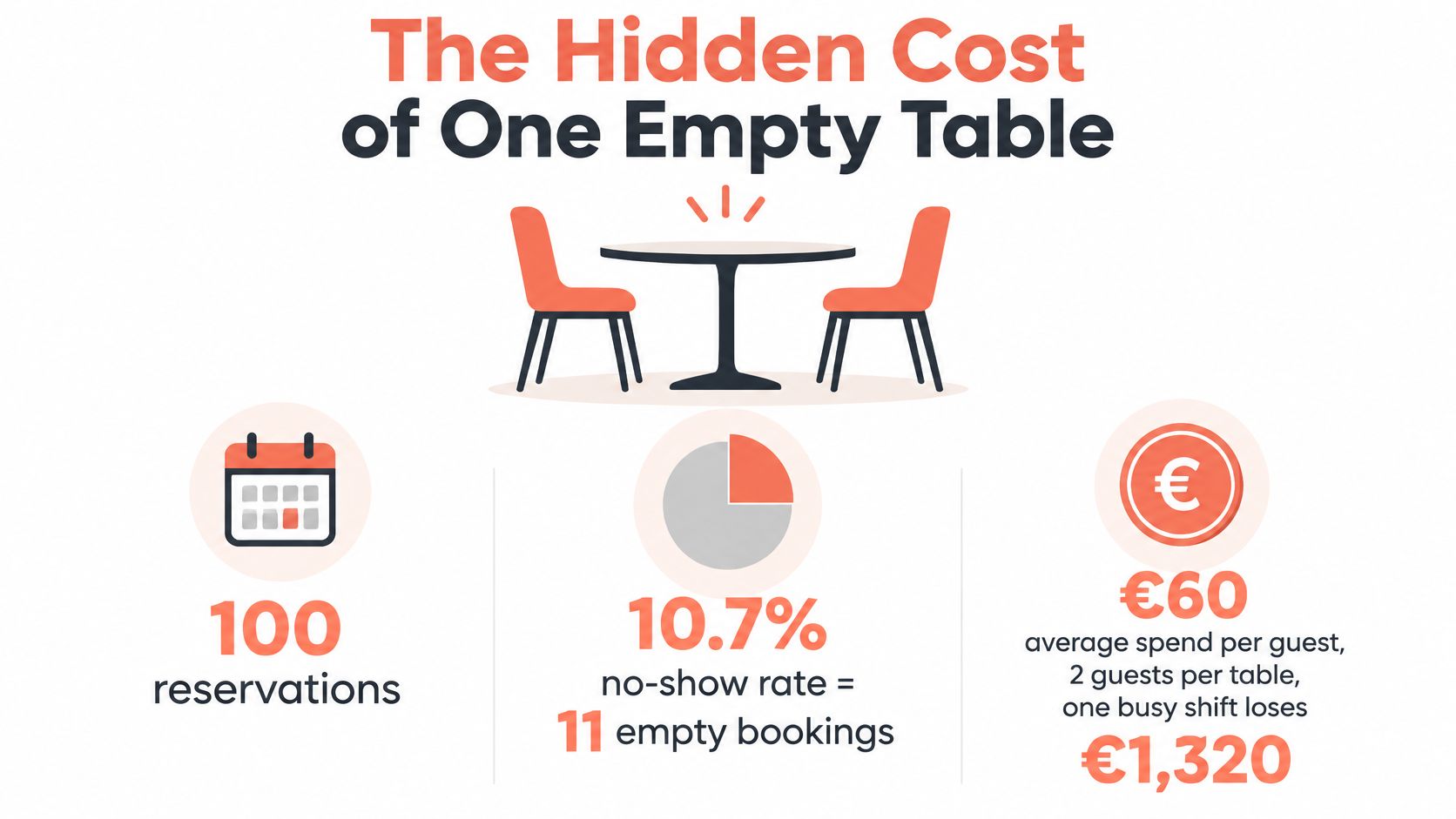
Consider a hypothetical busy shift with 100 reservations. Applying the historical baseline and rounding to 11 empty bookings, then assuming two guests per booking and an average spend of €60 per guest, produces €1,320 in unserved food and drink revenue. Those spend and party-size figures are example inputs, not industry averages.
That isn't €1,320 of lost profit. Food not prepared may save ingredient costs, while scheduled staff still need paying. The useful calculation separates unserved revenue, avoidable costs, and contribution lost.
Count the capacity that couldn't be sold
A missing reservation can affect more than its allocated table:
- Blocked inventory: The host declines another booking because the table still appears committed.
- Rejected walk-ins: Available guests leave while staff wait for an absent party.
- Unused preparation: The kitchen has already portioned products or prepared a fixed menu.
- Disrupted pacing: Replacement guests arrive together, rather than at the intervals the kitchen expected.
A recovered table also needs enough time to complete a worthwhile service. Filling a gap with guests who must leave before dessert may produce a poor experience without generating the expected contribution.
Use recovered covers × average contribution margin per guest, then subtract payment-processing costs, refunds, and contribution lost when booking friction drives guests away. Track fee income separately so it doesn't hide weaker dining demand.
Commercial rule: A cancellation charge can compensate for a missing guest. It doesn't prove that the restaurant used its seats well.
For capacity decisions, revenue per available seat hour helps connect revenue with the time a seat was available. It's more informative than celebrating a full reservation book that turns into an uneven dining room.
Judge recovery by additional covers served and contribution retained, not just the number of bookings marked absent.
Which Bookings Are Most Likely to Go Missing
Thursday and Saturday shouldn't automatically carry identical reservation rules. The operational revenue model summarised above placed the lowest combined no-show and late-cancellation probability on Thursday and the highest on Saturday, for both lunch and dinner.
The host needs that distinction visible before service starts, alongside the details that determine how expensive a missing party would be.
A reservation review should combine demand, party size, and commitment.
Prioritise exposure, not assumptions
Special occasions deserve separate planning because menu preparation, staffing, and table availability may be committed well before arrival. A normal service policy shouldn't carry over automatically to an event with limited resale opportunities.
Large parties matter because a missing group removes more covers at once. That's a measure of potential loss, not proof that larger groups are less reliable.
Booking source and lead time are useful fields to examine in the restaurant's own records. Don't assume a search-origin booking is unreliable or that a long-standing reservation will fail. Check whether those patterns predict missing covers before adding restrictions.
A practical service briefing can turn those fields into a short action list.
Consider a hypothetical Saturday evening booking for six, made well ahead through a search listing. The combination warrants attention because the party occupies substantial capacity during a valuable service, not because the booking channel proves bad intent.
The host should check whether the guest has acknowledged the reservation, whether the party size remains correct, and whether any event-specific requirements are complete.
Prioritise bookings by the covers at risk and the difficulty of replacing them. A high-probability loss on a small, easily refilled table may deserve less attention than an uncertain large party.
Confirmations, Deposits and Cancellation Rules That Work
Stricter rules can reduce missed bookings while discouraging legitimate demand. A 2025 peer-reviewed cancellation-policy study found that stronger cancellation barriers reduced stated no-show intentions, but stricter and more complicated cancellation processes also reduced booking intentions; experiments compared 24-hour and 72-hour notice requirements and US$20 and US$100 per-person fees.
These were stated intentions, not a promise of the same operational result in every dining room. The practical question is whether stronger commitment protects more contribution than it costs.
Commitment levers compared by strength and fit
| Lever | Setting | Effect on no shows | Best used for |
|---|---|---|---|
| Automatic confirmation and reminder | Sent before the visit | Prompts guests to confirm or cancel early | Every booking |
| Card guarantee | Card details secured at booking | Statistically significant decrease in one fine-dining study, p < .001, as discussed in restaurant analytics research | Peak periods and large parties |
| Deposit per person | Set amount per guest | Creates a financial commitment; no effect size reported in that research | Special events and tasting menus |
| Short-notice cancellation fee | US$50 per person for cancellations under 24 hours in the common urban policy described by the cancellation-policy study | Lower stated no-show intent, with booking-intention trade-offs | Saturdays and high-demand services |
| Longer notice window | 72 hours instead of 24, as tested in that study | Establishes an earlier deadline, potentially allowing more resale time | Planned events with fixed capacity |
Apply stronger commitments selectively to peak services, large parties, special events, and documented repeat absences. Keep ordinary, lower-exposure reservations straightforward.
A card guarantee and a deposit aren't the same. The former supports a later charge under disclosed terms; the latter collects money before the visit. The restaurant reservation deposit guide helps structure that decision around booking exposure.
Make the agreement understandable
State the cancellation deadline, fee, refund conditions, and treatment of party-size reductions before confirmation. Repeat the same terms in the guest's confirmation rather than introducing new conditions later.
For hosted celebrations and reserved nightlife tables, the Ultimate Party Amsterdam table guide provides useful context for discussing table-service expectations with an organiser. Restaurant-specific charges and cancellation terms still need their own explicit agreement.
Policy test: A rule that lowers no-shows but loses more profitable bookings than it protects isn't a successful rule.
Measure gross booking conversion alongside attendance. Make cancellation easy enough that guests tell the restaurant about changed plans while the capacity still has value.
How to Recover a Table When Guests Do Not Arrive
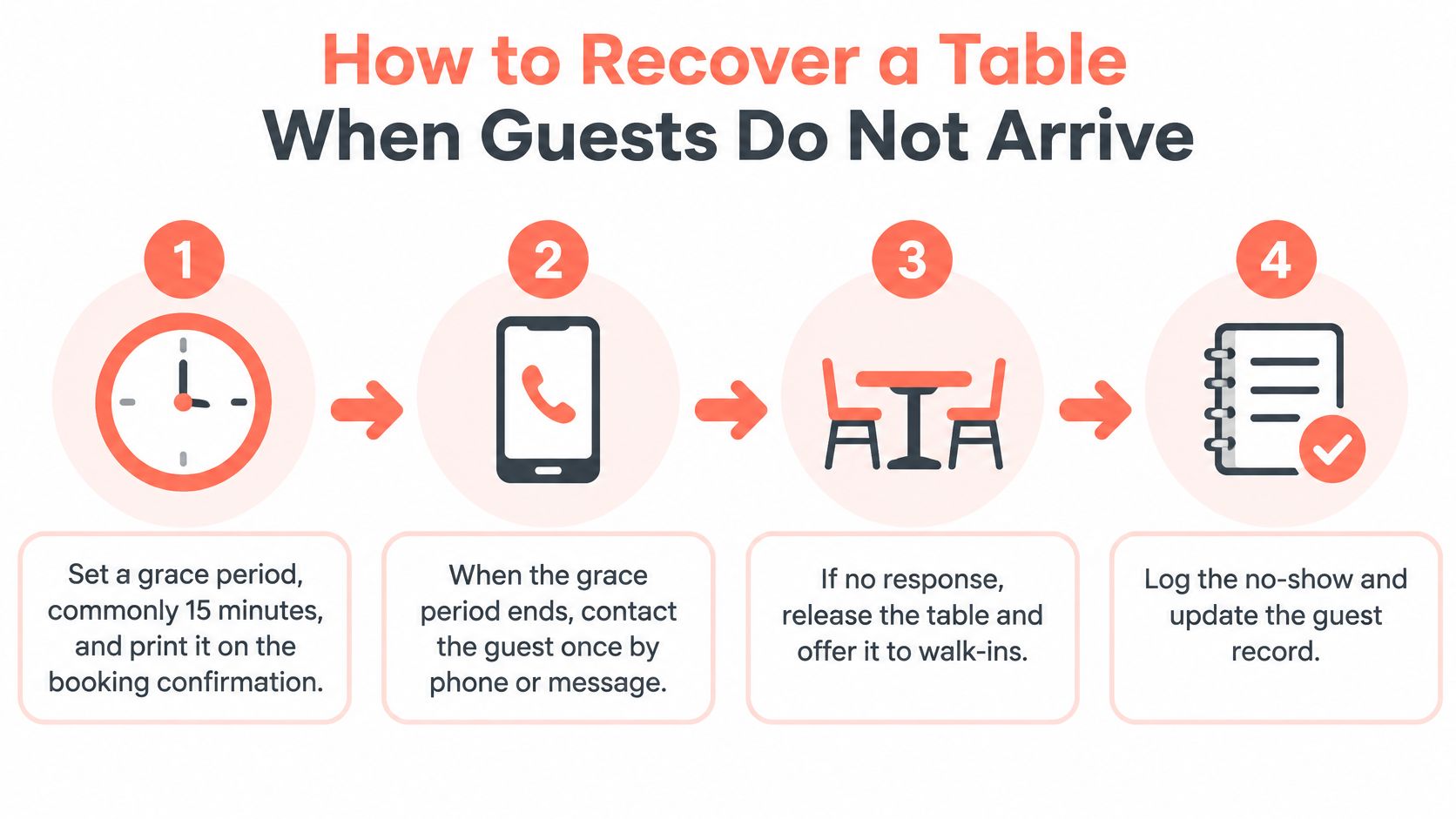
The host needs an agreed release procedure, not a fresh negotiation with the manager whenever someone runs late. The procedure should distinguish a recoverable delay from a table that must return to sale.
Give the host a release sequence
-
Publish the grace period. A restaurant might choose 15 minutes as an operating rule, provided it suits the service and appears on the confirmation. This is a policy example, not a universal standard.
-
When that period ends, contact the guest once by phone or message. Ask whether they're coming and request a realistic arrival time rather than accepting an indefinite delay.
-
Mark the booking late if there's no answer. Hold capacity only while doing so won't compromise another confirmed booking or a useful replacement seating. The host should have authority to act within that boundary.
-
Offer the slot to the first suitable walk-in or waitlisted party that can use the available dining window. State any departure time before seating, not after the guests have ordered.
-
Record the outcome accurately. Mark the booking as a late cancellation, partial no show, or full no show, with a short factual note. Avoid personal labels that turn a service record into a judgement about the guest.
-
Before reseating, check the kitchen's pacing. An available table doesn't mean the pass can absorb another order immediately.
Response by no-show scenario
| Scenario | Typical timing | Action |
|---|---|---|
| Early cancellation | Cancelled with enough notice to rebook | Offer the slot to the waitlist, no fee |
| Late cancellation | Inside the stated notice window | Apply the stated fee if the policy has one, then release the table |
| Partial no show | Some guests arrive, others don't | Seat the arrivals, release unused seats if the layout allows |
| Full no show | No contact after the grace period | Run steps 2 to 5 above and record the outcome |
A working restaurant waiting list needs party size, contact details, arrival readiness, and seating constraints. Without those details, staff can spend the remaining resale window calling guests who can't use the table.
For partial attendance, don't squeeze an unrelated guest into an unsuitable shared arrangement just to improve occupancy. Recover capacity only where the layout and promised experience allow it.
Measure No Shows by Service Before Changing Policy
Compare recent services by weekday, service, party size, booking source, and lead time. A spreadsheet works if each booking has a consistent status and cover count.
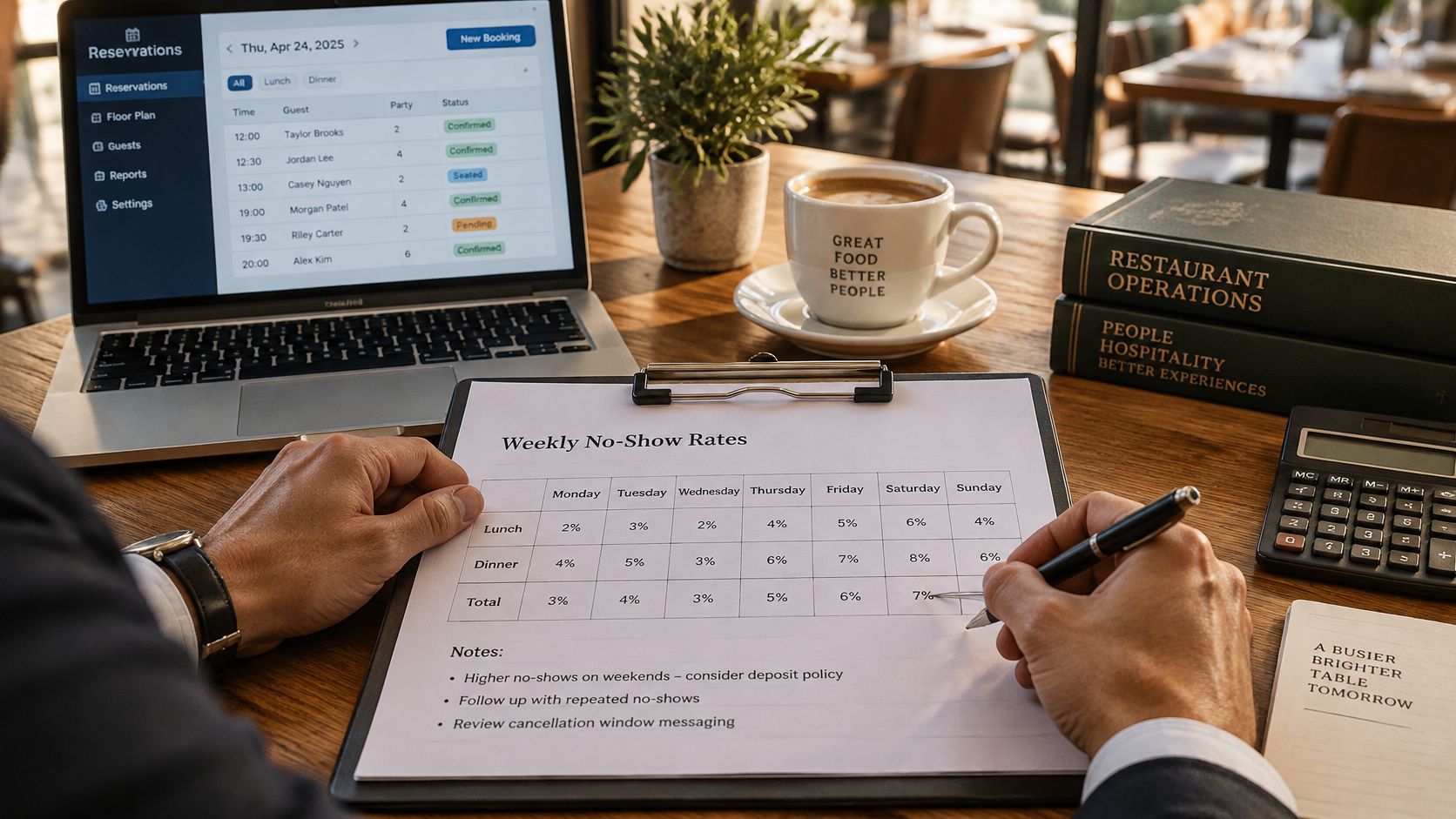
Divide full no-show bookings by eligible confirmed bookings to calculate the booking no-show rate. Track missing covers separately, including guests absent from partially attended parties. This shows how many seats went unused, not just how many bookings failed.
Rank the losses before choosing a rule
Sort service segments by lost covers and estimated contribution, rather than no-show percentage alone. A lightly booked lunch can show a high rate from a small number of bookings while costing less than a busy dinner with several missing covers.
Track four operational measures:
- Attendance: Full no-shows, late cancellations, and partial attendance, recorded separately.
- Recovery: Replacement covers seated and the revenue they generate.
- Conversion: Completed bookings compared with similar booking attempts, when that information is available.
- Policy costs and service effects: Refunds, processing charges, staff administration, disputes, delays, rushed meals, or kitchen congestion caused by replacement seating.
Change one commitment lever at a time and compare similar services. If demand, menu format, opening hours, and cancellation rules all change together, the manager cannot isolate what affected attendance. A lower no-show rate is useful only if completed bookings and recovered covers hold up.
GKS compliance for Belgian restaurants
For Belgian operations, keep GKS (Geregistreerd Kassasysteem) accounting separate from reservation-status reporting. A deposit, a retained cancellation charge, and a completed meal are different operational events.
Ask the accountant how to record each transaction and reconcile prepayments with final bills and refunds. A reservation platform's payment record does not replace the required cash-register and accounting treatment.
Choose tools around the operating process
10Seat is a restaurant reservation system with automatic confirmations and reminders, deposits that secure bookings through prepayments, and live table management. Restaurants using 10Seat see 30% more reservations, 40% fewer no-shows, and 10–15% more covers per shift.
Compare the system's capabilities with the host's workflow and expected cover volume. Measure the result in recovered covers and contribution, as well as attendance.
Export recent bookings, find the service losing the most covers, and assign a manager to test one targeted change.
10Seat's reservation system includes automatic confirmations and reminders, deposits, and live table management. Visit 10Seat to assess whether its workflow fits the restaurant's booking and service needs.