How to Do Optimization for Restaurant Seating Capacity
How to do optimization for restaurant seating: a step-by-step guide to table mix, turn times, service flow and walk-ins, with numbers you can use this week.
A full room can still leave money on the table. If couples occupy six-tops, bookings land in one rush, or the kitchen receives too many orders at once, seats look busy while revenue and hospitality suffer. Knowing how to do optimization well means fixing those mismatches with data you already collect, then protecting the experience that brings guests back.
Table of Contents
- What Seating Optimization Really Means
- Match Your Table Mix to Party Sizes
- How to Optimize Your Seating Step by Step
- Set Turn Times and Pace the Service Flow
- Fill the Gaps with Walk-ins and No-show Planning
- Keep GKS Compliance on Track in Belgium
- Choose a Flat Fee and Start This Week
What Seating Optimization Really Means
At high load, the peer-reviewed computational study on restaurant revenue management found that optimization-based seating increased revenue versus industry-standard FCFS by 7.65% to 13.13%, without increasing, and sometimes reducing, waiting time. That result reframes the job. Optimization isn't squeezing in more chairs. It's making a better assignment decision every time a party arrives.
Say a party of two walks in at 19:00 on Friday. You have a deuce by the window and a four-top near the pass. First-come, first-served logic or the smallest matching table rule might put them on the deuce immediately. A better decision also asks what happens next. Is a booked party of four due in ten minutes? Could that deuce combine with another for a likely party of five? Will seating this couple now push too many orders into the kitchen at once?
The Three Levers
- Capacity: Your table mix matches the party sizes that book.
- Allocation: Each party goes to the table with the lowest opportunity cost, based on later demand, flexibility, predicted duration and wait impact.
- Flow: Arrivals, turn times and kitchen pacing stay controlled so extra covers don't create crowding or rushed courses.
No single assignment rule wins in every service, because the best choice changes with arrival rate and party-size mix. That's why hosts need simple guardrails, not a rigid script. Track revenue per available seat-hour, waits, table turns, walk-aways and kitchen load. Even details that support spend without adding covers matter. Staff who understand the list, helped by resources on decoding a restaurant wine menu, can guide a relaxed second glass instead of rushing dessert.
The practical sequence is audit, rebuild, pace, buffer and review. Start with eight weeks of bookings, rebuild the mix, set turn targets, plan for walk-ins and no-shows, then review weekly for 15 minutes each Monday.
Match Your Table Mix to Party Sizes
Start with a concrete floor, then adjust it to your own demand. This sample suits a 40-seat bistro where couples dominate but groups still matter.
Sample 40-seat table mix for a bistro
| Table type | Seats each | Quantity | Total seats | Best for |
|---|---|---|---|---|
| Deuce (2-top) | 2 | 9 | 18 | Couples, walk-ins, push together for 5 to 6 |
| Four-top | 4 | 4 | 16 | Families and groups of 3 to 4 |
| Six-top | 6 | 1 | 6 | Large parties and celebrations |
The shape matters as much as the count. Square deuces combine cleanly, round tables soften tight corners, and banquettes use walls well. If you're choosing new furniture, a dining table shapes and seating guide helps you compare footprint and comfort before you buy.
Recalculate From Your Own Bookings
Pull the last eight weeks of reservations and count party sizes by day and daypart. Add arrival timing, dining duration, table combinations, revenue per cover and peak demand. Then compare supply with demand. If parties of two account for roughly half of peak covers, give deuces roughly half the seats. If Friday brings groups of six but Tuesday doesn't, don't lock both nights into the same floor.
Don't optimize for seat count alone. A couple on a six-top wastes four seats for a full turn, while three stranded deuces can't serve a party of six unless they combine cleanly. Flexible tables repair both problems. Mark which deuces push together without blocking service routes, and keep at least one combination available for larger parties during peak.
The best floor plan isn't the one with the most seats. It's the one with the fewest seats stranded at 19:30 on your busiest night.
The evidence for doing this work is strong. In a 68-restaurant Cornell sample reported in the Cornell publication on table mix, only 8 venues already had the optimal peak table mix, while the remaining restaurants could increase peak revenue by almost 15% on average. The same source notes that daily adjustment produced performance gains of more than 1% compared with retaining a weekly optimum.
Adapt the sample to your concept. Fine dining usually needs wider spacing, fewer cramped deuces and more comfortable four-tops. Brunch rooms often run deuce-heavy but need space for strollers and coats. Bar-led venues trading on drinks and small plates can favor flexible two-tops over one permanent large table. Test one candidate mix against a busy historical week before moving furniture, then stress-test it against your highest-load Friday.
How to Optimize Your Seating Step by Step
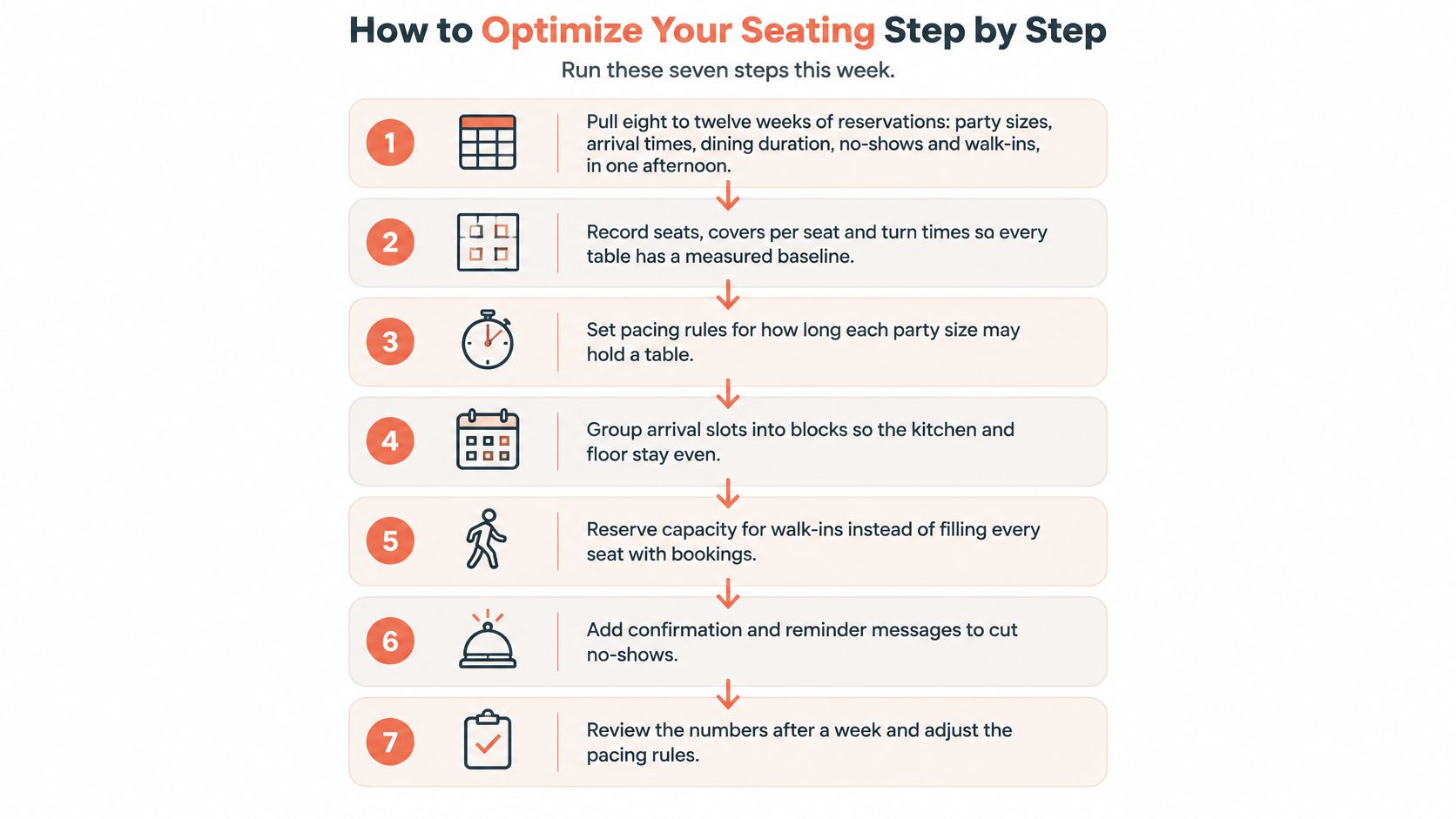
Run this as a one-week reset, not a renovation project. Most independent rooms can pull the data in an afternoon and remap the floor in about one hour on a quiet afternoon.
The visual below summarizes the sequence before the detail that follows.
Steps One to Three
- Pull eight to twelve weeks of reservations. Export party sizes, arrival times, dining duration, no-shows and walk-ins. Split Friday and Saturday from weekdays, because one average hides the peak problem you're trying to solve.
- Record the baseline. Write down seats, covers per shift, average turn time and peak utilization. For example, say a room has 60 seats, a two-hour peak and 90-minute turns. Its theoretical peak capacity sits near 80 covers, so 62 actual covers equals roughly 78% utilization. That gap tells you whether the problem is demand, allocation or pacing.
- Rebuild the mix. Use the 40-seat bistro pattern as a starting shape, then scale table counts to your own party-size frequencies. Change the physical floor only after the numbers show which tables strand seats.
Better forecasting makes step one easier over time, especially when you separate confirmed demand from likely walk-ins. A practical primer on restaurant demand forecasting shows how to turn booking history into nightly expectations without building a complex model.
Steps Four to Seven
- Mark flexible combinations and protected zones. Label deuces that push together for parties of five or six. Keep one quieter zone for celebrations, regulars and guests who booked a special occasion, even if a walk-in could fill it sooner.
- Seat by opportunity cost. Before assigning a table, compare the current party's value, expected later demand for that size, combination flexibility, predicted duration and waiting-time impact. Don't give away the only combinable pair to a deuce at 18:45 if parties of five usually arrive at 19:15. Offer the bar or a short wait instead.
- Set turn targets and stagger arrivals. Give each daypart a target duration by party size, then release booking slots in 15 to 20 minute waves. This protects the pass and stops the host stand from creating a kitchen spike.
- Add buffers for uncertainty. Use confirmations, a waitlist, a fixed release time for unconfirmed tables and one walk-in window per hour. Don't sell every seat in advance if your room depends on neighborhood walk-ins.
Change one lever per week. If you rebuild the floor, change pacing and alter the release rule on the same Friday, you won't know what worked. Review covers, wait times, walk-aways and ticket times every Monday. Keep the change if revenue per available seat-hour rises without longer waits or weaker guest comments. Reverse it if covers rise but the kitchen falls behind.
Host rule for tonight: Never spend a flexible table combination on a small party unless later demand for that combination looks weak.
Set Turn Times and Pace the Service Flow
Turn time decides how much revenue a seat can produce in a shift. For example, cutting an average dinner turn from 105 to 90 minutes can create roughly one extra peak seating across part of the room without moving a table. The gain only counts if guests don't feel hurried.
Use targets as planning aids, not scripts you recite to guests.
| Service | Party of 2 target | Party of 4 target | Party of 6 or more target |
|---|---|---|---|
| Lunch | 60 minutes | 75 minutes | 90 minutes |
| Casual dinner | 90 minutes | 105 minutes | 120 minutes |
| Fine dining dinner | 120 minutes | 135 minutes | 150 minutes |
Measure your actual averages for two weeks before tightening anything. If lunch parties of two already leave in 55 minutes, a 60-minute target adds nothing. If dinner fours average 125 minutes against a 105-minute booking assumption, your reservation slots are promising capacity you don't have. More detail on diagnosing that gap sits in this guide to restaurant table turnover.
Four Pacing Guardrails
- Stagger reservations in 15 to 20 minute waves. Never seat most of the room within half an hour, even if every table is technically free.
- Cap simultaneous covers below the kitchen's proven peak. During a new menu launch, for example, hold the room at 80% of seats until ticket times stabilize.
- Build a 10 to 15 minute recovery buffer between seatings. Staff need time to reset, brief allergies and clear the pass.
- Check fixed time marks. Drinks ordered by minute 10 and mains fired by minute 35 gives the floor an early warning long before dessert runs late.
These guardrails protect spend as well as speed. According to the National Restaurant Association release on industry growth in 2025, 64% of full-service customers say the dining experience matters more than price. A plan that adds covers but creates crowding, rushed courses or poor table adjacency can therefore lose repeat visits while looking efficient on paper.
Optimize for contribution margin per constrained service window, not covers alone. Ask one hard question each week. How many additional guests can this room serve before incremental covers reduce spend, satisfaction or repeat visits? If average spend drops as covers rise, you've found the ceiling. Hold it, even on nights when the waitlist tempts you to push further.
Train servers to pace through service, not pressure. Offer water and drinks quickly, take the full order when guests are ready, fire courses with clear timing and present the bill promptly when asked. Don't clear plates while one guest still eats or stack chairs around a lingering table. Fast internal handoffs save minutes without guests noticing. Visible rushing saves minutes once and costs goodwill for months.
Fill the Gaps with Walk-ins and No-show Planning
No-shows are small enough to manage and large enough to matter. The Resos No-Show Index, based on booking data from August 2025 through July 2026, reported a 2.33% no-show rate across advance reservations. Tables booked for one or two guests had the highest reported rate, at 2.63%, while parties of 10 or more had the lowest, at 1.15%.
Track your own rate by party size, channel and lead time instead of using one blanket assumption. A deuce booked three weeks ahead through a marketplace behaves differently from a regular's same-day booking for six. Even a low rate leaves recoverable seats. At roughly two to three empty bookings per 100 reservations, a controlled waitlist can refill much of that space.
A Host Checklist for Tonight
- Confirm at 24 hours and again three hours before. Make cancellation one tap or one short reply, so guests release tables they no longer need.
- Release unconfirmed two-tops 15 minutes after the slot. Call or message first, then move to the waitlist in order.
- Hold one deuce per hour as a walk-in window. Release it to bookings only when the hour is close and walk-in traffic looks weak.
- Take a card guarantee or deposit for parties of six or more. Large tables block flexible combinations, so a late cancellation costs more than the headcount suggests.
- Quote honest waits. A promised 20 minutes that becomes 40 damages the bar, the host stand and the table's mood before ordering starts.
A structured restaurant waiting list turns these releases into a fair queue instead of names scribbled on paper. Record party size, phone number, quoted wait and any time limit the guest gives you. When a table opens, match it to the party that fits best and can arrive immediately, not the first name if that party needs six seats and you have two.
Forecasts will still miss. Rain can raise no-shows and kill walk-ins on the same night, while a local event can do the opposite. Set an escalation trigger in advance. For example, if fewer than 80% of bookings are confirmed two hours out, open the waitlist early and call unconfirmed parties. If confirmed bookings are strong but the grill station is down a cook, protect pacing and refuse some walk-ins.
Refusing a walk-in costs one possible cover. Overloading the kitchen costs every table already seated.
Give the senior host authority to act on those triggers without waiting for the owner. The decision has to happen at the door, while guests are standing there and the next booking is walking in.
Keep GKS Compliance on Track in Belgium
For Belgian operators, extra covers aren't only an operations question. On-premise revenue can change your obligations under the GKS, the Geregistreerd Kassasysteem. Growth that fills seats more effectively may push your restaurant and catering turnover into territory where certified registration is required.
The general threshold and transition dates need separate handling. The threshold tells you whether the system applies. The transition schedule tells you when an existing operator must move to GKS 2.0. According to the VATupdate summary of GKS 2.0 from 1 July 2026, new hospitality businesses must use GKS 2.0 from 1 July 2026, and both the point-of-sale system and fiscal data module must be certified.
GKS 2.0 transition deadlines in Belgium
| Situation | GKS 2.0 deadline |
|---|---|
| New hospitality business | 1 July 2026 |
| Register bought before 1 January 2018 | 1 July 2027 |
| Register bought between 1 January 2018 and 31 December 2021 | 1 July 2028 |
| Register bought from 1 January 2022 | 2029 |
Don't treat a reservation system, floor plan tool or waitlist as a substitute for compliant sales registration. They solve different problems. Reservations decide who sits where and when. The GKS records sales through the certified register and fiscal data module, commonly called the black box.
A Quarterly Check
Every quarter, compare rolling on-premise restaurant and catering turnover with your current position and confirm the figure with your accountant. Check your existing register purchase date against the table. Then budget early if a replacement point-of-sale system, fiscal module, installation or staff training sits inside the next 12 months.
Do this before a busy season, not during it. If a seating reset adds covers per shift, revenue can move faster than your compliance planning. Put the deadline in the same operations calendar as menu changes, terrace opening and annual maintenance. Ask your point-of-sale supplier in writing whether both components are certified for your situation. Keep the answer with your purchase invoice.
That small administrative habit protects the upside of optimization. Extra covers should improve margin, not create a rushed equipment purchase in the month your deadline lands.
Choose a Flat Fee and Start This Week
Choose software after the floor and pacing rules are clear. A booking tool can't repair a table mix that strands seats, and it shouldn't make every extra guest more expensive to acquire.
The checklist below helps you compare pricing models before you compare feature lists.
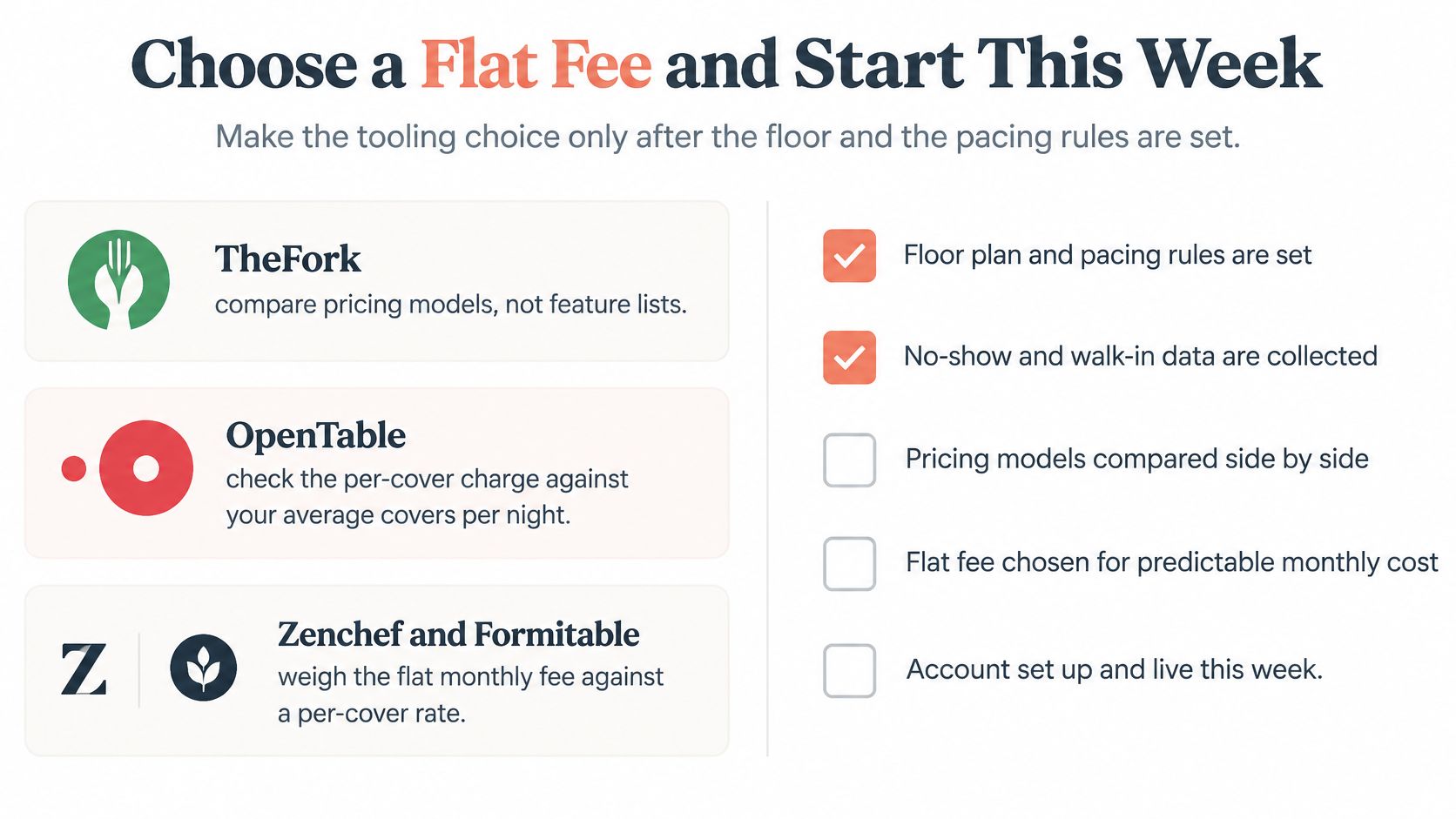
If bookings run through TheFork, OpenTable, Zenchef or Formitable, separate the channel value from the pricing model. A per-cover commission grows with every additional guest your optimization creates. A flat subscription doesn't. For example, at 400 covers a month, a charge of one euro per cover equals 400 euros before any other fees. Run your own cover count through that arithmetic.
10Seat reports that restaurants using the platform see 30% more reservations, 40% fewer no-shows and 10-15% more covers per shift. The Optimize package costs €189 per month, or €169 per month with annual billing (€2,028 per year). Migration of the entire reservation system takes 15 minutes, with no third-party platform and no lost reservations. Compare that fixed cost with your current commission on 10Seat pricing, using last month's actual covers rather than a sales estimate.
The short video below is useful once you've done that pricing check and want to see the working flow before changing tools.
Start this week with measurement, not a purchase. Pull eight weeks of party-size, duration and no-show data. Change one lever, hold it for four Monday reviews, and compare covers, waits, turn times and spend per guest. Keep what raises revenue without weakening the room.
10Seat gives independent Benelux restaurants commission-free reservation management, so the extra covers you win from a better table mix and tighter pacing don't create a bigger per-cover booking bill. Set up your floor, confirmations and waitlist in one place, then measure the next four weeks against your current covers and no-show rate. Visit 10Seat to compare the flat monthly cost with what you paid in commission last month and start with your first seating reset this week.