Types of Restaurant Reservations: Which Fits Your Venue
Types of Restaurant Reservation. Learn every type of restaurant reservation and which fits your venue. Compare timed bookings, walk-ins, call-ahead, and private
Reservations are not a single format. In some large cities, reservations fill about 60% of restaurant seats, while walk-ins fill roughly 40%, so choosing the right reservation types directly affects revenue, table turnover, and the number of guests a dining room can serve.
Friday service exposes bad reservation design quickly. The online book looks full, the host stand is surrounded by waiting guests, and two tables sit empty because reservation holders haven't arrived. Meanwhile, the kitchen has a burst of large parties arriving together, while the walk-in couple who could have filled a gap is told there's no room.
That isn't a booking-channel problem. It's an operational intent problem. A timed reservation, a walk-in, a call-ahead request, a waitlist entry, and a prepaid tasting-menu booking all represent different levels of commitment and different demands on the floor.
The right types of restaurant reservation depend on your demand pattern, table duration, kitchen pacing, party mix, and the cost of holding capacity empty. The following framework gives owner-chefs and GMs a practical way to combine those formats instead of forcing every guest through one booking rule.
Table of Contents
- Why Reservation Types Matter for Your Floor
- Common Types of Restaurant Reservations Explained
- Guaranteed Versus Non-Guaranteed Bookings
- How to Mix Reservation Models Without Losing Seats
- Using Data to Reduce No-Shows and Missed Seats
- Turning Mixed Reservations into More Covers Per Shift
- Choosing the Right Reservation Mix for Your Venue
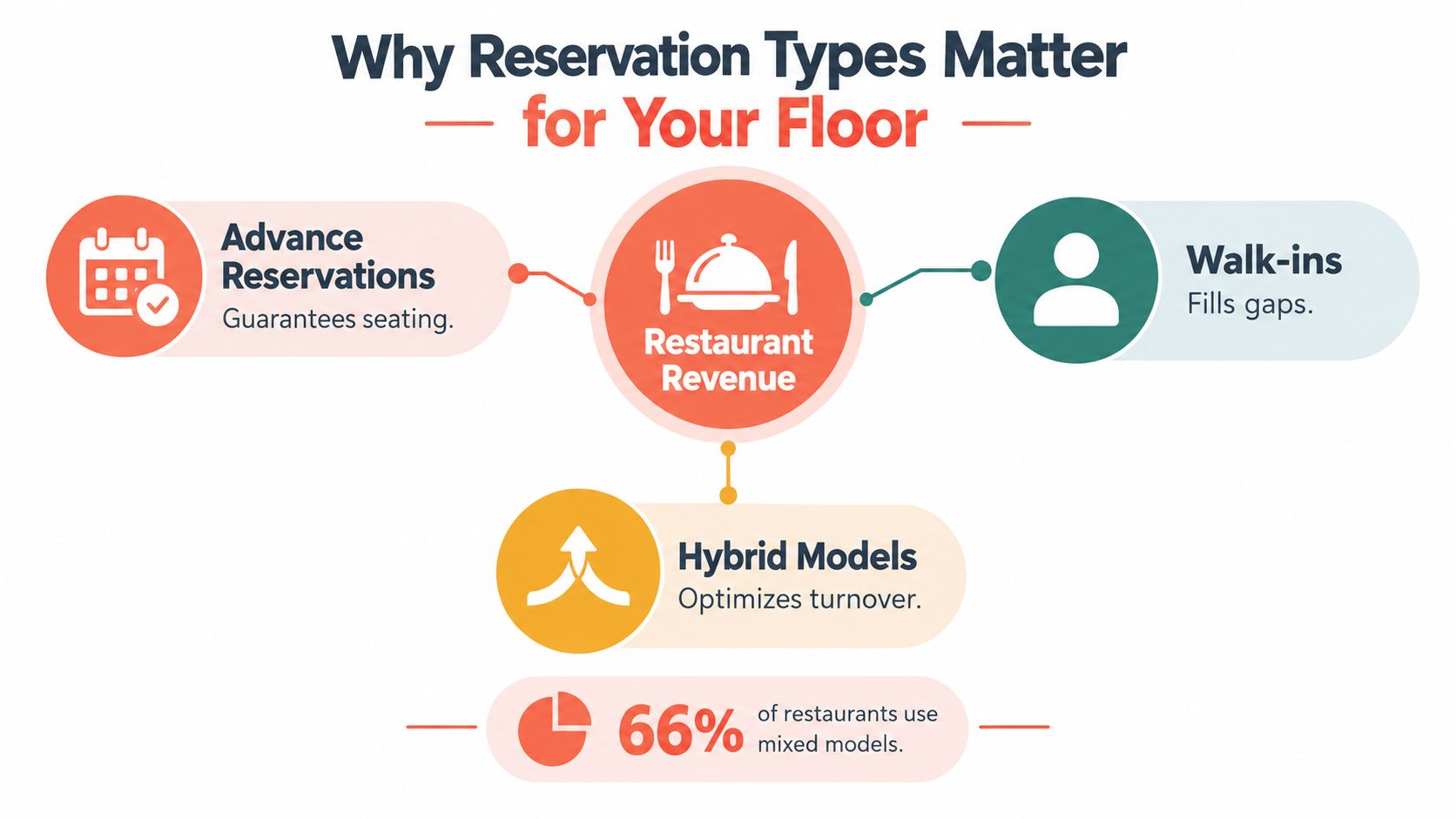
Why Reservation Types Matter for Your Floor
A reservation allocates future capacity. A seated party generates revenue. Treating those two events as interchangeable is how restaurants end up with a full booking sheet and empty chairs.
A reservation-heavy model gives the team visibility before service. It helps the kitchen prepare for arrival waves, lets the host build a seating plan, and gives guests confidence that a table is waiting. Walk-in demand offers the opposite advantage. It fills gaps, absorbs late demand, and can rescue a service when cancellations occur.
The Wharton School reported that, in some large cities, approximately 60% of seats are filled through reservations and 40% through walk-ins. The same Wharton analysis of restaurant reservations estimated that roughly 20% of reservation holders may fail to arrive when no no-show fee applies. A table held for an absent guest can remain unusable during the most valuable part of service.
Compare the operating models
| Model | Strength | Main exposure |
|---|---|---|
| Reservation-led | Predictable arrivals and easier preparation | Empty tables after late cancellations |
| Walk-in-led | Flexible demand capture and fewer booking barriers | Unpredictable peaks and longer waits |
| Hybrid | Balances early revenue with late demand | Requires disciplined inventory control |
The hybrid approach usually gives an independent restaurant the strongest operating position, but only when the team protects specific capacity for walk-ins rather than accepting every booking request. A small bistro may hold a few tables open during the first part of service, while a tasting-menu restaurant may use deposits and tightly timed arrivals.
The floor plan matters as much as the booking channel. A restaurant with many two-tops can absorb flexible arrivals differently from one built around large communal tables. Managers should map this relationship in a restaurant seating chart before changing reservation rules.
Practical rule: The right reservation type is the one that protects the next profitable seating, not merely the one that fills the booking calendar.
Wharton's modeled policy results reinforce that point. A 5% discount for reservation customers on less busy nights could increase profit by 7.4%, while a no-show fee equal to the price of a meal on high-demand nights could increase profit by 14.5%. Those outcomes show why reservation policy must follow demand intensity, table turnover, and the opportunity cost of empty capacity.
Common Types of Restaurant Reservations Explained
The main types of restaurant reservation should be classified by what they do for the operation, not only by whether they arrive online or by phone. A phone booking and an online booking can carry the same operational intent. A waitlist request and a confirmed reservation cannot.
Timed reservations
A timed reservation assigns a party a specific arrival slot. This is the standard format for fine dining, tasting menus, chef counters, and services where pacing controls the kitchen.
Timed bookings work best when the team defines:
- Arrival window: State when the table is held and how late arrival affects the experience.
- Table duration: Match the booking pace to realistic meal length, not an idealized schedule.
- Party size: Avoid accepting combinations that block efficient table configurations.
- Service rhythm: Stagger arrivals when the kitchen has limited capacity.
A timed reservation provides control, but it can create arrival bunching if every table is released at the same interval. Strong managers use arrival slots to regulate the room, not only to record demand.
Open seating and walk-ins
Open seating leaves capacity available for spontaneous guests. It suits casual bistros, brunch restaurants, bars with seated service, and venues where meal duration varies.
Walk-ins reduce booking friction, but they still need rules. Staff should know which tables can be offered, how long a guest may wait, and when a table must be protected for an upcoming booking. “We'll see what happens” isn't a floor plan.
Call-ahead programs
A call-ahead system lets guests join a phone queue while the restaurant continues seating other parties. It works well when demand is strong but arrival timing is uncertain.
The host should record the party size, contact details, and expected arrival range. A call-ahead guest isn't the same as a guaranteed reservation. The team should communicate that distinction clearly so guests don't expect a specific table at a precise time.
Ticketed or demand-based bookings
Ticketed bookings secure revenue before service. They fit pop-ups, special events, chef counters, and high-demand multi-course experiences where food preparation and limited seating make an empty place expensive.
The guest pays in advance or commits through a stronger guarantee. The restaurant gains planning certainty, but the purchase path must explain cancellation, transfer, lateness, allergies, and seating conditions before payment.
Guaranteed Versus Non-Guaranteed Bookings
The difference between a guaranteed and non-guaranteed booking is financial commitment. A non-guaranteed reservation usually requires a name, contact detail, and time. A guaranteed reservation uses a card hold, deposit, cancellation fee, or prepaid amount to protect scarce inventory.
Non-guaranteed bookings convert easily because they create little friction. They also expose the restaurant to late cancellations and no-shows. Guaranteed bookings reduce that exposure, but an aggressive policy can discourage legitimate guests who aren't yet ready to commit.
A credit-card guarantee for restaurant reservations should be treated as a capacity-control tool, not as a punishment. The policy needs to appear before confirmation, use plain language, and provide a simple cancellation route.
Match protection to risk
The Kellogg School of Management reviewed restaurant reservation research that found no-show rates between 3% and 15% in one documented restaurant, while rates around 20% were considered common in broader observations. For special events, the risk can be higher. New Year's Eve no-show rates reached as high as 40% in the reported observations. These figures come from the Kellogg reservation research review.
A single policy across every daypart is poor management. The protection should reflect scarcity:
- Low-demand lunch: Use a non-guaranteed booking with reminders and an easy cancellation link.
- Busy Saturday service: Consider a card guarantee for scarce time slots.
- Large parties: Use a deposit or stronger confirmation because one cancellation affects several seats.
- Tasting menus: Use prepayment or a clear deposit policy when preparation begins before arrival.
- Special events: Protect the entire inventory with a ticketed or prepaid model.
Track the booking trade-off
A stricter guarantee isn't automatically more profitable. Operations research recommends estimating cancellation and no-show probability from historical time-slot data, guest characteristics, and prior behavior. The restaurant can then decide whether to accept, waitlist, or re-offer that inventory.
The policy should be segmented by demand intensity, party size, lead time, and guest commitment. A blanket barrier may prevent no-shows, but it can also suppress bookings. A transparent policy supported by reminders and easy cancellation often protects attendance without making every guest face a punitive checkout.
How to Mix Reservation Models Without Losing Seats
A full booking sheet can be a warning sign rather than a success signal. If every table is committed to an advance reservation, the restaurant may lose the flexibility needed to capture late demand and recover cancellations.
About 66% of diners reportedly make same-day reservations, while 11% of UK diners rarely reserve and prefer walking in, according to the industry discussion documented by Petpooja on balancing online bookings and walk-ins. The operating implication is straightforward. Inventory must remain flexible because demand arrives at different times and with different levels of commitment.
Start with the floor, not the booking target
The manager should first identify the tables that are genuinely flexible. A two-top near the bar can serve a walk-in, a same-day booking, or a later reservation. A large table may need protection for a party that can use the full configuration.
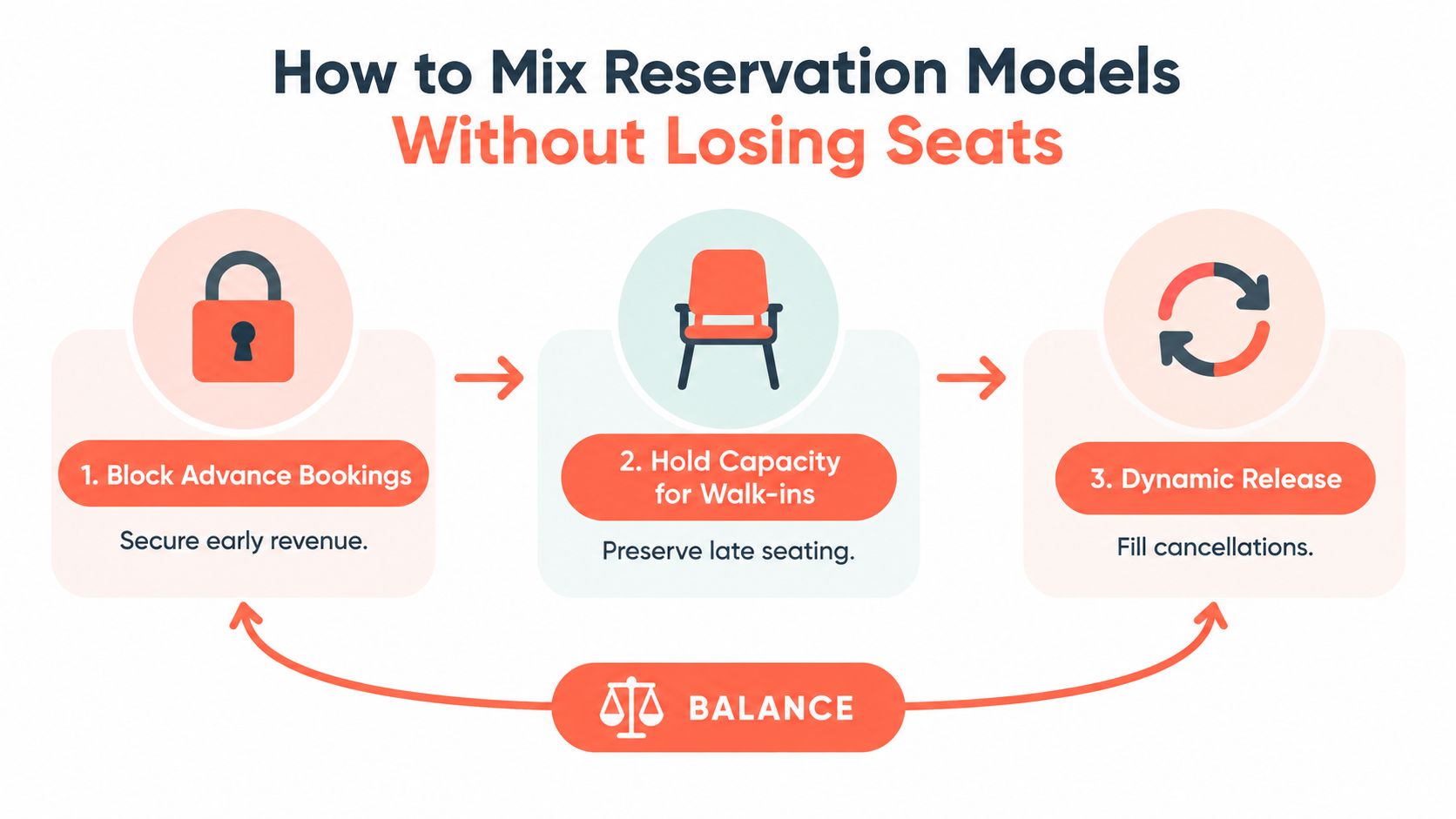
The release plan should answer three questions:
- Which tables are committed to high-value or guaranteed bookings?
- Which tables remain open for walk-ins and same-day demand?
- When does held capacity get released to the public?
A restaurant shouldn't reserve the same proportion of tables every day. Friday dinner, Sunday brunch, a quiet Tuesday, and a local event create different demand conditions. The manager should adjust the mix based on expected arrival timing, table duration, kitchen throughput, and the ability to refill a table after a cancellation.
Use dynamic release rules
Held inventory needs a clock. If a table remains unbooked as service approaches, the team should release it for walk-ins or same-day online bookings. If a reservation cancels, the table should move immediately to a waitlist, notify queue, or public availability pool.
This is the practical value of restaurant yield management. The aim isn't to maximize advance bookings. It's to maximize usable covers while respecting the kitchen and the dining room.
A table that stays protected after its recovery window has passed is no longer protected inventory. It's lost capacity.
Wharton's modeled findings support flexible planning. A 5% reservation discount on less busy nights was associated with a modeled 7.4% profit increase, while a meal-price no-show fee on high-demand nights was associated with a modeled 14.5% profit increase. The lesson is to use different controls for different demand conditions, not to impose one rule across the calendar.
Using Data to Reduce No-Shows and Missed Seats
Cancellation policy is part of the reservation product. Guests decide whether to book partly on the friction, cost, and clarity of the commitment.
A restaurant-reservation experiment compared a 24-hour notice requirement with a 72-hour requirement, and a $20 cancellation fee with a $100 fee. Booking likelihood was higher under the lenient policy, with mean scores of 4.37 versus 3.82 for a strict policy. Participants recognized the 24-hour condition 93.0% of the time and the $20 fee condition 97.2% of the time, as reported in the restaurant cancellation-policy experiment.
The practical answer is not to just “charge more.” State the notice period, charge, and cancellation method before confirmation. Make the cancellation link easy to find. Guests should understand the consequence without searching through terms and conditions.
Measure the whole funnel
A no-show rate alone doesn't show whether the policy works. A stricter rule may lower no-shows while also lowering booking conversion. Track the operating chain separately:
- Booking conversion: How many guests complete a reservation after viewing the policy?
- Cancellation lead time: How early do guests release the table?
- No-show rate: How often does a confirmed party fail to arrive?
- Recovered covers: How many seats does the team refill after a cancellation?
- Waitlist response: How quickly can a notified guest accept the released table?
A commission-free platform can help manage this mixed demand without adding tables. It can connect online bookings, waitlists, reminders, and live floor decisions so the host doesn't maintain separate lists during service. For broader practical guidance on reducing wasted staff effort and improving workflows, the hospitality operational efficiency guide provides useful context.
Automation should remove friction, not remove hospitality. Guests need clear confirmation, accessible contact options, and a quick way to explain allergies, occasions, or seating preferences. Managers need the data to decide whether a policy is protecting capacity or merely discouraging demand.
Turning Mixed Reservations into More Covers Per Shift
The right reservation mix becomes manageable when the team turns it into a visible service process. A timed booking, walk-in, call-ahead guest, and waitlist party should appear in one operational view, with each party's commitment and timing easy to understand.
10seat is designed for independent restaurants in Benelux and combines online reservations, walk-ins, phone or email reservations, waitlists, and live floor management. Its Capacity Engine and Smart Auto Seating map bookings to table configurations, while guest profiles can retain preferences, allergies, and special occasions for future service.
Build the system around four decisions
First, define the demand pattern. Fine dining and tasting menus need tighter arrival control and stronger commitment. A brunch venue usually needs more flexibility because party sizes and table duration vary. A bar with seated service may use call-ahead demand and a walk-in buffer rather than rigid slots.
Second, separate inventory by intent. Mark tables for guaranteed bookings, ordinary timed reservations, walk-ins, and waitlist recovery. Don't leave the host to interpret a colour code that has no operating rule behind it.
Third, connect every booking source. An instant booking page can take reservations from a website, social channels, or QR codes. Phone and email inquiries should enter the same floor plan, otherwise the team risks double-booking or overlooking a high-value request.
Finally, give the host live control. Walk-in demand changes every few minutes. The host needs to see which table can fit a party, which booking is late, and which cancelled table can be re-offered without calling the manager away from service.
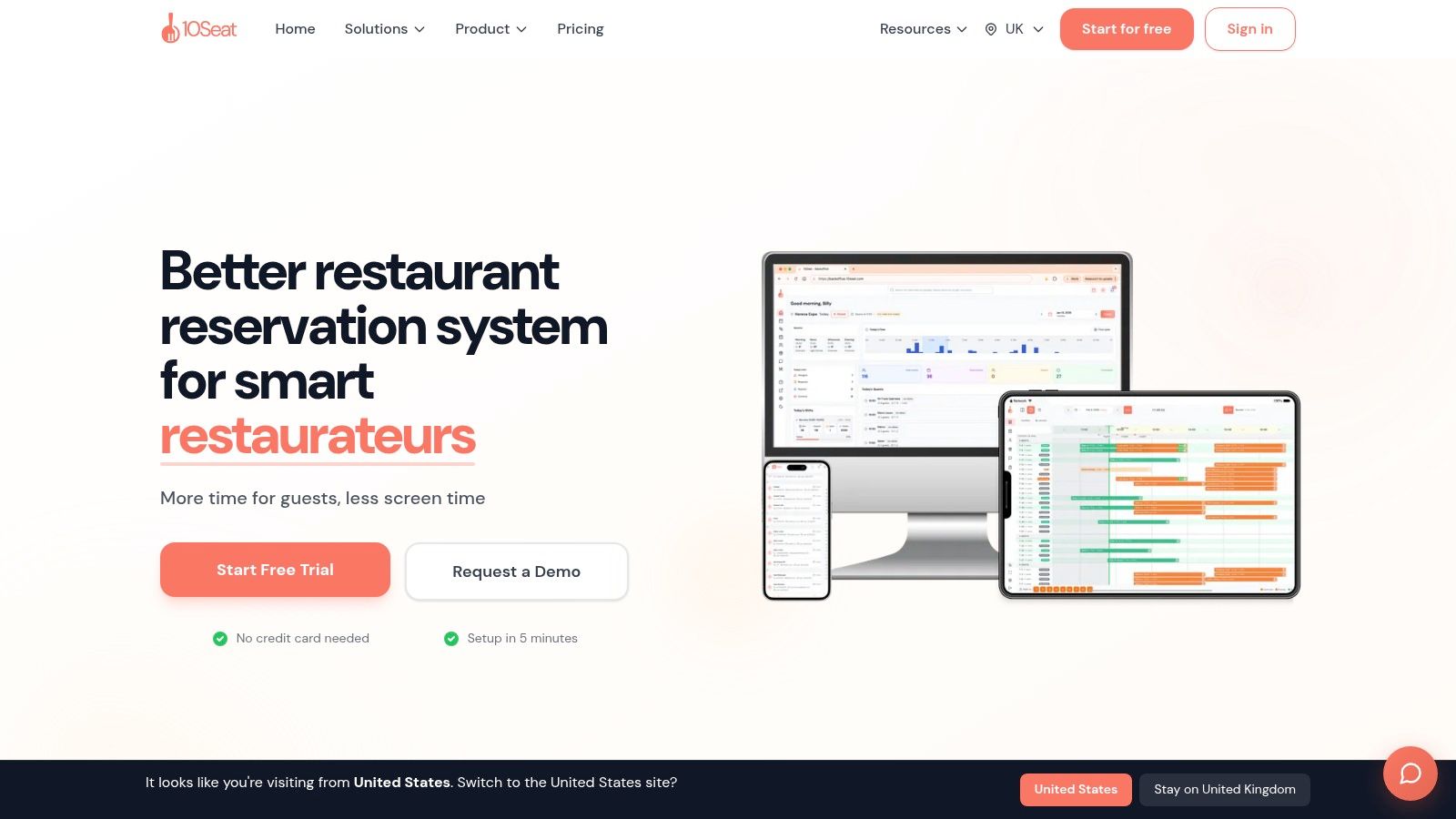
10seat offers an On the House plan up to 50 covers with no credit card required to begin, according to the publisher's product information. For an independent operator, the important test is operational rather than cosmetic: can the system show current inventory, support the chosen guarantees, and help the team make faster seating decisions?
A manager should also compare pricing structures when assessing reservation software. TheFork, OpenTable, Zenchef, Formitable, and 10seat use different commercial approaches, so the restaurant should compare subscription costs, commissions, booking sources, guest ownership, and the effect on direct reservations.
Choosing the Right Reservation Mix for Your Venue
The right mix starts with format, then adjusts for demand and risk. A fine-dining restaurant needs timed reservations, firm pacing, and stronger guarantees for scarce services. A brasserie can combine advance bookings with controlled walk-ins. A bistro may keep more open seating, while a brunch venue benefits from same-day availability and a practical waitlist.
The decision should also account for party size and lead time. A two-top arriving soon creates a different risk from a large party booking far ahead. A guaranteed reservation protects the latter, but a low-friction confirmation may work better for the former when the service isn't full.
Use this venue framework
| Venue type | Primary reservation approach | Protection to consider | Flexible capacity |
|---|---|---|---|
| Fine dining | Timed, guaranteed bookings | Deposit, card guarantee, or prepayment | Limited, released deliberately |
| Brasserie | Timed reservations plus walk-ins | Confirmation and targeted guarantees | Moderate |
| Bistro | Advance bookings plus open seating | Light policy during quiet periods | High |
| Brunch venue | Same-day reservations and waitlist | Reminder and easy cancellation | High, adjusted by daypart |
| Bar or lounge | Call-ahead and timed seating | Confirmation for scarce tables | Moderate |
| Chef counter or event | Ticketed or prepaid booking | Clear transfer and cancellation rules | Low |
The policy should become stricter as scarcity rises, not as a matter of habit. High-demand nights, large parties, long tasting menus, and limited-seat events justify stronger commitment. Quieter periods should remain easy to book so the restaurant doesn't turn away useful demand.
Reminders and cancellation links deserve as much attention as fees. The reported experiment showed that guests understood clearly stated notice periods and lower fees more readily than complex or severe conditions. A direct message, an obvious cancellation route, and a waitlist can recover capacity without making every guest feel distrusted.
Keep Belgian operations connected
Belgian restaurant operators also need to consider GKS, or Geregistreerd Kassasysteem, compliance. Reservation software doesn't replace the obligations of a compliant cash-register setup. The reservation record, actual arrival, consumed service, and recorded sale should support accurate operational and financial reconciliation, with the cash-register system handled according to the restaurant's applicable Belgian requirements.
The manager should review the system with the accountant or compliance adviser before relying on it for fiscal records. Reservation data can explain expected covers and missed arrivals, while the GKS records the relevant sales activity. Those systems serve different purposes and should not be treated as interchangeable.
Review the mix after service
A weekly review should compare booking conversion, cancellation lead time, no-shows, recovered covers, walk-in wait time, table duration, and seating pace. These metrics show whether the mix is filling real seats or just creating a busy-looking calendar.
A practical adjustment might be to release more two-tops for walk-ins, tighten guarantees for large parties, or open a waitlist earlier on high-demand nights. The manager should change one operating rule at a time, then compare the result across similar services.
The objective is simple: protect scarce capacity, preserve useful flexibility, and make the floor easier for staff to run. The best types of restaurant reservation are the ones that match the venue's service style and help the team turn available tables into seated guests.
10seat combines timed bookings, walk-ins, waitlists, and live table management in one commission-free platform for independent restaurants in Benelux. Visit 10Seat to assess the reservation mix, floor controls, and direct booking setup that fit the next service.