Restaurant Yield Management: The Operator's Playbook
Restaurant yield management explained for owners and GMs. Learn pacing, table optimization, no-show control, and how to add 10-15% more covers per shift.
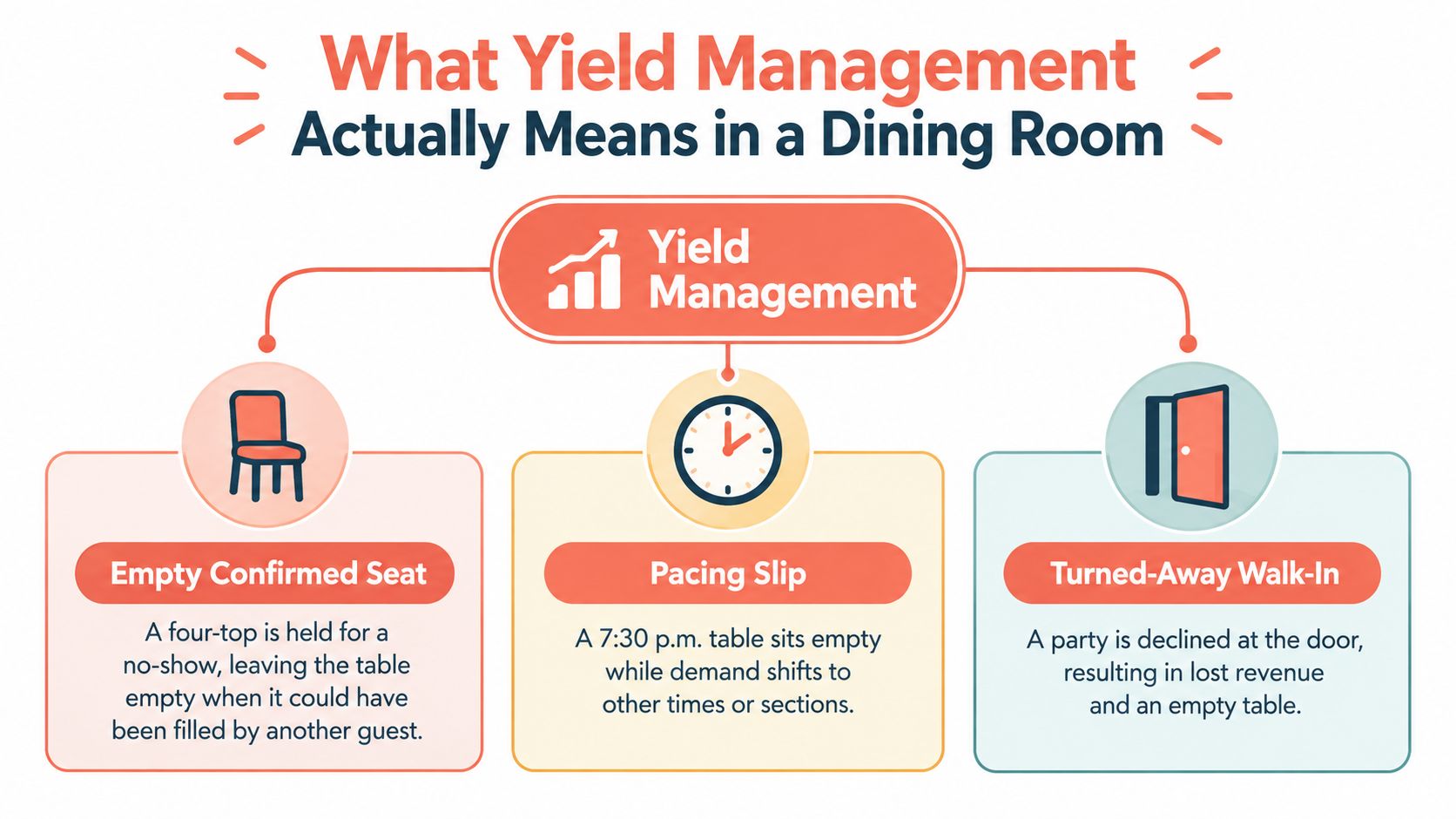
Friday service is full before the first bottle is opened. A four-top is held for a reservation that may not arrive, two two-tops remain unused because the floor plan was never adjusted, and a walk-in party is turned away while the kitchen waits for the next wave. At 7:30 p.m., the empty table is no longer an opportunity. Its selling window is disappearing.
That's the operating problem behind restaurant yield management. The answer isn't automatically higher menu prices. It's better control of tables, arrival times, party sizes, dining duration, and walk-ins, so the room serves more valuable covers without losing the rhythm that makes good hospitality possible.
Table of Contents
- What Yield Management Actually Means in a Dining Room
- The Four Levers That Move Covers and Revenue
- No-Shows and the Cost of an Empty Confirmed Seat
- Pacing, Table Optimization, and the Walk-In Squeeze
- Choosing the Right Tool and a 30-Day Rollout
- The Operator's Yield Checklist for Monday Morning
What Yield Management Actually Means in a Dining Room
A 60-seat restaurant does not sell 60 interchangeable units. It sells a table, in a particular configuration, during a limited service window. A four-top at 7:30 p.m. has a different operating value from a two-top at 5:45 p.m., depending on demand, party mix, kitchen throughput, and expected dining duration.
Restaurant yield management means assigning that perishable capacity to the party and time slot that produce the strongest practical return. The target is more covers and better room use without changing menu prices. That requires decisions about the floor plan, arrival flow, table combinations, meal duration, and walk-in handling.
Research identifies table-mix and dining-duration management as foundational parts of restaurant revenue management. The scarce resource is not an empty seat. It is a usable table configuration during a service window. The Cornell research on restaurant revenue management explains that distinction.
The idea comes from airline and hotel revenue management, where inventory expires after a departure or night passes. A restaurant faces the same time limit, but its controls are physical and immediate. A table can be recombined, held, released, or offered to a walk-in while the service is already running.
Four decisions shape the yield
- Pacing controls how quickly reservations arrive, reducing demand spikes for the kitchen and floor.
- Dynamic seating assigns each party to a table and arrival window that preserve useful capacity.
- Capacity optimization adjusts table combinations and splits to match expected demand. This guide to capacity management in restaurants provides a practical frame for treating the room, kitchen, and booking book as one system.
- Demand-based pricing changes the offer through minimum spends, set menus, off-peak discounts, or peak surcharges.
The first three decisions usually come before pricing. Reworking table use can raise covers while protecting guest trust. Pricing may improve revenue per cover, but it can also weaken demand or make the experience feel inconsistent. Operators comparing hospitality capacity controls can also review why yield management matters.
Practical rule: At 7:00 p.m., ask whether the table can still become an actual cover before service ends, not whether the booking screen shows it as occupied.
For Belgian operators, yield management and GKS compliance remain separate tasks. Yield decisions concern tables, timing, party size, and service capacity. Fiscal data concerns recorded transactions and reporting. A booking or floor-plan system can improve the first without replacing the controls required for the second.
The Four Levers That Move Covers and Revenue
A dining room can be full at 7:00 p.m. and still lose revenue through poor sequencing. If six parties arrive together, the kitchen stalls, servers lose control of their sections, and tables remain unavailable longer than planned. If arrivals are spread too far apart, the room carries idle capacity while later guests wait for space. Yield management is the discipline of controlling these decisions in sequence.
The four levers are pacing, dynamic seating, capacity optimization, and demand-based pricing. Test them in that order. The floor plan and service rhythm usually offer more reliable gains than changing menu prices.
1. Control arrival pacing
Pacing regulates how many covers arrive within each service interval. Set separate limits for the early period, the peak, and the late service rather than applying one daily rule. The correct limits depend on kitchen throughput, section design, menu complexity, and actual meal duration.
A room that releases too many reservations at once creates a queue inside the operation. A room that releases too few leaves seats unused while demand builds later. Review covers arriving per interval, ticket pressure, and table availability after each service. Adjust the release pattern from observed performance, not from another venue's settings.
2. Assign tables to protect the next decision
First-come, first-served seating can feel fair while reducing future options. A two-top may suit an incoming couple, yet using it too early can leave no workable table for a larger party when the room fills. Dynamic seating asks a more useful question: which assignment protects the next decision?
A dining room with many two-tops handles couples well but may struggle with larger groups. Too many large tables create unusable seats when demand concentrates among smaller parties. As noted above, table-mix optimization drives capacity. The operating point is allocation, not construction.
3. Change configurations by service
The room should not use one table logic every day. Combine two-tops when larger parties are expected. Split a six-top when the forecast favors couples and small groups. Keep enough flexibility to accept a walk-in without damaging a confirmed booking or forcing a poor table turn.
| Yield lever | Dining-room action | Primary KPI |
|---|---|---|
| Pacing | Release bookings in controlled arrival intervals | Covers arriving per interval |
| Dynamic seating | Match parties to tables while protecting future flexibility | Covers served and wait time |
| Capacity optimization | Combine or split tables by expected party mix | Usable covers by service window |
| Demand-based pricing | Test minimum spends, set menus, or off-peak offers | Contribution per table and guest response |
The floor plan is often the first commercial lever to test. A better allocation can add covers without changing the menu, provided the kitchen and service sections can support the additional flow.
4. Use price differentiation carefully
Minimum spends, set menus, and off-peak offers can improve contribution per table, but they also change how guests judge fairness. Consumer evidence from a behavioral experiment with 260 U.S. and U.K. participants found that dynamic restaurant pricing made people focus more on price, choose smaller portions, and spend 3% less on average. A separate poll found that 8% of consumers were willing to pay more at popular times, while 32% reported experiencing peak-time price increases at pubs and bars. These findings appear in this consumer reaction analysis of revenue-management solutions.
Use pricing only after pacing and table allocation are working. Operators comparing hospitality pricing models can consult this hotel direct booking guide by Data Hunters for context, then adapt the principle to the dining room. For Belgian operators, these yield decisions remain separate from GKS compliance. Table timing and floor-plan data improve capacity; fiscal records still require their own controls.
No-Shows and the Cost of an Empty Confirmed Seat
A no-show doesn't merely reduce the evening's sales. It blocks capacity that could have been offered to another party, and the lost window often can't be recovered once the service has moved on.
Restaurant reservation research reports observed no-show rates from 3% to 15% in one studied restaurant, describes rates around 20% as not unusual, and records rates reaching 40% on high-demand occasions such as New Year's Eve. More recent evidence cited in academic research indicates that 28% of U.S. restaurant reservations made during one measured year weren't honored. These figures are discussed in the restaurant reservation research review.
The response should be proportionate. A small neighbourhood restaurant may rely on confirmation messages and a clear cancellation window. A high-demand dining room may add card details, deposits, or selective overbooking for predictable no-show segments and service periods.
Four controls reduce different risks
| Control | What it controls | Main risk |
|---|---|---|
| Confirmation cadence | Whether the guest still intends to arrive | Late cancellations |
| Deposit or card hold | Commitment to the booking | Booking friction |
| Selective overbooking | Expected no-shows during constrained periods | Waiting and service failure |
| Rapid re-selling | Recovery of released capacity | Short notice and poor reach |
Payment protection has a measurable effect. In a dataset covering 3.77 million reservations at 2,417 restaurants, bookings with a deposit or other no-show protection had a 0.80% no-show rate, compared with 2.47% for bookings without a payment requirement. That's a reduction of roughly 68% relative to the unprotected rate, as reported by Resos reservation data.
For a restaurant serving 1,000 reserved covers per month, applying those observed rates would mean approximately 8 no-show covers instead of 25, a difference of about 17 covers before average spend. That's the concrete ROI of improving commitment, without raising a menu price.
The trade-off is guest trust. Stricter or more complex cancellation barriers can reduce no-show intentions, but they can also discourage bookings. Deposits often create a cleaner exchange than penalties because the guest sees the money as part of the reservation rather than as a threat attached to cancellation. The policy should be visible before confirmation, easy to understand, and applied consistently.
Selective overbooking is an operating instrument, not a moral position. It can protect against predictable no-shows, but aggressive use can create queues, walk-outs, complaints, and review damage. The guide to reducing restaurant no-shows provides a practical starting point for matching the control to the venue's demand pattern.
A short explanation of the policy also matters. Research on cancellation-policy design identifies a tension between reducing no-show intentions and discouraging bookings, so the operator must measure both outcomes rather than celebrating a lower no-show rate in isolation.
Pacing, Table Optimization, and the Walk-In Squeeze
The booking book creates the plan, but the host stand decides whether the plan survives service. A restaurant can accept a sensible mix of reservations and still lose yield if the team releases every table at once, assigns parties without protecting future combinations, or handles walk-ins by whoever speaks first.
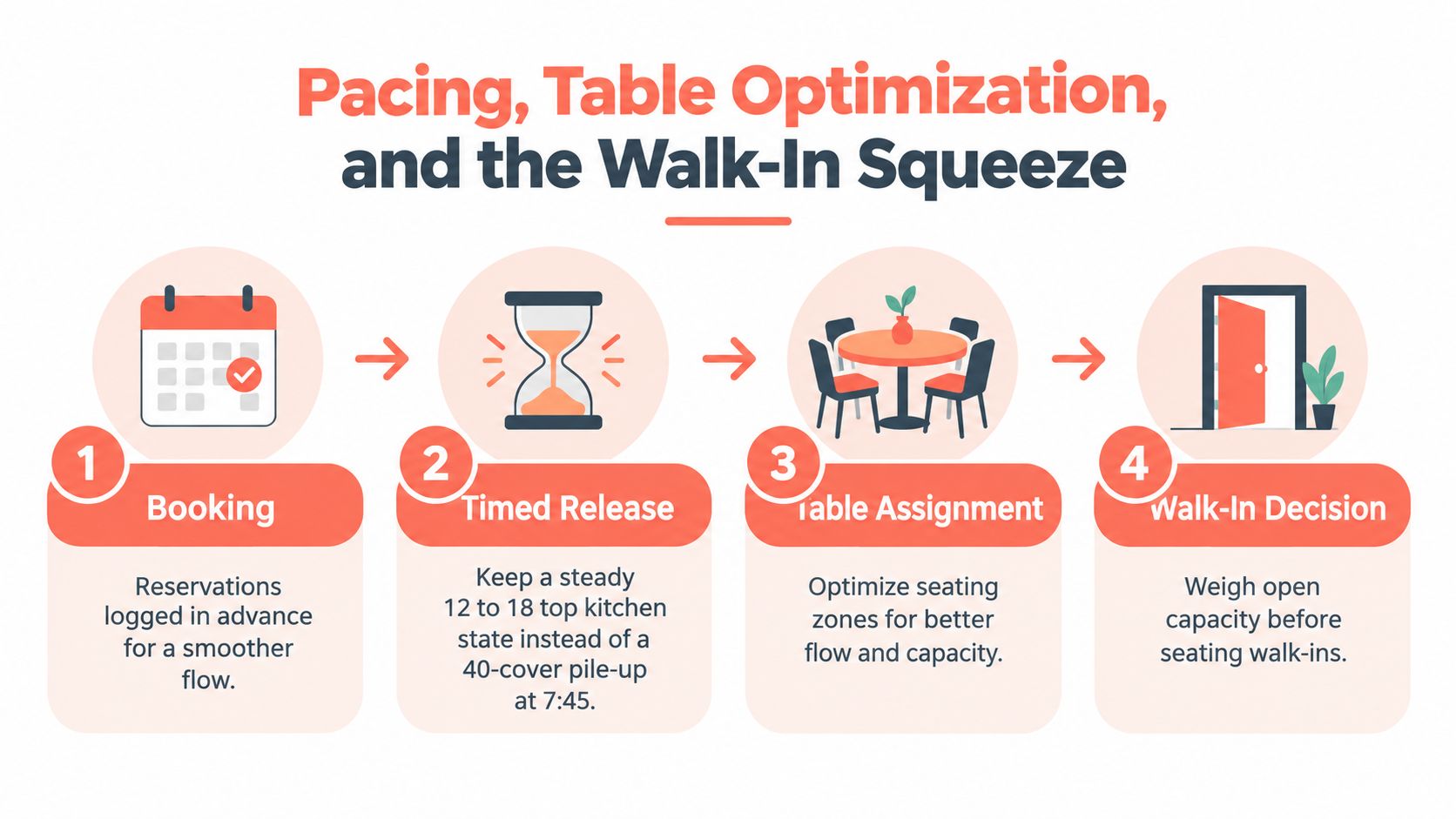
Consider a room that needs a steady 12 to 18 top kitchen state, but receives a 40-cover pile-up at 7:45. The problem isn't only kitchen speed. It's the timing of the demand released onto the floor. The host, manager, and kitchen need a shared view of which tables are expected, which tables are ready, and which configurations must remain available.
Build flexibility into the table map
Table optimization is a daily decision. Two-tops may be combined for a four-top when larger parties dominate the forecast. A six-top may be split into four and two when the service contains more small bookings. The preferred configuration is the one that serves the current party without closing off the next useful option.
Walk-ins create the sharpest test. If three parties arrive while the room is committed, the host must decide who can fit, which table can be released safely, and who receives an honest wait estimate. A vague “it shouldn't be too long” damages trust when the table remains occupied longer than expected. A specific wait gives the guest a decision.
Dynamic seating has measurable value when the room is loaded. An MIT optimization study found revenue improvements over standard first-come, first-served seating of 0.11% to 2.22% at low load factors, 0.16% to 2.96% at medium load, and 7.65% to 13.13% at high load, without increasing, and sometimes reducing, waiting times. The MIT restaurant revenue-management study links the result to selective capacity allocation.
The pattern matters more than the smallest percentage. When the dining room is quiet, there are several workable assignments. When it's full, one poor assignment can fragment the remaining capacity and block a larger party or later reservation. That's why seating discipline matters most when the team feels too busy to think.
Make the walk-in decision explicit
A useful live rule should answer four questions:
- Which tables are available, not merely clean or technically empty?
- Which reservations are close enough to protect, based on arrival time and confirmation status?
- Which party size fits without breaking the next table combination?
- What wait can the team quote accurately, given current dwell time and kitchen load?
An analysis using real Atlanta restaurant data found an optimized reservation model improved revenue by 3.5% under low demand and 7.3% under high demand, according to the same MIT source. The lesson is operational: dynamic seating isn't about making the guest feel processed. It's about making each assignment with the next assignment in mind.
Table-management software can support that discipline, but software won't rescue an undefined floor plan. The manager still needs to decide which combinations are allowed, how long a table should be protected, and when the restaurant should stop accepting additional demand.
Choosing the Right Tool and a 30-Day Rollout
The reservation platform should reflect the operating policy, not dictate it. Before selecting a tool, the general manager should identify whether the main leak is no-shows, poor pacing, weak table combinations, or walk-in confusion. A platform that only records bookings won't solve a floor-plan problem.
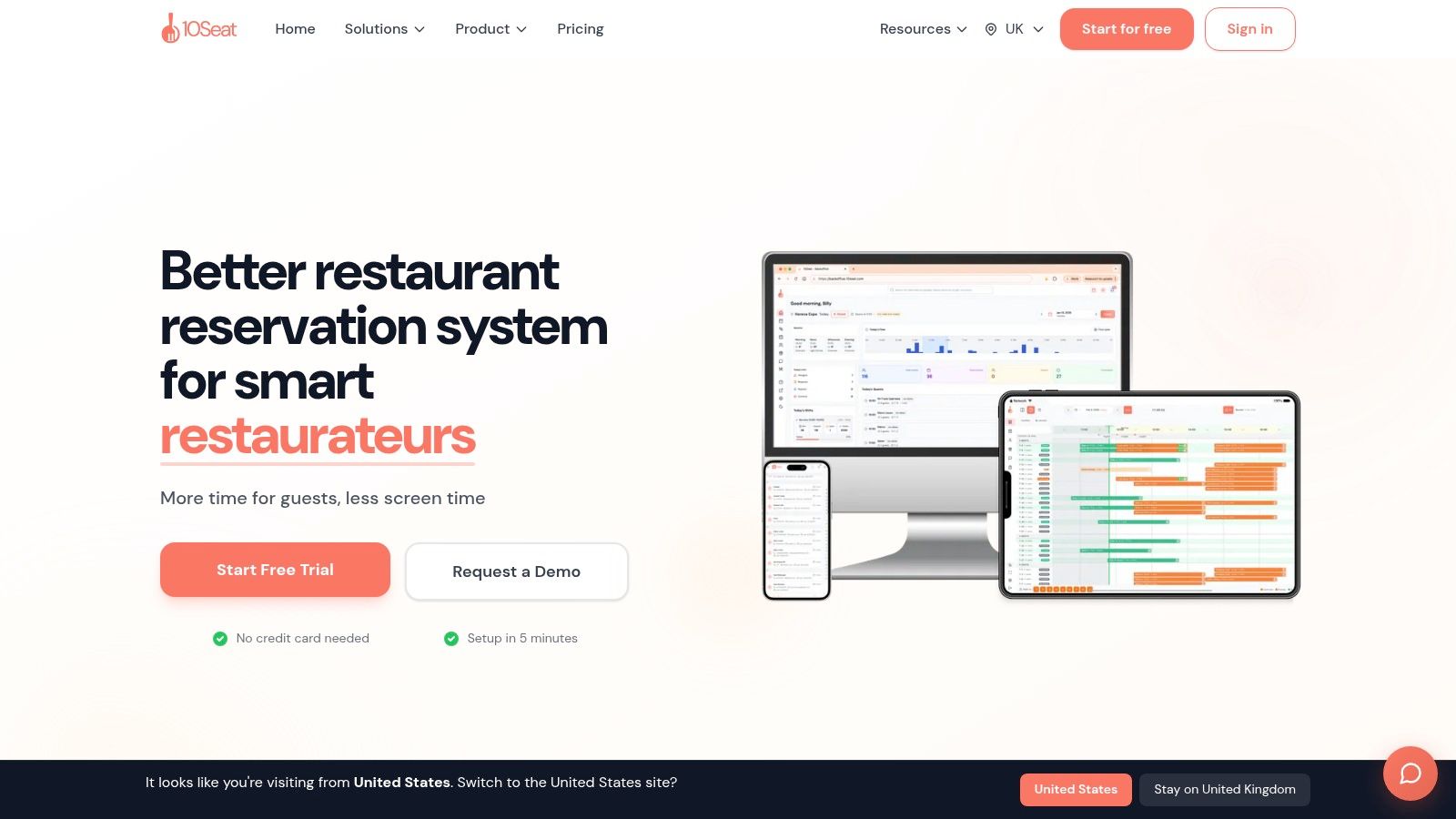
10seat is positioned as a commission-free reservation-management option for independent restaurants in the Benelux, with a Capacity Engine, Smart Auto Seating, Auto Seating Puzzle, and Walk-in Squeeze. The practical comparison with TheFork, OpenTable, Zenchef, and Formitable is primarily the pricing model. Those platforms may charge per cover or per month, while 10seat uses a commission-free approach. The right decision depends on the venue's booking sources, workflow, and willingness to pay for distribution or operational control.
The rollout should be gradual enough to expose bad assumptions before they affect a full service.
Week one establishes the baseline
Record covers served, no-show rate, average check, table-turn minutes, and dwell time. Split the results by service window and party size where the booking data allows it. A single nightly average can mask an underlying problem, such as late bookings arriving in clusters or large tables running long during peak service.
The floor plan also needs a working map. Mark which tables can combine, which can split, which should remain protected for larger parties, and which can accept a walk-in without disturbing confirmed bookings.
Week two changes the controls
Enable a confirmation policy and apply a deposit to larger parties or other segments that create meaningful capacity risk. Set pacing intervals by service window, then activate Smart Auto Seating so assignments follow the table rules rather than host-stand reflexes.
The team should know what the system is allowed to do and when a manager can override it. Every override should have a reason, such as a guest accessibility need, a service recovery, or a kitchen constraint.
Week three tests the walk-in process
Run an A/B comparison. One host follows the old seating order, while another uses Walk-in Squeeze rules that account for open capacity, protected reservations, table combinations, and expected dwell time. The test should compare covers served, quoted wait accuracy, walk-in conversion, and complaints, not only revenue.
Week four locks in what works
Read the numbers by service window. Keep the rules that improve capacity without harming wait times or hospitality, and remove rules that create friction without producing useful covers. The MIT evidence indicates that dynamic seating performs especially strongly under high load, but the local floor plan determines which constraints matter most.
Keep GKS separate from yield logic
Belgian operators must treat reservation operations and fiscal compliance as related but separate systems. A registered cash system, or GKS, is required when annual restaurant and catering turnover exceeds €25,000 excluding VAT and drinks, according to the official Belgian GKS guidance.
A compliant GKS has three components: the cash-register system, the Fiscal Data Module, or FDM, and the VAT Signing Card, or VSC. The cash-register system and FDM require certification, and the operator must complete the required registration and component-linking steps.
Reservation data can improve table decisions, but it doesn't replace certified fiscal infrastructure. Keep booking status, seating data, and guest communication operationally distinct from the records used for compliant sales recording.
The Operator's Yield Checklist for Monday Morning
Yield management becomes useful when it turns into a repeatable Monday routine rather than a project that disappears after a busy weekend. The manager should review the upcoming service before the first reservation arrives, when table combinations and pacing rules can still be changed without pressure.
Forecast the demand shape
Use the last four weeks of covers to forecast tomorrow by party size and service window. The purpose isn't to create a perfect prediction. It's to identify whether the busiest period is likely to favor couples, larger parties, early dining, late dining, or a mixed flow.
Then set the table mix for the day. Combine two-tops when larger parties are expected, split larger tables when smaller parties dominate, and protect the configurations that are hardest to recreate once the room fills.
Release and seat with intent
Pace bookings so the arrival rate matches kitchen capacity, not the order in which reservations happened to enter the system. During service, use Smart Auto Seating and Walk-in Squeeze rules instead of assigning the next party to the first apparently empty table.
The host should be able to explain every wait. A specific estimate based on current table status and expected dwell time is better hospitality than an optimistic answer that the floor can't support.
Review four numbers every week
| KPI | What it reveals |
|---|---|
| Covers served | Whether available capacity became actual business |
| No-show rate | Whether booking protection and confirmations work |
| Average check | Whether the added covers contribute properly |
| Table-turn minutes | Whether pacing and dwell assumptions match reality |
10seat is designed to help operators target 10% to 15% more covers per busy shift without adding tables or headcount, as stated in the platform overview. For a 60-cover brasserie doing 200 covers a night, that translates to 20 to 30 extra covers per shift at the existing average check. The 10seat pricing page gives operators a way to review the plan options, including a free On the House tier up to 50 covers without a credit card.
The calculation should still be tested against labor, kitchen throughput, average check, guest feedback, and service quality. More covers aren't automatically better if the restaurant can't deliver them consistently.
Restaurant yield management is a Monday-morning discipline. It lives in the table map, the booking rules, the pacing screen, and the host's decision when a walk-in reaches the door.
10seat provides commission-free reservation management with capacity planning, Smart Auto Seating, Auto Seating Puzzle, and Walk-in Squeeze for independent restaurants in the Benelux. Visit 10Seat to see how the platform can help turn existing tables and service windows into more deliberate, profitable covers.