Rules for Restaurant: Legal, Operational and Guest Rules
Rules for Restaurant explained: health and licensing law, staff conduct, reservations, cancellations and guest house rules, with enforcement tips.
The kitchen is ready, the phone keeps ringing, and a late party wants its table held while walk-ins wait at the door. Meanwhile, the host is explaining a cancellation charge that the guest says wasn't clear. None of these problems starts with a lack of effort. They start when the team doesn't know which rules are compulsory, which are house policy, and who can make an exception.
Good rules for restaurant operations protect guests without making service harder than necessary. The useful distinction is simple: legal rules set the boundaries, while operational and guest policies determine how well the restaurant works within them.
Table of Contents
- The Four Types of Restaurant Rules
- Legal and Health Rules Every Restaurant Must Follow
- Belgian GKS Cash Register Rules for Restaurants
- Kitchen and Staff Conduct Rules That Keep Service Safe
- Reservation, Seating and Cancellation Rules That Work
- House Rules for Guests and How to Enforce Them Fairly
- Table Allocation and Pacing Rules That Protect Revenue
- Confirm Your Rules Before Next Service
The Four Types of Restaurant Rules
A restaurant rule is any requirement the business must follow or any policy the team must enforce. The practical framework has four types, with legal obligations split into health and tax rows because different authorities oversee them.
Restaurant rule types at a glance
| Rule type | Typical examples | Who sets it | How often to review |
|---|---|---|---|
| Legal and health | Food safety, manager certification, illness exclusion, licensing | Health authority and licensing office | At each renewal and after every inspection |
| Tax and cash register | Registered cash register and receipts where the threshold applies | Tax authority | Yearly turnover check for each location |
| Kitchen and staff conduct | Allergen procedure, handwashing, uniforms, shift handover | Owner or head chef | Monthly and after every incident |
| Front-of-house policy | Booking window, deposits, cancellation terms, pacing | Owner or general manager | Weekly during peak season |
| Guest house rules | Dress code, children, phones, pets, smoking | Owner or general manager | Quarterly |
The first two rows come from outside authorities and change across countries, regions and municipalities. Owners translate those obligations into kitchen procedures, while front-of-house and guest policies are largely management choices. Those choices still have to respect consumer protection, accessibility and other applicable law.
Separate the requirement from the method
The law may require safe food handling. The head chef decides how station checks, labels and handovers make that happen during service. Likewise, the tax authority determines fiscal obligations, but the manager assigns responsibility for checking receipts and keeping records.
That distinction prevents a common mistake: treating every old habit as untouchable. A compulsory safety control can't be waived because service is busy. A rule that prevents smaller parties from using an otherwise empty table can be reconsidered.
Practical rule: Every written policy should identify whether it's a legal obligation, a safety procedure or a commercial choice.
Legal rules are the foundation, staff procedures are the structure, and guest rules are the finish. An attractive finish won't compensate for weak foundations, but unnecessary restrictions can still make a sound restaurant unpleasant to visit.
Make the same answer available everywhere
A booking taken by phone shouldn't come with different conditions from one taken online. The host needs approved wording for deposits, late arrivals, allergies and requests that require manager approval.
For restaurants reviewing how telephone enquiries become confirmed bookings, Recepta.ai's resource to explore hospitality call handling provides useful context for that workflow. The operational priority remains consistent information, regardless of who answers.
A quick audit starts with a separate sheet for each rule type. The manager lists existing policies, marks missing instructions and assigns an owner to every unresolved decision.
Legal and Health Rules Every Restaurant Must Follow
In 2017, restaurants were associated with 489 foodborne-illness outbreaks at single food-preparation locations, representing 64% of such outbreaks, according to the FDA Food Code supporting document. That document also reports CDC analysis of norovirus outbreaks from 2009–2014, with rates of 0.38 versus 0.75 outbreaks per million person-years in jurisdictions with versus without certified food-protection-manager requirements.
These are associations, not a promise that a particular policy prevents every incident. They explain why staff health, qualified supervision and contamination controls deserve attention before decorative compliance paperwork.
The FDA Food Code is a model framework, not automatically federal law. State, territorial, tribal and local authorities adopt and enforce their own versions.
Build the premises checklist
The manager should verify the following against the requirements enforced at the restaurant's address:
- Licence or permit: Keep the appropriate permission valid for each premises and its actual activities. A change in the operation may require a licensing review.
- Qualified supervision: Confirm whether a certified food-protection manager must be on site, and when. The rota must reflect the local requirement rather than assuming a certificate in a folder is enough.
- Employee illness: Maintain a written reporting and exclusion policy covering vomiting, diarrhoea and other locally specified conditions. Staff need to know whom to contact before arriving for work.
- Handwashing: Keep designated stations accessible, stocked and separate from food-preparation tasks. A sink blocked by trays isn't an effective control.
- Temperature control: Record the locally required limits for cooking, cooling, reheating and cold holding beside the relevant equipment. Include the corrective action when a reading fails.
- Approved suppliers: Keep purchasing and traceability information accessible so ingredients can be identified when a problem arises.
- Inspection records: Retain reports and evidence of corrective action on site or in an immediately accessible system.
The following checklist summarises the distinction between the model framework and locally enforced requirements.
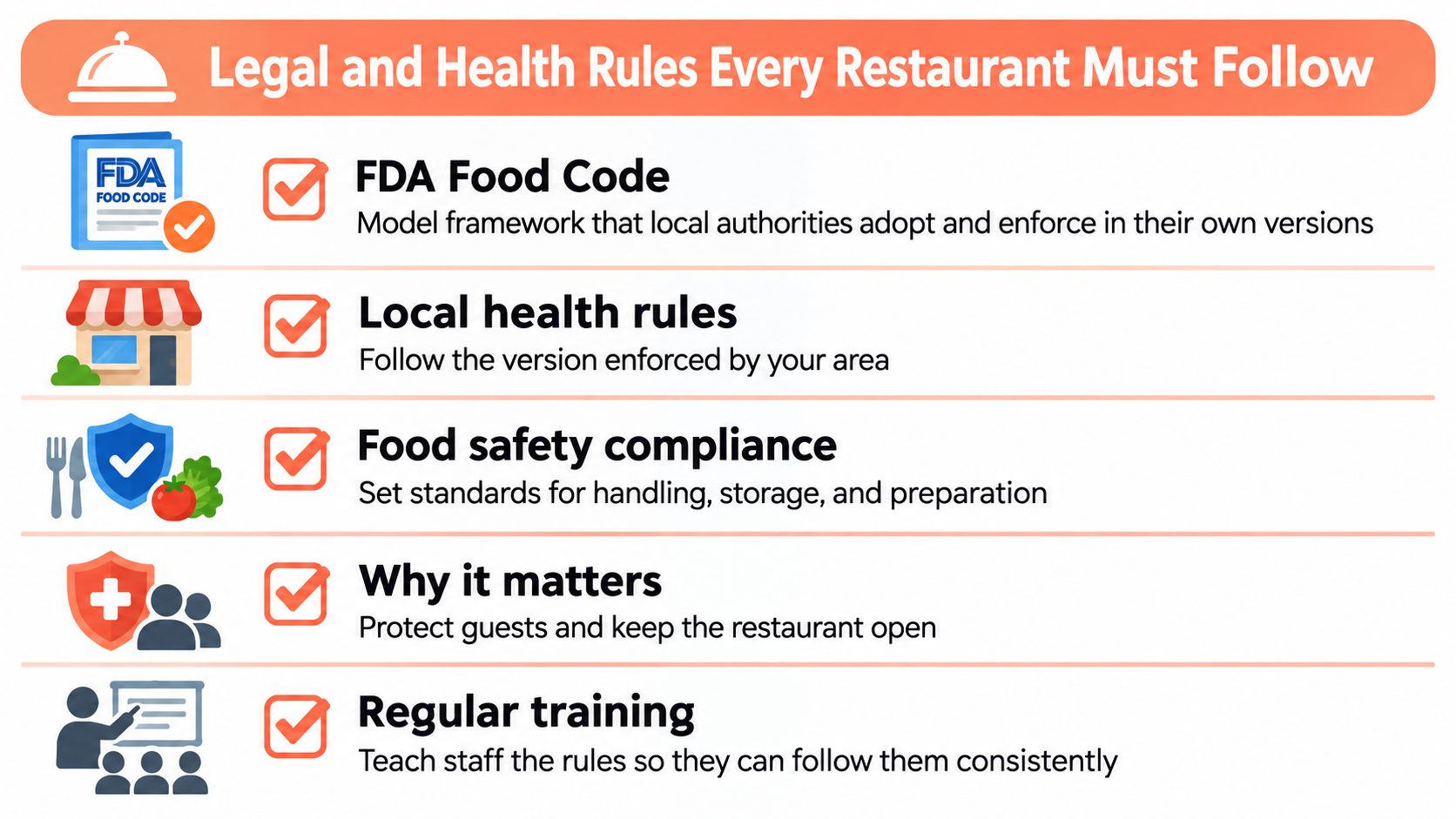
Use the right jurisdiction
The FDA's 2025 adoption report states that 62 of 64 state agencies had adopted regulations based on some version of the Food Code, but only 18 agencies across 14 states had adopted the latest 2022 edition. A restaurant group therefore needs a location-specific rule register, not a single assumption that every site follows identical requirements.
For Belgian and Dutch restaurants, the US framework is a reference point, not local law. Operational checklists must reflect requirements from FAVV/AFSCA in Belgium, NVWA in the Netherlands, and the relevant local municipal inspectors.
The restaurant's HACCP food-safety procedures should connect hazards, controls, monitoring and corrective actions. AnchOps' guide to employee policies for restaurant teams can help organise the staff-facing instructions around those controls.
For inspection readiness, the manager should keep the licence, applicable manager certificate and temperature log together. Where local certification requirements differ, the file should contain the corresponding evidence of required competence.
Belgian GKS Cash Register Rules for Restaurants
Belgian restaurant and catering businesses generally enter the GKS obligation when annual qualifying turnover exceeds €25,000, excluding VAT and drinks, assessed separately for each establishment, according to the European Labour Authority's Belgian cash-register guidance. GKS stands for Geregistreerd Kassasysteem, the registered cash register system.
Calculate the position by establishment
- Add restaurant and catering service sales for the financial year at each establishment separately.
- Remove VAT from the calculation.
- Exclude drinks when assessing qualifying turnover.
- Compare the resulting amount with the threshold.
- Where the obligation applies, issue the required receipts through the registered system, including meals and drinks served with those meals.
Drinks create an important distinction: they're excluded from the threshold calculation, but that doesn't mean accompanying drink sales fall outside the receipt obligation once the establishment is covered.
Keep fiscal records separate from bookings
A compliant registered system includes a certified till component and certified fiscal data module, commonly called the black box, as described in the Belgian fiscal requirements overview. A reservation confirmation or ordinary payment record isn't a substitute for the required fiscal receipt.
A group VAT number doesn't remove the need to assess each establishment. The same review can be relevant to cafés, bakeries with seating, company restaurants, mobile food operations and hospitality outlets within other venues when they provide restaurant or catering services.
Reservation and table-management software should remain separate from fiscal receipt processing unless a specific integration preserves the required records. The accountant and manager should document which sales enter the calculation, retain the supporting ledger and review the position annually.
The useful output isn't merely a yes-or-no answer. It's a calculation that an inspector can follow without reconstructing the business's accounts.
Kitchen and Staff Conduct Rules That Keep Service Safe
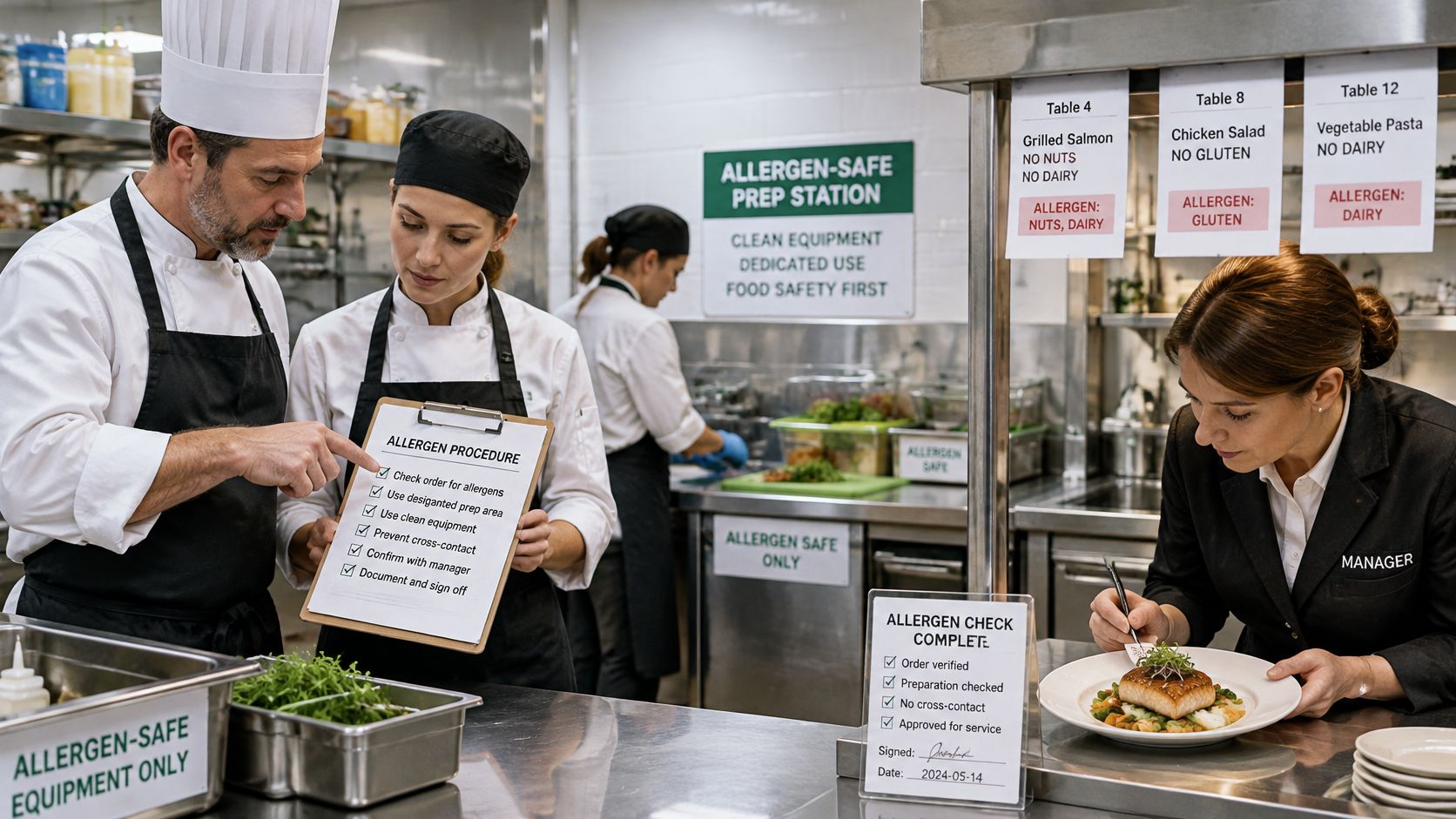
The most important kitchen rule to make explicit is the allergen procedure. The host records the guest's information, the server flags the order, the kitchen confirms whether it can prepare the dish safely, and a named person authorises the plate before it leaves the pass.
Nobody should infer that removing a garnish makes a dish suitable. The procedure must address ingredients, substitutions, utensils, preparation surfaces and the risk of cross-contact.
Set the shift up correctly
Before service, each station needs a short instruction sheet covering its own tasks rather than a general handbook left in the office. Labels, probes, cleaning materials and the current allergen information must be available where staff use them.
- Opening checks: Check refrigeration and relevant holding equipment, record readings and act on failures before food enters service.
- Personal hygiene: Wash hands at designated stations before food handling, after breaks and whenever tasks create contamination risk. Replace soiled uniforms or aprons.
- Pass discipline: Keep personal phones away from the pass. Any essential operational device needs a defined handling and cleaning procedure.
- Briefing: Use a five-minute pre-service briefing to confirm unavailable dishes, allergy bookings, equipment faults and changes to preparation.
The briefing is a recommended operating routine, not a substitute for training. A new starter needs supervised practice and a short training record during the first week, including confirmation that the person can demonstrate the task.
Clear preparation and documentation help the kitchen handle special requests without relying on memory.
Close the loop during handover
The outgoing shift should hand over 86'd items, allergy bookings still to arrive, unresolved equipment faults and corrective actions. A verbal mention across a noisy kitchen isn't reliable enough for information that changes what can be served.
Temperature logs need checks at opening and before close, alongside any additional monitoring required by the food-safety plan. Closing checks must include what happened to food affected by an equipment problem, not only whether somebody signed the sheet.
A rule is usable only when a new starter can follow it on the first busy Friday without guessing.
Illness, injury, spills and complaints should enter an incident log the same day, with the action taken and the person responsible for follow-up. Sensitive staff and guest information should be restricted to those who need it.
If trained staffing falls below the level needed to run an allergen workflow safely, the manager should reduce availability or simplify the menu. Accepting another booking isn't a sensible trade when the team can't deliver the promised service safely.
Reservation, Seating and Cancellation Rules That Work
Typical reservation deposit and cancellation rules
The following is a sample policy framework, not a statement of universal market practice. Except for the labelled Chicago examples, the timings are proposed settings for an operator to test against its service model and local consumer rules.
| Booking type | Deposit example | Cancellation window | Practical note |
|---|---|---|---|
| Standard table, weeknight | None or card hold | Suggested 2 to 24 hours | Suggested table hold of 10 to 15 minutes after booked time |
| Standard table, weekend peak | $45 per person, Chicago example | Suggested 24 to 48 hours | Charge only under the agreed late-cancellation or no-show terms |
| Tasting menu or chef's table | $150 per person, Chicago example | 24 hours in the reported example | Deposit forfeited if cancelled late or missed |
| Large party, 8 or more | Set per person by written agreement | Suggested 7 days | Confirm menu and numbers in writing |
| Walk-in or waitlist | None | No cancellation deadline | Quote a realistic wait when adding the party |
The $45 standard-table deposit, $150 tasting-menu deposit and forfeiture within 24 hours or for a no-show come from a Chicago restaurant example described in LegalClarity's reservation-form guide. They illustrate a US practice, not an appropriate local price benchmark.
Write the booking timeline
A complete restaurant reservation policy states the booking window, minimum and maximum party size, cancellation deadline, deposit treatment and late-arrival procedure. Special events, tasting menus and large groups need their own clearly identified conditions.
A practical timeline can run as follows:
- At booking: Display the conditions before payment, then send the same terms in the confirmation.
- Before the deadline: Send a reminder, for example 48 hours before arrival, with a direct cancellation or rescheduling route.
- At the cut-off: Make the exact deadline and resulting charge unambiguous.
- On the night: Contact late guests where practical, apply the published hold time and release the table consistently.
- After cancellation or absence: Apply the agreed charge or refund treatment and record any authorised exception.
The following visual shows how booking conditions connect to seating and pacing.
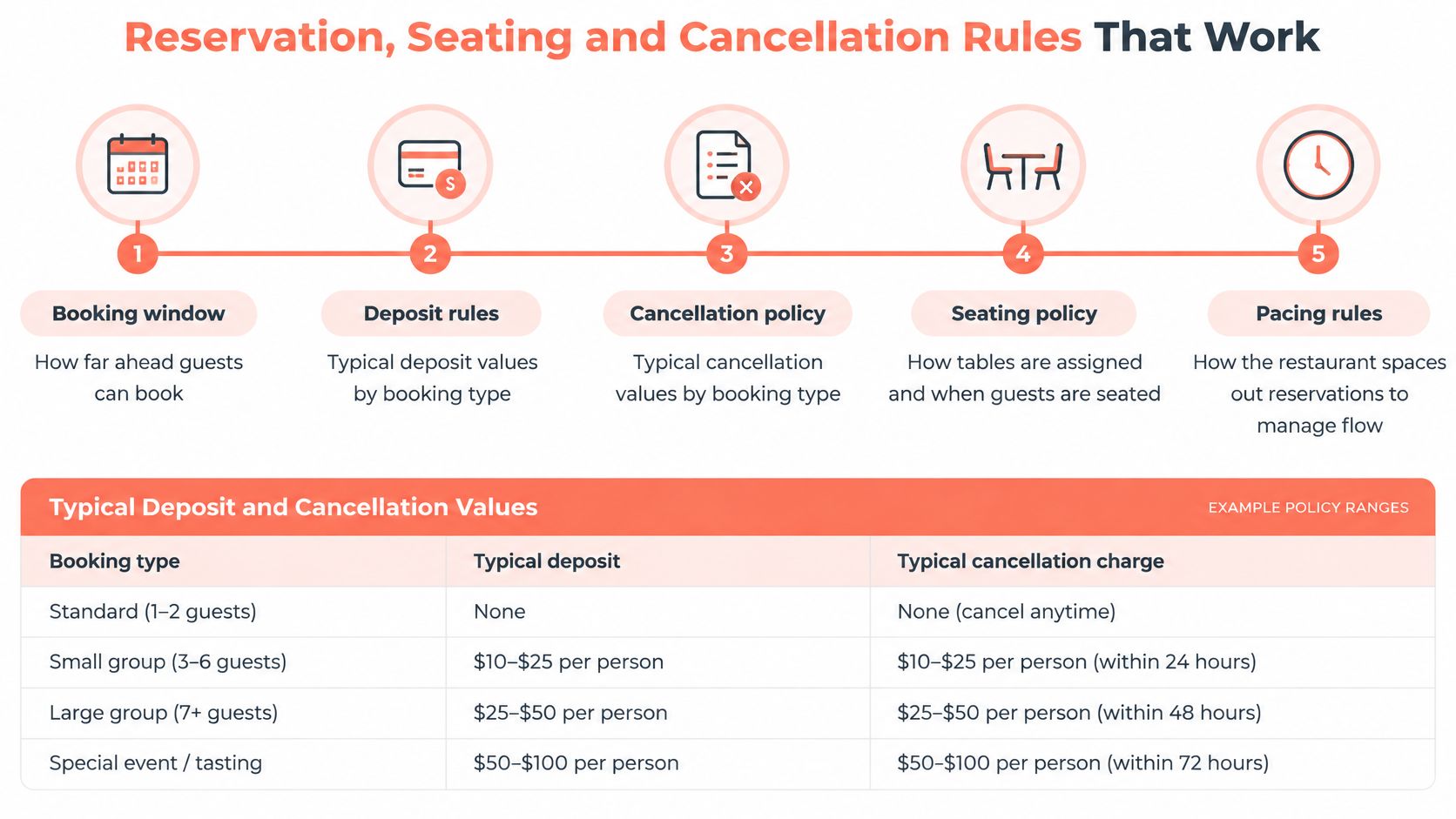
Protect capacity without excluding guests
The condition guests can easily misread is what happens to the deposit. The policy should state whether it reduces the final bill, when it's refundable and precisely when it's forfeited. A card hold also needs a clear explanation of what can be charged.
A proportionate policy protects genuine preparation and capacity risk. It shouldn't make an ordinary meal unnecessarily difficult for guests on lower incomes or those whose circumstances make rescheduling harder.
A no-deposit weekday option and a clear rescheduling route provide alternatives. As a fairness policy, the restaurant shouldn't charge a no-show fee when a disabled guest's circumstances changed for reasons outside that guest's control; agreed accommodations should be recorded appropriately rather than improvised at reception.
Local consumer and accessibility requirements must govern the final wording. For walk-ins and waitlists, staff should quote the expected wait based on live table progress and update it when conditions change, rather than offering an optimistic guess.
House Rules for Guests and How to Enforce Them Fairly
The house rules worth keeping concern dress, children's seating arrangements, pets, noise, payments and shared tables. Not every restaurant needs a rule in every category, and operational convenience alone isn't a strong reason to restrict guests.
A useful test is whether the rule prevents a recurring problem that staff can describe clearly. A vague requirement for appropriate behaviour is harder to enforce fairly than a specific request for headphones when using personal devices.
Keep the public list short
A restaurant might publish the following:
- Dress and seating: State any dress expectations and whether communal seating forms part of the experience.
- Children: Explain suitable seating arrangements and any service-specific timings, subject to applicable law.
- Pets: State the pet policy while recognising that assistance or service animals require separate legal consideration.
- Noise and phones: Ask guests to avoid speakerphone calls and audible device playback.
- Payments: Explain bill-splitting limits and bar-tab procedures before guests incur charges.
Five or six clear rules are a reasonable editorial limit, not a target to fill. The website, booking page and menu should use the same wording.
Smoking restrictions must follow local law. Likewise, a pet ban or payment policy can't override accessibility or consumer obligations.
State the rule, offer an alternative, then decide
The enforcement script should remain calm and factual. For a hypothetical smart-casual restaurant, the host can explain the dress requirement and offer a jacket or a suitable alternative seating arrangement.
For a hypothetical limit of six bill splits, the server should explain the payment options before presenting the bill. That conversation belongs with the floor team, not with the kitchen.
Fair enforcement: Staff should respond to the guest's conduct and agreed needs, not assumptions about appearance, income or background.
Documented disability or medical accommodations allow staff to respond consistently without asking guests to repeat sensitive explanations. Manager approval should be available when a standard rule produces an unreasonable outcome.
A monthly review should count challenges and examine the reason behind them. If a rule creates more conflict than the problem it prevents, the owner should revise or remove it rather than asking staff to defend it more forcefully.
Table Allocation and Pacing Rules That Protect Revenue
A Journal of Operations Management study found that eliminating customer waiting could increase total revenue by nearly 15% under its operating conditions, while simulations of more flexible table allocation indicated potential revenue gains of up to 7.5% within existing capacity. These are study-specific findings, not guaranteed restaurant returns.
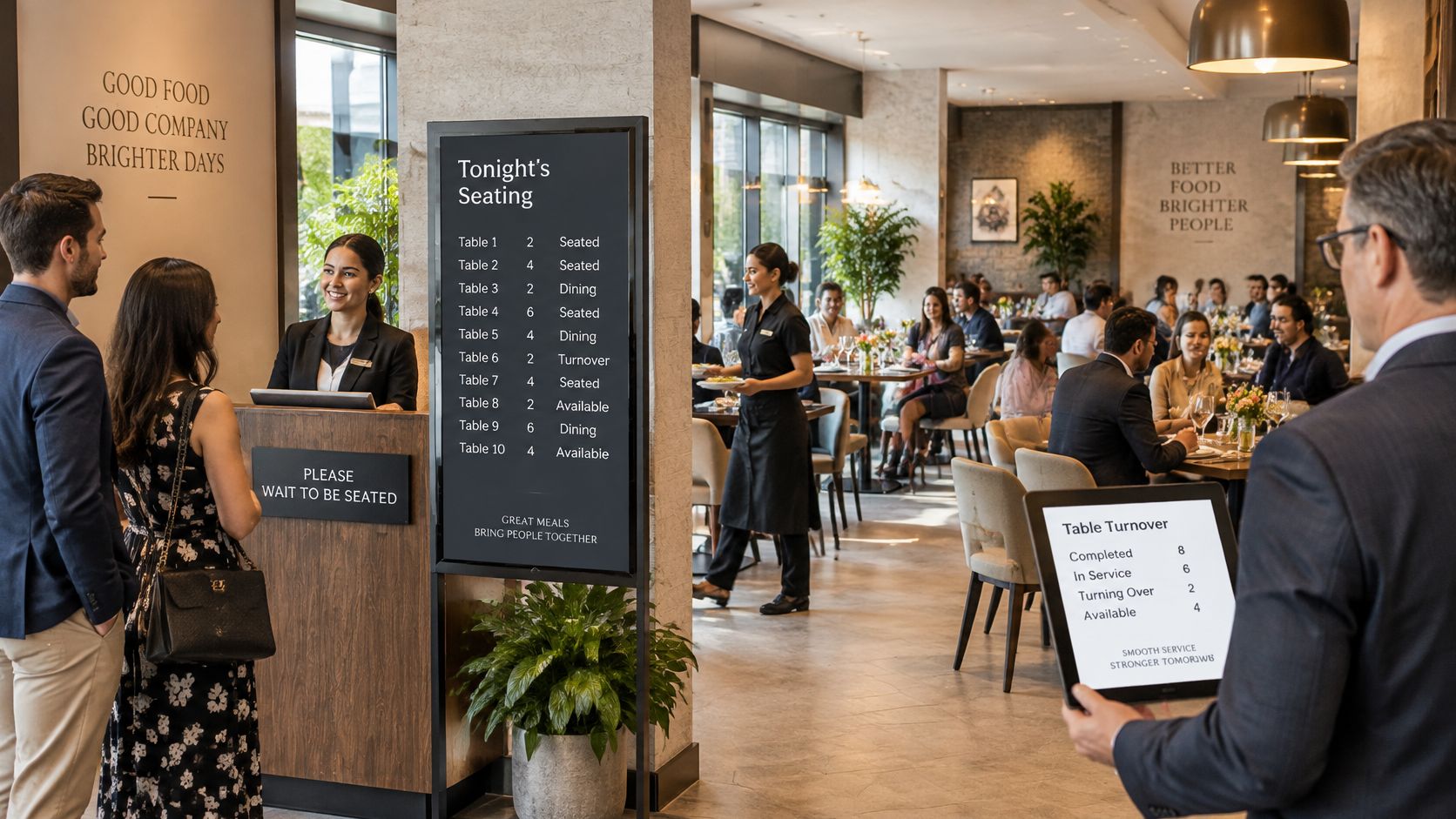
The practical lesson is that first-come, first-served table assignment isn't always the best operating rule. Party size, arrival time, table combinations and expected dining duration all affect which seating decision works.
Live decisions at the entrance need to reflect both the dining room and the kitchen.
Set capacity rules before opening bookings
Effective restaurant seating management starts with constraints the host can apply without repeatedly calling the manager.
- Cap arrivals by time slot. Base the limit on kitchen and bar load, qualified staffing and menu complexity, not on empty chairs.
- Set a service duration for each booking type, including clearing and reset time. Communicate any guest-facing time limit before confirmation.
- Release late tables consistently. The host needs a clear point at which an absent party no longer blocks usable capacity.
- Return unused tables to availability when operational restrictions have cleared. A manager-held table shouldn't remain unavailable because nobody remembers why it was blocked.
- Define walk-in gaps. Identify which short openings can support a complete meal and which must stay protected for arriving reservations.
- Close or restrict a slot when an unavailable key dish prevents delivery of its advertised experience. Losing a tasting-menu course may require a booking stop; losing an optional side usually doesn't.
A workable policy also defines manager overrides. Every exception should have a reason, because repeated overrides often reveal that the underlying rule needs changing.
The following video provides additional context for floor and reservation management.
Measure useful covers, not just accepted bookings
In a hypothetical 60-cover shift, a 10% improvement means six additional covers. That arithmetic provides a test target, not a forecast: the manager still needs to check contribution after food, payment and any additional labour costs.
The comparison should use similar services and record seated covers, waiting, late starts, refusals and guest complaints. A fuller room isn't an improvement if the kitchen falls behind and diners lose the experience they booked.
Restaurants using 10Seat see 30% more reservations, 40% fewer no-shows and 10–15% more covers per shift. Its live table and capacity tools help staff identify usable gaps and apply seating decisions consistently rather than reconstructing the floor from memory.
Those figures shouldn't replace a restaurant's own baseline. The useful commercial question is how many additional guests can be served well with the existing tables and a safely staffed operation.
Confirm Your Rules Before Next Service
Before the next service, make sure each rule has an owner and a clear purpose: legal rules protect compliance and safety; house rules shape the guest experience and the pace of the room.
- Assign ownership. Write each rule in a sentence and name the person responsible for keeping it current.
- Check legal requirements with the relevant food-safety authority, tax office or licensing office. Assess each Belgian establishment's GKS position separately.
- Publish guest-facing conditions. Show deposits, cancellation terms and house rules on the booking page and in confirmation messages before payment.
- Set pacing by time slot, service durations and release instructions so the host can follow the plan during service.
- Schedule reviews. Add renewal checks, incident reviews and seasonal policy reviews to the manager's calendar.
Replace repeated manual checking
Paper books and phone-only reservations leave staff checking availability and exceptions by hand. Automation works best when it applies clear rules consistently. A booking form cannot resolve an unclear policy.
Most restaurants are up and running with 10Seat within 24 hours. Its online reservations, booking policies, deposits and time-slot pacing controls let restaurants apply their chosen rules to availability and service flow. The free plan covers up to 50 covers per month; above that, a paid plan is required to keep taking reservations.
Compare the plan cost with the value of unfilled gaps and missed bookings, while keeping legal compliance separate from software settings. Before the first service, print the rules and review them with the team.
10Seat helps restaurants put booking policies, deposits and capacity controls into practice. Visit 10Seat to see how its reservation and table management tools can support the rules your restaurant has set.