Restaurant Reservation Policy: A Practical Guide
Write a restaurant reservation policy that protects revenue without driving guests away. Covers deposits, cancellation rules, scripts, and training tips.
Friday service is underway. Eighteen guests are booked for 19:30, but three tables are still empty at 20:15. The host has called two parties, the kitchen has already prepped for them, and a queue is forming at the door while the dining room appears full on paper. That gap is where a restaurant reservation policy earns its keep.
A useful policy decides who keeps a booking, how late a table is held, when a cancellation becomes chargeable, and what staff should say when a guest disputes a fee. It also gives every host the same answer, even after turnover, pressure, and a difficult phone call. The strongest policies are living operating documents, linked to capacity, service timing, guest behavior, and Belgian compliance where relevant.
Table of Contents
- Why Your Restaurant Reservation Policy Matters Now
- The Building Blocks of a Restaurant Reservation Policy
- Choosing the Right Enforcement Mechanism
- Communication Scripts That Set Expectations Early
- Enforcement, Pacing, and Belgian Compliance Notes
- Rolling Out the Policy with Your Front-of-House Team
- Common Policy Questions from Operators
Why Your Restaurant Reservation Policy Matters Now
A reservation isn't just a promise to seat someone. It blocks a specific piece of inventory at a specific time, often while the restaurant schedules staff, orders food, allocates sections, and manages kitchen pacing around expected covers.
Historically, this structure is relatively new. A review of dining history explains that restaurant reservations are mainly a 20th-century development, while even high-quality restaurants previously often used first-come seating rather than booked tables. The change reflects a shift toward managing scarce seats and predictable service timing in busy urban markets, as described in this historical review of restaurant reservations.
That history matters operationally. Deposits, cancellation windows, and card guarantees aren't timeless etiquette rules. They're tools created to manage limited capacity, peak demand, and fairness between guests who want the same table.
What the policy controls
A written policy should answer practical questions before the reservation reaches the floor:
- Who keeps the slot: Define the booking holder and the information required to confirm the reservation.
- How late is late: State the exact grace period in minutes, then explain what happens after it expires.
- What a no-show means: Specify whether a booking is a no-show when nobody arrives, when the party is materially incomplete, or when guests fail to respond.
- What the restaurant may charge: Explain deposits, card holds, late cancellation fees, or prepaid amounts in plain language.
- How exceptions work: Give managers discretion for emergencies, transport disruption, or genuine misunderstandings, but record every waiver.
Vague rules fail at the worst moment. “Tables are held briefly” means one thing to a trained manager and another to a new host facing a late party. “Large groups may need a deposit” creates an argument if nobody stated the threshold or amount during booking.
Practical rule: A guest should be able to understand the consequence of cancelling late without calling the restaurant.
The commercial stakes are visible in the evidence. A 2025 peer-reviewed study cited OpenTable data reporting that 28% of restaurant reservations made in the previous year were not honored. The same study found that a stricter cancellation barrier reduced no-show intentions but also reduced booking intentions, proving that enforcement protects capacity while adding conversion friction. That trade-off makes instinct a poor basis for policy design.
A good policy changes with the service. Friday dinner may need stronger commitment than Monday lunch. A tasting menu may justify prepayment, while a short brunch booking may only need a reminder. The document remains consistent, but the controls respond to the actual value and replaceability of each seat.
The Building Blocks of a Restaurant Reservation Policy
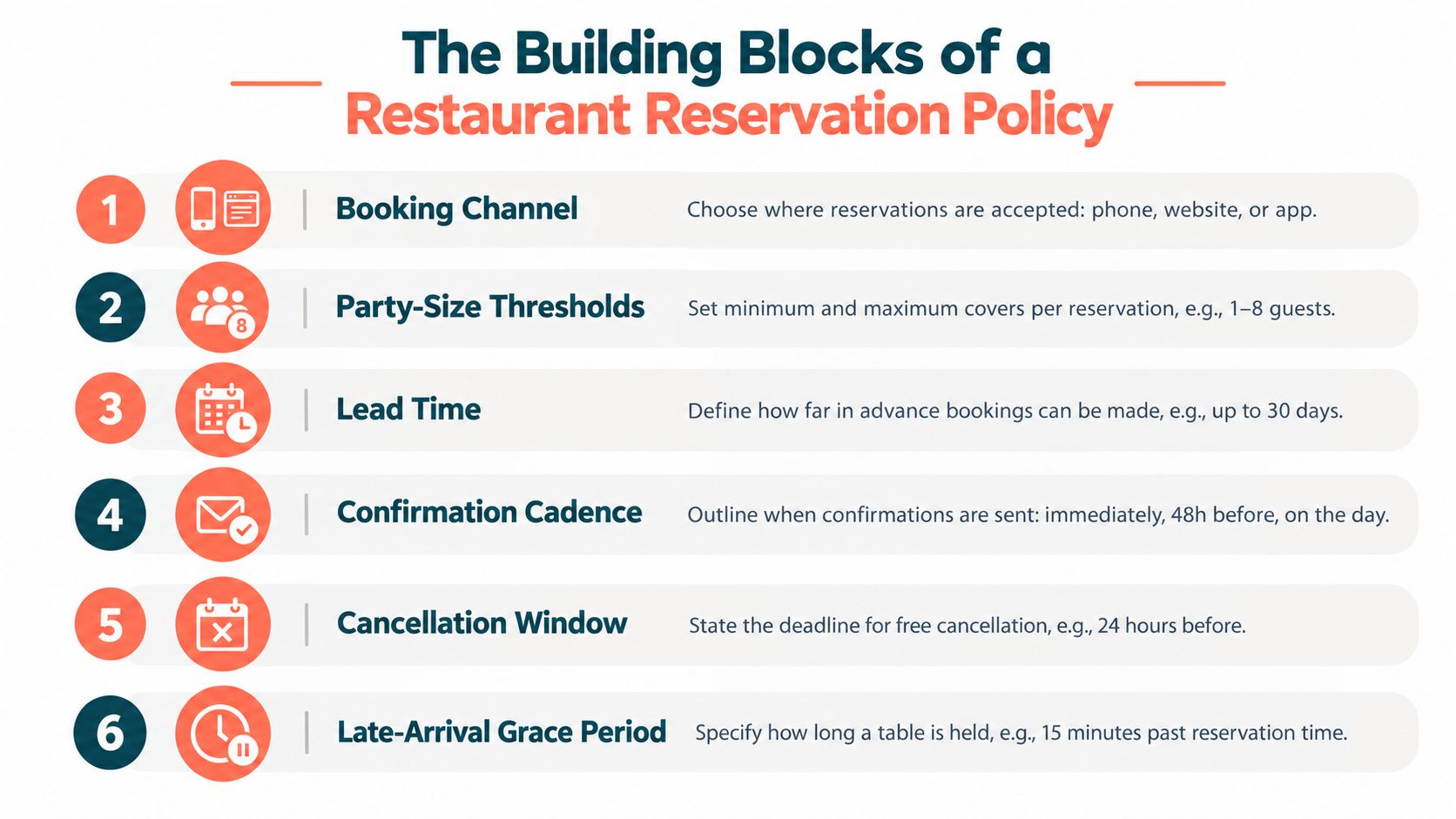
A practical policy follows the sequence a host uses while taking a booking. Each block should be clear enough to apply under pressure and flexible enough to change by service.
Start with the booking rules
Booking channel identifies where guests can reserve, such as phone, website, or app. Keep every channel connected to the same availability, otherwise the host team will sell the same table twice or quote different terms.
Party-size thresholds define the smallest and largest online booking. An independent restaurant serving roughly 60 to 80 covers might accept individual bookings online and route larger groups to a manager, but the right threshold depends on table combinations, kitchen capacity, and private dining space.
Lead time controls how far ahead a guest can book. A shorter window protects flexibility for restaurants whose menu and staffing change frequently. A longer window suits destination dining, special events, and tasting menus, but it creates more opportunity for plans to change.
Confirmation cadence sets the contact points. A sensible sequence is immediate confirmation, a reminder before service, and a same-day nudge for higher-risk bookings. The wording should repeat the time, party size, arrival expectation, and cancellation terms.
Set the commitment and release rules
Cancellation window defines the final point for free cancellation. A 24-hour deadline can suit a high-demand dinner, while a lighter policy may work better for a quiet lunch. The deadline must show the exact date and time in the guest's booking confirmation.
Late-arrival grace period states how long the table remains protected. Fifteen minutes is a workable starting point for a 60 to 80 cover restaurant. Ten minutes may be appropriate on Friday and Saturday when every turn matters, while 20 minutes may be kinder for Monday lunch.
No-show definition should cover both non-arrival and failure to communicate. A party that arrives after the release point isn't automatically treated the same as a party that never contacts the restaurant. Staff need a decision path for seating, moving, or charging.
Deposit triggers identify bookings that require financial commitment. Use them for tasting menus, special events, peak dates, or larger parties where a lost table is difficult to replace. Industry guidance describes several enforcement options, including card guarantees, no-show penalties, deposits, full advance payment, and late-cancellation charges, as outlined in this Cornell Hospitality Report on restaurant reservation practices.
Overbooking buffer is the controlled amount of extra demand accepted against expected cancellations. It should never be a blind percentage. It must reflect table shapes, arrival patterns, kitchen limits, and whether walk-ins can absorb released capacity.
For operators comparing systems, an Opentable integration page from RecensioAI B.V. can help clarify how an external booking source connects with reservation workflows. The operational principle remains the same across tools. One policy should govern every source.
The detailed workflow can be paired with this guide to managing restaurant reservations. These building blocks are modules, not permanent sentences. The restaurant can tighten one for a busy dinner, loosen another for lunch, and keep the core policy readable.
Choosing the Right Enforcement Mechanism
A deposit, card hold, no-show fee, and prepayment all create commitment, but they do it at different moments and at different costs to the guest relationship.
The choice should follow the value of the seat and the restaurant's ability to resell it. A strict rule applied to every booking may protect a few peak tables while discouraging reliable guests from making lower-risk reservations.
The 2025 study using OpenTable data reported that 28% of reservations made in the prior year were not honored, and it also found that stronger cancellation barriers reduced both no-show intentions and booking intentions. That makes peak-night enforcement reasonable, but it doesn't justify treating a quiet lunch like a sold-out tasting menu.
Reservation enforcement mechanisms compared
| Mechanism | Cash Flow Timing | Guest Friction | Admin Load | Best Used For |
|---|---|---|---|---|
| Deposit | Taken at booking and applied or refunded under the stated terms | Moderate, because payment is required upfront | Moderate, including refunds and changes | Larger parties, peak services, special dates |
| Card-on-file hold | No payment unless the stated trigger occurs | Low to moderate, because the guest provides card details | Moderate, with clear authorisation records required | Prime-time weekend bookings |
| No-show fee after the fact | Charged only after a defined breach | Lower at booking, higher if disputed later | High, because staff must assess and document each case | Repeat no-shows or bookings with clear card guarantees |
| Full prepay | Entire experience is paid before arrival | Highest, but clear for the guest | Moderate, with amendments and refunds managed carefully | Tasting menus, holidays, prepaid events |
A practical decision rule is simple:
- Use prepayment for tasting menus, holiday seats, and experiences with fixed purchasing or staffing commitments.
- Use a deposit for parties over eight, provided the threshold is visible before the guest submits payment.
- Use a card hold for prime-time weekend bookings where the restaurant needs commitment without taking cash immediately.
- Use light-touch reminders for off-peak services where the table is easier to refill.
Some industry reporting describes fine-dining deposits ranging from $1 to $50 to secure a reservation and notes that deposits are often set at $20 to $40 per person, with stricter policies for tasting menus. Those figures are examples of market practice, not automatic recommendations, as shown in OpenTable's diner insights report.
The policy should function like a dial. Operators can increase commitment for a Saturday tasting menu and reduce friction for a Tuesday table. A useful operational checklist is available in this guide to reducing restaurant no-show rates.
Communication Scripts That Set Expectations Early
A policy only works when guests see it before booking and hosts repeat it consistently. The language should be warm, specific, and measured in minutes and clock times rather than vague phrases such as “shortly after” or “late cancellations may incur charges.”
The confirmation cadence should be predictable:
- Immediately: Send the booking details, policy link, cancellation deadline, and any deposit terms.
- 24 hours before: Ask the guest to confirm or modify the booking.
- Same day: Send the arrival time, grace period, and contact method for delays.
Copy-ready wording for common moments
Cancellation email
“Your reservation can be cancelled without charge until [date] at [time]. Cancellations after this deadline, or a failure to arrive, may result in the charge stated below. Please use [cancellation link] so the table can be released immediately.”
Late-arrival SMS
“Your table is reserved for [time]. Please call [phone number] if you're delayed. We'll hold the table for 15 minutes after the reservation time, subject to service conditions. After that, the table may be released or your booking may be treated under the cancellation policy.”
Large-party deposit explanation
“Because your booking is for [number] guests, a deposit of [amount] is required to reserve the tables. The deposit will be [applied to the bill or refunded] under the terms shown here: [policy link]. The same terms apply to changes in party size.”
Walk-in response
“The dining room is holding a reservation at [time]. The table may be available before then, but seating depends on the expected duration of your meal. The earliest confirmed option is [time], and the team can add your party to the walk-in list.”
Overbooking recovery
“The restaurant is sorry, but the earlier table has not been released as expected. The team can offer [alternative time], [bar seating], or [nearby partner option]. The manager will confirm the chosen option and any adjustment before seating.”
Script Library for reservation teams
| Channel | Scenario | Script Snippet |
|---|---|---|
| Phone | Explaining a deposit | “The deposit reserves the table and is applied under the terms shown during booking. The deadline and refund conditions are visible before payment.” |
| Confirmation | “Your reservation is confirmed for [party size] on [date] at [time]. Review the policy at [policy link].” | |
| SMS | Reminder | “Please confirm your [time] reservation by [method]. Contact the restaurant if your arrival time changes.” |
| Phone | Late arrival | “The table is held until [exact time]. After that, the manager will check whether seating remains possible.” |
| Walk-in desk | No immediate table | “The next confirmed opening is [time]. The team can contact you if an earlier table becomes available.” |
A first-time guest shouldn't hear a warning disguised as hospitality. The host should explain the reason, the amount, the deadline, and the action required, then stop talking. The policy page should be linked from the confirmation email, not buried in a footer.
For Belgian venues serving international guests, the core message can be pasted in both languages:
EN: “Please cancel by [date and time] to avoid a charge. We'll hold your table for 15 minutes after the reservation time. Call us if you're delayed.”
FR: “Merci d'annuler avant le [date et heure] afin d'éviter des frais. Votre table sera conservée pendant 15 minutes après l'heure de réservation. Appelez-nous en cas de retard.”
Enforcement, Pacing, and Belgian Compliance Notes
A policy should follow the restaurant's actual no-show pattern rather than a universal rule. The 2026 Resos index examined 3,768,761 bookings across 2,417 restaurants and recorded an average no-show rate of 2.33%, calculated as recorded no-shows divided by eligible reservations multiplied by 100. Dinner recorded 2.63%, compared with 1.84% at lunch, while bookings made two to six days ahead recorded 2.67%, compared with 2.09% for same-day bookings, according to the Resos restaurant no-show rate index.
Those results support tiered controls. Dinner and advance bookings may justify stronger reminders or a card guarantee, while same-day lunch can often use a lighter touch. The restaurant should measure its own results by daypart, lead time, party size, and booking source before tightening terms.
Release tables without destroying walk-in demand
A table freed two hours before service still has resale value, but releasing it incorrectly can create a second problem. If the team immediately sells the table at the same time as a nearby table, both parties may arrive together and overload the kitchen.
Use a release cascade instead:
- T-2 hours: Contact the absent or uncertain party, then flag the table for controlled resale.
- T-1 hour 45 minutes: Offer the table through the online channel if the kitchen can absorb the arrival.
- T-1 hour 30 minutes: Add it to the host's confirmed availability and call suitable waitlist parties.
- T-1 hour 15 minutes: Recheck table configuration and pacing.
- T-1 hour: Release the final version to walk-ins or online demand.
A strict fee can improve attendance reliability, but it can also create disputes and reduce future bookings. A lenient policy protects goodwill but leaves the restaurant carrying the cost of preparation and idle labor. Managers should record waived fees and disputed charges, not only successful collections.
Belgian records and GKS controls
Belgian operators need to distinguish a reservation promise from a completed charge. Terms should be disclosed before acceptance, the guest should actively agree to the relevant conditions, and the restaurant should retain the booking record, timestamp, policy version, authorisation status, cancellation history, and receipt.
For payment processes and audit questions, a payments compliance guide from Suby provides useful background. The booking form should also separate operational messages from marketing consent, identify the data being collected, state the purpose, and offer a clear way to withdraw consent.
GKS procedures require particular care. Card-on-file authorisations should be documented, traceable to the booking, and reversible within 30 days when the guest requests reversal. Receipts and audit records should match the actual transaction, including the applicable Btw/TVA line where a charge is issued. Belgian terms should be made available in the languages appropriate to the venue and guest base, with Dutch, French, and German considered where required.
The practical reference for card guarantees is this explanation of what a credit card guarantee means. A manager should never charge first and search for the policy later.
Rolling Out the Policy with Your Front-of-House Team
A new policy fails when the document changes but the floor routine doesn't. The general manager should roll out the rules in a short, controlled sequence, with one owner for each task and a small set of measures that reveal where the process breaks.
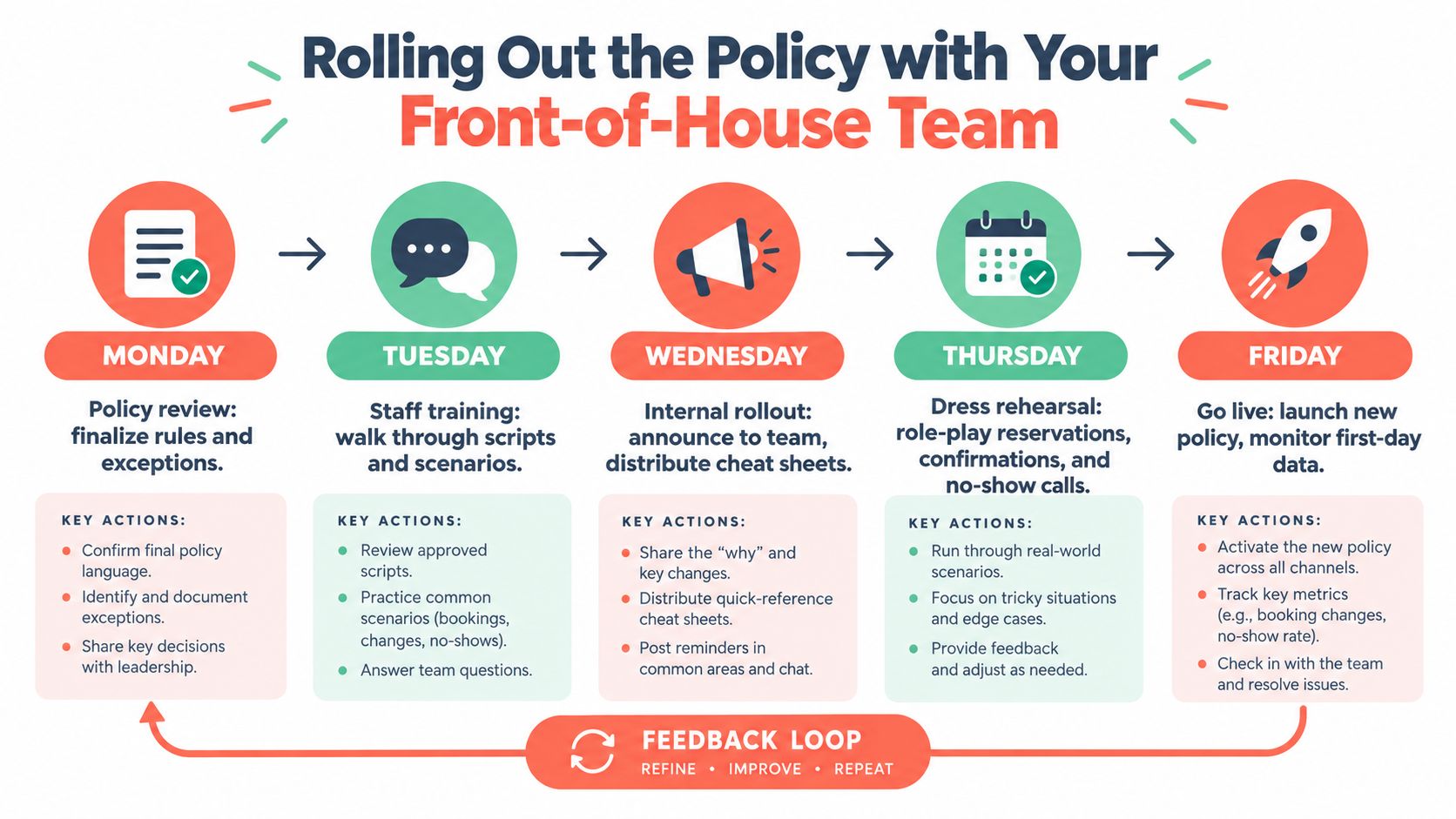
A five-day rollout
Monday, policy review: The general manager finalises booking channels, party-size limits, lead times, grace periods, deposits, cancellation deadlines, exceptions, and escalation rights. The owner or finance lead checks payment wording and receipt requirements.
Tuesday, staff training: The floor manager runs role-play for three difficult situations: a guest disputing a deposit, a late party of eight, and a walk-in asking for a table already held for a reservation. Staff should practise the exact words, not just discuss the principle.
Wednesday, soft launch: Hosts use the new scripts and manually track confirmations, deposits, late arrivals, cancellations, and waived fees. The manager listens to calls and corrects inconsistent explanations before full activation.
Thursday, full activation: The policy appears in the booking flow, confirmation email, SMS reminder, and staff reference sheet. The host stand keeps one visible version so nobody works from an old screenshot or printed draft.
Friday, retrospective: The manager reviews the first service's no-show records, confirmation open rate, deposit conversion, late-arrival count, and waived-fee count. The team records guest objections separately from staff errors, because those require different fixes.
The work becomes easier when booking, deposits, confirmation messages, table rules, and policy versions sit in one workflow. 10seat is one option that centralises those controls through availability, timing, and party-size settings, with a product workflow described at 10seat.com/product. Other platforms, including TheFork, OpenTable, Zenchef, and Formitable, can be compared by their booking features and pricing models rather than by brand reputation alone.
The one-page staff sheet
The printed cheat sheet should contain:
- Booking facts: Party size, arrival time, table duration assumption, and contact details.
- Policy facts: Cancellation deadline, grace period, deposit trigger, and no-show definition.
- Scripts: One approved sentence for phone, SMS, late arrival, walk-in, and dispute handling.
- Escalation: The manager authorised to waive, refund, or uphold a charge.
- Recording: Where the host logs the reason for every exception.
The team doesn't need a longer policy. It needs one current policy, repeated accurately, with exceptions visible.
Common Policy Questions from Operators
Can a restaurant legally charge a no-show fee?
A fee is more defensible when the guest sees it before booking, accepts the terms, and receives a clear confirmation. The amount should relate to the protected service and shouldn't operate as a hidden or punitive surprise. Belgian requirements can differ by transaction and venue, so owners should verify the wording with a hospitality lawyer.
For Belgian operations, the charge must be recorded correctly. Under the GKS framework, a no-show fee treated as a service rendered should appear on an issued receipt with the matching Btw/TVA line and a traceable link to the reservation and payment record.
How long should staff hold a late table?
The policy should state minutes, not “a reasonable time.” Fifteen minutes is a workable default for many independent restaurants, but a busy Friday service may require a shorter release point and a quieter lunch may allow more flexibility. Staff should call the guest, record the contact attempt, and let the manager decide whether the table can still fit the service plan.
When should a party of eight or more prepay?
Full prepayment fits fixed menus, special events, and services where purchasing and staffing are committed in advance. For a normal à la carte booking, a deposit or card guarantee may protect the table with less friction. The threshold should reflect table configuration, kitchen pacing, and how difficult the booking is to replace.
What happens when a guest cites an emergency?
The host should acknowledge the situation, check the booking history, and escalate rather than arguing at the desk. A manager can waive a charge for a documented or credible emergency, but the reason should be recorded so exceptions don't become invisible policy.
Should repeat offenders receive refunds?
Not automatically. A restaurant can offer a goodwill waiver once, then require a deposit or prepayment for future bookings. The decision should be consistent, documented, and communicated before the next reservation is accepted.
How do dietary needs affect deposits?
Dietary requirements and seating constraints can make a reservation more costly to replace, but they shouldn't be used to penalise guests. The booking form should capture the requirement early, confirm what the kitchen can provide, and explain any fixed-menu commitment before payment. Owners should have local counsel review terms because enforcement limits differ by market.
10seat helps independent restaurants connect booking rules, table availability, confirmations, deposits, and service pacing in one operating workflow. Visit 10Seat to review the product and pricing options, then use the policy framework above to set rules your hosts can apply consistently from the next service.