Restaurant Seating Management: How to Fill Every Seat
Restaurant seating management explained: capacity, turn times, pacing and no-show control, with the numbers and steps to fill more seats each service.
It's Friday evening. Guests are waiting by the door, the kitchen is taking orders faster than it can finish them, and an empty table is still being held for a party that hasn't arrived. The booking list looks healthy. The dining room feels anything but under control.
Restaurant seating management starts with the minutes each seat is available, not the number of reservations accepted. A table can look busy while leaving chairs unused. Another can sit empty between bookings because nobody has agreed when to release it. Filling those gaps takes a clear floor plan, realistic timing and a host who knows which decision to make next.
Table of Contents
- What Restaurant Seating Management Really Controls
- Turn Time, Covers and Seat Utilization to Track
- How to Build a Daily Seating Routine
- Stopping Empty Seats from No-Shows and Walk-ins
- Seating Setups for Fine Dining, Bistros, Brunch and Bars
- How Capacity Engines and Smart Auto Seating Work
- GKS Compliance for Belgian Seating and Till Data
- Measure One Week of Seating Before You Change Anything
What Restaurant Seating Management Really Controls
Two bookings can each list four guests and still use very different amounts of the room. A party at a four-top may occupy all four seats, while a couple at the same table leaves two chairs unused. If both stay for the same length of time, the second booking consumes fewer guest seat-minutes but ties up the same table. That difference affects how much capacity remains for later arrivals.
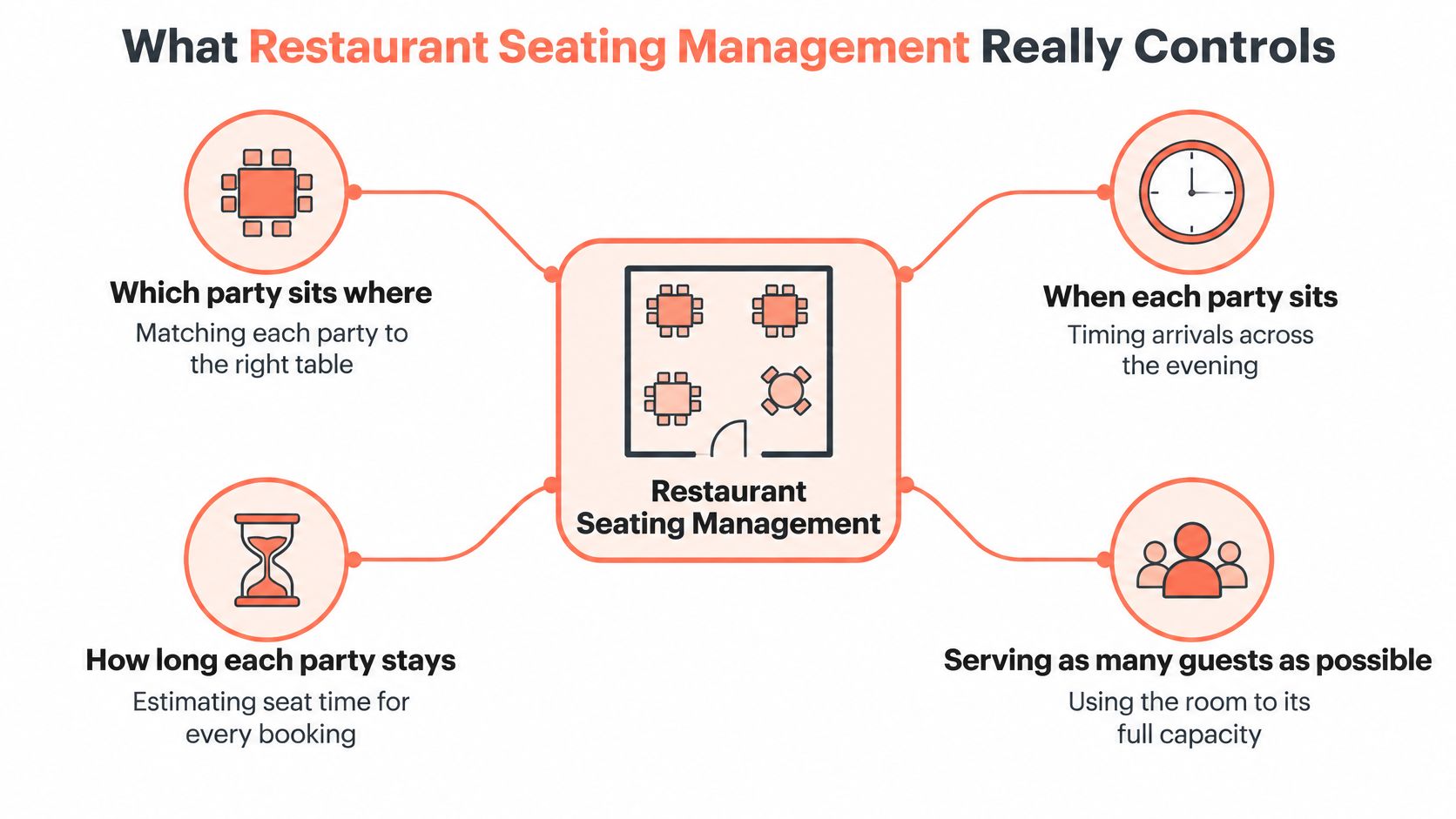
Restaurant seating management is the daily work of assigning parties to tables and coordinating arrivals, meals and resets. Its job is to make practical use of the seats and minutes available without treating guests' meals as a race.
Four connected decisions shape the result:
- Capacity: Which seats and tables are available for service, including any held back for accessibility, staff needs or room flow.
- Table mapping: Which party sizes fit each table, and which tables can be combined. This comes before timing decisions because the floor plan limits where each party can sit.
- Pacing: How closely seatings can be scheduled without sending more orders to the kitchen and floor than they can handle. Good pacing depends on the available tables and their likely use.
- Host workflow: How staff respond when guests arrive early or late, a table takes longer than expected, or a walk-in needs a seat. This puts the other decisions into practice as service changes.
A four-top booked for two guests is not automatically a poor assignment. It may be the only suitable table available, or splitting the table may disrupt service. The cost is the unused seat-minutes and the chance that a larger party cannot be seated there during that period. Track the trade-off before changing the floor plan.
The same party size can also occupy a table for different lengths of time. A two-top used for a quick lunch and a two-top used for a long dinner both count as two guests, but they leave different windows for another seating. Table style, service pace and the occasion can all affect how long a party stays. Use your own service records to set expectations; the figures in a general reference table are not reliable limits for a particular restaurant.
A reservation holds a place in the plan, not a guaranteed arrival. Before reducing seats, check how often tables sit unused, how many seats remain empty within occupied tables, and whether the layout gives hosts workable options when plans change.
Turn Time, Covers and Seat Utilization to Track
Seat utilization = occupied seat-minutes ÷ available seat-minutes. Occupied seat-minutes count the time guests use seats. Available seat-minutes count every usable seat across the service period.
Consider a hypothetical calculation, not an industry benchmark. A room with 40 seats open for 180 minutes offers 7,200 seat-minutes. If guests occupy 4,900 of them, utilization is approximately 68%.
An empty chair beside a seated couple still counts as unused capacity. That's why table occupancy alone can give a misleading picture of the room.
Core seating metrics and what to watch
Covers are guests seated, not reservations received. Turn time runs from seating until the table is cleared and reset, so it includes the work needed before another party can sit.
| Metric | How to calculate it | Where to find it | Red flag |
|---|---|---|---|
| Covers per service | Guests seated in one service | Booking or POS report | Lower than the same weekday last month |
| Turn time | Minutes from seating to table cleared and reset | Host log or table timers | Comparable parties consistently exceeding their usual duration |
| Seat utilization | Occupied seat-minutes divided by available seat-minutes | Service log and floor plan | Below the restaurant's average for the same daypart and weekday |
| No-show rate | No-shows divided by total reservations | Booking system | Above the restaurant's recent rolling average |
| Revenue per seat-hour | Service revenue divided by available seat-hours | Till report and floor plan | Falling while covers hold steady |
Compare like with like. Lunch and dinner can produce the same utilization while carrying different staffing, menu and spending patterns. A combined daily percentage can hide the service that needs attention.
A restaurant revenue-management case study reported that a 90-seat restaurant with $50 average guest spend added nearly $6,000 in daily revenue after monitoring and adjusting turn times. That amount is equivalent to roughly 120 covers at the stated spend, but the source doesn't establish that extra covers accounted for the entire gain. It's an illustration, not a forecast for another restaurant.
Practical rule: Remove avoidable waiting around the meal before trying to shorten the meal itself.
Keep a service log with party size, seating time, departure, reset completion and no-shows. Recording departure separately helps distinguish a long meal from a slow reset.
Review covers, turn time, utilization and no-shows weekly, with revenue per seat-hour as the commercial cross-check. The restaurant yield-management guide provides a related framework for connecting capacity decisions to revenue. Change a single process at a time so the result remains interpretable.
How to Build a Daily Seating Routine
A useful seating routine gives the host a starting plan and permission to adjust it. A rigid allocation that nobody can change is little better than no plan at all.
Start with bookings and duration estimates, as illustrated below.
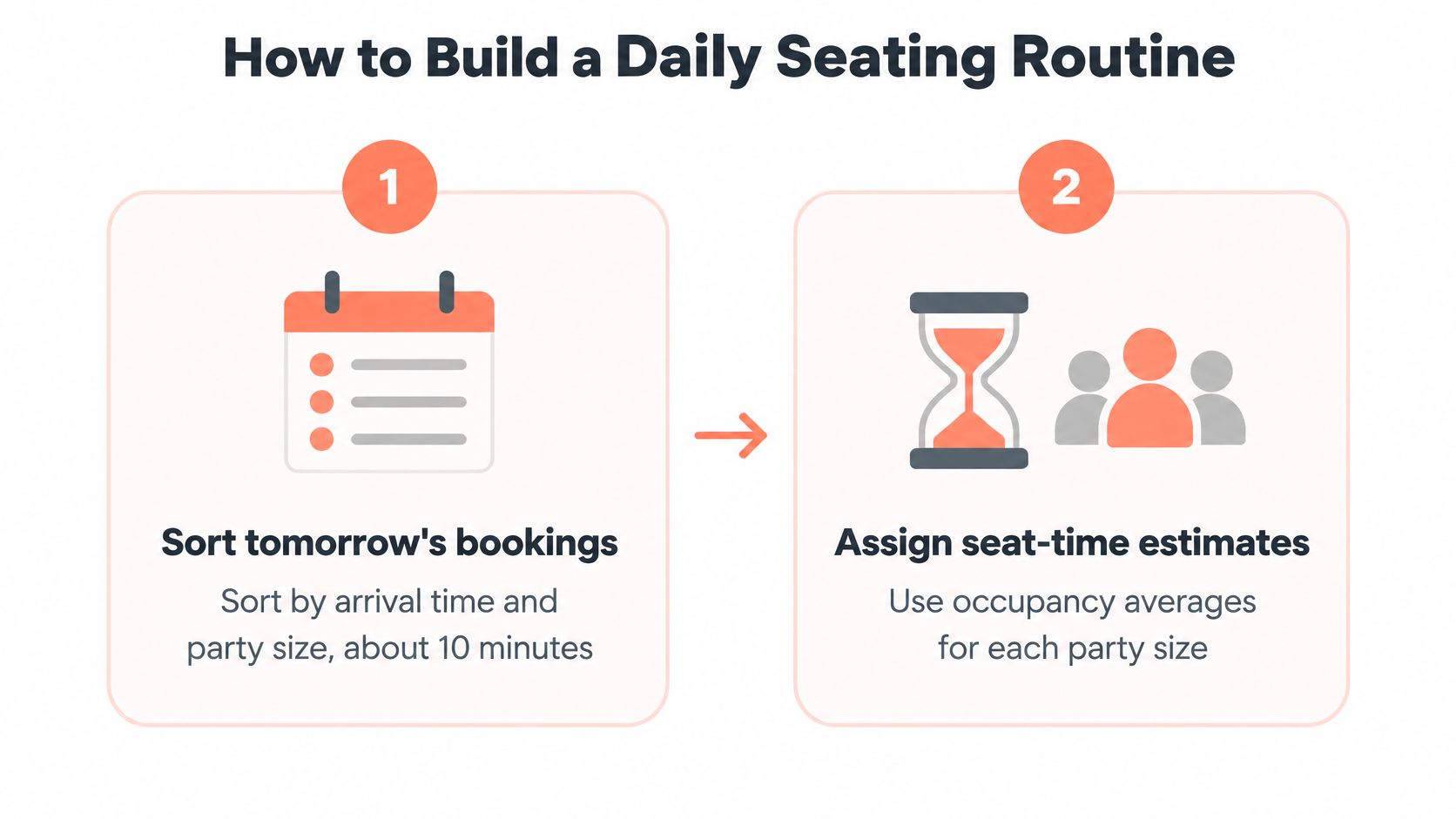
- Sort tomorrow's bookings by arrival and party size. Include guest requirements and incomplete confirmations so the host doesn't discover them at the door.
- Assign a likely seat time to each booking using the restaurant's own records. The earlier occupancy table is a starting reference, not a substitute for local experience.
- Place the least flexible parties first. Large groups and bookings requiring particular access or table arrangements leave fewer alternatives.
- Divide arrivals into manageable blocks and set the last acceptable seating time before each table's next commitment. Check kitchen workload as well as physical space.
- Define confirmation deadlines and release rules. Communicate them before arrival rather than inventing a grace period during an argument.
- Brief the host on table priorities, waitlist order and promised waits. Include who can approve exceptions when a party runs late.
- Check actual progress against the plan throughout service. Remap future allocations when a delay becomes likely, rather than waiting until the next guests arrive.
- After service, record actual durations and the reasons for unusual delays. Otherwise, next week's plan will repeat the same assumptions.
Make waiting fair and understandable
A workable table isn't always the smallest table that fits. Accessible routes, comfortable seating, family configurations and an already-exceeded promise can justify a different assignment.
Restaurant waiting research summarized by Toast reports that 72% of diners will wait no more than 30 minutes, while 66% may wait longer with a comfortable waiting area. The same article reports Cornell perceived-wait scores of 5.58 for reservations, 4.31 for call-ahead seating and 2.68 for waitlists, with reservation arrangements perceived more favorably. These are perception scores, not minutes.
Hosts should explain table suitability without disclosing another guest's private requirements. A smaller party might be seated earlier because a suitable smaller table opened, not because the restaurant ignored the queue.
The service video below can be used as a prompt for a host-team discussion about the routine.
A short pre-service review is a planned investment, not a guaranteed labor saving. Its value should be measured through fewer table reassignments, fewer repeated wait enquiries and less manager intervention during service.
Stopping Empty Seats from No-Shows and Walk-ins
A Friday dinner reservation for four can leave more capacity stranded than a booking for two, even if both guests fail to arrive. The difference depends on the table, the time held and whether the restaurant can refill those seats. Track the empty seat-minutes, not just missed bookings.
An analysis of 212,000 reservations across 300 Italian restaurants found a 12.8% no-show rate, compared with 5.4% at restaurants using deposits or card preauthorization. For every 100 booked covers, that gap represents about 7.4 covers that might be recovered if the restaurant can resell the capacity.
The rates vary by market. A US analysis of 3.77 million reservations reported a 3.17% no-show rate. At 150 reservations a week, that rate equals about 4.8 missed bookings weekly, or roughly 250 in a 52-week year. These figures describe bookings, not the seat-minutes lost: a missed four-top at peak time can cost more usable capacity than a two-top that the host can refill quickly.
Preventing a no-show and recovering an empty table require different actions.
No-show and walk-in tools compared
An Italian analysis of no-show prevention and recovery practices reported the effects and adoption figures below. Adoption does not mean a tool will suit every dining room.
| Tool | Reported effect or adoption | Guest friction | Use when |
|---|---|---|---|
| Automated reminders by SMS, WhatsApp or email | Absences cut by 32% | Low | Every service, as the first line of defense |
| Deposit of about €20 per guest or card preauthorization | No-shows fell from 12.8% to 5.4% in the analysis above | Medium to high | Peak dinners, large parties and event-driven demand |
| Digital waitlist | Used by 57% of restaurants | Low | Filling cancelled tables the same evening |
| Controlled overbooking | Used by 14% of restaurants | Medium to high | Only slots with a proven no-show pattern |
Start with reminders for bookings that are easy to replace. A deposit or card hold may make sense for a large party at peak time, when a late cancellation could leave a table idle. Explain fees, deadlines and exceptions before guests confirm.
Optimize expected occupied seat-hours, not the number of confirmed bookings.
Recover the table without breaking trust
When a booking looks doubtful, contact the guest, follow the stated deadline and alert the waitlist. Keep the table until that deadline if the guest reasonably expects it to be held.
Walk-ins need a clear policy too. Reserve flexible capacity when demand supports it, quote waits based on actual table progress and release held tables under rules guests have been told. A waitlist helps only when the party size fits the table that has opened.
Overbooking should depend on the history of a specific time slot and a workable plan if every guest arrives. Otherwise, the restaurant shifts its risk onto diners. Use this guide to reducing restaurant no-shows to review confirmation, cancellation and recovery rules.
Seating Setups for Fine Dining, Bistros, Brunch and Bars
The same principles need different settings in different dining rooms. A fine dining restaurant must protect the meal's pace, while a bistro may depend more heavily on keeping small tables flexible.
Long courses and uncertain departures make fine dining particularly sensitive to optimistic timing. Its floor plan should protect both the guest's experience and the kitchen's ability to deliver it.
Match the method to the service
These are illustrative operating choices, not claimed performance results.
| Venue type | Main problem | Practical move | Metric to watch |
|---|---|---|---|
| Fine dining | Departures vary with the meal | Map by expected duration and protect buffers | Turn-time variation |
| Brasserie or bistro | Small parties compete with larger bookings | Keep combinable tables available until needed | Seat utilization |
| Casual or group-heavy venue | Late or incomplete groups block capacity | Set confirmation and arrival rules in advance | Unused time on held tables |
| Brunch restaurant | Arrivals concentrate around a queue | Use a live waitlist and realistic promises | Quoted versus actual wait |
| Bar with seated service | Bar and table demand overlap | Separate allocations and offer bar seating by consent | Table waits and accepted alternatives |
| Multi-location group | Sites record service differently | Standardize definitions and review comparable periods | Site-level trends by daypart |
For a bistro, joining tables too early can remove useful options. Keep the required combination protected in the plan without unnecessarily making it unavailable to an earlier, shorter booking.
A group-heavy venue needs a clear approach to incomplete arrivals. Whether service starts before everyone arrives should reflect the menu and kitchen, not whichever server happens to take the booking.
Protect the promise
At brunch, an honest wait matters more than an optimistic one that needs repeated extensions. A bar alternative should remain an offer, not an assumption that every diner can comfortably use a high stool.
Fine dining needs particular care when assigning successive bookings. The fine dining seating solution is relevant when evaluating controls for longer meals and table-specific planning.
For groups operating several venues, consistent definitions matter more than identical targets. A tasting-menu restaurant and a neighborhood bistro shouldn't be pushed toward the same turn time just because they share an owner.
How Capacity Engines and Smart Auto Seating Work
A capacity engine solves a changing table-allocation puzzle. The pieces are table sizes, booking times, expected durations, existing commitments and permitted combinations.
When a booking arrives, the system checks where it can fit without unnecessarily blocking later demand. Smart Auto Seating applies those rules to an allocation. Auto Seating Puzzle revisits arrangements when the booking picture changes, while Walk-in Squeeze looks for a suitable opening for an unexpected party.
The important distinction is between finding an empty table now and preserving a workable room later. Software should help with both, but the host still needs authority to reject an allocation that doesn't suit the guest.
Check the controls before the demonstration
A polished floor-plan display isn't enough. Evaluate the operating details:
- Floor-plan setup: Confirm that combinations, zones and unavailable tables reflect the actual room.
- Editable rules: Check whether party sizes, dining durations and buffers can be changed by service.
- Host workflow: Test seating, moving and clearing a party while other arrivals are waiting.
- Guest requirements: Check how preferences, allergies and accessibility needs are recorded and displayed.
- Till connection: Establish what data passes between reservations and the point-of-sale system, and what still needs reconciliation.
10seat is a commission-free reservation-management option for independent Benelux restaurants, combining capacity planning with live seating tools. Its product details provide a starting point for checking those functions against an actual floor plan.
Buying test: Ask the supplier to demonstrate a late arrival, an overrun and an unexpected walk-in on the restaurant's own table layout.
Compare total charges, not headline prices
When comparing TheFork, OpenTable, Zenchef and Formitable, review each current quote's subscription, per-cover, commission and optional-service terms. Don't assume every provider or plan uses the same charging structure.
The useful cost calculation is straightforward: chargeable covers multiplied by the quoted cover fee, plus fixed charges and extras. Compare that total with a flat subscription using the same booking volume and included services.
A lower bill doesn't compensate for unsuitable seating controls. Equally, a long feature list doesn't justify paying for functions the restaurant won't use. Check the available pricing plans against the actual service requirements before committing.
GKS Compliance for Belgian Seating and Till Data
A dining room can be full while the till records a different number of covers. In Belgium, restaurants and caterers must use a Geregistreerd Kassasysteem (GKS) when annual qualifying turnover exceeds €25,000 excluding VAT, according to the official Belgian GKS guidance. Ask an accountant to confirm which turnover counts toward the threshold. Don't assume that drinks or separately billed hire charges are included or excluded without checking the applicable rules.
Check the obligation and the workflow
- Confirm the turnover calculation. Ask your accountant to identify the revenue included in the threshold and document the basis for the calculation.
- Check the registered cash-register setup. Ask your POS supplier whether the system is a registered GKS and whether the required certified components are installed and configured for your business.
- Set a reconciliation process. Compare booked party sizes with the covers served and the final bills. Investigate differences, since a reservation record alone does not establish the number of guests served.
For example, a booking for four may arrive as three, or a walk-in party may be seated without a reservation. Record what happened and reconcile it against the till records your system supports.
Have your accountant confirm the obligation, and consult FOD Financiën or the official GKS guidance before changing the cash-register setup. This is general information, not legal advice.
Measure One Week of Seating Before You Change Anything
A full-looking booking list isn't enough evidence for changing the floor plan. Start with a week of observations, then identify whether capacity is being lost through absences, mismatched tables, slow resets or unrealistic timing.
- Record the service. Log party size, seating, departure, reset completion and no-shows for seven days. Use existing system timestamps where possible rather than adding duplicate work.
- Calculate utilization separately for each daypart using the earlier formula. Keep unusable or deliberately closed seating clearly identified.
- Find the largest recoverable loss. Compare no-shows with the restaurant's own recent history, using the earlier US reference only as context. If reliable historical records don't exist, establish a baseline before drawing conclusions.
- Change a single process and measure again the following week. Record what changed, who applied it and whether guest complaints or kitchen pressure increased.
Keep the review practical
A reminder policy won't fix a slow reset. A tighter dining limit won't fix poor table matching. Choose the intervention that addresses the observed loss, not the feature that is easiest to switch on.
Set aside a regular weekly review and retain a short change log. For restaurants considering automated mapping, compare the required capacity and seating controls with the plan options, then test them against the existing floor plan.
10seat offers commission-free reservation management with capacity planning and live table allocation for independent Benelux restaurants. Visit 10Seat to assess how its seating tools could help the host manage arrivals, table changes and walk-ins using the room already available.