Restaurant Host Responsibilities: Duties, Steps and Limits
Learn restaurant host responsibilities for greeting, reservations, seating and service coordination, plus the duties hosts should escalate.
The entrance is filling up, the phone is ringing, and a server says the next table can't come into their section yet. Meanwhile, a reservation has arrived early and a walk-in can see an empty table. Someone at the stand has to explain why empty doesn't always mean available.
That's where restaurant host responsibilities become operational, not just welcoming. A capable host keeps the booking book, dining room and waiting guests aligned, with clear authority to act and a clear route to a manager when the decision goes beyond the stand.
Table of Contents
- Core Host Duties at a Glance
- Greeting Guests and Setting the First Impression
- Keeping the Reservation Book and Waitlist Accurate
- Seating Parties and Rotating Tables Fairly
- Coordinating With Servers, Kitchen and Managers
- Quoting Waits and Handling Peak Service
- Deciding What Hosts Own and What They Escalate
- Confirm Your Host Duties Before the Next Service
Core Host Duties at a Glance
| Duty | What it covers | When it happens |
|---|---|---|
| Greeting guests | Welcome guests, confirm names and reservations, set expectations | On arrival |
| Reservations and waitlist | Keep the booking book accurate, add walk-ins, quote waits | Before and during service |
| Table status tracking | Know which tables are occupied, checking out, cleaning or ready | Throughout service |
| Seating parties | Match party size to a suitable table and follow the rotation | Every arrival |
| Server and kitchen coordination | Share seating, timing and special requests | Throughout service |
| Guest communication | Update waits, answer calls, handle questions and concerns | Throughout service |
| Departures and farewells | Thank guests, note feedback, reset the host stand | End of service |
A host is an operational coordinator, not just the person beside the menus. The U.S. Bureau of Labor Statistics defines the occupation around welcoming patrons, seating them at tables or lounges, and helping ensure the quality of facilities and service. At the stand, those duties connect reservations, walk-ins, servers, the kitchen and guests.
A seating decision changes more than table occupancy. It determines who receives the next order, whether a server can greet promptly, and whether an arriving reservation still has a suitable place. Reservation control and table-status tracking deserve the earliest attention because mistakes there make every later decision less reliable.
What a complete shift includes
Opening work means checking the book, floor plan, menus and guest notes. During service, the host keeps those records current rather than relying on memory.
Departures deserve attention too. The host thanks guests, passes actionable feedback to the manager, and records useful preferences without adding subjective labels to guest profiles. Closing work leaves the next shift with a tidy stand and an accurate account of unresolved issues.
Greeting Guests and Setting the First Impression
A reliable greeting gives guests a welcome and a clear next step. It doesn't need to sound rehearsed, but it does need a consistent sequence.
- Prepare the likely arrival. Review the next reservation or waitlist entry before the party reaches the stand, where practical. Never assume identity from appearance.
- Welcome and identify. Use the guest's name once confirmed, or offer a simple welcome and ask for the booking name.
- Confirm the essentials. Check party size, seating preferences and any occasion recorded at booking. Discuss sensitive needs discreetly rather than reading notes aloud.
- Explain what happens next. State whether the table is ready, whether there's a wait, or whether the party will be contacted while waiting at the bar. Give an estimate only after checking the floor.
- Complete the handoff. Escort the party, provide menus and identify the server who'll look after them. Notify that server rather than assuming they noticed the arrival.
The handoff prevents an awkward gap between being seated and receiving service. Indeed's restaurant-host career guidance includes coordinating that transition alongside greeting, reservations and wait estimates.
Two slips worth removing
Asking a guest to repeat their name repeatedly usually means nobody recorded it properly. Leaving an arrival unacknowledged while finishing a phone call sends a different message: the caller matters more than the person standing there.
A glance and a brief acknowledgement can hold the welcome while the host places the caller on hold appropriately.
Arrival test: Could an on-time guest explain, within a minute, what happens next and who will look after them?
Keeping the Reservation Book and Waitlist Accurate
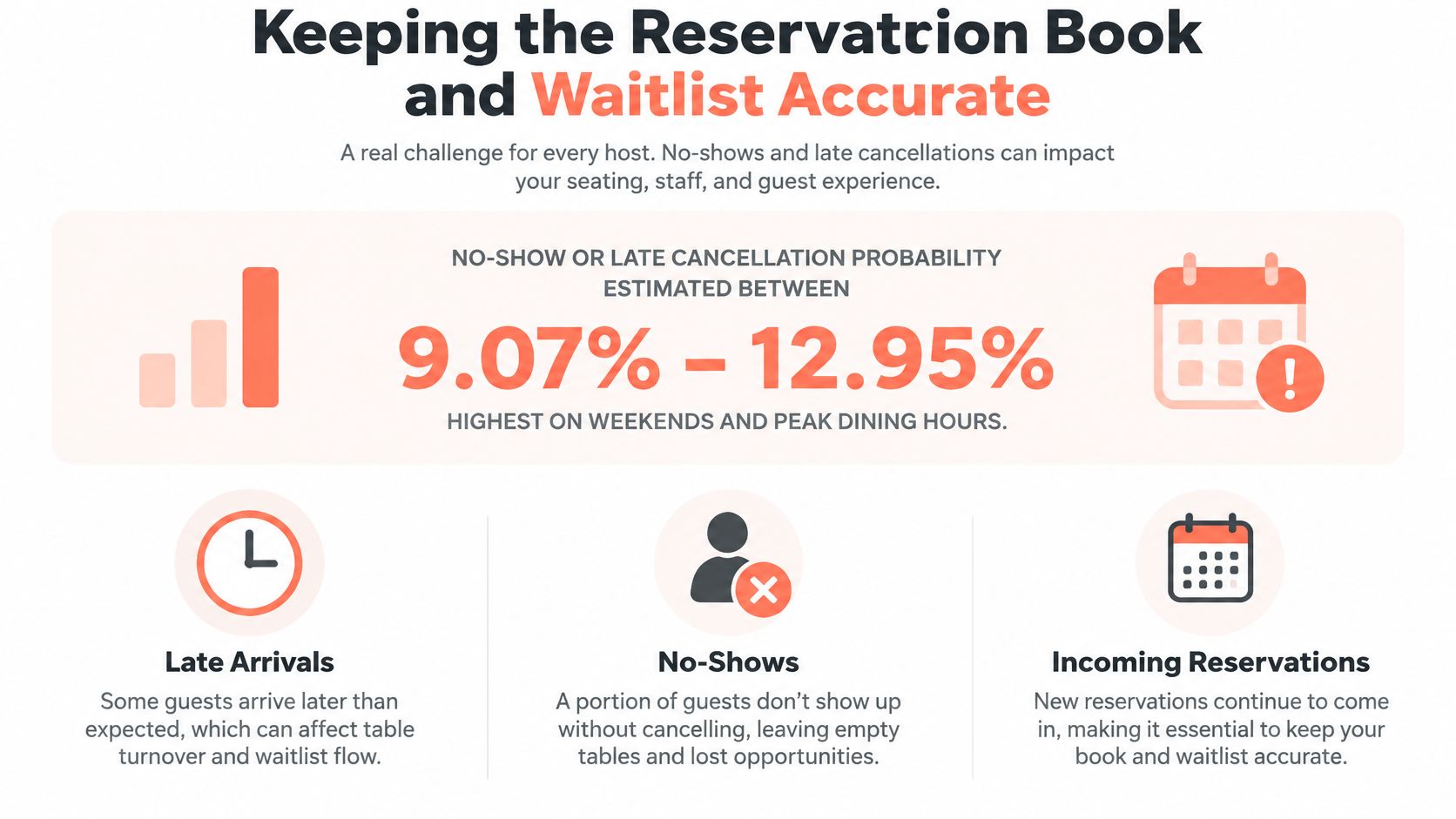
A peer-reviewed restaurant-management study estimated no-show or late-cancellation probability between 9.07% and 12.95%, with the highest probability on Saturdays and the lowest on Thursdays for both lunch and dinner. That's a finding from the study, not a forecast for every restaurant, but it gives managers a reason to examine risk by service rather than treating every booking alike.
Saturday preparation should therefore include earlier confirmation checks and a usable replacement list where the restaurant's own history supports it. Thursday may need less intervention, but neither service benefits from unrecorded cancellations or tables held indefinitely.
Keep the book usable during service
- At opening: Review booking times, party sizes, contact details, table combinations and requests. Flag bookings needing clarification, not guests judged by appearance or presumed spending.
- Before arrivals: Confirm the next two hours of bookings as a working routine, using the restaurant's agreed confirmation process.
- For every walk-in: Record a name, party size, arrival time, contact method and quoted wait. A verbal promise without an entry isn't a managed queue.
- When plans change: Mark arrivals, amendments, cancellations and no-shows immediately. Apply the published late-arrival policy before releasing a held table.
Waitlist reviews should happen at agreed checkpoints and whenever table availability changes. The host also needs to distinguish guests who've left from guests waiting elsewhere, otherwise a stale entry can delay everyone behind it.
Managers should review the reasons behind lost bookings, not just count them. An unreachable guest, a cancellation received but not entered, and a genuine no-show require different fixes.
A reservation is a forecast, not guaranteed revenue. The host's responsibility is to keep that forecast current, including when the service becomes too busy for anyone to want another administrative task.
Seating Parties and Rotating Tables Fairly
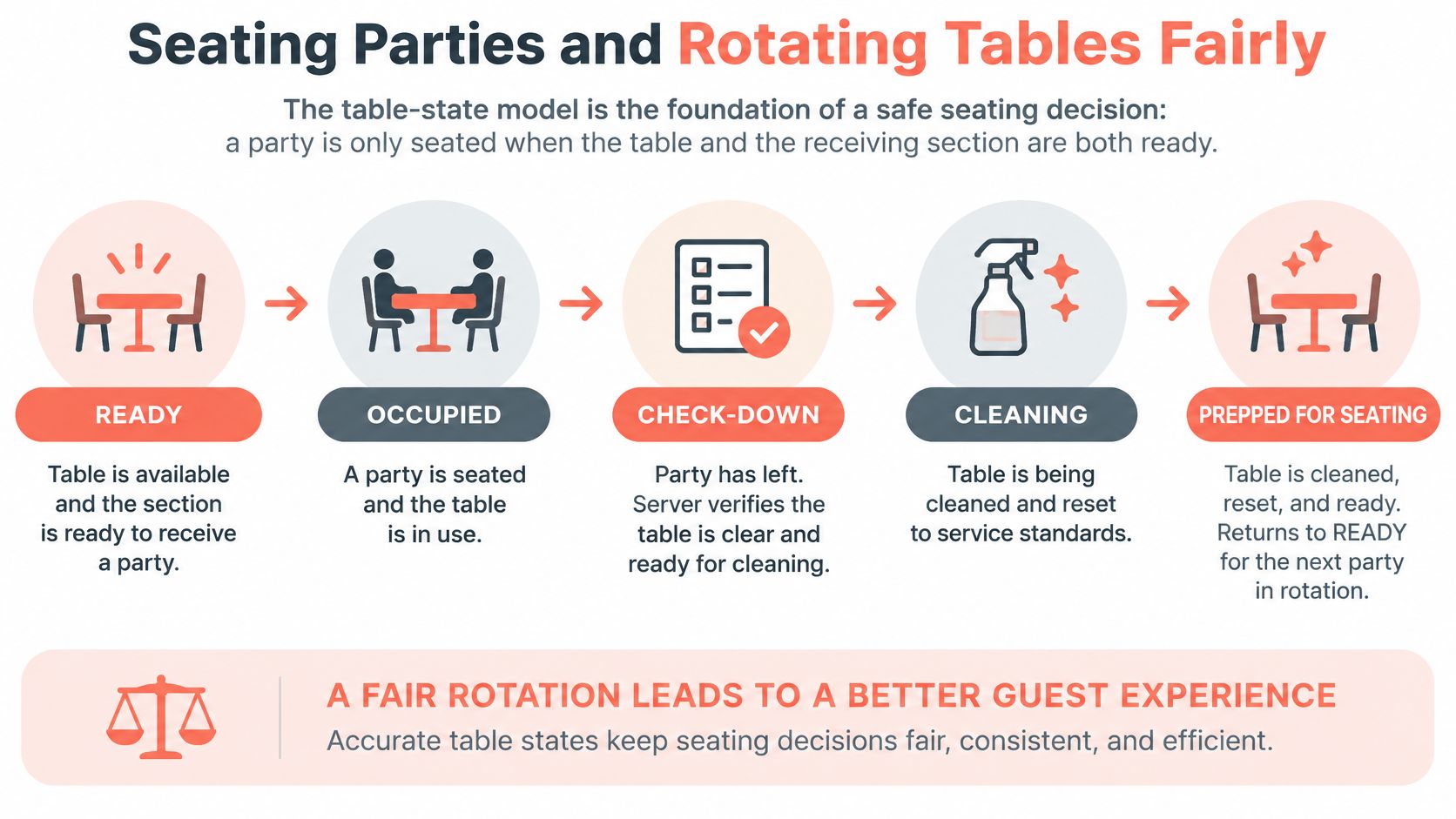
| Table state | What it means | Can you seat it? |
|---|---|---|
| Ready | Clean, reset and set for the next guests | Yes, if the server section can take it |
| Occupied | Guests are seated and eating | No |
| Check-down | Guests have paid and are leaving | No, until the table is cleared |
| Cleaning | Table is being cleared and reset | No, until it is marked ready |
| Blocked | Reserved for a party, or out of service | No, unless the block is released |
The table and its receiving section must both be ready. The Illinois State Board of Education's front-of-house curriculum identifies table-status tracking, customer flow, seating rotation and communication with servers and bussers as host duties.
A seating routine that protects service
- Check readiness. Confirm the table is reset and the receiving server can take another arrival. A cleared table awaiting cutlery isn't ready.
- Match party size to a suitable table. Place larger groups where there's enough room for service, using proximity to the kitchen only when it helps rather than obstructs circulation.
- Follow the agreed rotation, accounting for current workload and recent arrivals. Equal table counts don't necessarily mean equal work.
- Seat and update immediately. Mark the table occupied before another host can allocate it.
- Record seating time so later decisions use current information rather than a remembered sequence.
Accessibility requires a conversation, not an assumption. Offer a suitable step-free table, including one near the entrance or restroom when that matches the guest's preference, and confirm the route is usable. Tell the server before seating so chairs, space and service arrangements are ready.
Fair doesn't always mean identical
Suppose a party of six arrives while other parties are approaching the stand. The host chooses the suitable section that's been quiet longest, provided its server is ready, and tells the other server that the next suitable seating is theirs.
That explanation matters. An unexplained exception looks like favouritism, even when the decision was sensible.
A good floor isn't simply full. Tables turn steadily, available servers aren't overlooked, and guests never arrive at a dirty table.
Coordinating With Servers, Kitchen and Managers
The host should pass information before someone has to chase it. Each handoff needs a recipient, a useful detail and a clear indication of anything still awaiting confirmation.
The service handoffs
To the server: Share party size, seating time, relevant allergies or occasion notes, and whether the party is a first visit or a known regular when that information is available. Allergy notes are a prompt for the restaurant's confirmation procedure, not permission for the host to promise that a dish is safe.
To the kitchen: Flag large parties, fixed-time experiences and requests for timed courses through the agreed channel. The host communicates the request; the kitchen or service lead confirms whether it can be delivered. A guest's preferred finish time mustn't become a promise the kitchen never accepted.
To the manager: Report a growing queue, a blocked table affecting arrivals, or a complaint requiring a decision. Include the practical impact and the decision needed, rather than announcing that service is busy.
Before and after service
At the opening check, the host and lead server agree on the rotation, the first five expected arrivals and any special arrangements. They should also identify who can authorise a pause in seating and who covers the stand during an absence.
The closing check should record specific failures: a table marked ready too early, an allergy note not passed on, or an amendment missed during a handover. A useful correction names an owner and changes the routine.
For tasting menus and other tightly paced services, fine dining service standards should match what the host is authorised to promise. Early information is the host's responsibility; accepting operational commitments belongs to the person delivering them.
Quoting Waits and Handling Peak Service
Suppose a party of four arrives at 7:40 p.m. and receives a 20-minute wait estimate. At 7:45, the host checks progress and updates the party that the wait is now about 10 minutes. The table becomes ready at 7:52.
These are illustrative timings, not a recommended universal wait. The useful behaviour is the update: the host checked the forecast and spoke to the guests before they had to ask.
Separate the forecast from the promise
The internal forecast should change as conditions change. The guest-facing estimate should account for uncertainty, including clearing, resetting and the receiving server's availability.
Record arrival time, quoted wait, table-ready time, seating time and first server contact. Comparing those entries reveals whether the delay came from an optimistic quote, a slow reset, an unnoticed ready table or a missed handoff.
Research published in the Journal of Hospitality & Tourism Research found a significant negative relationship between waiting-related review comments and overall ratings. A shorter quoted wait isn't helpful if guests experience it as a broken promise.
Peak-service rule: A wait the team can keep is better than a short wait it can't keep.
Keep the queue understandable
When parties arrive together, use the agreed seating order and explain relevant differences. A smaller party may fit an available table that cannot accommodate the group ahead, but the host should make that distinction clear.
Regular status or expected spending shouldn't override the queue. Any manager-approved exception needs an operational reason the team can defend without exposing another guest's private information.
A consistent restaurant waiting-list process also sets the escalation point when estimates keep slipping. Hosts shouldn't keep inventing fresh reassurance while the underlying capacity problem remains unresolved.
Deciding What Hosts Own and What They Escalate
A checklist isn't enough without decision rights. The stand needs authority over routine flow, but not responsibility for decisions the host cannot control.
| Decision | Host decides | Escalate to |
|---|---|---|
| Quoting a wait | Quote from the table-ready forecast | Manager when the forecast keeps slipping |
| Accepting walk-ins | Add to the waitlist when tables are free | Manager when the kitchen is at capacity |
| Changing table assignments | Move parties within the same server section | Server lead when a rotation is affected |
| Seating accessibility needs | Choose a suitable table | Manager for any layout change |
| Guest complaints | Acknowledge, apologise and calm the guest | Manager for refunds or comps |
| Bussing or food running | Only when no guest is waiting | Not a standing duty during peak service |
Refunds, complimentary items, major layout changes and kitchen-capacity calls belong to the manager or designated lead. The host should introduce that person with context, so guests don't have to repeat the whole complaint.
Before adding a task, the manager should ask: does it help the next guest get seated or informed, and could someone else handle it during peak service? Cashiering, takeout packing and food running need cover arrangements, not an assumption that the host will somehow manage.
Written boundaries belong in restaurant host training, alongside practice escalating a problem without abandoning the stand.
GKS compliance in Belgian restaurants
Belgian payment duties require a separate control. VATupdate's GKS guidance describes GKS 2.0 as requiring a certified cash register and certified fiscal data module, commonly called the black box.
A host handling payments must follow the restaurant's compliant cash-register workflow. Reservation records don't replace fiscal records, and the manager should own questions about configuration, corrections and the applicable transition timetable.
Confirm Your Host Duties Before the Next Service
A host stand rarely fails on a full book. It fails on the tasks nobody claimed. Settle two things before the next service.
- Assign ownership. Write down each core duty, name its owner on every shift and resolve any unassigned work.
- Measure the gap. For a trial week, record quoted and actual waits, then review the reasons for the differences.
10Seat's live table and floor management lets staff seat guests, manage changes and handle walk-ins from a shared view, and seating a party or clearing a table takes a single tap.
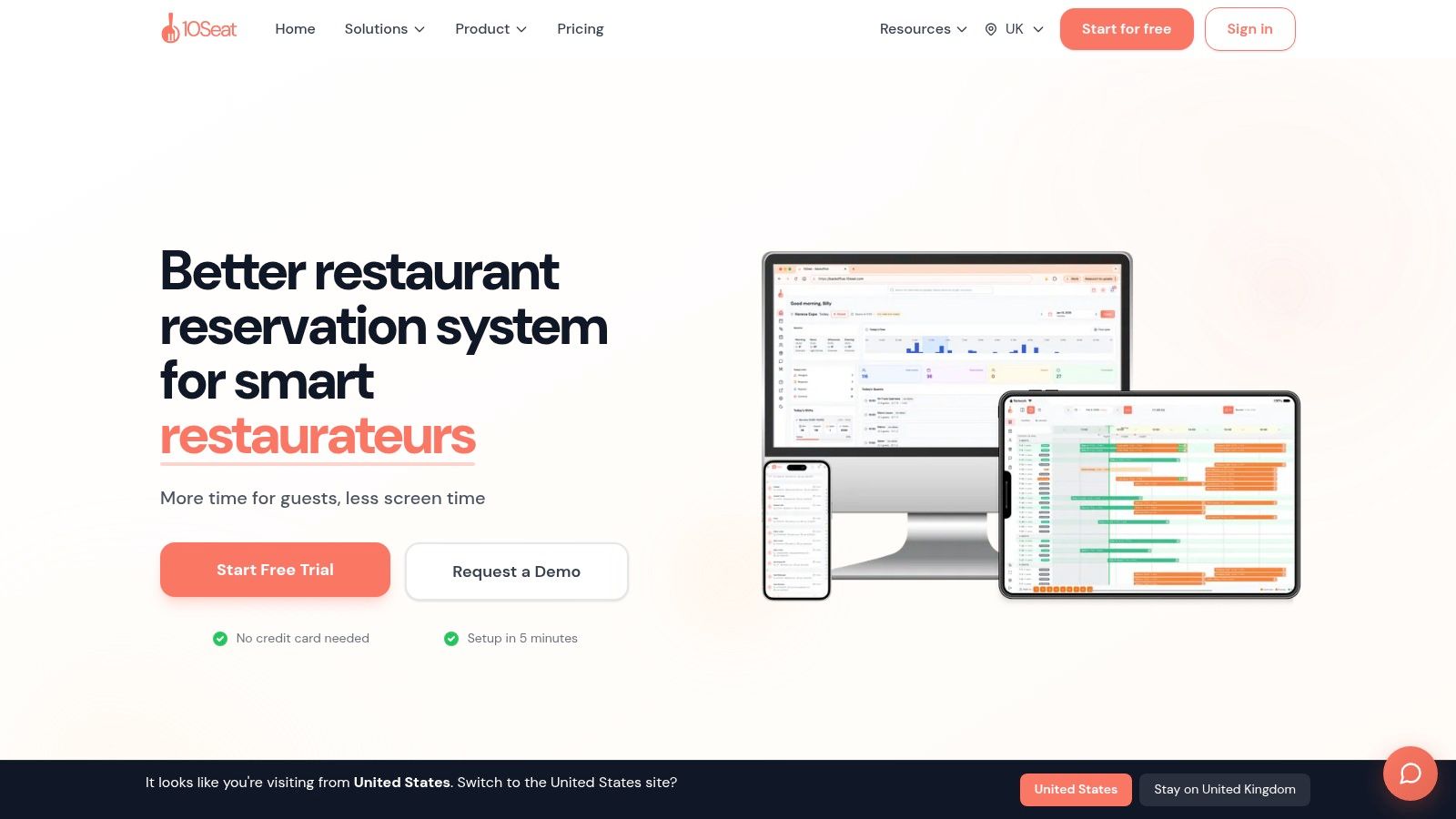
Restaurants using 10Seat see 30% more reservations, 40% fewer no-shows and 10% to 15% more covers per shift, though the numbers still depend on your baseline, staffing and service constraints.
Visit 10Seat to see how live floor management handles bookings, table changes and walk-ins from one shared view, and start with the free On the House plan for up to 50 covers.