Planning a Restaurant: From Concept to Opening Night
Planning a restaurant that actually works. A practical guide covering concept, location, finances, staffing, and launch for owner-chefs and GMs.
You're looking at a lease, a half-finished menu, and a spreadsheet that looks profitable only because every assumption points in your favor. That is where most openings are won or lost. Planning a restaurant isn't picking paint and hoping for covers. It's testing whether demand, labor, kitchen capacity, and rent can survive a bad month before you sign anything.
Table of Contents
- What Planning a Restaurant Actually Means
- Define the Concept and Prove the Market
- Choose the Location with a Sales Forecast, Not a Gut Feeling
- Design the Floor for Variable Demand, Not Static Seats
- Build the Financial Plan Around Prime Cost
- Compare Reservation Platforms on Pricing Model
- Your 30-60-90 Day Pre-Opening Plan
What Planning a Restaurant Actually Means
Planning a restaurant is a constraints exercise, not a creative exercise with a budget attached. Location, labor, food cost, service capacity, and demand variability compete for the same euro before a single plate leaves the kitchen. You don't get to optimize them separately.
Start with realistic survival assumptions. The claim that 90% of restaurants fail in the first year is repeated constantly, but it isn't supported by the longitudinal evidence.
Use a Realistic Baseline, Not Fear
A longitudinal Ohio State University study of 2,439 Columbus restaurants found approximately 26% failed in the first year, 19% in the second, and 14% in the third, producing a cumulative three-year failure rate near 59%. That's serious. It isn't inevitable.
The lesson isn't caution for its own sake. It's that risk stretches across three years, not one opening month. Your plan therefore needs multi-year cash-flow projections, conservative sales assumptions, a break-even analysis, and contingency capital that covers slow ramp-up and cost shocks.
Don't plan for opening night. Plan for the Tuesday in month nine when covers are soft and a key cook quits.
Optimize the Right Target
Most plans chase raw covers. That's the wrong target. More covers can mean more labor, longer tickets, slower turns, and worse hospitality. The better target is contribution margin per constrained hour, whether that constraint is kitchen throughput, host capacity, or available tables at peak.
That shift changes every later decision. A smaller menu that the kitchen executes cleanly beats a broad menu that creates bottlenecks. Shorter hours with strong pacing can beat long hours staffed thinly at the edges. A dining room designed for profitable throughput beats a room designed for maximum seats.
Build the plan around controllable fundamentals: location, concept-market fit, staffing, service capacity, pricing, and cost control. Those are decisions you control before opening. Weather, reviews, and viral attention aren't.
Define the Concept and Prove the Market
Concept work is the cheapest planning you'll do and the most expensive to redo. Write the restaurant down on one page before you tour a single space. If you can't explain it clearly, guests and staff won't understand it either.
Write a One-Page Concept Brief
- Cuisine and menu scope: Name what's served, what isn't, and which items the kitchen must execute perfectly at peak.
- Service style and occasion: Define whether guests come for a fast weekday lunch, a long celebration dinner, brunch, or drinks with food.
- Average check and target guest: State who pays, how often they can return, and what else they could choose nearby.
- Draw radius: Decide whether demand comes from the immediate streets, the wider neighborhood, destination diners, or a mix.
That brief becomes a filter. It tells you which sites to reject, how many seats you need, what staffing model works, and whether prices can support the rent.
Prove Demand on Foot
Walk the trade area at the actual service hours you're proposing. Count pedestrian flow, watch where people enter and exit, and note offices, transit, hotels, schools, theaters, and residential density. Visit direct competitors as a guest. Observe pace, party sizes, price points, empty periods, and where queues form.
Structured research helps you avoid relying on impressions from one sunny Saturday, which is why a practical approach to market research for restaurants is useful before you commit to a site shortlist.
Decision rule: End this stage with a verdict of go, fix, or drop. Do not carry a weak concept into lease negotiations and hope design will save it.
Consider a bistro built for repeat weekday lunch trade from office workers. It needs speed, predictable demand Monday to Friday, and a menu priced for frequent visits. Put that concept in a tourist-heavy area and the logic breaks. Guests arrive in a compressed midday wave, they don't return weekly, and weekend demand looks nothing like weekday demand. The food could be good and the room attractive, but staffing, pacing, and repeat revenue were planned for a market that doesn't exist there.
Fix the concept on paper while fixing it costs nothing.
Choose the Location with a Sales Forecast, Not a Gut Feeling
Location locks in rent, labor pool, guest mix, and daypart pattern for years. Treat it as a model, not an opinion. A broker's confidence isn't a forecast.
The demand model comes before the shortlist is scored.
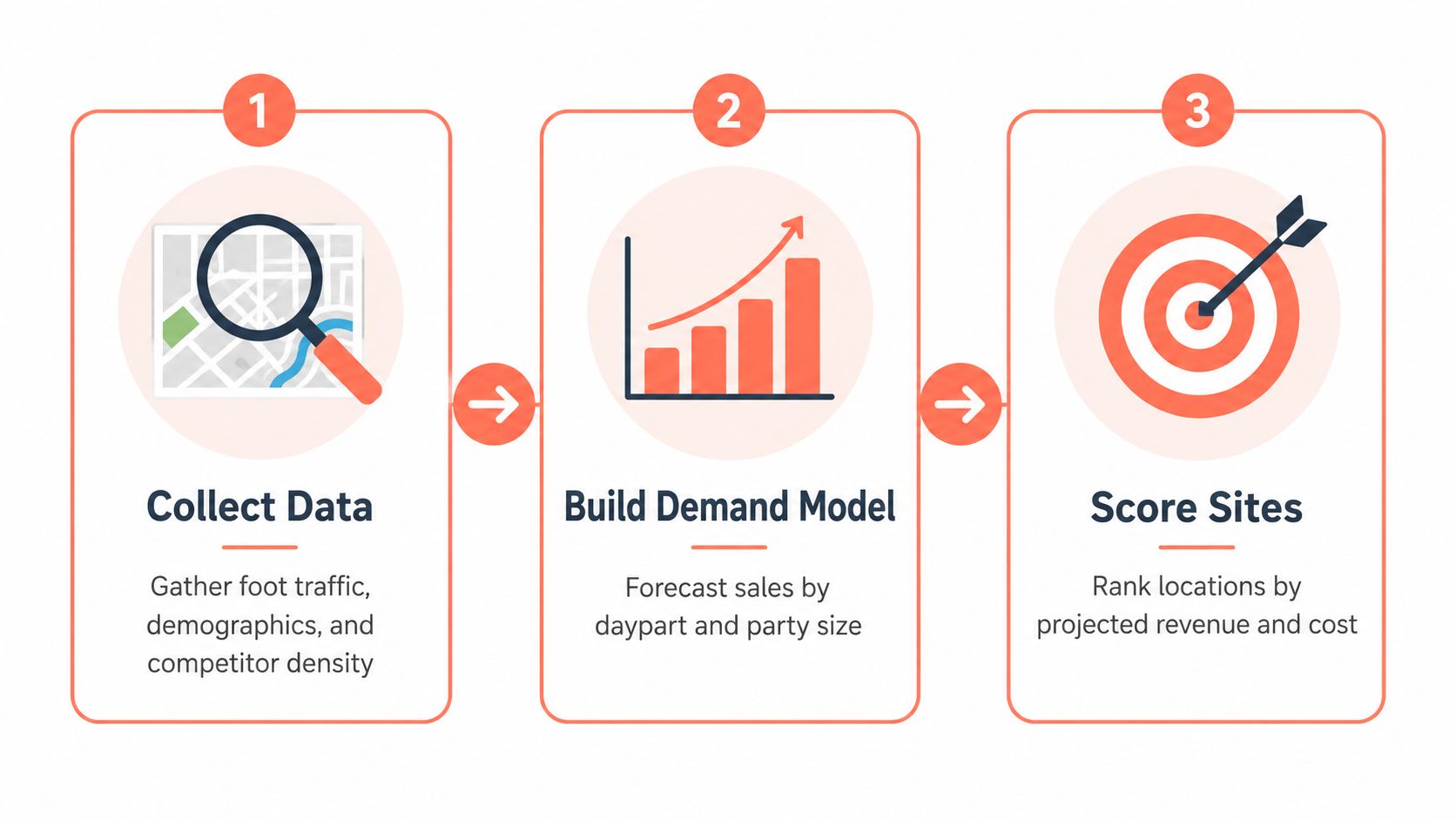
Use Three Stages Before You Sign
- Attribute selection: Identify what drives profitability, including pedestrian access, visibility, nearby demand generators, competition, demographics, and occupancy cost.
- Similarity evaluation: Compare each candidate with proven locations or a carefully chosen peer set with similar guest, price, and daypart patterns.
- Sales prediction: Forecast with a statistical model instead of intuition or a broker estimate.
That sequence matches restaurant location research describing attribute selection, similarity evaluation, and kernel-regression sales prediction, which reports that the approach can improve identification of profitable sites. If you need a plain-language primer before building your own model, see revenue forecast options explained and adapt the method to covers, not just annual sales.
Convert Demand into Operations
Build conservative, base, and upside cases. Translate each case into covers by daypart, average check, table turns, seat count, and opening days. Then test whether required covers are plausible given local traffic, your conversion rate, and the time a table needs for proper service.
Don't stop at annual revenue. Model peak hours. A room can have enough seats across the week and still fail on Friday because the kitchen, host stand, or bar can't handle the compressed peak that produces most revenue.
Stress-test the site by reducing projected revenue and increasing rent pressure, wages, and food prices. Use the practical checks in this guide to choosing a location for a restaurant alongside your own site scores, so qualitative issues like access and visibility don't get lost in the spreadsheet.
Reject a site if the downside case cannot cover fixed costs and realistic operating expenses, even when the base case looks attractive.
Headline foot traffic is the most common trap. Busy pavement means nothing if those people aren't your target guest, aren't there at your dayparts, or won't convert at your price point. Prove alignment, or walk away.
Design the Floor for Variable Demand, Not Static Seats
A floor plan is a forecast of how demand arrives. It isn't a drawing of an empty room filled to legal capacity. Design for party mix, pacing, and kitchen throughput, not for the largest seat count a landlord can advertise.
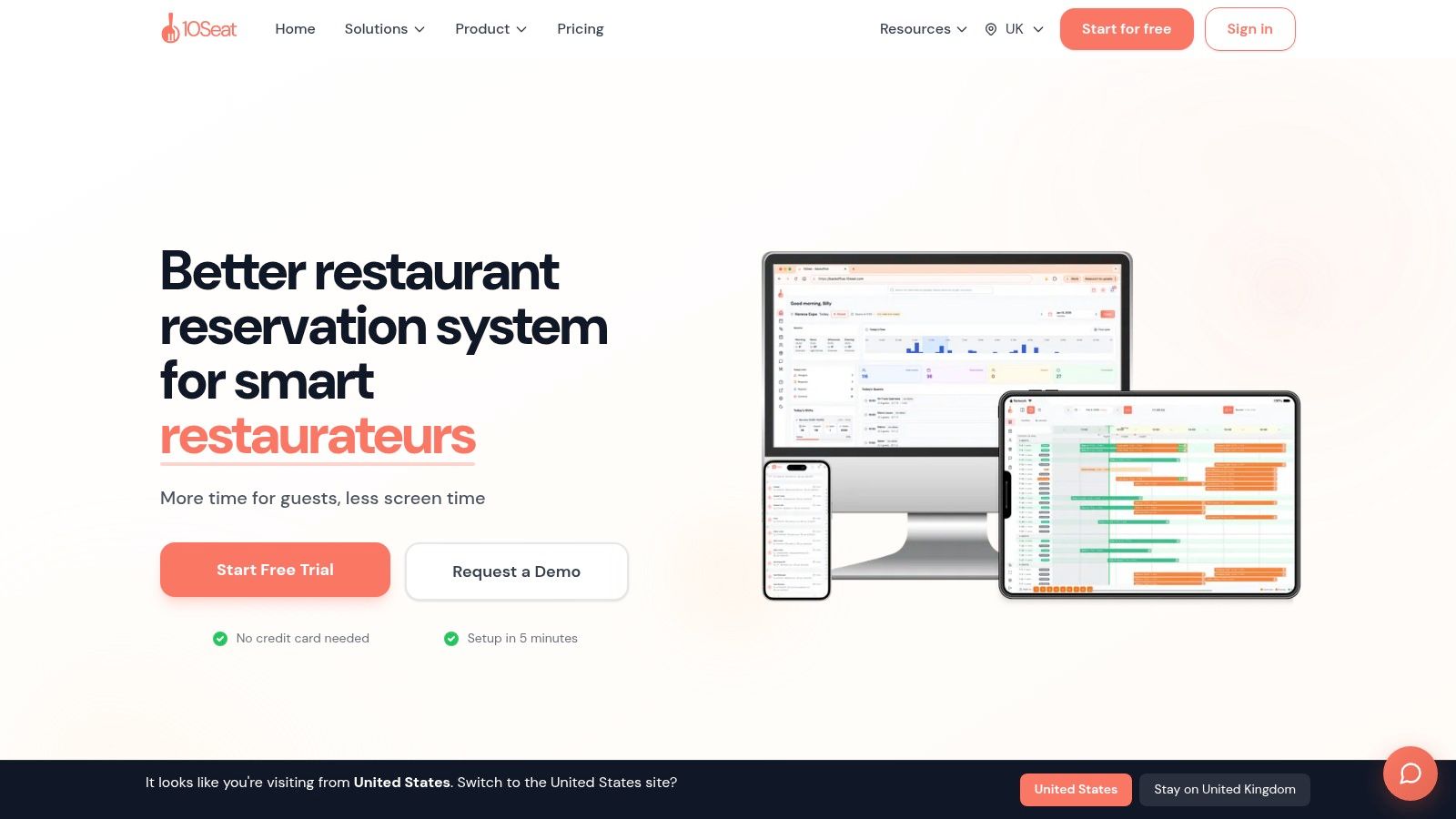
The operating view below shows why table assignment needs to be planned as a live system rather than fixed on paper.
Plan for Parties, Not Seats
Demand arrives unevenly. You get couples who linger, large parties that need joined tables, walk-ins during a reservation peak, late cancellations, and brunch surges that don't resemble dinner. Build flexibility into the room:
- Combinable tables: Use tables that can split and join cleanly without blocking service routes.
- Deliberate walk-in buffer: Hold planned capacity for walk-ins where the concept depends on them, rather than filling every slot in advance.
- Clear service paths: Protect routes for runners and servers, because pretty rows of identical tables create identification and traffic problems during service.
- Acoustic and durable finishes: Choose materials for noise control and cleaning under pressure, not just opening photos.
If you're assessing whether specialist design help is worth it, find a Chicago restaurant architect as an example of the kind of restaurant-specific expertise to look for locally. General contractors often miss acoustics, station placement, restroom flows, and waste handling until changes are expensive.
Adding seats can reduce margin. If the kitchen can't turn tickets at peak, more occupied tables produce longer waits, more comps, and slower turns. Revenue rises briefly. Profitable throughput falls.
Model No-Shows Before Opening
Booked covers aren't arrived covers. Academic and industry research on restaurant reservation practices reports observed no-show rates ranging from 3% to 15% in academic studies, with broader industry observations around 20% described as not unusual. For a 60-seat room with 100 booked covers, that's 3 to 20 covers potentially lost before cancellations and walk-ins are considered.
Your pacing rules, confirmation process, cancellation policy, and table-release logic must account for that gap. An operational layer such as 10Seat's Capacity Engine and Smart Auto Seating fits, assigning bookings to efficient table combinations in real time. Review the table logic on the 10Seat product page and test it against your own party-size assumptions.
The short walkthrough below shows how live reassignment works when demand changes during service.
Design the room for the demand you will get, including the guests who do not show up.
Build the Financial Plan Around Prime Cost
A one-time opening budget won't protect you. Prime cost will show you, week by week, whether the operating model works. Treat it as a discipline, not a year-end accounting exercise.
Know the Formula and the Benchmark
Prime cost equals food and non-alcohol beverage cost plus labor cost, divided by sales. For U.S. full-service restaurants, published benchmark data on restaurant costs puts median food and non-alcohol beverage cost at 32.0% of sales and median labor cost, including salaries, wages, and benefits, at 36.5%. Combined, that's about 68.5% before occupancy and other expenses.
The labor gap is where planning pays or fails. A 2024 benchmark reported median labor costs of 34.2% of sales for profitable full-service operators and 42.9% for unprofitable operators, an 8.7-point gap worth roughly €43,500 on €500,000 of annual sales. That's your concrete ROI case for planning staffing, pacing, and capacity together. Small scheduling errors repeated nightly become a lease-sized problem.
Build Theoretical Models, Then Compare Weekly
Create a recipe-level theoretical food-cost model for every dish. Schedule labor from forecast covers and explicit service standards, flexed by daypart and reservation forecast. Define who opens, who preps, who covers peak, and who closes. Don't add staff to solve a demand problem until you've measured throughput.
Review variances every week. Separate causes instead of staring at one blended percentage.
| Variance | Food side | Labor side |
|---|---|---|
| Price or schedule | Purchasing price paid versus recipe assumption | Scheduled hours versus the roster plan |
| Usage or paid time | Portion usage versus theoretical quantity | Paid hours, including early clock-ins and late finishes |
| Loss or premium | Waste and spoilage recorded by item | Overtime hours and the reason they occurred |
| Mix or productivity | Sales mix shifting toward lower-margin dishes | Sales per labor hour by daypart |
Set alerts when prime cost exceeds your concept target or labor rises faster than covers. Common errors include excluding benefits from labor, treating food cost as fixed despite menu-mix changes, and pricing dishes without updated ingredient costs.
For the wider opening budget beyond weekly operations, see Capital Express on business startup costs to sense-check categories you may have missed. Then come back to the sensitivity test: model 5%, 10%, and 15% increases in labor and ingredient costs, plus weaker demand, before signing the lease. If only the perfect case works, the plan doesn't work.
Don't ask whether the concept can be profitable. Ask which cost movements break it, how quickly you'd see them, and what you'll change first. Price, portion, hours, staffing, and capacity are your levers. Decide the order now, while you're calm.
Compare Reservation Platforms on Pricing Model
Your reservation platform shapes demand mix, acquisition cost, and floor control. It's a planning decision, not an administrative purchase after the POS arrives. Compare pricing models first, features second.
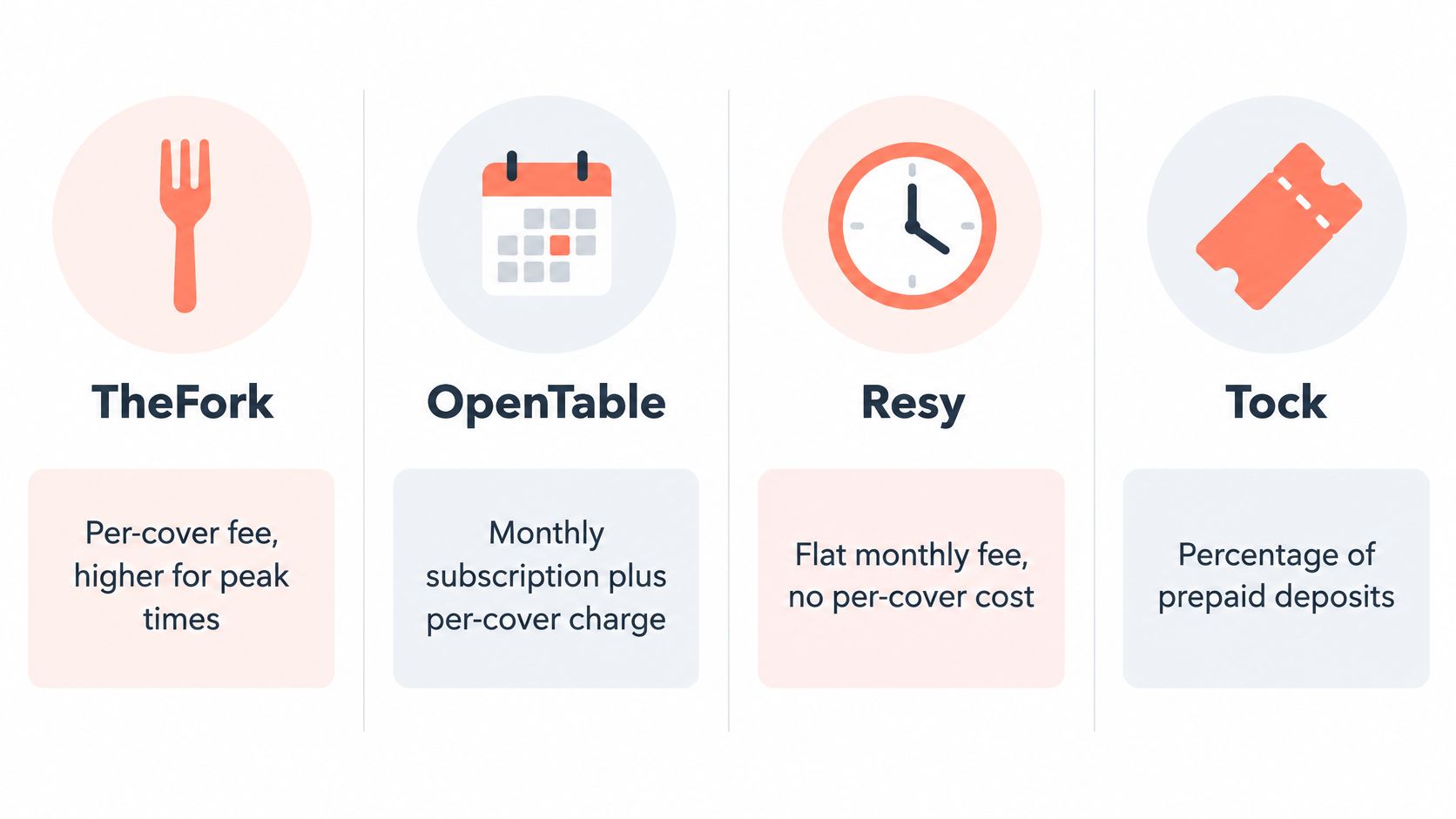
Contrast How Platforms Charge
TheFork and OpenTable have historically charged restaurants a per-cover commission on diners arriving through the channel. That can be useful as a launch channel because cost follows booked demand, but the same structure becomes a recurring margin cost as covers grow.
Zenchef and Formitable publish subscription pricing with no per-cover commission. 10Seat is commission-free, with a free plan up to 50 covers on its On the House tier. Check the current structure on 10Seat pricing before modelling your break-even covers.
Do the math at your forecast volume. At low volume, per-cover pricing may look cheap because there is no large fixed fee. At higher volume, calculate total commission against a flat subscription and ask which channel created the booking. A guest who would have booked direct should not cost the same as a new guest.
Also test operational fit. A platform must support pacing, party-size rules, table combinations, walk-in handling, and real-time reassignment. If it fills slots without respecting kitchen capacity, it creates revenue the team can't serve profitably. Use this review of restaurant reservations app options to compare workflow questions alongside price.
Bring Staffing, Technology, and Compliance Together
Hiring, technology, and legal setup compete for the same pre-opening weeks. Plan them on one timeline. Hire kitchen and floor leads first, then build a skeleton crew around them. Define service standards by role, train to those standards, and schedule by daypart and reservation forecast from day one.
Choose POS, payment processing, and reservations as an integrated stack. Test modifiers, printer routing, payment flow, table status, and guest notes during mocked service. A system that works in a demo can fail at peak if staff need too many taps or orders print to the wrong station.
For Belgian operators, cash-register compliance belongs in the opening budget, not as a late surprise. In Belgium, the Geregistreerd Kassasysteem, or GKS, is mandatory for businesses where annual turnover from restaurant and catering services exceeds €25,000 excluding VAT, with VAT receipts issued at the moment the service is completed. Include GKS-compatible POS equipment, implementation time, staff training, and receipt procedures. Map compliance across every sales channel in the establishment, not only table service.
Pre-opening check: Permits, insurance, supplier contracts, menu prices checked against theoretical food cost, trained leads, tested technology, and a soft opening with mocked service. If one item is missing, opening night becomes the test.
Run at least two soft services with invited guests, staggered arrivals, and a structured debrief. Watch ticket times, host decisions, table identification, payment delays, and where staff hesitate. Fix the few issues that hurt guests most. Don't rewrite the whole menu because one table disliked one dish.
Your 30-60-90 Day Pre-Opening Plan
Dates force decisions. Use this sequence to turn the plan into deliverables with an owner and a deadline, not a collection of good intentions.
Days 1 to 30 Prove the Idea
Owner-chef or GM delivers: a one-page concept brief, target guest profile, trade-area walk notes, competitor visits, and a first prime-cost model. The decision at the end of this window is blunt: proceed, revise the concept, or stop. No site should be negotiated seriously until that call is made.
Test menu items for execution time and theoretical cost during this phase. A dish that tastes right at home but blocks a station during peak needs redesign now.
Days 31 to 60 Prove the Site and Numbers
Owner with broker and accountant delivers: a scored location shortlist, proposals from landlords, peer comparisons, and conservative, base, and upside forecasts. Run sensitivity tests on rent, wages, food prices, and weaker demand. Reject any site where the downside case can't cover fixed costs.
Draft the floor plan from party mix and pacing assumptions during this window. Confirm kitchen throughput, host capacity, storage, waste flow, and staff routes before lease terms harden around the wrong layout.
Days 61 to 90 Build the Operating System
GM and head chef deliver: permits in progress, POS and reservation platform selected, GKS-compliant equipment ordered where applicable, supplier contracts signed, and kitchen and floor leads hired. Train the skeleton crew, load menus and modifiers, test payments, and configure table combinations and pacing rules.
Close this window with two soft-opening services. Stagger guests, create realistic pressure, debrief immediately, and fix priority issues before public opening. Track what changed between the first and second service so improvements are visible, not guessed.
A restaurant is a system. The plan that survives treats demand, labor, and food cost as variables, not constants.
That's the standard for every decision above. If a choice only works when demand is smooth, labor is cheap, and guests behave predictably, it isn't a plan yet. Rewrite it until it survives contact with a real service.
10Seat gives independent restaurants commission-free reservation management with capacity and table-assignment tools built for variable party sizes, walk-ins, and peak-hour pressure. Use it to connect your floor plan, pacing rules, and booking flow before opening night, then start on the free plan and test your actual service assumptions. Visit 10Seat to set up your restaurant and plan the room you can run profitably.