Location for a Restaurant: Step-by-Step Site Selection Guide
Choose the right location for a restaurant with our step-by-step guide covering demographics, foot traffic, rent benchmarks, permits, and GKS compliance.
Location can account for 60% to 70% of a restaurant's success variance, according to a figure commonly attributed to Cornell University School of Hotel Administration. The right location for a restaurant matters more than a polished menu, an admired chef, or an expensive launch campaign.
That statistic should change how an owner-chef or GM evaluates a new site. A busy road isn't automatically a good address, and a fashionable neighborhood won't rescue a concept whose rent, access, and customer base don't fit. The strongest operators assess a location as a live operating system, using qualified traffic, daypart demand, customer fit, competition, access, compliance, and forecast sales together.
Table of Contents
- Why Location Matters More Than Your Menu
- How to Measure Foot Traffic and Turn It into Sales
- Evaluating Rent, Competition, and Accessibility
- Navigating Zoning, Permits, and GKS Compliance
- Running Site Visits That Actually Reveal the Truth
- Using a Weighted Scorecard to Pick the Best Site
- Final Checklist and Next Steps Before Signing
Why Location Matters More Than Your Menu
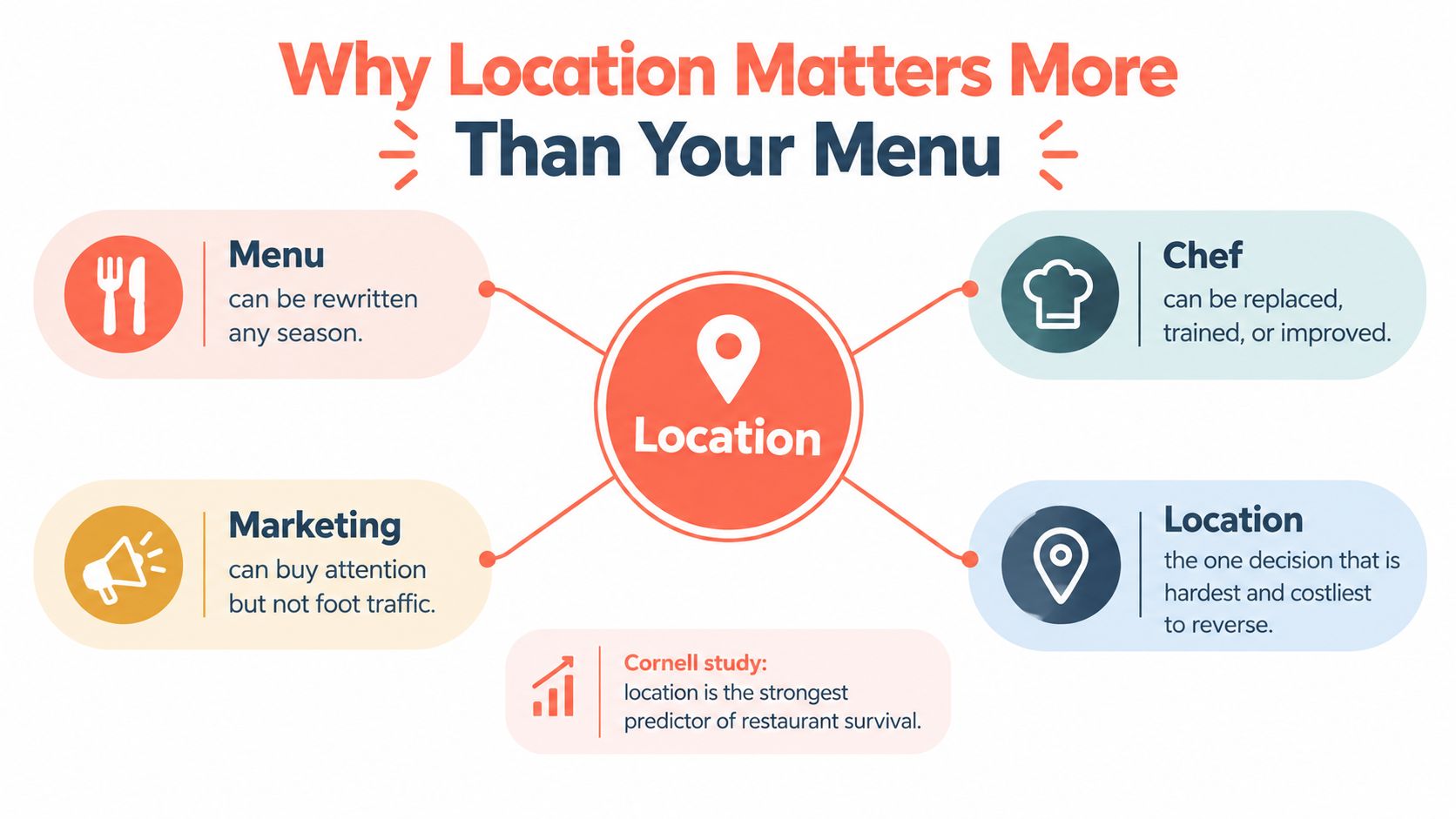
A menu can be rewritten. A chef can be trained, replaced, or supported by a stronger brigade. Marketing can buy attention. Location is the decision that's hardest and most expensive to reverse.
The Cornell figure makes the commercial argument clearly. If location explains 60% to 70% of success variance, then the address deserves more analytical attention than branding details that can still change after opening. A restaurant with an excellent concept in the wrong catchment has to fight for every cover. A simpler concept in the right catchment can build repeat demand through convenience and habit.
Judge the catchment, not the street
A trade area defines the customer pool from which most revenue will come. Site-selection models commonly divide that pool into three zones:
- Primary trade area: This zone generates 55% to 70% of customers, making it the most important area to validate. (Restaurant Site Finder explains restaurant trade areas)
- Secondary trade area: This contributes 15% to 20% of customers, often through destination visits, workplace traffic, or occasional trips. (Restaurant Site Finder explains restaurant trade areas)
- Tertiary fringe area: This supplies the remaining customers and usually depends on stronger differentiation or destination appeal. (Restaurant Site Finder explains restaurant trade areas)
Those zones aren't just circles on a map. They need to be tested against your price point, cuisine, service speed, opening hours, and daypart. A breakfast café needs morning access and nearby routines. A fine-dining restaurant needs evening convenience, destination appeal, and enough customers willing to travel.
Practical rule: Stop asking whether a site is busy. Ask whether the people passing it have a reason to enter your restaurant at the time you need them.
Visibility still matters, but it works only when the surrounding catchment can support the concept. Operators assessing frontage, access, construction constraints, and site usability can also consult this practical guide to location-based commercial construction advice. The right address combines discovery with customer relevance. That's why qualified traffic should lead the analysis, not replace it.
How to Measure Foot Traffic and Turn It into Sales
Pedestrian counts are useful only after they're filtered for intent. A commuter rushing toward a station, a shopper browsing nearby units, a local resident walking a dog, and an office worker looking for lunch all represent different commercial opportunities.
A 2022 research review identifies population density, real-estate prices, parking, traffic, mapping-app visibility, and competition density as relevant location factors. It also points to underused sources such as Google Maps, municipal capacity records, and reservation systems. (The research review on restaurant location suitability)
Count the traffic that can become covers
For an urban fast-casual concept, one industry guide gives a peak-window benchmark of 800 to 1,200 pedestrians. The same guide reports that sites with 1,000 or more daily pedestrians outperform lower-footfall sites by about 35% on average. (Kwickspot's restaurant location selection guide)
Those figures shouldn't be treated as automatic revenue forecasts. They're screening benchmarks. The operator still needs to record:
- Daypart alignment: Count traffic during the exact breakfast, lunch, dinner, or late-night window the concept depends on.
- Customer relevance: Separate likely guests from people with no reason to stop.
- Direction and speed: Fast-moving traffic may see the storefront but never have enough time to enter.
- Conversion friction: Crossings, stairs, poor sightlines, and obstructed entrances reduce the value of raw footfall.
- Repeat potential: Local residents and nearby workers can create more dependable demand than occasional passers-by.
The practical calculation is simple: estimate qualified pedestrians, apply a realistic visit assumption based on the concept, then translate expected visits into covers and sales. The visit assumption must come from observed behavior and comparable operating data, not optimism.
Protect the rent-to-sales relationship
Rent should be tested against forecast sales before the lease becomes emotionally attractive. Industry guidance recommends keeping occupancy cost at or below about 8% of sales, with 10% treated as a profitability warning threshold. Independent guidance cites median occupancy costs of 5.7% for full-service restaurants and 5.2% for limited-service restaurants, while recommending total occupancy costs stay below 10% of revenue. (Mytraffic's restaurant site-selection guidance)
| Service Type | Recommended Max | Median Benchmark |
|---|---|---|
| Full-service restaurant | 8% of sales, with 10% as a warning threshold | 5.7% of sales |
| Limited-service restaurant | 8% of sales, with 10% as a warning threshold | 5.2% of sales |
A high-footfall site can still be a poor location for a restaurant if the traffic doesn't match the offer. A lower-rent site may be stronger if discovery, access, and customer intent produce dependable covers. The decision should come from the relationship between qualified traffic and occupancy cost, not from the landlord's description of the street.
Evaluating Rent, Competition, and Accessibility
Rent isn't dangerous by itself. Misaligned rent is dangerous. A high-rent corner can work when visibility creates qualified demand, access is simple, and forecast sales support the occupancy cost. A cheaper unit can lose money when customers struggle to park, find the entrance, or understand what the restaurant offers.
Operators should screen candidate locations using measured footfall, trade-area demographics, competitive density, zoning and permitting feasibility, and occupancy cost. The analysis then converts traffic into expected covers and revenue before comparing rent with forecast sales. (Mytraffic outlines the site-selection method)
Compare the whole operating burden
A site visit should assess more than the guest entrance. Check delivery access, staff arrival routes, waste collection, kitchen extraction, parking turnover, and the path from pavement to table. Poor ingress and egress create guest frustration, while poor staff access can make recruitment and retention harder.

A useful comparison looks like this:
- High-rent, high-visibility site: Accept it only when qualified traffic, frontage, access, and forecast sales justify the premium.
- Lower-rent, weaker-discovery site: Accept it when mapping visibility, local demand, parking, and destination appeal compensate for the quieter frontage.
- Busy but awkward site: Reject it when parking, crossings, delivery access, or entrance visibility create too much friction.
- Well-priced but overcompetitive site: Reject it when direct competitors already own the same daypart and customer occasion.
For competition, use a defined walking radius instead of saying an area feels crowded. One published framework uses fewer than 4 direct competitors within 500 meters per 10,000 residents as a minimum criterion. It also specifies at least 4 meters of unobstructed frontage, with parking within 150 meters unless substantially higher pedestrian flow compensates. (Masterestaurant's operational site benchmark)
Read the lease before reading the sign
The headline rent isn't the complete occupancy cost. Service charges, repair obligations, indexation, fit-out responsibilities, break clauses, permitted use, and renewal terms can alter the economics. Before committing, restaurant operators should use a clear guide to reading a commercial lease agreement and have local counsel review the final document.
The internal analysis should also include market research for restaurants, especially when a high-rent site competes with a quieter site that may have stronger local fit. A site passes only when the rent-to-sales ratio remains viable after realistic operating assumptions.
Navigating Zoning, Permits, and GKS Compliance
A promising address can become an expensive mistake if the premises cannot legally support the intended operation. Verification needs to happen before signing, not after the deposit is paid.
Start by requesting the property's zoning classification and permitted food-service use from the municipality. Then confirm whether the planned kitchen, extraction system, grease capacity, waste handling, outdoor seating, signage, alcohol service, delivery activity, and operating hours are allowed.
Request documents before committing
The landlord should provide documentation for the premises, utilities, previous use, building systems, and any known restrictions. The operator should ask the municipality and relevant authorities to confirm:
- Permitted use: The site must allow the intended restaurant format.
- Kitchen infrastructure: Hood extraction, grease management, power, gas, drainage, and ventilation must support the menu.
- Occupancy and fire requirements: The planned seating and layout must fit applicable safety rules.
- Noise and opening hours: Neighbour complaints can restrict a concept even when food service itself is permitted.
- Construction permissions: The fit-out must be feasible within the building and local approval process.
In Belgium, operators must also address GKS, the Geregistreerd Kassasysteem, when the business falls within the applicable registered cash register requirements. The system affects how restaurant sales are recorded and how the operation handles fiscal compliance. It should be included in the pre-opening plan alongside the POS, accounting workflow, receipts, and reporting process, rather than treated as an administrative detail after the kitchen is installed.
The broader risk is material. An industry guide citing Kalibrate research says an average of 91,500 restaurants closed annually between 2022 and 2024, with location factors playing a significant role in many closures. Another guide summarizing Bureau of Labor Statistics data analyzed by SCORE says roughly 81% of restaurants survive year one, while just over half continue after five years. (GoFoodservice's guide to choosing a restaurant location)
For Belgian operators, the VAT on food guidance from 10seat can sit alongside advice from the accountant and fiscal adviser when the operating model is being built. Operators researching scaling brands and off-market sites should apply the same compliance discipline to every location, whether the property came through a broker or a private introduction.
Running Site Visits That Actually Reveal the Truth
A single drive-by proves almost nothing. A location for a restaurant can look excellent during a sunny lunch and fail during dinner, weekends, bad weather, or delivery periods.
Candidate sites should be tested at multiple times of day and across different days of the week, because lunch, dinner, and weekend patterns can differ sharply. The operator should distinguish commuter flow from steady evening traffic before deciding whether the site fits breakfast, lunch, dinner, or all-day service. (Restaurant Site Finder's guide to testing restaurant locations)

Observe the service reality
Each visit should produce evidence, not impressions. Count qualified pedestrians, note weather and local activity, observe parking turnover, and record how easily people see and enter nearby restaurants. Watch whether competing venues fill from local residents, office workers, destination diners, or passing traffic.
The physical layout matters just as much. A narrow entrance, a hidden staircase, a delivery bay beside the dining room, or a queue that blocks the pavement can affect the guest experience before the first course leaves the kitchen. The proposed dining room should also be tested against the restaurant floor plan and layout considerations.
Turn visits into a decision record
After each visit, record the same observations in the same format. A useful scorecard includes:
- Qualified traffic during the target daypart.
- Customer mix and apparent intent.
- Parking, walking routes, and entrance visibility.
- Competitor activity and spacing.
- Delivery, waste, and staff access.
- Noise, odour, construction, and neighbourhood conditions.
The operator should avoid changing the criteria to favour a preferred address. If the site passes only during one convenient visit, it hasn't passed. The strongest evidence comes from repeated observations that agree with the sales forecast.
Using a Weighted Scorecard to Pick the Best Site
Three plausible addresses can produce decision paralysis because each one wins on a different variable. The cure is a weighted scorecard created before the final choice.
First, define the concept's commercial priority. A quick-service lunch offer may weight qualified pedestrian flow and speed of access heavily. A destination dining room may give more weight to parking, evening convenience, acoustic conditions, and rent-to-sales ratio. A brunch venue may need a different balance again.
Set non-negotiable thresholds
The published benchmark below provides a practical starting point for rejecting weak sites. It isn't a substitute for local validation, but it prevents attractive properties from surviving on instinct alone. (Masterestaurant's site-selection thresholds)
| Criterion | Minimum Standard |
|---|---|
| Qualified pedestrian flow | At least 400 people per hour in the peak window |
| Rent | Capped at 10% of projected sales |
| Direct competition | Fewer than 4 direct competitors within 500 meters per 10,000 residents |
| Frontage | At least 4 meters unobstructed |
| Parking | Within 150 meters, or substantially higher pedestrian flow to compensate |
A threshold is a pass or fail, not a soft preference. If rent exceeds the limit, the forecast needs a documented reason and a credible sales case. If frontage is too narrow, the operator shouldn't award extra points for attractive interior finishes.
Weight the variables that drive the concept
After the pass/fail screen, score surviving sites against the variables that matter most:
- Traffic alignment: Does the flow arrive when the restaurant needs covers?
- Access: Can guests, suppliers, and staff reach the premises without avoidable friction?
- Frontage and discovery: Can the concept communicate itself from the pavement and mapping apps?
- Parking: Does the site serve customers who arrive by car?
- Competitive spacing: Is there room for the offer, or is the same occasion already well served?
- Rent-to-sales ratio: Does occupancy cost leave room for labour, food, utilities, and marketing?
The final score should include written evidence for every rating. That record gives owners, partners, and investors a clear explanation of why a less glamorous site may be financially stronger.
The best site isn't the one with the highest raw score. It's the one that passes the hard constraints and wins on the variables the concept actually needs.
Final Checklist and Next Steps Before Signing
Before signing, the operator should treat the lease as the final output of the analysis, not the beginning of it. Every important assumption needs a document, a site observation, or a forecast that another person can challenge.
The pre-signing review
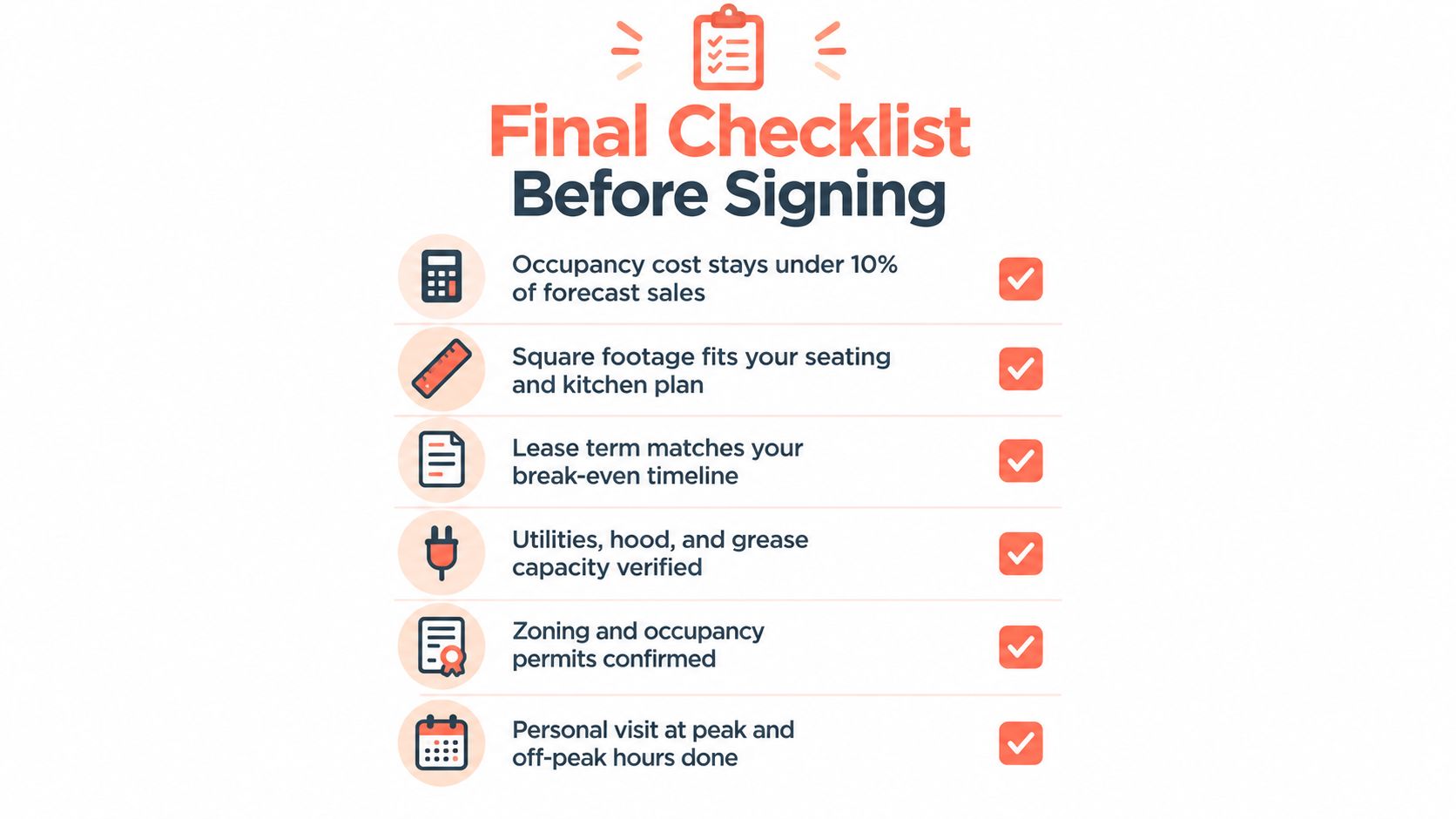
The final review should confirm:
- Occupancy economics: Rent and total occupancy cost fit the forecast sales model. The operating plan should keep occupancy cost at or below about 8% of sales, while treating 10% as a profitability warning threshold. (Mytraffic's occupancy-cost guidance)
- Demand evidence: The site has been visited during relevant peak and off-peak periods, not judged from one drive-by.
- Physical fit: The premises can accommodate the kitchen, extraction, storage, toilets, circulation, seating plan, and delivery flow.
- Legal viability: Zoning, occupancy, fire, noise, signage, alcohol, and operating permissions have been checked.
- Competitive position: Direct competitors have been mapped by concept, daypart, price, and customer occasion.
- Lease protection: Permitted use, fit-out rights, repair obligations, rent changes, break options, and opening conditions are understood.
- Operational readiness: Belgian operators have included GKS compliance in the cash-management and POS plan where applicable.
An urban fast-casual operator can use 800 to 1,200 pedestrians during the peak service window as a traffic benchmark, while the cited guide reports that sites with 1,000 or more daily pedestrians outperform lower-footfall sites by about 35% on average. (Kwickspot's urban fast-casual traffic guidance) The figures help screen a site, but they don't override customer fit, access, or rent.
A better decision than the obvious corner
Consider two candidates. The first sits on a prominent corner with impressive raw traffic, but the rent strains the forecast and evening access is poor. The second has less visual drama, stronger local relevance, workable parking, and a healthier rent-to-sales ratio.
The disciplined operator chooses the second site if repeated observations show that qualified customers arrive during the target service, the premises pass compliance checks, and the scorecard supports the forecast. Once the address is secured, reservation and table management can help the team control pacing, combine bookings with walk-ins, and use existing tables more efficiently. 10seat is a commission-free reservation management platform for independent restaurants in the Benelux, with live booking and floor-management tools that support that operating task.
The location decision creates the potential. Daily measurement and disciplined service management determine whether that potential becomes reliable covers.
10seat helps independent restaurants manage reservations, table configurations, pacing, and walk-ins without commission-based booking fees. Visit 10seat to see how the platform can turn a carefully selected location into more consistent service and better use of the dining room.