Manager Tools DISC: Coaching for Busy Floors
Manager tools DISC explained for restaurant GMs: four styles, shift coaching moves, and when one clear standard beats a personality label.
Skip the certificate. Manager tools DISC sort self-reported behavior into four patterns: Dominance, Influence, Steadiness and Conscientiousness. Use them to change how you coach tonight, never to decide who gets hired.
The popular advice says assess everyone, learn the letters, then phrase every instruction in the style's preferred language. That turns a questionnaire into a management system, and a system built on self-reported preference lets a weak habit hide behind a letter. The narrower version survives a Saturday night. Pick one person and one visible miss. Write one hypothesis about what happened. Keep the standard exactly the same and change only the order of the words. Judge it on the next shift, not on the profile.
Table of Contents
- Four DISC Styles You Can Use Tonight
- What the Scores Can and Cannot Prove
- How to Adapt the Message by Situation
- Standards You Do Not Bend by Style
- Retention Habits That Beat a Profile
- Belgian GKS Dates Your Floor Still Has to Meet
- Run a One-Week Coaching Test
Four DISC Styles You Can Use Tonight
Start with the lookup, because that's what you need before the next shift, not a certificate for the wall. Manager tools built on DISC sort self-reported behavior into four patterns: Dominance, Influence, Steadiness and Conscientiousness, still called Compliance in older material. The model dates to 1928, when American physiological psychologist William Moulton Marston published Emotions of Normal People and described four broad response patterns built on how a person sees themselves against a friendly or hostile environment. The history of DISC timeline published by Everything DiSC traces today's questionnaires to industrial psychologist Walter V. Clarke and his 1940s work in personnel selection, not to Marston himself. The instrument in front of you is a later commercial product built on his framework.
So treat a score as a snapshot of how someone tends to act when the room feels friendly or hostile. It is not a skill test, not a measure of guest recovery, and not a hiring filter.
| Style | Notices first | Coaching move | Backfires when |
|---|---|---|---|
| Dominance | Pace, control, and the result | State the outcome and the deadline in one line | You debate them in front of the pass |
| Influence | People, energy, and recognition | Give a brief human beat, then the ask | You deliver a long critique mid-rush |
| Steadiness | What will stay the same | Name the change and what does not change | You alter the rota with no warning |
| Conscientiousness | Accuracy and the standard | Give the spec and the reason | You say just handle it with no detail |
The move that backfires is usually your habit
Read the last column again. None of those failures are the employee's style problem. Debating a fast, control-oriented cook in front of the pass costs you the whole line's attention. Delivering a written critique to a people-oriented server in the middle of a rush lands as public shame. Swapping a section on the rota without telling a steady, routine-driven commis chef creates the anxiety you were trying to avoid. Telling an accuracy-driven pastry chef to just handle it removes the one thing they need, the specification.
If you want a plain-language version of the four patterns to hand to a supervisor who has never seen this material, this guide to the four DISC personality types explains the model without the vendor jargon.
Practical rule: one hypothesis beside one name. "This closer may need the spec before the pep talk" is a hypothesis. "She's a C" is a label, and labels stop you from watching the floor.
Write it on a lineup card, in pencil, and expect to erase it.
What the Scores Can and Cannot Prove
The technical case for DISC-style instruments is real but narrow. Read the numbers by interval, because the interval is where the story sits.
| Check | Interval | Reported figure |
|---|---|---|
| Internal consistency | Same sitting | Median alpha 0.87 |
| Test-retest | Typical retest | Median 0.86 |
| Test-retest | One week | 0.87 to 0.89 |
| Test-retest | Five to seven months | 0.73 to 0.84 |
| Test-retest | One year | 0.71 to 0.80 |
The published validation summary of Everything DiSC research behind this table reports a median coefficient alpha of 0.87 across the instrument's scales and a median test-retest reliability of 0.86. That work also examined the assessment's circumplex structure through multidimensional scaling and factor analysis, and cites correlations with the Revised NEO Personality Inventory and the Sixteen Personality Factor Questionnaire as evidence of construct validity.
Read the table as a short-term snapshot that softens with time. Alpha shows the questions in a scale hang together in one sitting. The retest rows are the ones that matter to you: strong after a week, weaker across five to seven months, weaker still after a year. The letter drifts. Nothing in these figures says it predicts who survives a Saturday double or who leads a brigade.
Who those figures belong to
They belong to the tested instrument, not to every quiz on the internet. Different item sets, scoring systems and normative samples mean you cannot paste a 0.87 onto a free ten-minute test a server found on their phone. Ask a vendor for equivalent reliability data before you treat their output as more than a conversation starter.
Self-reports move with stress, self-awareness and the mood of the week. A score taken in someone's worst month measures the month.
Use a score the way you use a hunch about a new hire: a hypothesis you test against the floor. Retest when the person is not in a bad stretch. A profile can open a conversation. It cannot reject a candidate, set pay, or explain away a missed allergen call. When two managers disagree about what happened on a shift, another questionnaire will not settle it. The shift log will.
How to Adapt the Message by Situation
Four moments repeat in every dining room: the rush, the error, the review, the schedule change. You don't need a new theory for each. You need one standard that stays fixed and a delivery that flexes.
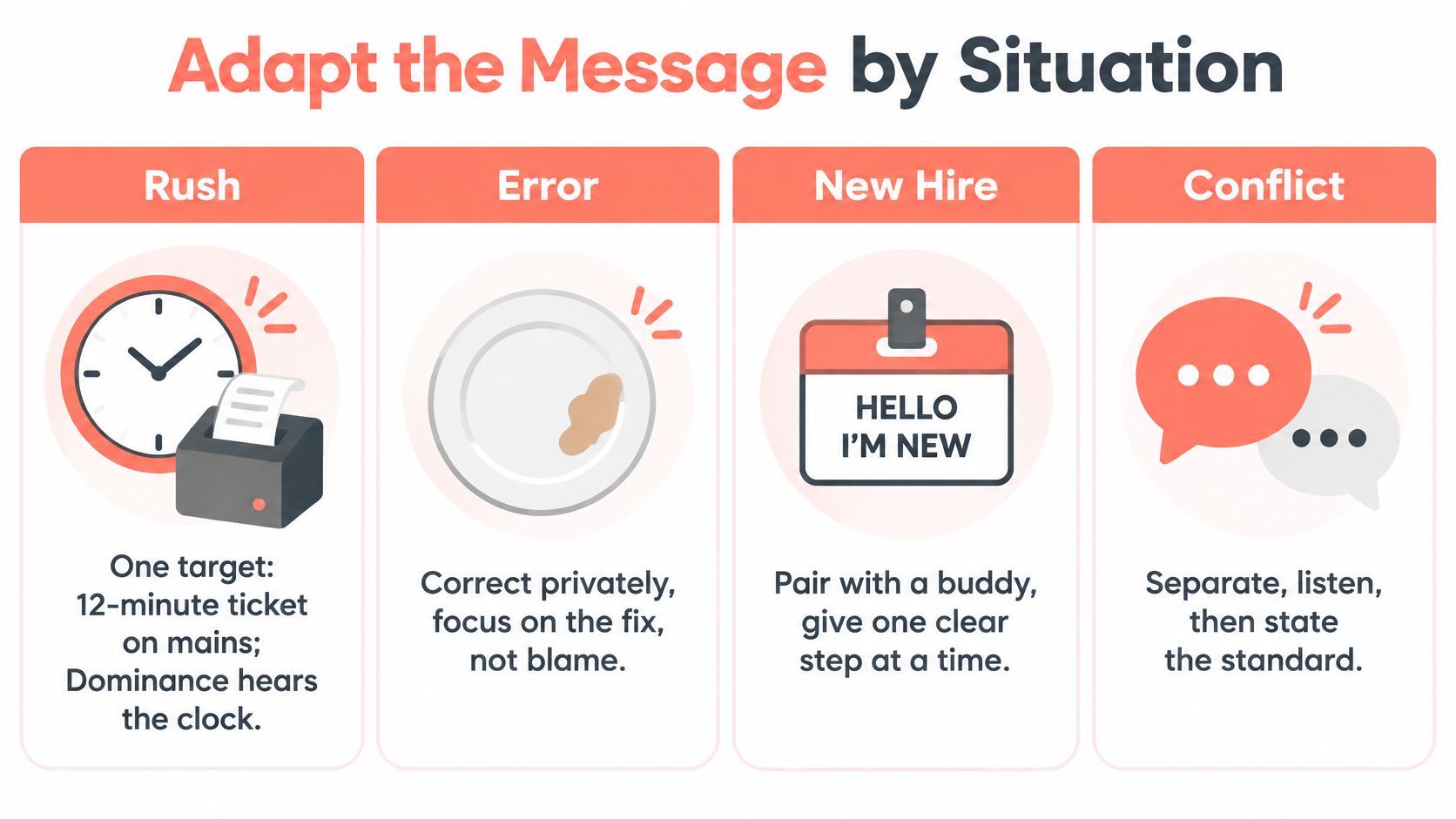
| Moment | Standard that stays fixed | What you change | Sign it worked |
|---|---|---|---|
| Rush | Ticket time and station ownership | Order of the words, not the target | The person repeats the time and the owner |
| Conflict | Guest recovery before blame | Questions about what was said and sent | Next plate matches the recovery |
| Review | Readiness, recovery, follow-through | Which fact you lead with | The person names one change for next week |
| Schedule change | Fair notice and the start time | How much context you add | No surprise when the person clocks in |
Rush
Set one target, say twelve minutes on mains, then vary the packaging. A pace-and-control cook hears the clock and the ownership. A people-oriented server hears who needs help on the station. A routine-driven commis hears that sections stay exactly as set out in the prep sheet. An accuracy-driven chef hears which chits count and what doesn't.
Same words every time, in this order: "Twelve on mains, you own the grill handoff, sections set, chits 41 to 47 count and the amuse doesn't."
Conflict
Separate the guest recovery from the personality story, every time. Three questions settle it: what did the guest hear, what did the kitchen send, and what happens on the next plate. Anything past that is theatre, and it usually damages the person who is already having the worst shift of their week.
Review
Keep the same three facts for everyone: station readiness, guest recovery, follow-through. Change only the order. Lead with the gap for someone who wants the problem up front. Lead with one true strength for someone who needs the ground under them before criticism. Someone who processes slowly needs a beat to think, so don't demand an answer in the same breath. Someone who wants evidence wants dates and examples, not adjectives.
Schedule change
Say what changed, what did not change, and when it starts. Give a 60-second version at pre-shift and a two-minute version after service for anyone who wants the detail. Vague reassurance ("it'll be fine") is what creates the rumour.
The check that matters: the person restates the task, the station is ready, or the same miss doesn't repeat next shift. If none of those move, stop adjusting tone and manage the behaviour.
Standards You Do Not Bend by Style
Allergen calls. Alcohol service. Cash handling. Gas and knife safety. Harassment rules. These get one wording for the entire team, and the wording does not soften because someone prefers calm or shorten because someone prefers speed.
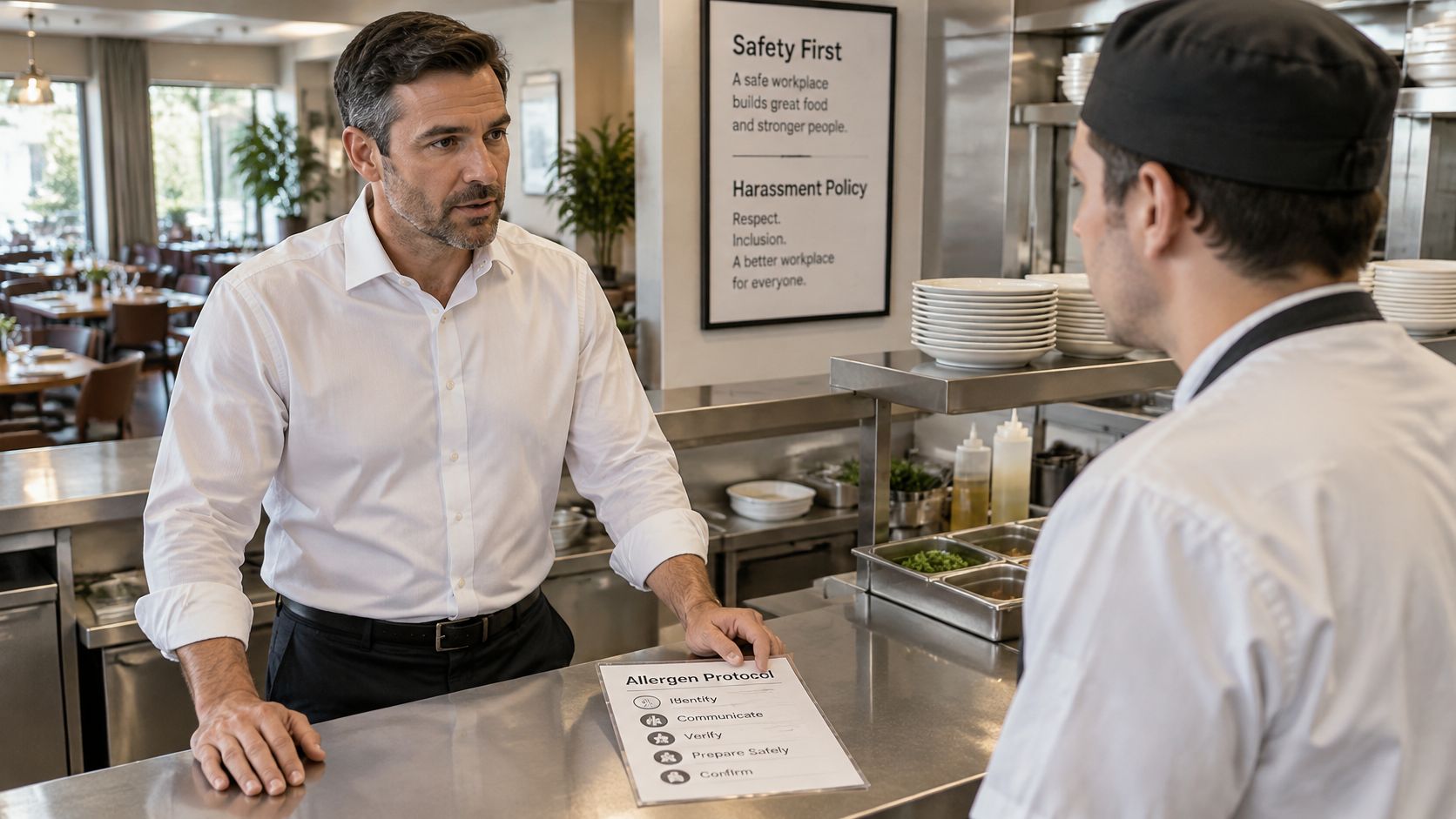
A steady, measured server does not earn a looser allergen script. A fast, decisive closer does not earn a skipped void procedure. The moment your standards flex by preference, you've stopped coaching style and started running a room where the rule depends on who's on shift. Fairness breaks the same way. Send one closer home with a quiet recap and haul another over the coals for the identical miss, and the team reads favouritism, not flexibility.
Three floor cases make the line concrete. A dish that hits 86 gets announced once, in the same words, to every section, whoever is on the pass. A late party is held to the house release time, not to whoever argues hardest at the door. A no-call, no-show on the rota is handled under the written policy first and discussed privately after, to find the cause. If you want the service-standard side of this written down properly, the fine dining service standards breakdown is a sensible template for the language.
Think of a recipe card. You can change how you teach a new cook the sauce. You don't change the salt because the cook prefers stories to numbers.
Five lines stay identical for every style: the allergen script, the 86 announcement, the void rule, the release time for late parties, and who to call when the printer dies. Read them at pre-shift, keep them unchanged mid-service, and start style coaching only after they're clear.
Here's the video walkthrough of how that standard-first coaching sounds in practice.
Retention Habits That Beat a Profile
The retention numbers are harsher than any personality report. Annual employee turnover approached 80% in January 2024, compared with about 74% during the decade before the pandemic, and 54% of operators still had difficulty filling management and back-of-house roles in 2025, according to Deloitte's frontline human capital research on restaurants. The same research identifies the first 30 to 90 days as critical, links more than three hours of structured orientation with roughly 13% lower non-management turnover in full-service restaurants, and ties front-of-house training above 13 hours to approximately 11% better turnover outcomes.
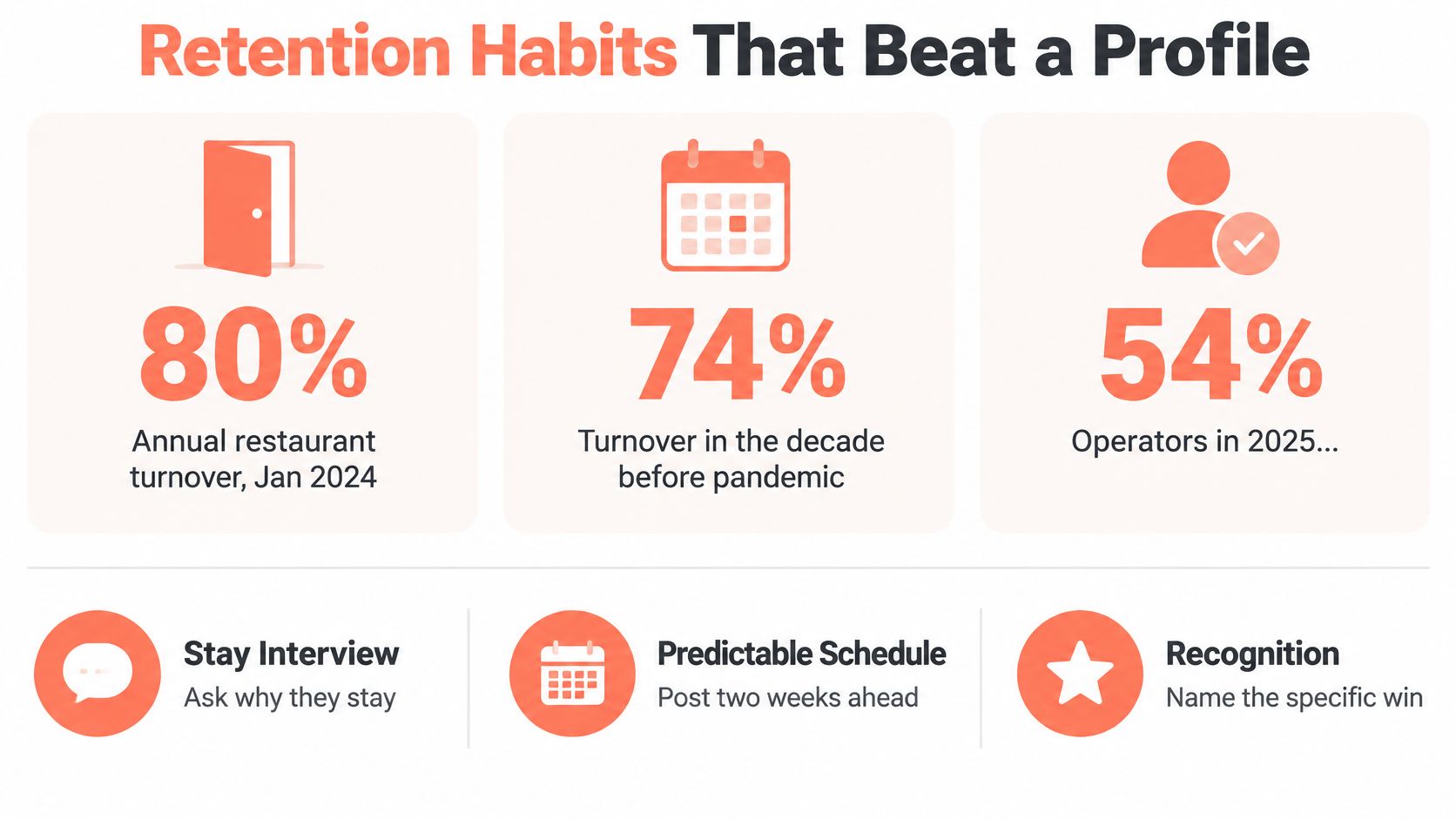
Those gains come from structured hours, not from guessing a letter on day one. Nobody stays because a manager correctly identified their style. They stay because the section map made sense, the schedule landed two weeks early, and someone told them plainly when they got something right.
Standardize these, no exceptions
- The section map and sidework list: same format for every new hire, printed, no verbal variation.
- The allergen script: identical words, drilled in the first week.
- The void and discount rule: one procedure, one approver.
- Break times and the handover point: written, not negotiated per person.
- Who to call when the printer, the till, or the cold room fails: one name and one number on the wall.
Tailor only these
The pre-shift coaching sentence, the moment you give feedback, and whether you confirm understanding out loud or in a note. That's the whole tailoring budget, and it costs minutes rather than hours.
Give a 15-minute day-one brief, then a day-30 check on three behaviours: on time, station ready, guest issue recovered. If all three are solid, style notes are optional and probably unnecessary. If one is failing, fix the habit before anyone buys another assessment. Keep a light log, three columns, the message you gave, the response you saw, and the next-shift outcome. Two lines per shift is enough to see which habits move results, and it beats a personality report you read once in March.
Belgian GKS Dates Your Floor Still Has to Meet
Coaching tools don't replace the cash system Belgian law requires. Put the deadline on the same management list as your pre-shift routine, because it will outlast most of your staff.
The Belgian Federal Public Service Finance announcement on GKS 2.0 sets the deadlines in the table below. From 1 July 2026, new hospitality businesses must run a certified GKS 2.0 system: the cash register plus the fiscal data module, also called the black box. Existing businesses get longer, and the cut-off depends on when the current register was bought.
| Situation | Purchase window | Deadline |
|---|---|---|
| New hospitality business | First register | 1 July 2026, certified GKS 2.0 |
| Existing register | Before 1 January 2018 | 1 July 2027 |
| Existing register | 1 January 2018 through 31 December 2021 | 1 July 2028 |
| Existing register | From 1 January 2022 | 1 January 2029 |
If you run more than one register, the most recent purchase date sets your deadline. One invoice decides the date for every till you own.
Check the purchase invoice this month. Write the replacement year beside it, then brief the manager who will still be in the building when that year arrives, which is rarely the person who bought the till. Swapping registers means deliveries, hardware runs and a stockroom to keep straight alongside service. If you need someone to own that side of the operation, browse logistics and warehousing openings to see the kind of profile that handles it.
A booking screen is not a GKS. Keep one till procedure that never changes by personality: how to open, how to void, how to close. 10Seat's read-only POS integration shows covers and pacing without disrupting operations, and it never touches the fiscal record. For the weekly operating rhythm around all of this, use the guide to how to run a restaurant.
Run a One-Week Coaching Test
DISC earns its keep only when it survives contact with a real shift. Run it as a three-service experiment that fits inside pre-shift and costs about two minutes per shift. That is the entire administrative load, and it is what separates a coaching tool from a personality label.
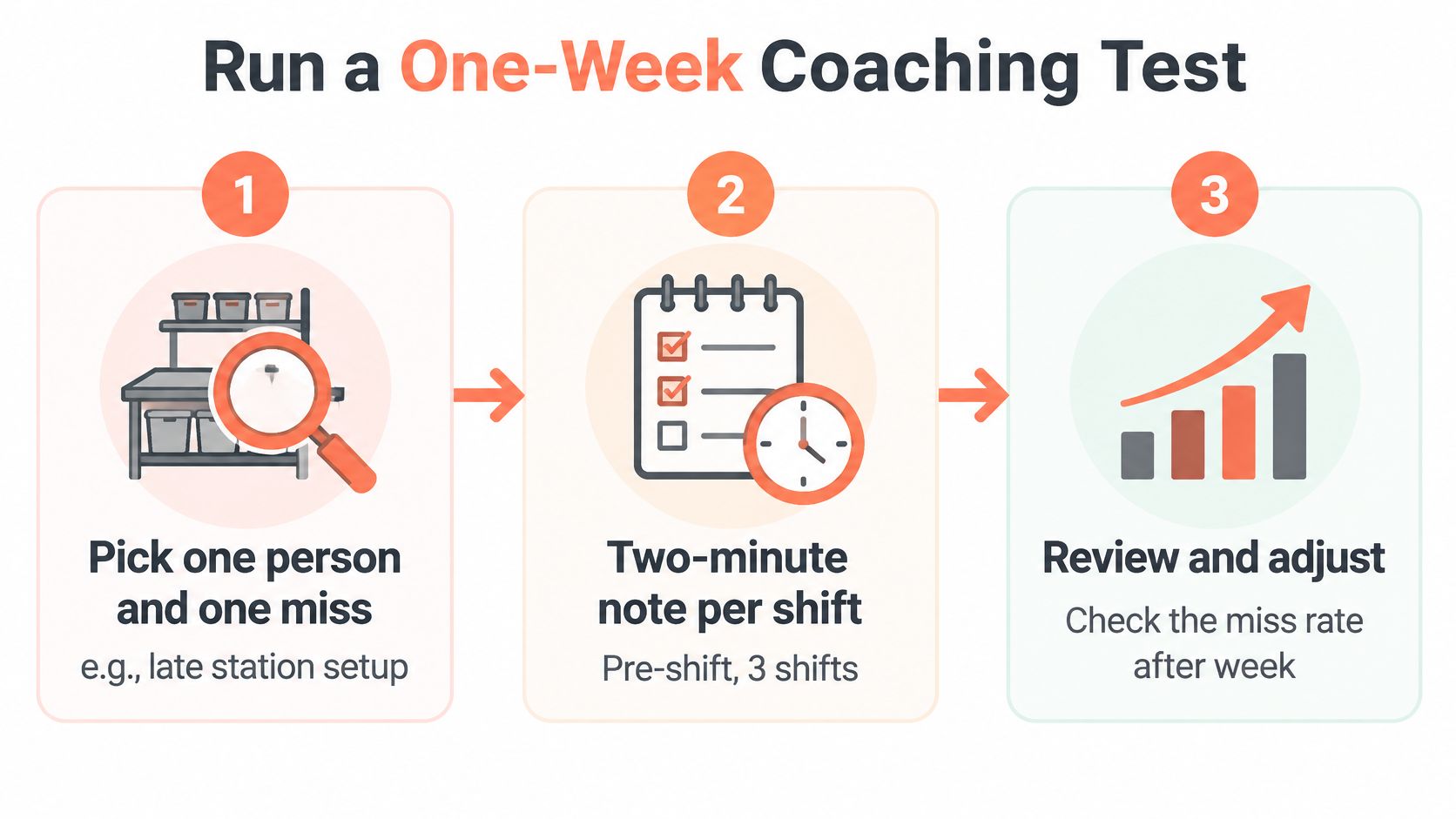
- Pick one person and one miss you can see. Late station setup, a weak handover, plates leaving without a wipe. Something a camera could catch.
- Write a one-line hypothesis. "This closer may need the spec before the pep talk." A guess about delivery, not a verdict on character.
- Deliver the same standard you'd give anyone, changing only the order of the words.
- Log the response during the shift in six words or fewer. Restated the time. Argued. Went quiet. Fixed the station.
- On the next shift, score only the outcome. Ready or not, recovered or not, followed through or not.
- If the outcome improved, keep that delivery for two more shifts. That is how a cue becomes a habit rather than a theory.
- If it didn't improve, drop the style story and coach the task again with a demonstration.
A notebook line or a note on the lineup card is enough. Skip the spreadsheet; that is where coaching systems go to die.
Why test at all? Because DISC scores were never designed to measure skills, capability or job success. Critics warn the framework is too limited to represent people's complexity or to support hiring decisions, and coaching practitioners make the same point from the other direction: results are self-reported snapshots shaped by stress, self-awareness and context, with weak evidence for predicting leadership or workplace performance. So use the model where it holds up, generating hypotheses, and test every one against shift-level behaviour.
A Saturday worked through
Say your last food call is 9pm and two bartenders keep missing it in different ways. Tell the fast, control-oriented one in a single sentence: "Last food call 9pm, you call it, I back you." Tell the accuracy-driven one the same cut-off with the detail they need: "9pm is the cut-off, drinks orders after that are fine, food chits after that are voided."
Both still stop at 9. Neither gets a different rule. After three services you either have a repeatable cue or proof the cue was theatre. For the host side of that same shift, this piece on restaurant host training covers how to hold the door script steady while the coaching flexes.
Booking data is the other half of the test. An unreplaced table loses real revenue, whatever its size, so an empty seat at 8pm is money gone rather than an annoyance. That is why the test needs a live view: table and floor management in 10Seat shows all tables live during service, so staff can seat guests, manage changes and handle walk-ins, and Capacity Booster adds 10 to 15% more covers per busy shift within the existing floor plan, with no extra tables needed. There's no lengthy onboarding and no daily maintenance, so the two minutes you spend on the coaching note stays two minutes instead of growing into an admin job.
Coaching that never gets checked is just a nicer way of guessing. 10Seat gives you the evidence to check it: live tables, live covers, and a record of what happened on the shift you coached. Run the three-shift test on one person this week, then let the floor data tell you whether the change held. Start free at 10Seat and put the two minutes where they earn something back.