Management in a Restaurant: A Practical Operator's Guide
A practical guide to management in a restaurant, covering staffing, floor control, cost discipline, and tools that help independent operators run tighter
Your host has guests waiting, the kitchen is asking for breathing room, and a server wants permission to move a booking. You're trying to protect tonight's sales without promising a service your team can't deliver. That's where management in a restaurant becomes practical: deciding what happens next, who owns it, and what must stop.
Table of Contents
- Friday Night at a Full Restaurant
- What Restaurant Management Actually Covers
- The Core Responsibilities of a Restaurant Manager
- Running a Live Service Without Losing the Room
- Getting More Covers Without Adding Staff
- Reservation Tools and Commission Models Compared
- GKS Compliance for Belgian Restaurants
- A Weekly Operating Checklist for the GM
Friday Night at a Full Restaurant
Consider a Friday service with 28 covers booked, two no-shows, a VIP arriving early, and a party of six asking to change its seating arrangement. Then a line cook walks away from the pass. This is a hypothetical shift, not a performance case study, but the competing demands are familiar.
Your first temptation might be to solve whichever problem is loudest. Seat the VIP. Move the larger party. Tell the kitchen to catch up. Each move looks reasonable alone, but together they can overload the same section and send another wave of orders into an already weakened kitchen.
The immediate job is to establish the constraint. Ask the chef what the remaining team can execute, then tell the host what seating pace that supports. Until those answers agree, an empty table isn't necessarily an available table.
Decide what must wait
The VIP needs a welcome, not an automatic jump into an overloaded section. The larger party needs a workable configuration, not a reshuffle that breaks later reservations. The absent guests need handling under a disclosed policy, not an improvised decision based on who complains first.
Make the operational priorities explicit:
- Kitchen capacity: Confirm which station is short and which dishes are affected.
- Guest communication: Give waiting parties an honest explanation and a named contact.
- Floor ownership: Put a capable person in charge of seating while you resolve the staffing problem.
- Commercial restraint: Don't accept demand that the remaining team can't serve properly.
Practical rule: Protect the next service decision before trying to recover the entire evening.
You're managing people, tables, production, and money at the same time. A policy manual can support those decisions, but it can't make them for you.
The useful operating system is one that makes responsibilities clear before pressure arrives. Your team should know who can pause seating, authorize recovery, adjust assignments, and communicate a revised promise to guests.
What Restaurant Management Actually Covers
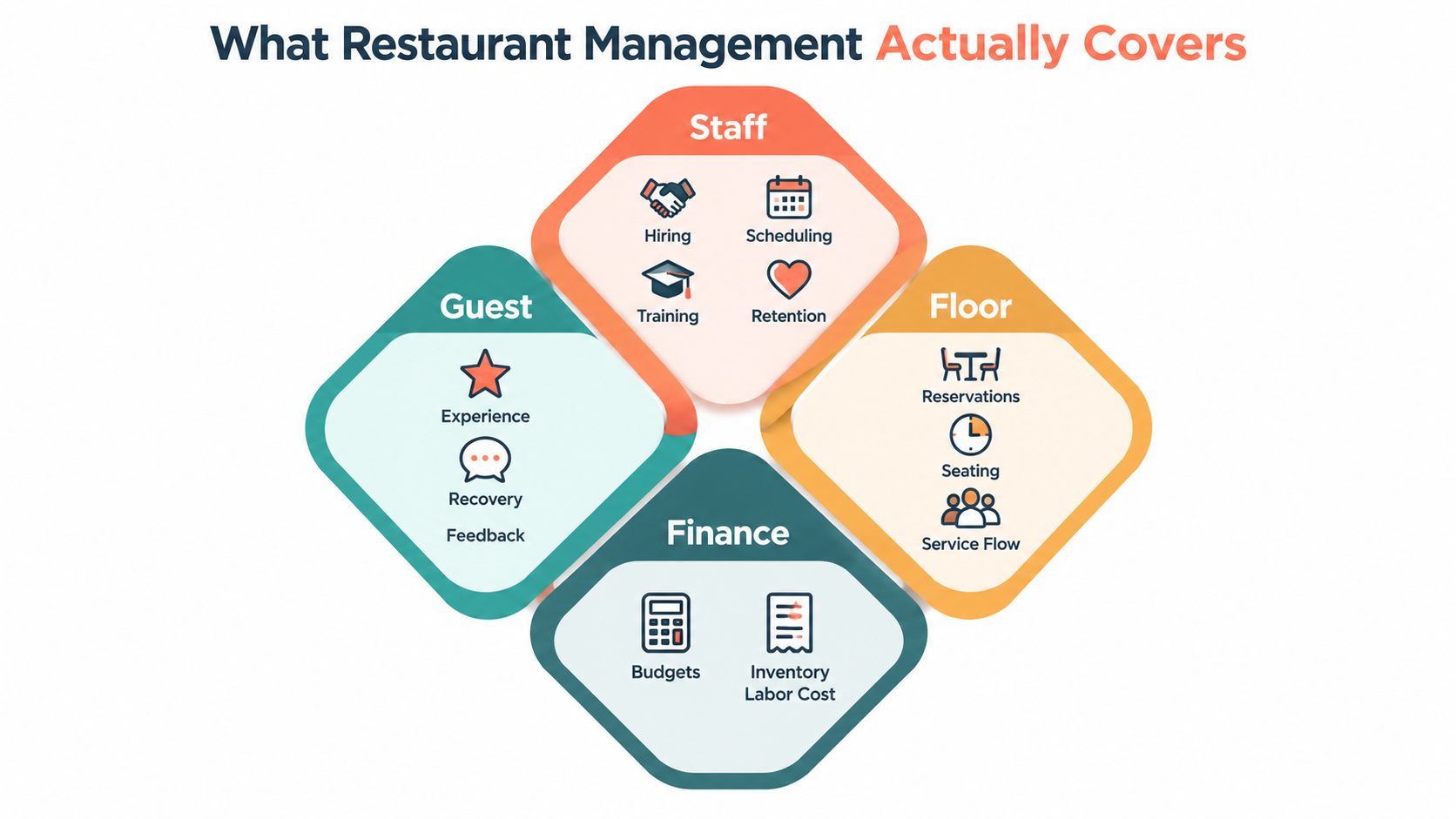
Management in a restaurant is an operating system, not a job title. For an independent operator, it helps to divide that system into staff, floor, kitchen, and finance. Guest experience runs across all of them.
That scope reflects the structure of the industry. In the United States, 9 in 10 restaurants have fewer than 50 employees, and 7 in 10 are single-unit operations, according to the National Restaurant Association's industry statistics. Those are US figures, not Benelux benchmarks, but they illustrate why independent managers often carry responsibilities that larger businesses divide between departments.
The diagram places guest experience alongside staff, floor, and finance. In daily operations, kitchen execution must also have a clear owner.
Give each layer a decision owner
Your staff layer covers recruitment, scheduling, training, and retention. Its practical output is a team that knows its stations, escalation routes, and limits. A rota filled with names isn't enough if nobody can cover the role that fails during peak service.
The floor layer covers bookings, seating, pacing, and recovery. Its owner decides whether a table can receive another party without damaging existing service commitments.
Kitchen management connects preparation to actual demand. Prep availability, station workload, ticket progress, and food-safety checks belong here. The finance layer translates those decisions into labor expense, food cost, booking expense, and contribution from the covers served.
| Layer | Question before service |
|---|---|
| Staff | Who can perform each essential role today? |
| Floor | What arrivals can the room absorb? |
| Kitchen | What can the team produce consistently? |
| Finance | Which service decisions protect contribution? |
Manage the connections
A floor decision becomes a kitchen workload. A staffing decision changes the service you can sell. A recovery decision affects both guest confidence and contribution.
Don't treat those connections as someone else's problem. Assign an owner to each layer, then agree how information crosses between them. An owner-chef can sketch that arrangement beside the floor plan and use it during the briefing.
The Core Responsibilities of a Restaurant Manager
The GM's responsibilities should follow the order in which the restaurant operates. Your job isn't to personally perform every task. It's to make sure essential tasks have an owner, a standard, and an escalation point.
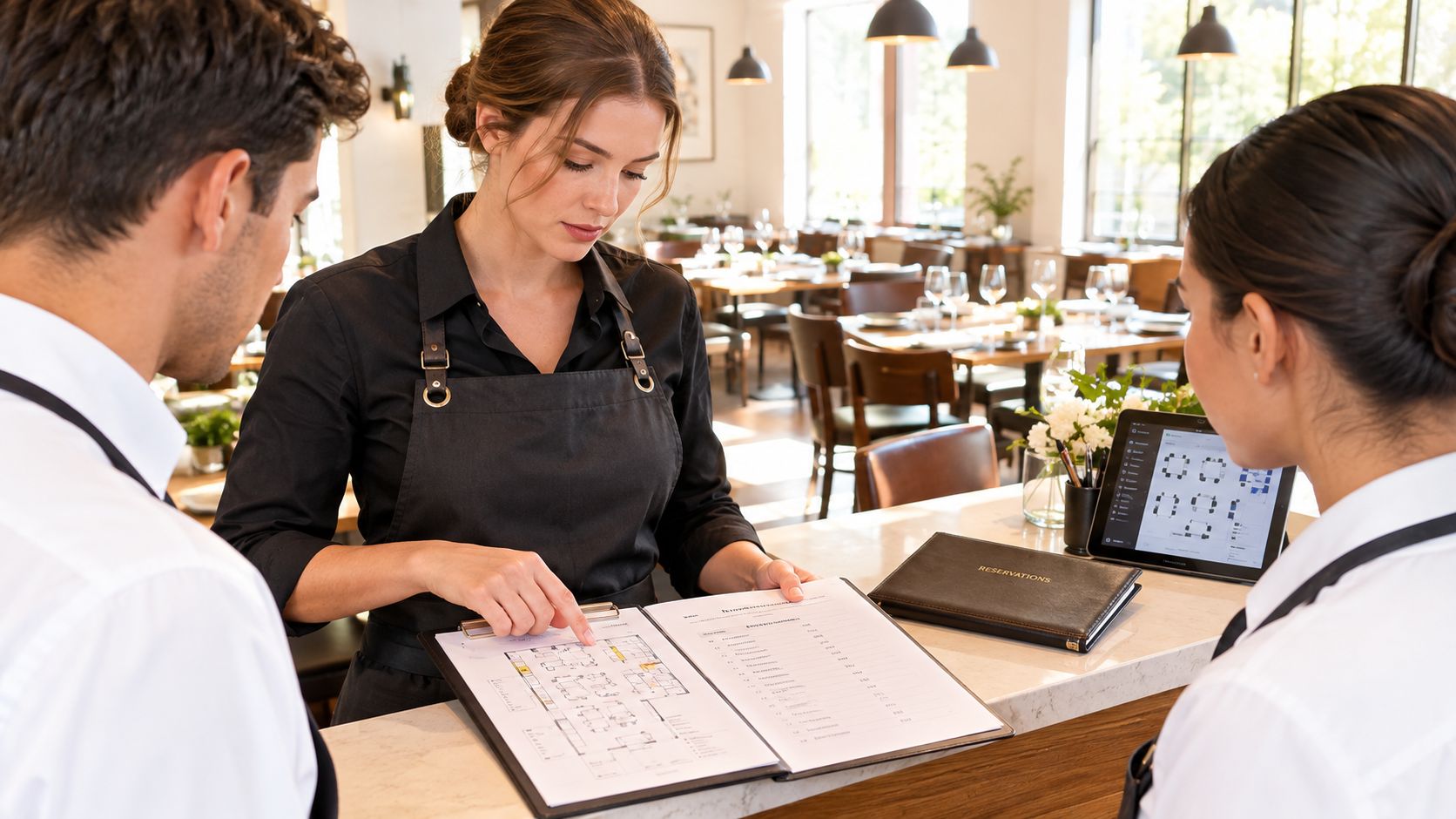
Use the reservation list and floor plan together during the briefing, rather than treating them as separate documents.
Before and during service
The pre-shift briefing should explain what differs today: missing staff, unavailable dishes, unusual parties, accessibility requirements, and expected pressure points. Avoid reading out information everyone already knows. Ask staff to confirm the decisions that affect their work.
Section assignment comes next. Balance expected workload, not just table count. A server handling a demanding celebration and a complicated allergy conversation may need support even when another section has more seated guests.
Reservation and walk-in balancing belongs to a named floor lead. Give that person authority to hold arrivals when the kitchen or service team reaches its limit. Otherwise, the host becomes responsible for accepting demand but powerless to control it.
- Ticket pacing: Watch whether delays affect a station, a dish, or the whole pass.
- Guest recovery: Authorize proportionate action and ensure someone follows up.
- Food and safety: Confirm that checks are completed, not merely assigned.
- Staff support: Move help toward the bottleneck instead of asking everyone to work faster.
Reconcile the shift before leaving
At close, reconcile payments, refunds, discounts, booking outcomes, and unresolved guest issues. Explain exceptions while the people involved can still remember them. A vague note about a difficult table won't help the next manager.
Next-day preparation should convert tonight's failures into specific actions. A missing garnish needs a prep correction. Repeated confusion at reception needs a clearer ownership rule. Neither needs a general speech about standards.
Watch outputs alongside costs. In a Cornell study of 60 units, average operational efficiency was 0.820, and researchers estimated that closing the gap with better-performing units could increase revenue and tips by approximately 24%, as described in the Cornell restaurant-efficiency study.
That's an efficiency opportunity in the studied chain, not a promise for your venue. The useful management lesson is to examine ticket-time creep, slower turns, and labor-percentage drift together before cutting hours.
Running a Live Service Without Losing the Room
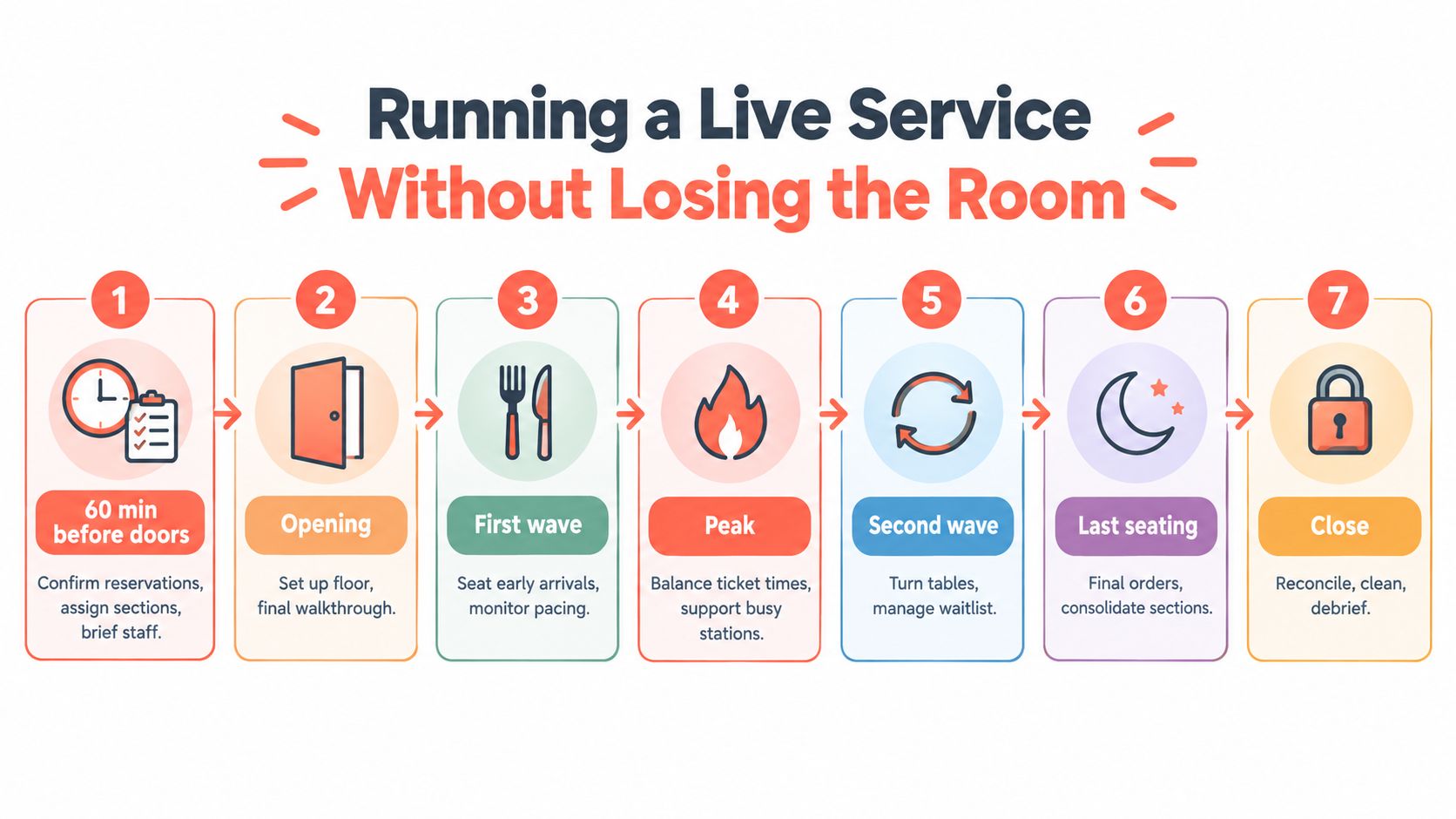
Run service as a sequence of decisions, not a fixed timetable that ignores what's happening. The workflow below is a suggested operating routine, not a measured time-saving claim.
Use the service stages as checkpoints for changing the plan.
Establish readiness and absorb arrivals
Before doors: Review bookings, assign sections, and inspect readiness at reception and the pass. If prep is incomplete, change availability before guests order the affected dishes.
At opening, walk the actual guest route. Check that staff can find booking notes, communicate allergies, and identify who owns an exception. An attractive floor plan doesn't compensate for an unclear handover.
The first wave tests whether the planned rhythm works. If the kitchen starts accumulating unfinished tickets, don't keep seating at the original pace just because reservations are arriving on time.
- Peak: Support the constrained station and obtain a credible update on stuck tickets.
- Second wave: Confirm tables are fully reset before promising them to waiting guests.
- Last seating: Agree final ordering arrangements with the kitchen before consolidating sections.
- Close: Reconcile the shift, complete safety checks, and leave actionable handover notes.
Keep safety inside the workflow
Cooling food needs a monitored procedure. The FDA Food Code's cooling requirements specify cooling cooked time/temperature-control-for-safety food from 135°F (57°C) to 70°F (21°C) within 2 hours, then to 41°F (5°C) or below within the next 4 hours. These are US requirements, not a substitute for applicable Belgian, Dutch, or Luxembourg rules.
Assign cooling checks to a named employee, use calibrated thermometers, and record the checkpoints. A manager should verify the record before accepting that the task is complete.
For a supplementary staff-training resource, review BacteriaFAQ.com's food safety practices for staff alongside your local requirements and written procedures.
The embedded video can support a team discussion, but your venue's operating procedure should remain the reference point.
Getting More Covers Without Adding Staff
Fix capacity discipline before adding headcount. That doesn't mean understaffing. It means finding out whether the constraint is a missing employee or a poor sequence of arrivals, assignments, and orders.
The pressure is real: 77% of US operators identified recruiting and retention as a leading challenge, while 32% lacked enough workers to support existing demand in the National Restaurant Association's 2025 industry findings. Those figures describe the US market, so use your own roster and service results to assess the local position.
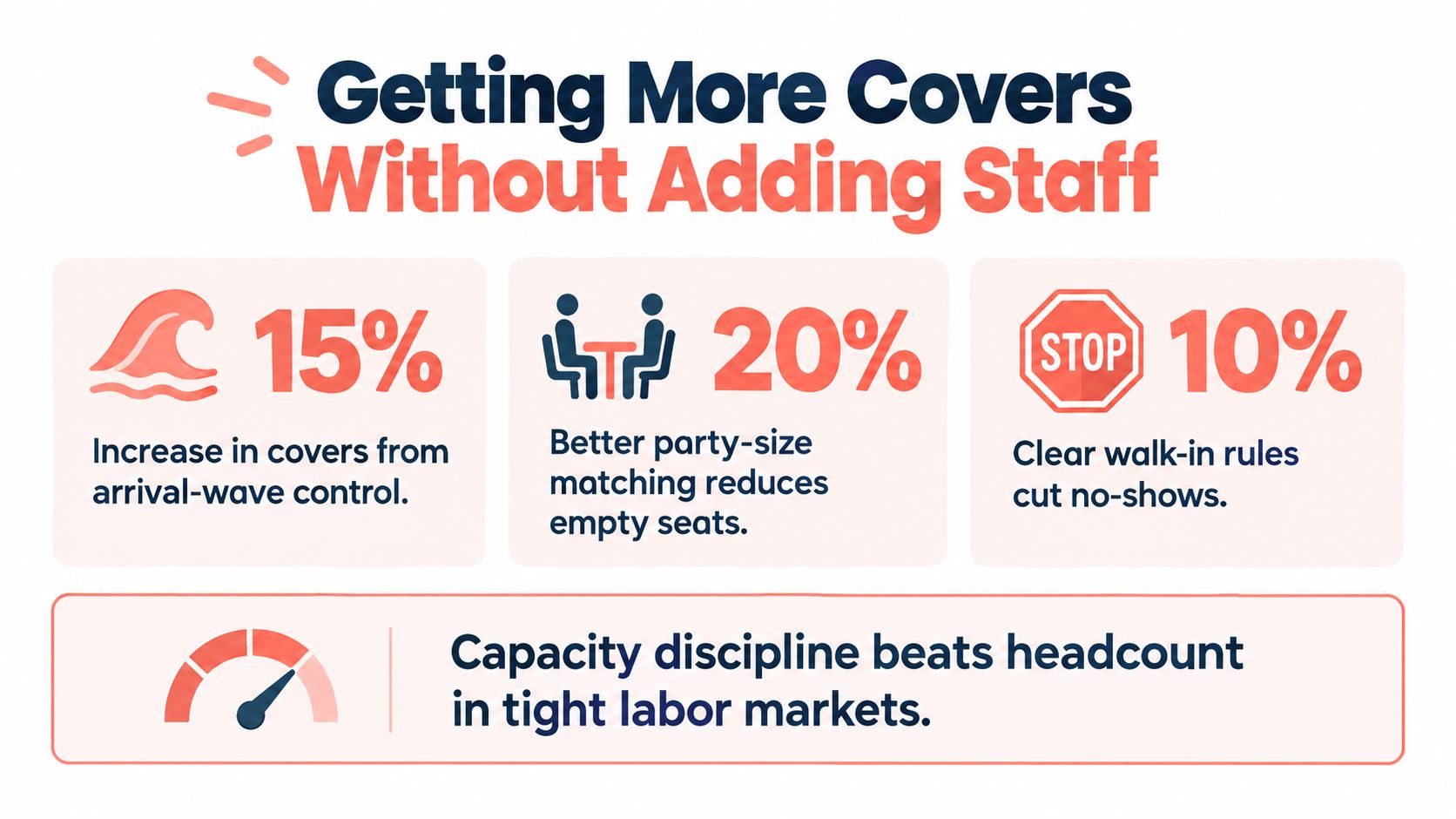
The illustration highlights capacity levers. Its percentage labels aren't substantiated performance benchmarks and shouldn't be used in a budget or forecast.
Start with the existing floor plan
Identify which tables can combine, which configurations strand seats, and which sections depend on the same service station. Then compare that physical capacity with what the kitchen can support.
Arrival-wave control should prevent a booking interval from becoming a mass ordering event. Party-size matching should preserve suitable configurations for later reservations. A walk-in rule should require checking the next arrival commitment before offering an apparently vacant table.
Turn-time targets should reflect party size and dining format. Don't turn a tasting-menu reservation into a rushed meal just to achieve a target. Research on restaurant waiting times and table management identifies turnover as a revenue lever, but any improvement needs measurement against your baseline and production capacity.
More covers are useful only when the team can serve them without creating avoidable recovery costs.
Track the complete result
Use these metric groups when reviewing capacity changes:
- Labor productivity: Covers per labor hour.
- Table use: Average turn time by party size.
- Waiting: Variation between promised and actual waits.
- Staff strain: Overtime frequency and hours.
- Execution: Remakes and the reasons behind them.
Use the restaurant yield-management guide to connect availability decisions with the service you can deliver. Business Loan Warrior's boost restaurant revenue tactics can provide a wider commercial checklist, but don't increase demand before resolving the service constraint.
Cross-train selectively. Teach staff the adjacent tasks that release the bottleneck, rather than expecting everyone to perform every role.
Reservation Tools and Commission Models Compared
A reservation platform belongs in the operating budget, not just the marketing budget. Compare the total expense of obtaining and managing a seated cover, including subscription charges, acquisition fees, payment costs, and staff handling.
Don't assume every booking channel has the same economics. A direct reservation and a marketplace-acquired reservation may be priced differently within the same contract. Request the terms that apply to your country, plan, and acquisition channel.
Reservation platform pricing at a glance
The table is a procurement checklist. Current vendor contracts haven't been verified here, so it deliberately avoids assigning unsupported fees or pricing terms.
| Platform | Typical pricing model | Impact per cover | Floor plan control |
|---|---|---|---|
| TheFork | Verify subscription and marketplace booking terms | Check which seated bookings attract charges | Demonstrate configuration and live changes |
| OpenTable | Verify subscription and channel-specific booking terms | Separate direct and network booking costs | Test reassignment during service |
| Zenchef | Verify subscription, payment, and optional-service terms | Establish whether booking-related charges apply | Test pacing and manager overrides |
| Formitable | Verify current offering, subscription, and transaction terms | Calculate the applicable cost per seated cover | Confirm features in the quoted package |
| 10Seat | Commission-free reservation management | No per-cover reservation commission | Reservation and table-management tools |
For the commission-free option, compare the product scope with the actual tasks performed at reception. Don't assume that similar booking screens mean identical operating workflows.
Compare contracts and live decisions
A per-cover commission is a variable acquisition expense. A flat subscription is a recurring commitment that still costs money during quieter periods. Neither model removes the need to calculate total cost against actual seated bookings.
Cornell's review of seven reservation policies found that customers regarded credit-card guarantees and table-holding policies as the fairest options, according to its reservation-policy research. Check whether the platform supports your chosen policy and communicates it clearly.
Read the real cost of per-cover commission before the budget meeting. Then ask each supplier to demonstrate an early arrival, a late party, a seating change, and a kitchen-driven pause.
Measure decision effort and exception handling. Don't buy a longer feature list if the host needs more clicks to manage a difficult arrival.
GKS Compliance for Belgian Restaurants
Belgian operators need to distinguish reservation management from fiscal recording. A table marked paid in a floor-management tool isn't, by itself, proof that the required registered receipt was issued.
The Geregistreerd Kassasysteem, commonly called the GKS or white cash register, becomes mandatory when annual turnover from restaurant and catering services exceeds €25,000 excluding VAT. Drinks and takeaway meals are excluded from that threshold calculation, as explained in the Flemish government's registered cash-register guidance.
Separate the threshold from transaction coverage
The calculation that determines whether the obligation applies isn't the same as the scope of receipts once it applies. After the threshold is exceeded, the receipt requirement covers transactions connected with supplying meals and drinks in the establishment, including drinks served without a meal, under the official GKS transaction guidance.
Don't configure reception or payment procedures to record only meal orders through the registered-cash workflow. Train staff on the distinction so that drinks-only transactions don't disappear into an informal process.
Your operational controls should include:
- Turnover monitoring: Have the accountant identify qualifying service turnover separately.
- Certified receipt handling: Route covered transactions through the GKS process.
- Correction ownership: Restrict voids, refunds, and adjustments to authorized staff.
- Reconciliation: Investigate differences between service records and fiscal records.
Keep integrations within their proper role
Reservation software can coordinate arrivals, table status, and guest notes. The certified cash-register process handles the fiscal obligation. Keep those roles distinct unless an integration is explicitly compliant with Belgian GKS requirements.
Use the restaurant POS system guide to frame supplier questions. Ask what data transfers, where the certified receipt originates, and how corrections are recorded. A supplier saying that systems connect doesn't answer those questions.
Compliance boundary: A reservation record supports operations. It doesn't replace a required fiscal receipt.
Keep fiscal receipts, reconciliation records, correction documentation, and evidence supporting the turnover calculation. Confirm statutory retention requirements with your Belgian accountant rather than inventing a filing period.
Test the front-of-house procedure with ordinary meals, drinks-only orders, split payments, cancellations, and refunds. Staff should know the compliant route before encountering an exception during peak service.
A Weekly Operating Checklist for the GM
Review the operating system while the week's decisions are still fresh. Keep the checklist beside the pass, with an owner beside each unresolved action.
Check execution and economics
- Staff: Resolve skill gaps, recurring absences, and unclear delegation.
- Floor: Review booking conflicts, arrival pressure, and recovery incidents.
- Kitchen: Investigate bottlenecks, prep failures, and incomplete safety records.
- Finance: Reconcile labor, food, booking, and recovery costs.
Compare the capacity measures already identified: productivity, turns, waiting, overtime, and remakes. Look for trade-offs, not an isolated improvement that creates a problem elsewhere.
Close the control gaps
Check reservation invoices against the contract and actual seated bookings. Belgian venues should also review qualifying turnover and the registered-receipt workflow.
For cleaning procurement, use the Fillaree guide to eco-friendly cleaning as a discussion resource, while keeping sanitation requirements in charge of product selection.
Evaluate commission-free reservation management through a concrete ROI calculation: avoided booking commissions plus contribution from verified additional covers, minus subscription and implementation costs. Compare that result with the current pricing. Don't apply the Cornell efficiency estimate to software savings or promise an unsupported return.
10Seat offers commission-free reservation and table management for independent restaurants in Benelux. Visit 10Seat to assess how its tools fit your floor plan, arrival pacing, and live-service responsibilities before changing your booking setup.