How to Manage a Restaurant Without Losing Your Mind
Learn how to manage a restaurant with practical systems for service, staff, and cost control. Built for owner-chefs and GMs who don't have time for fluff.
It's 8:40 p.m. on a Friday, the host stand has a queue, and the kitchen printer won't stop. You don't need another checklist about hospitality. You need a way to manage a restaurant when reservations, walk-ins, staffing gaps, and ticket times collide at the same minute. That's a labor and capacity problem, and it's solvable with a live floor, a disciplined table mix, and rules your team can run without you standing beside them.
Table of Contents
- The Friday Night That Breaks Most Restaurants
- Why Managing a Restaurant Is Really a Labor and Capacity Problem
- Running a Shift From a Live Floor Plan Instead of a Paper Chart
- The Table Mix and Assignment Cycle That Fills the Room
- Stop Treating Labor as a Line to Cut
- Reservation Policy, No-Shows, and the Belgian GKS Reality
- A 90-Day Operating Rhythm That Survives Manager Turnover
The Friday Night That Breaks Most Restaurants
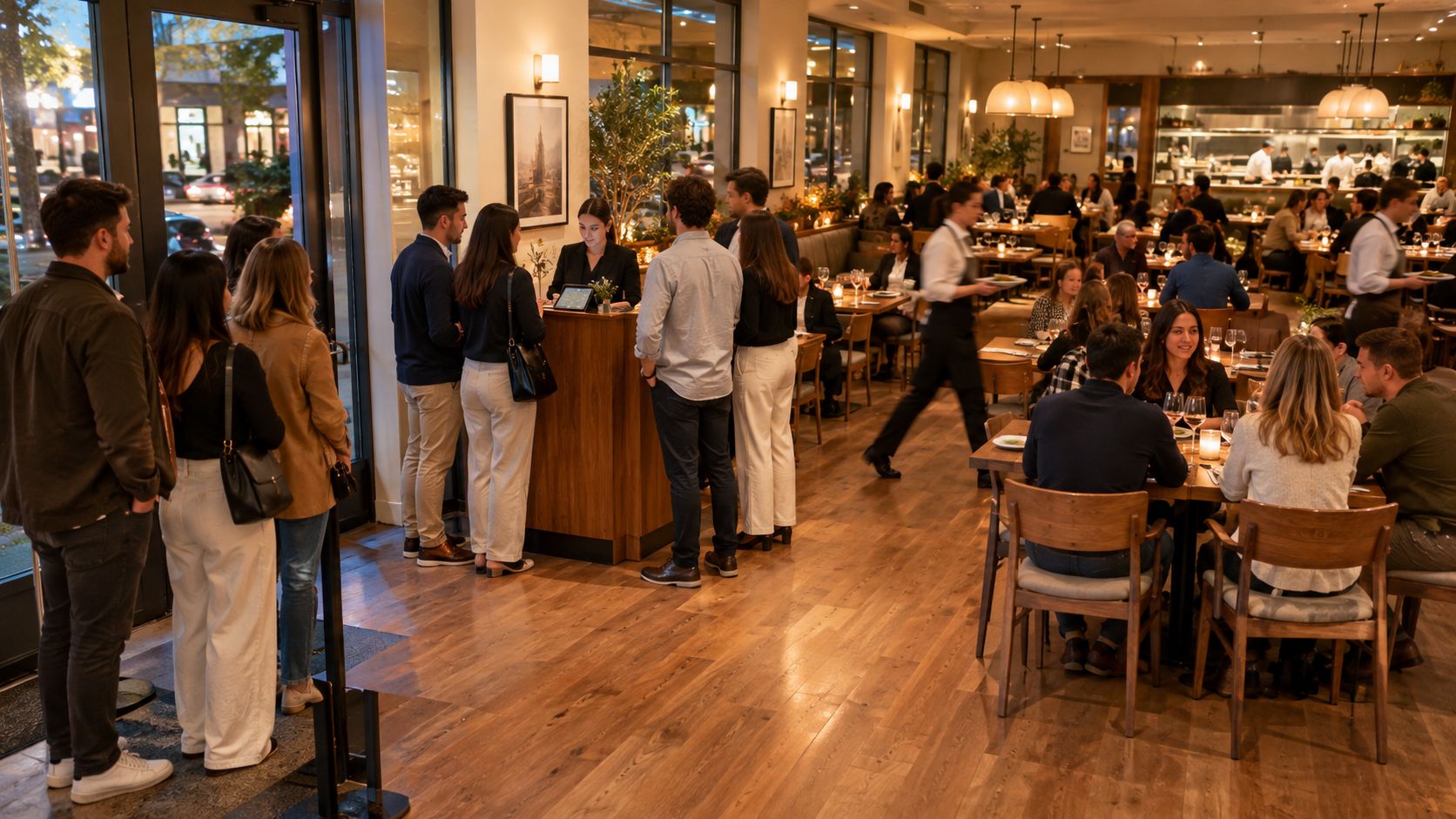
Two parties of four are still waiting at 8:40 p.m. on a 90-cover floor. Both booked, both arrived on time, and neither has a table because the 7:00 p.m. turn ran long. A walk-in queue is forming at the door, and the host is quoting times from memory.
In section two, a server flags that ticket times just crossed into complaint territory. The bar needs a runner. A six-top booked for 7:15 p.m. may have called to cancel, or may not have, and nobody wrote it down clearly. The room looks full, but it's not productive. It's blocked.
The Failure Pattern Behind the Chaos
That scene isn't caused by lazy staff or bad luck. It's caused by four decisions made too late: seating too many large parties at once, holding tables without a release rule, combining tables reactively, and letting the kitchen absorb a pace the host stand created. Each decision looks harmless in isolation. Together, they strand usable seats while guests wait.
The host is doing memory work instead of decision work. The server sees the ticket problem before the manager does. The manager becomes a messenger between the door, the pass, and the floor, repeating information that should already be visible on one screen.
If the only person who knows the state of the room is the host, the restaurant doesn't have a system. It has a single point of failure.
Good management fixes that snapshot in advance. It sets reservation intervals the kitchen can honor, protects table combinations for the parties most likely to arrive, and gives the host a clear rule for walk-ins when the book is tight. It also defines when to slow seating, even with money waiting at the door.
That's the standard for everything that follows. If a tactic doesn't help you survive 8:40 p.m. on Friday without hurting the guest, the kitchen, or margin, it's admin, not management.
Why Managing a Restaurant Is Really a Labor and Capacity Problem
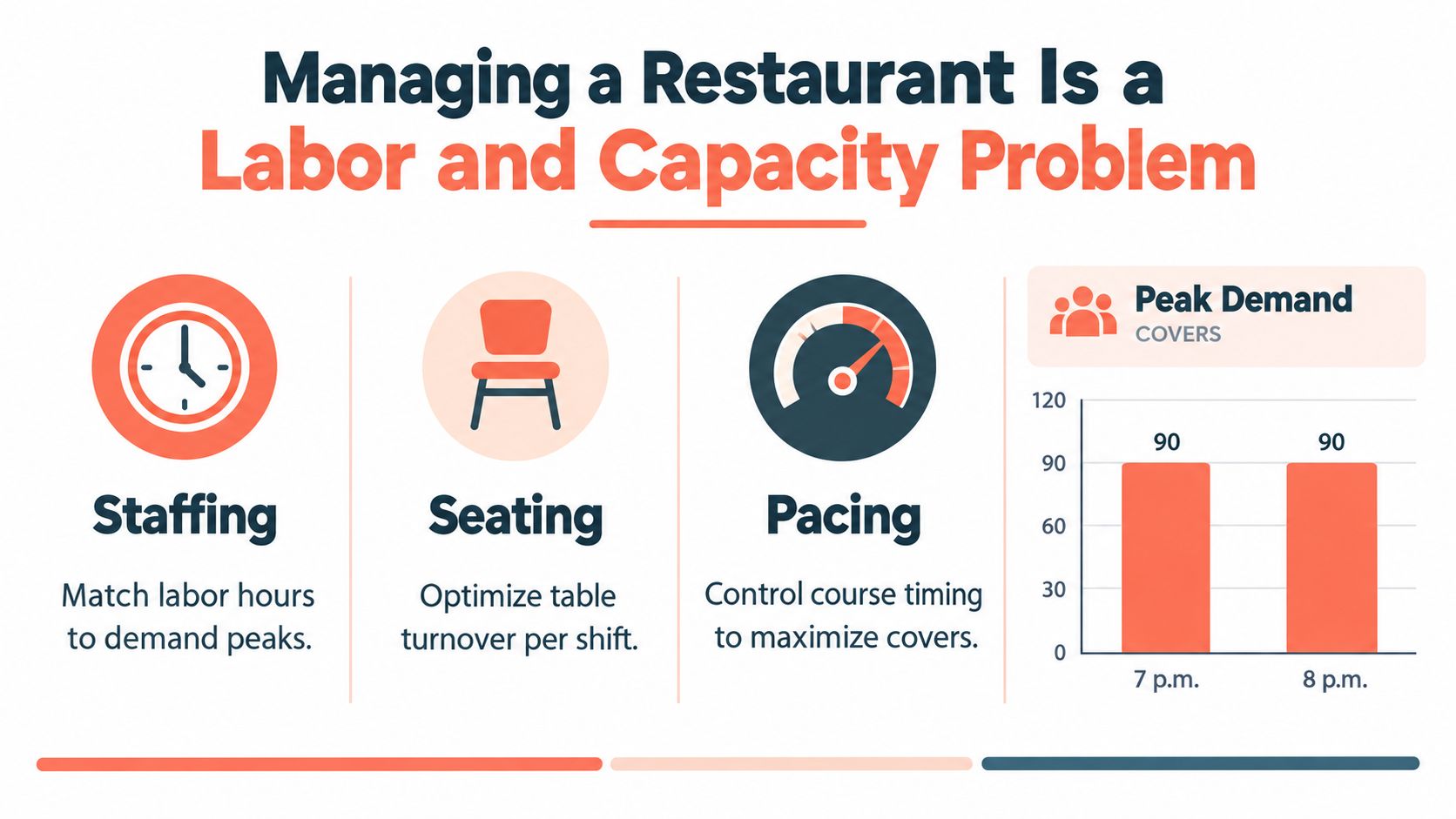
You can't decorate your way out of thin margins. You manage covers per labor hour, table turns, wait times, and kitchen throughput, because those variables decide whether a busy night makes money. Marketing brings demand. Operations decides if demand becomes profit.
The Math That Governs Every Decision
- Labor is the largest controllable cost: Salaries, wages, and benefits represented a median 36.5% of full-service sales in 2024 and a median 31.7% in limited-service, while median income before taxes was 2.8% for full-service and 4.0% for limited-service, according to the National Restaurant Association analysis of restaurant labor costs.
- Prime costs leave little room for error: The same economic picture puts labor alongside food and beverages as the load that consumes most of each sales dollar, so small changes in covers, deployment, or table utilization hit profit disproportionately.
- The workforce turns over constantly: U.S. restaurant and foodservice employment was approximately 15.7 million people in 2025, average turnover was 122%, food-services employees averaged about 25.2 weekly hours, and average hourly earnings were approximately $22.04, per the National Restaurant Association hiring and staffing research insight.
Those numbers make one point bluntly. You're running a high-labor, low-margin business with a part-time workforce that changes fast. A system that depends on experienced staff remembering everything will fail on schedule.
Capacity planning is therefore not an office exercise. Managers outside hospitality face the same discipline of matching available people to timed demand, and the guide for HR leaders from Acheloa Wellness is useful background for thinking about capacity as a planning function rather than a hope. In a dining room, capacity is seats multiplied by time, constrained by kitchen output and server sections.
Treat a seat hour that passes empty as inventory you can't recover. You can't sell last Tuesday's 6:30 p.m. two-top on Friday. That is why staffing, seating, and pacing sit at the center of the job. Menu design, decor, and promotion matter, but they orbit the labor and capacity math.
Running a Shift From a Live Floor Plan Instead of a Paper Chart
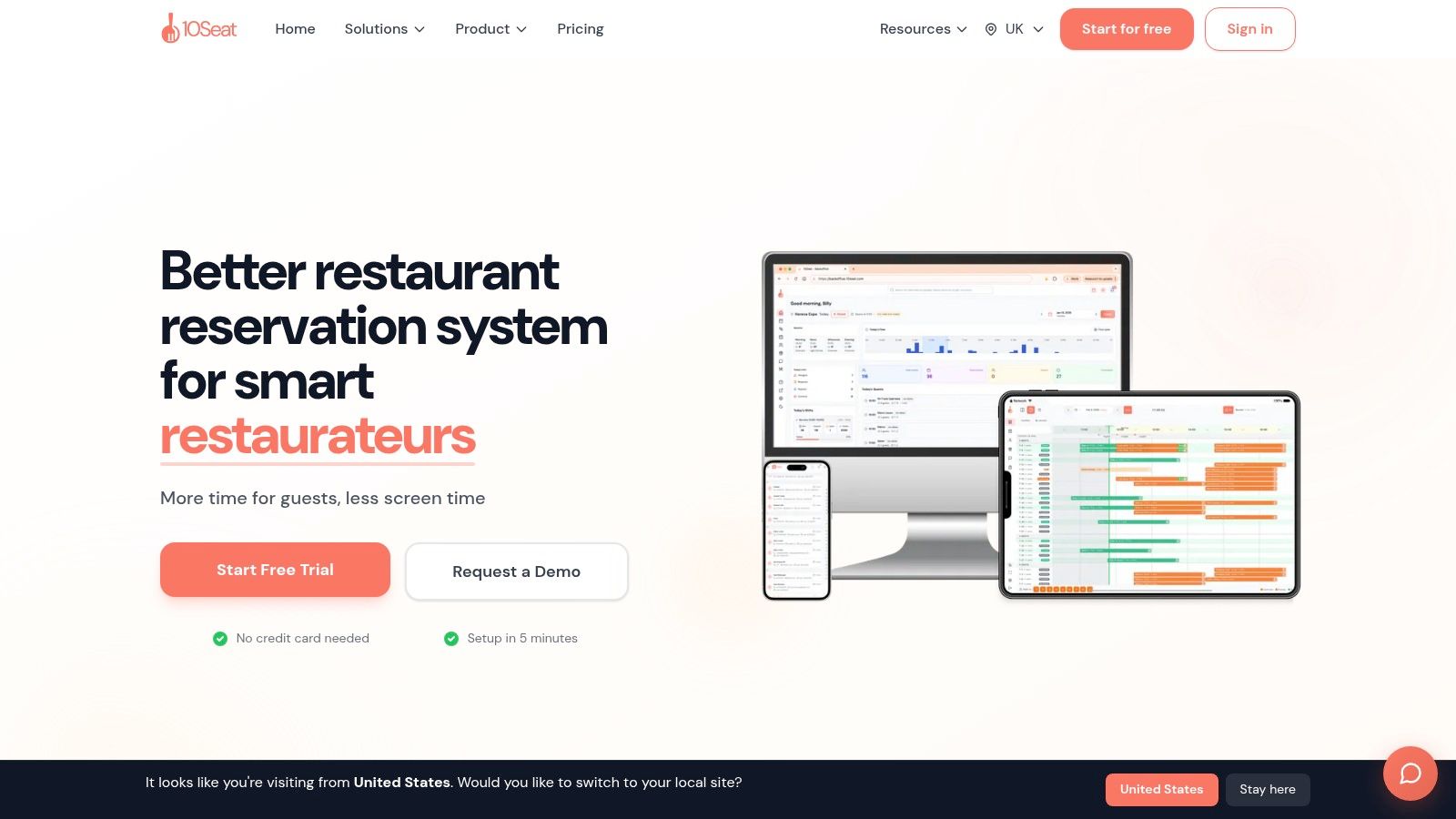
A paper seating chart describes the room you planned at 4:00 p.m. A live floor plan shows the room you're running at 8:40 p.m. That difference is the whole game. Your host should see table status, incoming bookings, walk-ins, course stage, and reset needs without asking three people.
This example shows the host view during service.
The Three-Part Shift Routine
Sixty minutes before doors: Lock the expected table mix, check large parties and special requests, confirm server sections, and set the walk-in rule for the night. Call or message unconfirmed bookings that block prime combinations. Agree the kitchen constraint in plain language, such as maximum covers per quarter hour, and put it where the host can see it.
Every 15 minutes during service: Review average wait, late arrivals, ticket time, and complaint risk. Release held tables that pass the grace limit. Rebalance sections before a server drowns, not after. If ticket times deteriorate, slow seating for one interval rather than stacking five tables that will all complain together.
Within 30 minutes of the last cover: Record no-shows, late releases, table combinations that failed, and any guest preference worth keeping. Note where the bottleneck sat. That debrief is short, factual, and written in the system, not left in the closing manager's head.
A static chart can't do that work. If you're rebuilding yours, this practical guide to building a restaurant seating chart covers the layout decisions that should happen before you digitize anything.
What the Host Screen Should Do
The screen should recommend the smallest suitable table, protect combinations you need later, and make a walk-in decision in seconds. As one example, 10Seat, described on its product page, combines Smart Auto Seating and Auto Seating Puzzle features to map bookings to efficient configurations and support 0.5-second host decisions. The point isn't more software on the stand. The point is less calculation under pressure.
This walkthrough shows that host workflow in motion.
Guardrail rule: Never raise booking density when wait time or ticket time is worsening. Filling seats faster than the kitchen can feed them doesn't create revenue. It creates refunds, comps, and reviews.
Run that rhythm daily and a new manager can work the floor on day three. The routine carries the knowledge. The person makes the judgment calls.
The Table Mix and Assignment Cycle That Fills the Room
Most dining rooms don't have a table shortage. They have a mismatch between party sizes arriving and configurations available at that minute. Six two-tops don't help a party of eight, and one broken-apart eight-top can destroy your next two turns of fours.
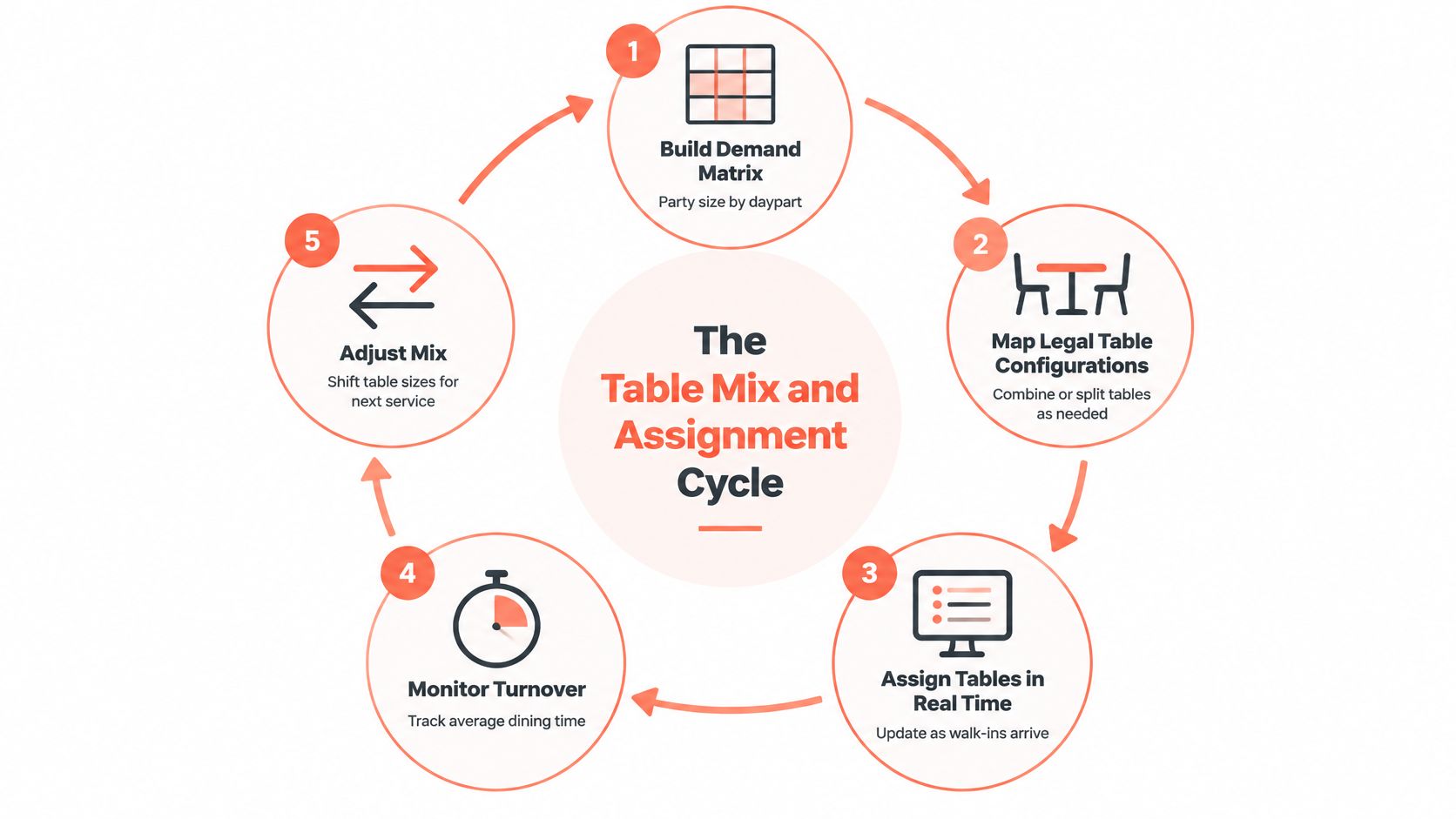
Run the Cycle by Daypart, Not by Habit
- Build a demand matrix: Count party sizes by daypart and day of week. Friday dinner and Sunday brunch are different businesses sharing a room.
- Map every legal combination: List which tables can join or split, the resulting seat count, reset time, and any accessibility or fire-code clearance limits.
- Apply operating constraints: Cap seating by server section and kitchen throughput, not by empty chairs alone.
- Assign the smallest suitable setup: Seat arrivals in the configuration that fits, while preserving larger combinations for forecasted demand.
- Review outcomes weekly: Compare seat utilization, wait time, meal duration, and service level by party size, then change the mix.
Measure the result as Revenue per Available Seat Hour (RevPASH), calculated as revenue divided by available seats and operating hours, a method detailed in peer-reviewed research on restaurant revenue management and table mix. Occupancy alone misleads you. A full room of slow, low-spend tables can underperform a paced room with better party fit.
The evidence for daily attention is concrete. In a Cornell study of a 240-seat full-service restaurant, changing the table mix daily improved performance by more than 1% versus retaining a weekly mix, and the optimization approach averaged within 0.1% of optimal in testing, according to the Cornell table-mix optimization study.
The Peak-Hour Mistake to Stop Making
Don't combine tables reactively just because a large walk-in looks valuable. You may strand two-tops, overload one server, and block the four-top booked in twenty minutes. Protect four-top combinations, hold flexible bar seating for walk-ins where service standards allow, and never break a configuration you can't rebuild before the next booking window.
That's how you manage a restaurant floor as time-based inventory. The mix is a daily decision. The wall chart is history.
Stop Treating Labor as a Line to Cut
Cutting a server on a forecasted peak to hit a labor percentage is bad arithmetic. You save a few hours of wages and lose turns, drink sales, table maintenance, and repeat guests. In a business with pre-tax margins of only a few points, a revenue loss and a labor saving of the same percentage are not equivalent. Lost contribution hurts more.
The pressure is real, and pretending otherwise helps nobody. In 2025, 89% of surveyed operators reported higher labor costs, 27% identified finding and keeping staff as their biggest challenge, 23% cited sales volume as their main worry, and 52% ranked food inflation as their primary concern, according to the Restaurant365 2025 State of the Restaurant Industry Midyear Report.
Protect the Peak, Flex the Shoulders
Hold full, competent coverage for the periods that produce the money. That's not generosity. That's throughput protection. A strong host, a runner who keeps sections moving, and enough closers to reset fast all convert demand you already paid to attract.
Flex the shoulders instead. Before the rush and after it, compress roles where quality allows: host and reservation follow-up, bar back and polisher, runner and reset support. Cross-train deliberately for those combinations. Don't improvise role compression at 8:00 p.m. and call it agility.
This breakdown of practical ways to reduce restaurant labor costs is useful for separating structural savings from cuts that move the cost into slower service.
Measure Profit per Labor Hour
Labor percentage alone rewards the wrong behavior. A manager can improve it by understaffing and shrinking sales, then look efficient on a spreadsheet while the dining room deteriorates. Track profit per labor hour beside labor percentage, covers per server hour, average wait, and ticket time.
- Cut: Idle overlap with no assigned side work, duplicate manual reporting, and shifts that stay open out of habit after demand drops.
- Protect: Peak host coverage, expediting, reset labor, and experienced closers who prevent end-of-night drift.
- Test: Earlier last seating on weak nights, a tighter menu during shoulder periods, or limited bar seating when the kitchen is the constraint.
Labor control means putting expensive hours where they produce contribution. Blanket cuts are not control. They're abdication.
Make the trade-off explicit every week. If you remove an hour, name which task disappears, which service standard changes, or which demand you'll refuse. If nobody can answer, don't cut it yet.
Reservation Policy, No-Shows, and the Belgian GKS Reality
An unhonored booking isn't a minor annoyance. It's a seat hour you protected from walk-ins and then sold to nobody. A peer-reviewed study reports that 28% of U.S. restaurant reservations were not honored in the referenced year, creating inefficiencies and blocking walk-in seating, according to research published in the International Journal of Consumer Studies.
Your policy should change with demand. On soft services, use reminders and light confirmation to fill the room without scaring guests off. On nights likely to sell out, require a card hold or deposit, state the grace period plainly, and release tables the minute that period expires. If confirmation calls overwhelm the host stand, a trained virtual receptionist can handle routine confirmations so floor staff stay with arriving guests.
Reservation Policy Levers by Demand Level
| Demand Level | Confirmation Window | Deposit or Hold | Walk-in Release | Estimated Profit Lift |
|---|---|---|---|---|
| Soft night | Reminder before service | Usually none | Short hold, then release | 7.4% in the modeled 5% discount scenario in Wharton-summarized reservation research |
| Busy night | Reminder plus reconfirmation | Card hold or deposit | Immediate release after grace period | 14.5% in the modeled no-show fee scenario in that same analysis |
| Large party | Direct confirmation required | Deposit recommended | Release only by manager decision | Protects combinations and staffing |
Treat those modeled lifts as a frame, not a promise. Your market, cuisine, and guest base decide what's enforceable. Pair the policy with your point-of-sale discipline, as covered in this overview of restaurant POS system responsibilities, but don't confuse booking records with fiscal records.
The Belgian GKS Carve-Out
For Belgian operations, the GKS (Geregistreerd Kassasysteem) becomes mandatory when annual turnover from restaurant and catering services exceeds €25,000 excluding VAT and drinks, and in-scope businesses must issue a VAT receipt through a registered cash register system, according to the Flemish government GKS guidance. Reservation and table tools don't replace that obligation. Keep bookings, seating activity, payments, and GKS records operationally distinct, and process the final sale through the compliant register.
A 90-Day Operating Rhythm That Survives Manager Turnover
A well-run restaurant shouldn't collapse when a general manager leaves. If performance depends on one person's memory, contacts, and private notebook, you don't own a system. You rent competence from whoever hasn't quit yet.
The churn risk is not theoretical. Separate 2025 workforce data reported 55% annual manager turnover in high-volume units, an estimated $16,800 replacement cost for one general manager, and 43% of hires leaving within 90 days, according to the CrunchTime 2025 restaurant operations research report. Build for that reality from day one.
Daily, Weekly, Monthly
Daily: Run the pre-shift lock, 15-minute floor review, and post-shift debrief. Record guest preferences, allergies, and service failures in the shared profile, not on paper. A new host should be able to greet a regular correctly without being briefed in a corridor.
Weekly: Recalculate the table mix, review profit per labor hour, clean duplicate guest profiles, and inspect back-of-house completion tasks. Operational basics belong in the same rhythm, including sanitation and pest prevention checks. Operators who need a concrete reference for that side of compliance can consult this guide for Woodstock food-service operators on restaurant pest control responsibilities.
Monthly: Review RevPASH by daypart, no-show rate by channel, meal duration by party size, and complaint patterns. Run a leadership handoff drill where the duty manager runs service using only the written rules and dashboard. Whatever breaks in the drill is your next documentation task.
Write Escalation Rules for the Three Hard Calls
Define who can release a large-party table, who can stop seating during a ticket surge, and who can refuse a walk-in when the book is exposed. Give each rule a threshold, an owner, and a guest-facing sentence. Ambiguity burns out new managers faster than workload does.
Standardize the handoff between shifts with open tables, pending complaints, VIP notes, staffing risks, and kitchen constraints in one place. Keep it short enough to read in two minutes. Long handover documents don't get read during service.
The test of your operating system is simple: a competent stranger should run a safe, profitable Friday from your rules, your floor plan, and your guest records.
After 90 days, you'll know which rules survive contact with service and which were theater. Keep the survivors and delete the rest. Operators evaluating the software side of that system can review the current pricing page against commission-based models from platforms such as TheFork, OpenTable, Zenchef, and Formitable, then decide based on cost structure and floor control, not brand familiarity.
Stop running Friday night on memory, paper charts, and hope. 10Seat gives independent restaurants commission-free reservation and live table management built around pacing, table fit, and fast host decisions, so your existing room and team can serve more of the demand you already have. Set it up, load your floor, and run your next busy service from one clear screen.