Customer in Restaurant: Types, Needs and How to Serve Them
Understand the customer in restaurant settings: guest types, expectations, service touchpoints, pain points, complaint handling and guest profiles.
It's 7:15 on a Friday, the door won't stop, and three different parties want three different things at once. A regular expects recognition, a couple expects quiet, and a walk-in just wants an honest wait. The food can be right and the evening can still fail if staff misread what each customer in restaurant service came for.
Table of Contents
- What Guests Expect From a Single Restaurant Visit
- Six Restaurant Customer Types and What Each One Expects
- How Guests Decide to Visit, Return or Drop Out
- Service Touchpoints From First Contact to Farewell
- Common Pain Points and Their Root Causes
- Building Guest Profiles That Make Regulars Feel Known
- How to Handle a Guest Complaint Step by Step
- Start Your Guest Profile Routine This Week
What Guests Expect From a Single Restaurant Visit
A couple arrives for an anniversary, coats still on, scanning the room for someone to notice them. They'd booked a window table. They're seated beside the kitchen door instead, the food's excellent, and they still leave saying the evening felt rushed. That outcome is common because guests judge the whole trip, not one stop on it.
A restaurant visit works like a short trip with a planned route. Guests carry three layers of expectation through every stage.
The Three Layers Guests Judge
- Certainty: The booking's confirmed, the table's ready, and the bill makes sense.
- Attention: Someone notices them without hovering, and the team remembers what they asked for.
- Fit: Pace, noise and food match the reason they came.
The anniversary failure wasn't the kitchen. It was fit and attention. The table contradicted the occasion, and no one corrected it.
Guests rarely remember one dish in isolation. They remember whether the visit matched the reason they booked.
The customer also isn't always one person. It's often a party, and the person who booked may not be the person whose experience decides whether anyone returns. Design for the whole table.
The first two minutes and the last five minutes shape memory more than the middle. A warm greeting and a clean exit can carry a slow main course. A cold arrival and a messy bill undo good cooking. Use certainty, attention and fit as a checklist for every guest type and touchpoint that follows.
Six Restaurant Customer Types and What Each One Expects
Most rooms serve three or four of these types on any given night, and the mix shifts by day, season and location. Treat the table as a starting point, not a fixed profile.
| Guest type | Main expectation | Biggest risk | What staff should do |
|---|---|---|---|
| Regular | Recognised, with a usual table and drink | Being treated as a stranger | Greet by name and use saved preferences |
| Business lunch guest | Speed, a quiet table and a clear bill | Late courses on a timed lunch | Confirm lunch length at booking and pace the courses |
| Date-night couple | Privacy and attentive but unhurried service | A table next to the door or kitchen | Hold a corner or booth and limit interruptions |
| Celebration group of six or more | Shared seating, coordinated timing and a moment to mark the occasion | Split bills and staggered courses | Set one course timing and confirm bill split at booking |
| Tourist or walk-in | Clear information and a fair wait | Long, unexplained waits | Quote a realistic wait and check back on time |
| Guest with dietary or accessibility needs | Needs captured once and respected | Repeating the request to every server | Record the need in the booking and brief the floor before arrival |
The six types fall into three families. Regulars and business guests come back, date-night couples and celebration groups come for an occasion, and walk-ins and guests with dietary or accessibility needs need the venue to adapt.
The Two Types Most Rooms Misjudge
Regulars are lost fastest by indifference. Being treated as a stranger after repeated visits tells them loyalty runs one way. A practical guide to personalized dining experiences starts with the basics, name, usual table and usual drink, because recognition is the product for this guest.
Accessibility gets treated as compliance when it's a retention issue. A 2025 survey of more than 600 blind and low-vision restaurant-goers found 58% had experienced negative restaurant interactions specifically because of their disability, 84% said accessibility affects whether they return, and 92% said they would return to a restaurant offering an accessible customer experience.
In practice that means booking without a forced phone call, noting the need once, choosing a seat that doesn't isolate the party, and briefing the floor before arrival. Business guests need the same discipline applied to time. Protect the lunch budget and they'll protect the booking habit.
End each type with one test. What would make this specific guest say they'll come back?
How Guests Decide to Visit, Return or Drop Out
The decision to book is only part of the story. A reservation that does not turn into a seated guest leaves a gap in the service plan, and the pattern varies across datasets. A large reservation dataset recorded an average no-show rate of 2.33%, based on 3,768,761 reservations across 2,417 restaurants between August 2025 and July 2026. At 1,000 advance reservations a month, that would mean about 23 empty bookings.
A reservation dataset from Bloom Intelligence found 3.7% of advance reservations ended in a no-show and 15% were cancelled. Together, 18.7% of booked tables did not seat a guest. At 1,000 monthly bookings, about 187 reservations would need replacement demand or revised planning. The methods differ, so use these figures as benchmarks, not a universal average.
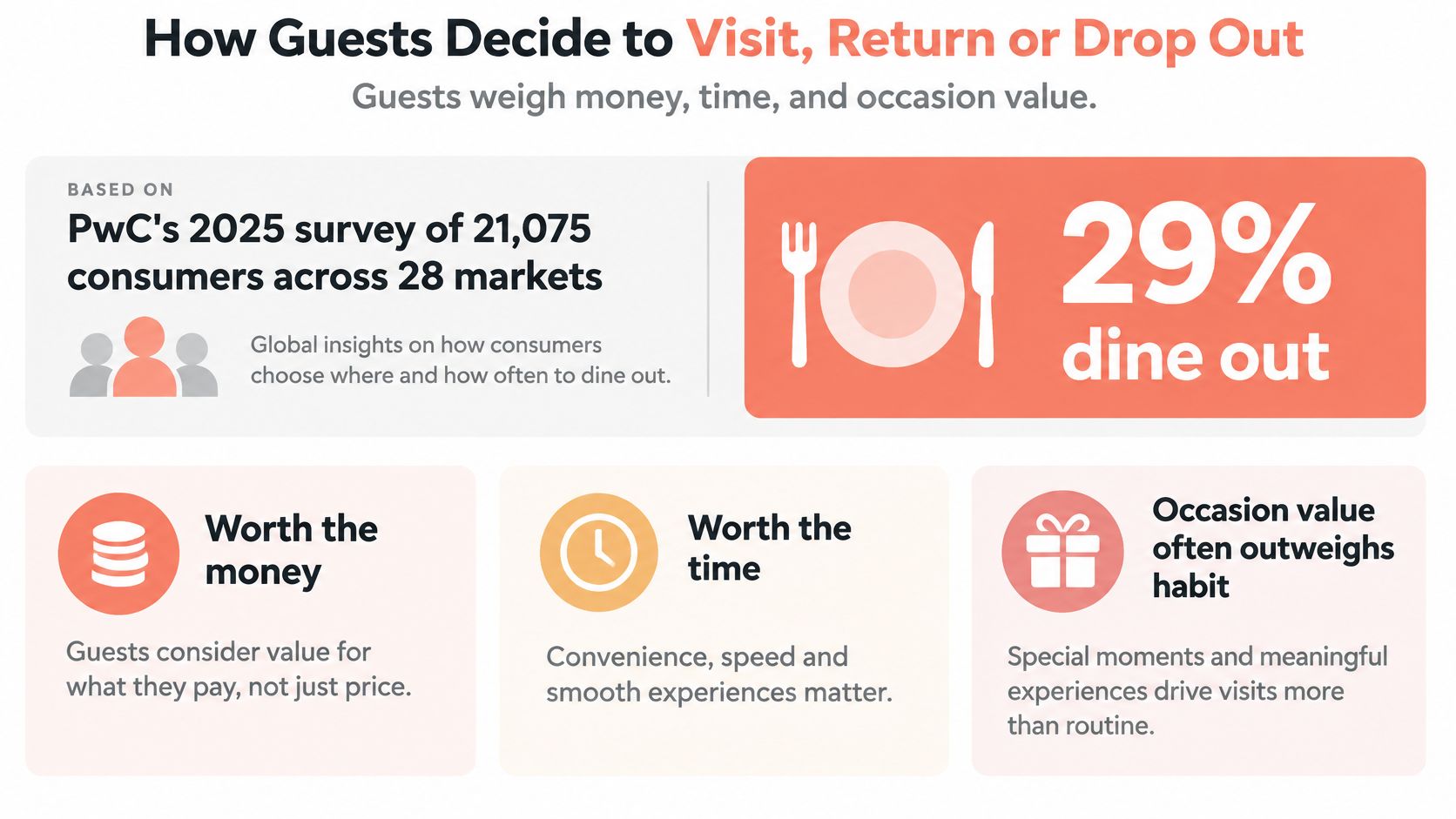
Occasion Value Beats Habit
A guest weighs the money and time against staying home. PwC's 2025 survey of 21,075 consumers across 28 markets found 29% dine out at least weekly, while 34% choose home-delivered takeaway. That makes the signs around each booking worth tracking: who comes, when they arrive, and whether they return.
TouchBistro's 2025 American Diner Trends Report found U.S. diners reported average spending of $54 per restaurant visit, up from $48 in 2023. Average spend per visit is rising, so each visit carries more weight for both the guest and the restaurant.
Peak-time clustering, groups arriving in waves, late cancellations on busy weekends, and regulars returning on the same weekday are visible signs of demand and capacity pressure. Track no-shows and cancellations for four weeks by day and party type. Adjust deposit rules or confirmation timing only where the pattern is strongest. Return decisions also show up in public reviews. TheBestReputation's guide for restaurants explains how reputation management relates to those guest responses.
Service Touchpoints From First Contact to Farewell
The map below shows where a visit is won or lost before food arrives.
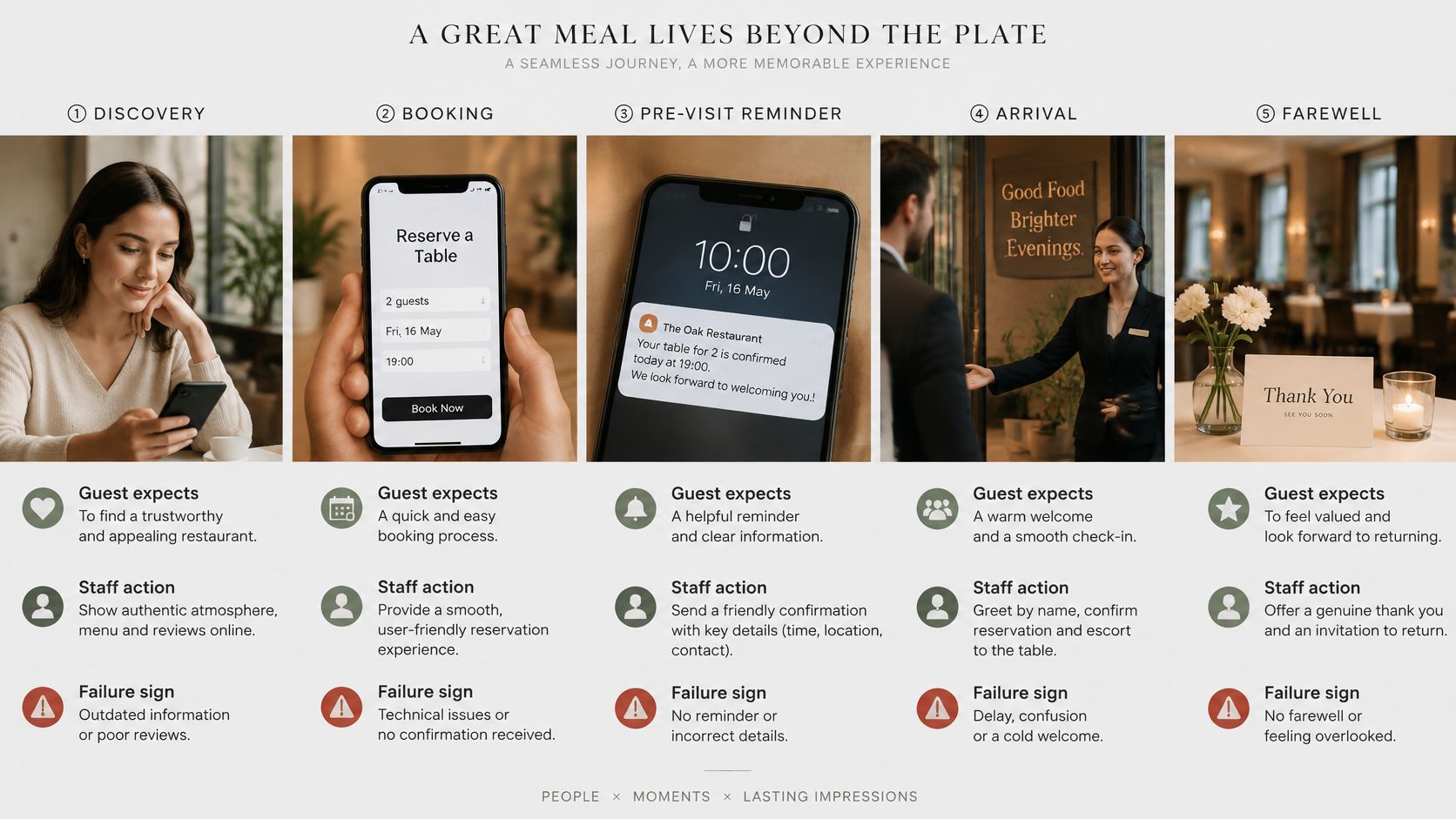
| Touchpoint | What the guest expects | What staff should do | Failure sign |
|---|---|---|---|
| First contact | Accurate hours, menu and booking link | Keep listings current and answer messages the same day | Calls asking for hours already published |
| Booking | Confirmation and clear rules on party size | Confirm promptly and state the cancellation rule | Party size changes at the door |
| Arrival | Greeted without waiting at the door | Greet within a minute and confirm the name or booking | Guests standing with coats on for several minutes |
| Seating | A table that suits the occasion | Match table to party type and noise level | Couples seated beside the kitchen door |
| Ordering and pacing | Attention without pressure | Take the first drink order within a few minutes | Long wait for the first course |
| Bill and payment | A clear total and quick settlement | Bring the bill when asked and check split details | Surprise charges or a long wait for the terminal |
| Farewell and follow-up | A reason to return | Thank the guest by name and send a visit message if opted in | No contact after a strong visit |
Where Avoidable Complaints Start
Arrival and seating set the mood. Greet guests within a minute and offer the table that matches their reason for visiting, not just the first free one. Ordering and pacing then create the perceived speed of the meal. A first drink within a few minutes feels attentive. A long silence feels like neglect, even if the kitchen is on time.
The short video below walks through pacing and handoffs during service.
Payment is a trust test. An unexpected charge or a long wait for the card terminal breaks it quickly. For Belgian operations, the GKS guidance on who must use a registered cash register states restaurants and caterers must use a registered cash register system when annual turnover from restaurant and catering services exceeds €25,000, excluding VAT and drinks. Below that threshold, a control document such as an invoice, receipt or cash-register ticket is still required.
Keep reservation and table management clearly separated from those fiscal functions. Guest tools shouldn't replace the compliant receipt workflow handled by the certified cash register, fiscal data module and VAT signing card.
Close with a thank-you that refers to something specific from the visit. Generic farewells don't give anyone a reason to return.
Common Pain Points and Their Root Causes
Waiting time drives behaviour, not just perception. An empirical study of 94,404 visits to a popular Indian restaurant found longer waits were associated with a higher probability of customers abandoning the queue, a longer interval before returning, and a shorter subsequent dining duration. Guests face greater time cost and uncertainty, so they leave sooner and come back later.
| Pain point | Sign before complaint | Root cause | Fix |
|---|---|---|---|
| Wait longer than quoted | Guest asks how long again, then leaves | Single wait number, no band data | Quote waits in bands |
| Peak arrivals with no table ready | Guests standing near the door with coats on | Arrivals bunched around 7 pm | Set walk-in acceptance rules |
| Held tables for no-shows | Empty table visible while guests queue | No grace period on holds | Release held tables after a set grace period |
| Slow first contact | Guest waits to be greeted | One host covers the door at peak | Assign one person to first contact at peak |
| Noise blocks conversation | Guests lean in or raise their voices | Table placed near the busiest zone | Seat by noise level at booking |
| Rushed celebration | Plates cleared before the toast | Courses not coordinated | Set one course timing at booking |
| Allergy missing in kitchen | Guest repeats allergy to each server | Need not recorded before arrival | Record it in the booking and brief the kitchen |
| Surprise bill | Second request for the bill or a scan of the total | Split or pricing not confirmed | Confirm split details at booking and bring the bill when asked |
Read Waits by Band, Not by Average
Four rows are wait-related for a reason. Averages hide the damage. A room can post a reasonable average wait while peak guests get waits that drive them out of the door.
Floor rule: If a guest has to ask twice how long the wait is, the quote was wrong or no one checked back.
Analyse outcomes by wait-time bands instead. The relationship gets more damaging during peak periods, when guests have fewer alternatives and staff have less capacity to recover. Monitor quoted versus actual waits, spot the arrival periods where queues accelerate, and use table assignment and walk-in acceptance rules to stop bottlenecks forming.
The study is observational, so read it as strong behavioural evidence rather than proof every link is purely causal. It's still enough to act on. For spotting the other rows early, a structured approach to customer feedback for restaurants helps staff log signs before they become reviews.
Building Guest Profiles That Make Regulars Feel Known
A guest should feel remembered without feeling watched. That balance decides whether a profile helps service or harms trust.
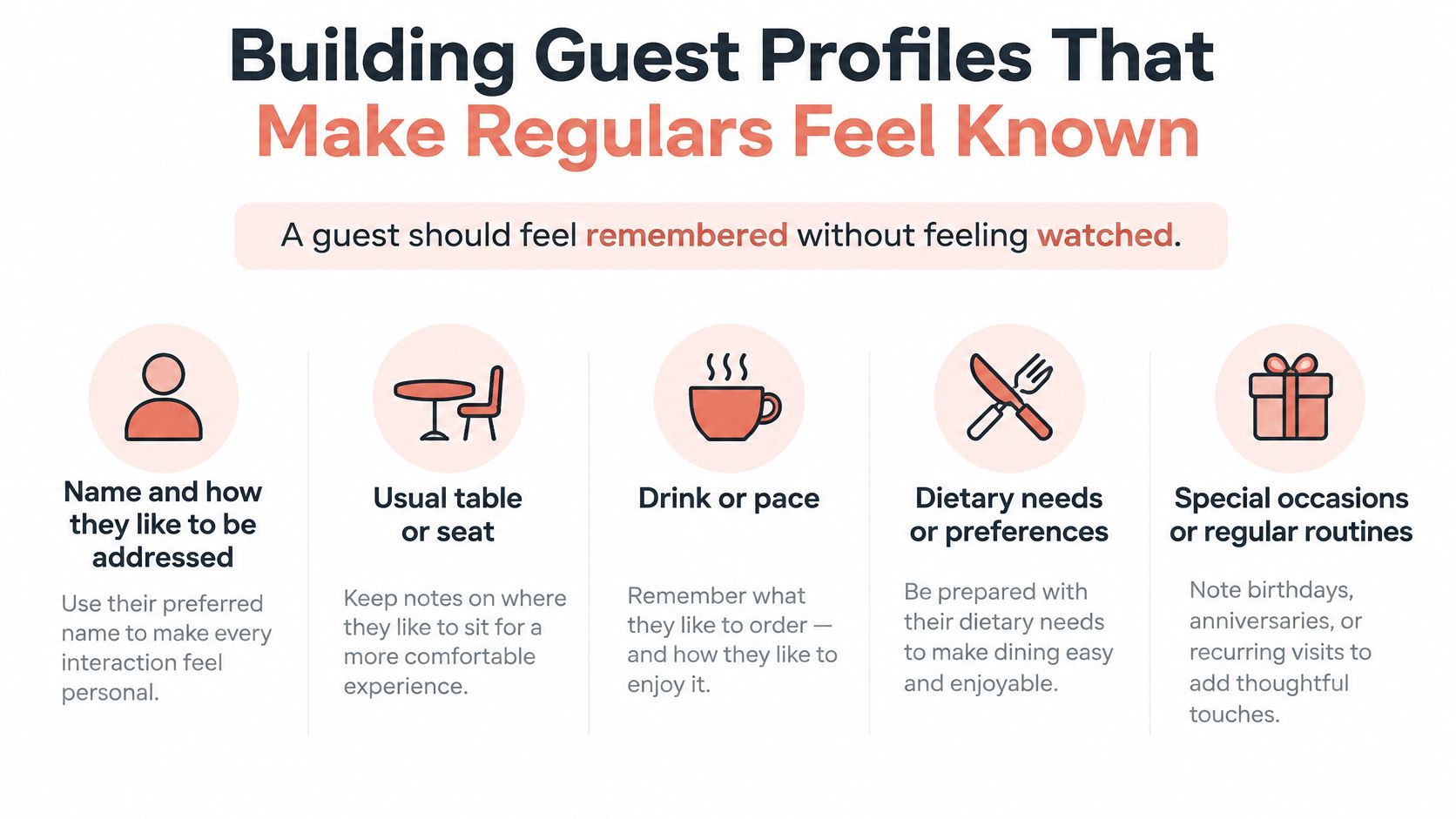
What Belongs in a Profile
- Name and address: How the guest likes to be addressed.
- Usual table or seat: Window, booth, quiet corner.
- Drink and pace preferences: Still water on arrival, unhurried courses.
- Dietary needs and allergies: Only what the kitchen needs to serve safely.
- Occasions: Birthdays, anniversaries, regular routines.
- Party details: Usual size and companions.
- Visit history: What they enjoyed, and any service recovery notes.
Allergies and dietary needs get confirmed on every visit, never assumed from the profile. Health details stay limited to what the kitchen needs. Anything more is exposure without benefit.
Capture happens at three moments. At booking, through structured questions. During the visit, when a question fits naturally. After the meal, when the server notes what the guest enjoyed while it's still fresh.
The Routine That Keeps Profiles Usable
Review new notes at the morning briefing. Tag the three most useful items per guest and delete stale notes every quarter. A profile nobody reads is just storage.
Say a regular always asks for a window table and still water, with a birthday in March. The profile seats them by the window, water arrives without asking, and a card appears in March. Nobody on the floor had to remember it personally. That's the point.
Avoid notes that feel invasive, such as personal details the guest never shared. Avoid the opposite failure too, detailed notes that never reach the host stand. Choosing guest management software matters less than whether staff open the profile before service.
Start with ten profiles, chosen from the regulars who visit most often. Prove the routine works before scaling it.
How to Handle a Guest Complaint Step by Step
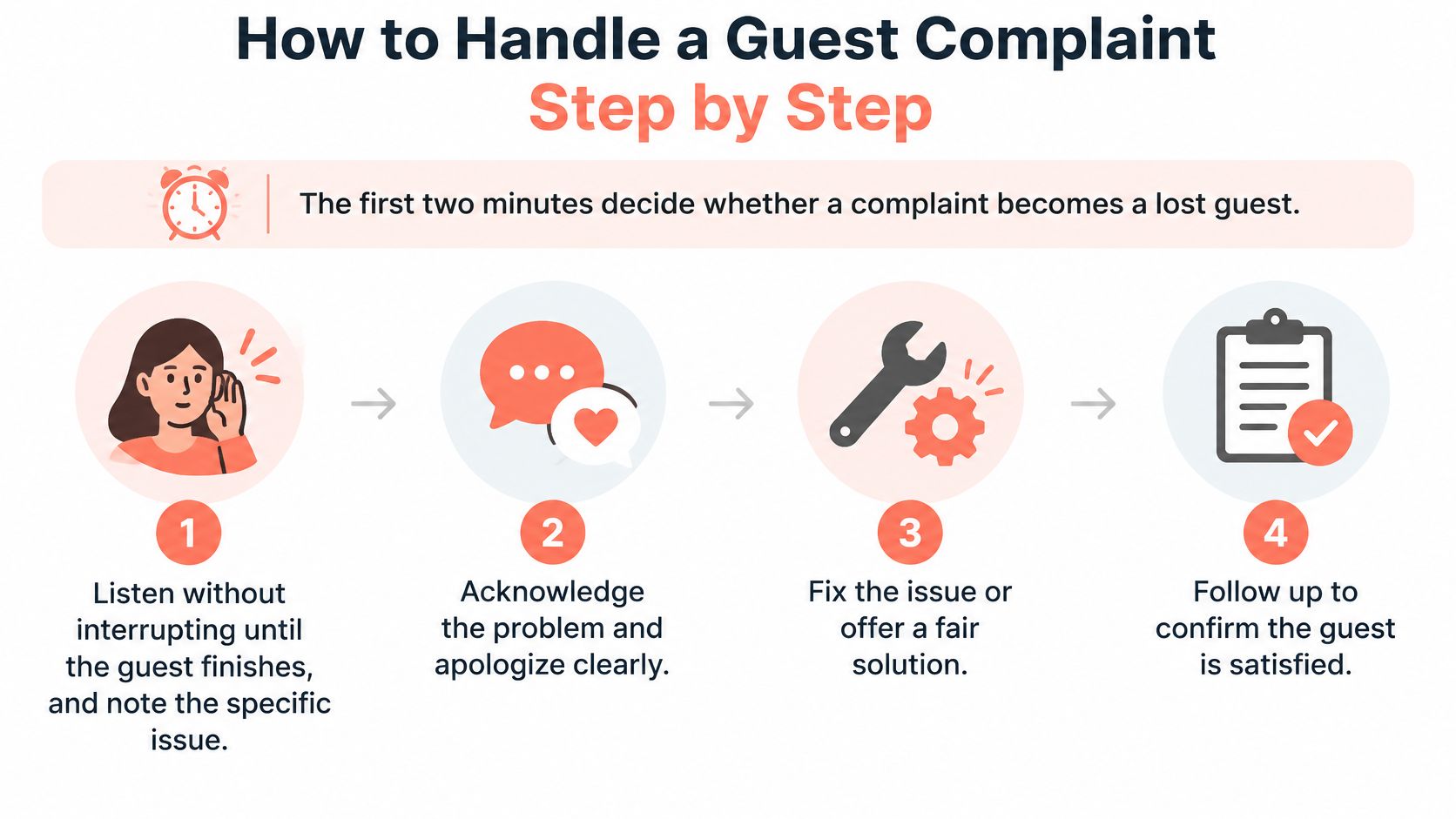
The first two minutes decide whether a complaint becomes a lost guest. Speed matters more than a perfect explanation.
The Routine
- Listen without interrupting until the guest finishes, and note the specific problem.
- Repeat the problem in one sentence so the guest knows it landed.
- Apologise once for the experience, without blaming the kitchen, the host or the previous shift.
- Offer one fix deliverable within five minutes, such as replacing a dish or moving the table.
- Confirm acceptance, and escalate to the manager if the guest doesn't accept.
- Record the issue and fix in the guest profile so the next visit starts informed.
- Follow up within 48 hours with a short message asking whether the fix met expectations.
A steak returned overcooked gets replaced within ten minutes. It doesn't get discussed at length at the table. Argument turns a kitchen error into a service failure.
Where Staff Hesitate
Complimentary items cause the first hesitation. Set the limit in advance so the whole team knows what a server can offer without approval. Improvised generosity creates inconsistency, and guests compare tables.
A clear comp limit protects staff as much as margin. No one should negotiate policy in front of a full room.
The second hesitation is an angry guest in front of others. Move the conversation to a quieter spot, calmly and without turning it into a show. Privacy lowers volume faster than counter-arguments do.
Start Your Guest Profile Routine This Week
Choose a touchpoint where staff can spot a problem before a complaint: an unconfirmed request, a missed preference, or a guest waiting without an update. Start with ten regulars. Record what each asks for, then brief the floor before they arrive.
Set a baseline for no-shows and wait accuracy, and compare your figures after four weeks. At the morning briefing, review new guest notes and see how much time the routine takes. A fixed estimate may not fit every restaurant, so keep the process simple enough to maintain during service.
A reservation system can support the routine while staff use their judgment. Guest notes store preferences, guest messaging lets restaurants contact guests before and after a visit, and dietary requirements can be collected before service.
Restaurants using 10Seat see 30% more reservations, 40% fewer no-shows and 10 to 15% more covers per shift. Compare these figures with your own baseline rather than assuming the same results. Fewer confirmation calls may also leave hosts more time to manage arrivals.
10Seat offers reservation management with guest notes, messaging and live floor control. Set it up, run the routine for four weeks, and judge it against your own no-show and wait figures.