Customer Feedback for Restaurants: A Practical Guide
Learn proven methods for collecting, analyzing, and acting on customer feedback for restaurants. Step-by-step tips to boost reviews and loyalty.
A two-star Google review appears while a six-top is still on dessert. The host sees it, the floor manager wants to answer immediately, and the chef is asking whether the fish complaint came from the table that just sent back a plate. By closing time, the comment has already become part of the public record.
That is the operating reality of customer feedback for restaurants. Guest comments now arrive alongside reservations, cancellations, table changes, and payment data. The useful question isn't whether feedback matters. It's whether the restaurant can turn a comment into a better decision before the next service.
For independent operators, the strongest system links feedback to the table, reservation, order, and shift that produced it. A complaint about slow water service should affect the next floor briefing. A repeated portion-size concern should reach the chef before the next menu meeting. A positive experience should create a clear path to a public review. Practical guidance on improving guest satisfaction is available in this restaurant guest satisfaction guide.
Table of Contents
- Why Customer Feedback Matters More Than Ever
- The Main Feedback Channels and When to Use Each
- Designing Surveys That Guests Actually Finish
- Turning Comments Into Same-Shift Actions
- Less Feedback, Better Questions
- Responding, Closing the Loop, and Staying Compliant
- Your First Week of Better Feedback
Why Customer Feedback Matters More Than Ever
A public review can influence the next booking before the restaurant has finished processing the previous night's takings. A 2025 Toast survey found that about 84% of respondents leave restaurant feedback at least occasionally, while 36% do so frequently. The same survey found that 40% say online ratings moderately influence where they eat, and only 6% say reviews have no impact. Toast's restaurant feedback data shows why feedback is no longer a rare post-visit event.
The signal also reaches beyond sentiment. Industry data summarized by InMoment reported that 94% of diners choose restaurants based on online reviews, while 46% said positive reviews made them more likely to visit. The source also reported that 33% of customers won't choose a restaurant with an average three-star rating. InMoment's restaurant reputation guidance connects the public rating to a practical commercial issue, fewer people may consider the restaurant before the host ever answers the phone.
Feedback reveals problems sales data misses
A point-of-sale report can show that a dish sold well. It can't show that the fish arrived overcooked at the busiest seating, that water service stalled during a large booking, or that guests felt the portion was poor value. A short comment can identify the failure while the people responsible are still on the premises.
The same applies to the reservation desk. A guest may praise the meal but complain that the booking confirmation was unclear, the table wasn't ready, or a no-show policy felt unexpected. Those details belong beside reservation data, not in a quarterly folder.
Reputation needs a response system
Only about 10% of customers leave an unprompted restaurant review after a visit, according to review collection guidance from SocialPilot. Passive collection therefore misses most guests, including satisfied diners who might have reviewed the restaurant if the prompt had been convenient and timely.
The operational promise is simple. Every useful comment should reach a named person before the next seating, the next shift, or the next weekly review, depending on its urgency. Feedback that waits for a monthly meeting has already lost much of its value.
The Main Feedback Channels and When to Use Each
A 40 to 80 cover restaurant does not need every feedback channel running at full volume. Each channel answers a different question and carries its own bias. Choose two primary channels, then use the others to close specific gaps during the same shift or week.
| Channel | Effort | Response Rate | Signal Quality | Best Use |
|---|---|---|---|---|
| In-person check-back | High staff attention | Moderate | High for immediate problems | Recovering an unhappy table |
| Receipt or table QR prompt | Low after setup | Moderate when timely | Moderate to high | Capturing broad post-meal sentiment |
| Post-visit email | Low after setup | Low to moderate | High for considered comments | Following up with booked guests |
| Public review sites | Low to monitor, moderate to answer | Passive | Biased toward extremes | Reputation and discovery |
| Reservation platform message | Low after setup | Moderate | Moderate | Linking feedback to booking history |
What each channel can and can't do
In-person check-backs give the team its fastest chance to recover a table. A server or manager can ask about the dish, pacing, and table setup while the restaurant can still correct the problem. The trade-off is coverage. Guests may soften criticism face to face, and staff cannot hold a useful conversation with every table during a compressed service.
QR prompts collect broader post-meal feedback without adding another table conversation. Place the prompt on the receipt, table card, or payment screen, and review responses against the shift, table, and order details while the context is still clear. A digital menu can remove friction from the scan, and this free restaurant menu tool can help operators assess that part of the guest journey.
Email often produces more considered comments from reservation guests, but the delay weakens operational value. A message sent the next morning may not identify which table, server, or course created the problem. Use it for follow-up, not as the only channel for same-shift correction.
Public reviews matter for reputation and discovery, but they are an uneven sample. Guests with an unusually good or poor experience are more likely to post than guests whose visit was ordinary. Monitor them for recurring patterns, while treating private feedback as a better route to diagnose the service.
Reservation-platform messages add context when feedback must connect to a booking, table, or guest profile. The 10seat review management product is designed for that connection, helping teams keep the comment alongside reservation information for follow-up during the shift or weekly review.
Designing Surveys That Guests Actually Finish
A restaurant survey should behave like a well-run payment process. It should be quick, clear, mobile-friendly, and finished before the guest has moved on to another task. Best-practice guidance recommends 5 to 10 questions, a completion time of under 3 minutes, a mix of 1 to 5 rating scales, and one open-ended question, as summarized by SocialPilot's restaurant review statistics guide.
For a busy independent restaurant, an even shorter default works better. A receipt slip or single QR screen can use four items:
- Overall recommendation: “How likely are you to recommend us to a friend this week?” Use a 0 to 10 scale with clear endpoints.
- Visit diagnosis: Ask the guest to rate the food, service, ambience, and value with one tap for each.
- Open comment: “What is the one thing we could change to earn a higher score?” Leave this unprompted rather than listing possible answers.
- Follow-up consent: Let the guest choose whether a manager may contact them about the visit.
The third question is where the operational detail appears. A low score tells the manager that something failed. The open comment can identify whether the failure was portion size, temperature, pace, menu clarity, or something else.
Timing matters more than personalisation
Send the prompt between 60 and 120 minutes after the seated guest leaves. The meal is still fresh, but the guest isn't being asked to complete a form while staff are clearing the table. A QR prompt can appear on the receipt immediately, with an email or text reminder reserved for booked guests who haven't responded.
Useful wording is direct:
- Email subject: “How did dinner go at [Restaurant Name]?”
- QR call-to-action: “Help improve the next service, 45 seconds”
A long survey creates the appearance of thoroughness without producing usable coverage. A brief survey with one strong open question gives the manager a consistent score and a reason to investigate it.
Turning Comments Into Same-Shift Actions
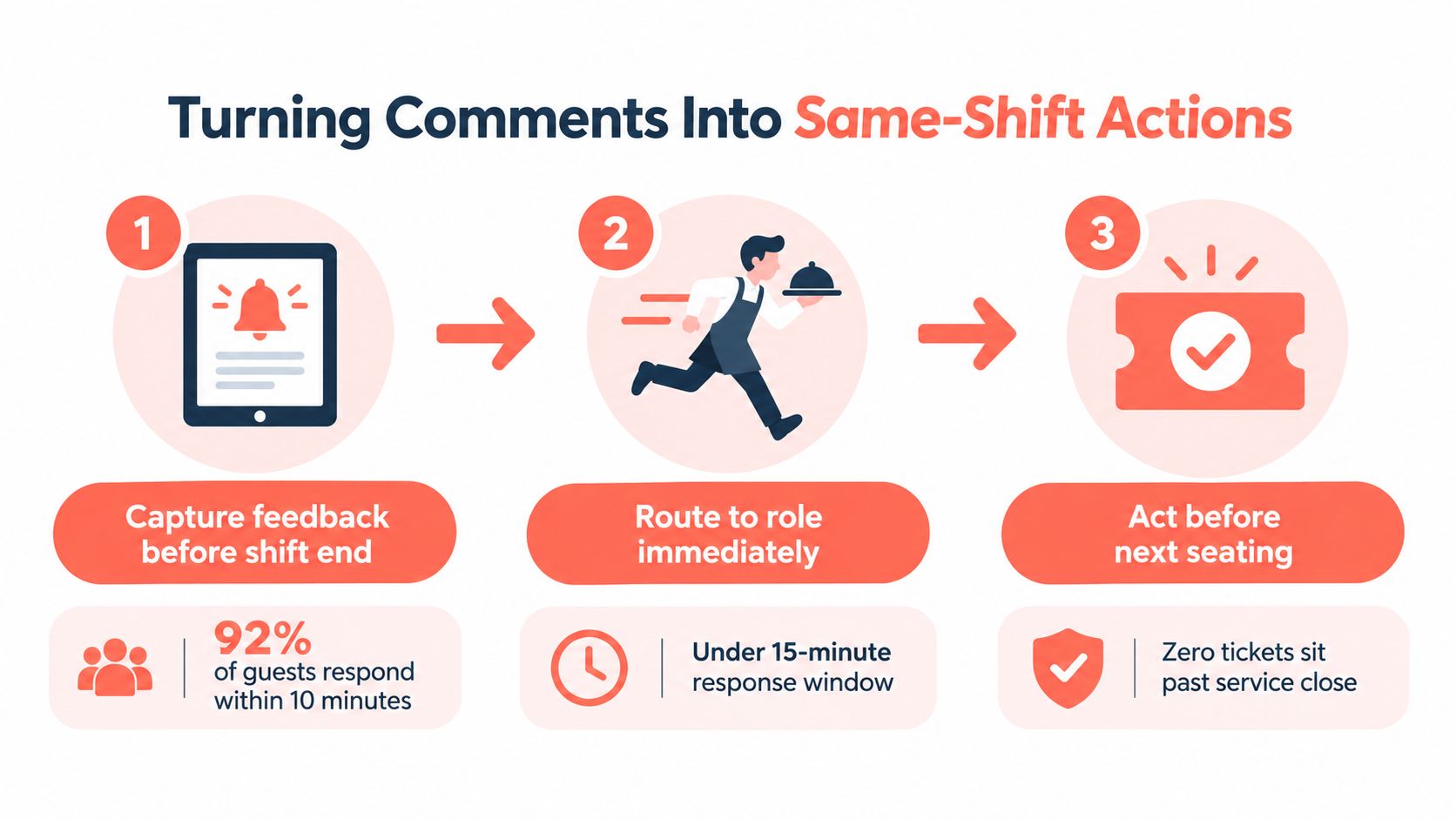
Feedback dies in a shared inbox. A manager reads a complaint on Monday, remembers that the issue happened on Friday, and loses the chance to test a fix while the same team and menu are still in place.
The routing sheet should fit on one page. It needs the comment, table or reservation reference, named owner, action deadline, and escalation path.
Route the problem to the person who can fix it
A server can flag a live table that has mentioned slow service. The kitchen lead can inspect a dish that has drawn repeated complaints and remove it from the pass if the preparation is failing. The floor manager can visit the table, correct the experience, and record the recovery. The host can add a rebooking note so the next visit begins with the relevant context.
A practical routing structure looks like this:
- Service complaint: Floor manager owns the immediate table visit and records the recovery.
- Food complaint: Kitchen lead checks the dish, preparation, and ticket timing.
- Reservation complaint: Host checks confirmation, seating notes, and table availability.
- Repeated pattern: Owner reviews the issue at the weekly operating meeting.
Practical rule: A comment without an owner is only information. A comment with an owner, deadline, and recorded action can improve the next service.
If a QR survey connects to the ticket or reservation, a low score should trigger a manager pass during the same ticket cycle. The weekly measure is straightforward: count comments that produced a same-shift intervention, then count those rolled forward. The second number should fall as routing becomes part of service discipline.
Reservation and table data add the missing context. A complaint about waiting may mean the kitchen slowed down, the table turn was misjudged, or the host seated a large party before a smaller table was ready. Feedback becomes useful when the manager can compare the comment with pacing, covers, course times, and table movement.
Less Feedback, Better Questions
More prompts don't automatically produce better decisions. Chasing five-star volume across every channel can consume staff attention while producing little insight about the issue that needs fixing this week.
The manager should start with the decision, not the survey. If the decision concerns a dish, ask about food quality, portion size, and value. If the decision concerns pacing, ask whether courses arrived at the expected rhythm and whether the table waited for attention. If the decision concerns pricing, ask whether the meal felt worth the price and what specifically shaped that judgment.
Public review data shows why broad interpretation is risky. A 2026 McKinsey study found that among consumers who said dining out wasn't worth the money, most were disappointed specifically by food quality and portion size, not only service speed or friendliness. McKinsey's restaurant outlook for 2026 supports a useful diagnostic distinction. “Too expensive” may mean the price is wrong, but it may also mean the portion or execution didn't meet expectations.
| Channel | Response Rate | Signal Quality | Best Use |
|---|---|---|---|
| Nine-question email survey | Low | Broad but diluted | Occasional deeper research |
| Single QR prompt at the table | Higher when timely | Focused | Immediate service or meal feedback |
| Public review request | Uneven | Strong for reputation, weak for diagnosis | Review visibility |
| Manager check-back | Limited by floor capacity | Strong for live recovery | Fixing an active experience |
The trade-off is clear. A narrow prompt returns less total information, but the answers are easier to classify and act on. A survey that asks about everything can reveal nothing specific enough to change tonight's briefing.
Responding, Closing the Loop, and Staying Compliant
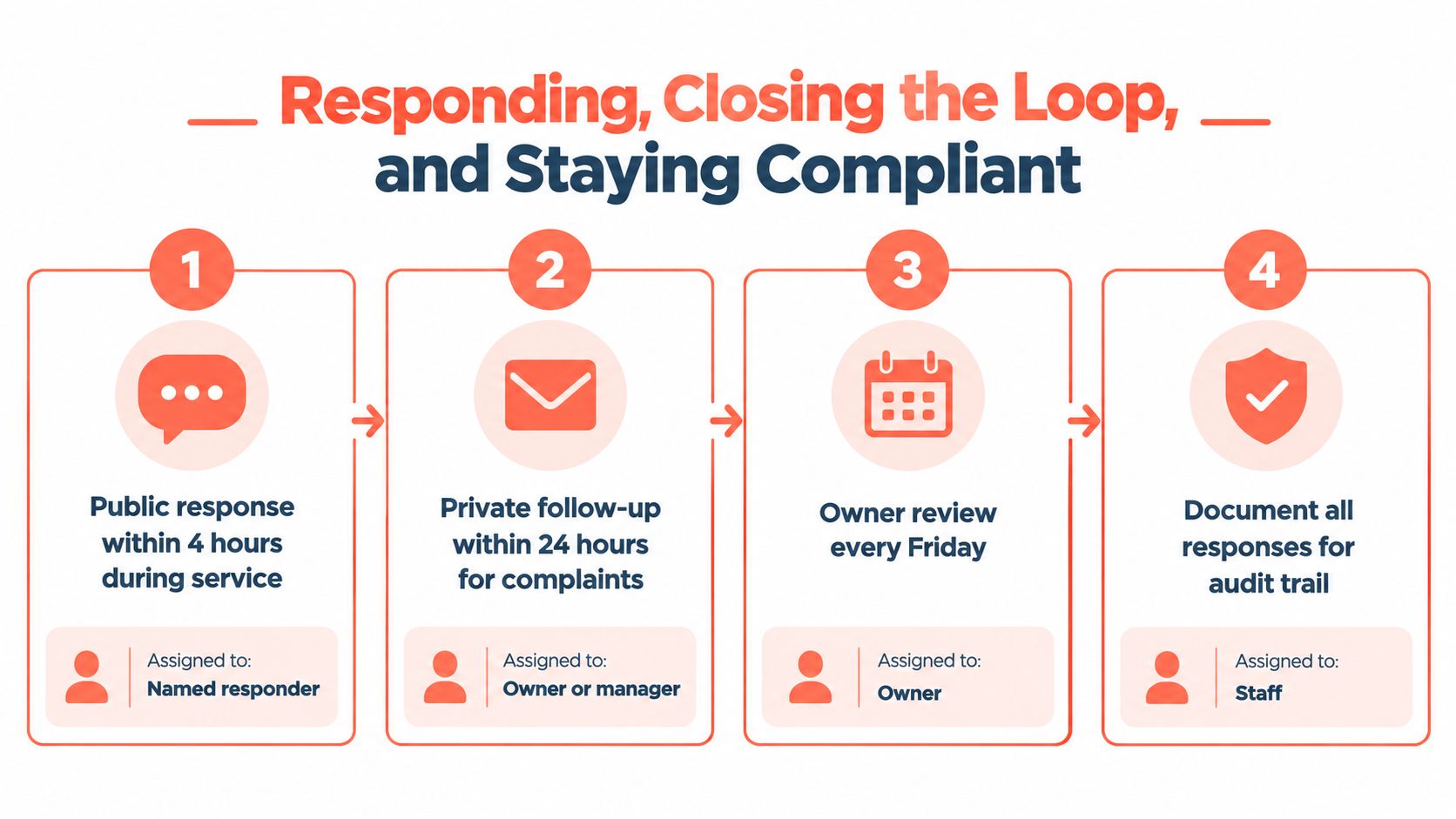
A response workflow needs ownership and deadlines. One named responder per shift is more reliable than a committee, particularly when a public review arrives during service.
For positive reviews, the responder should mention one specific detail from the visit, such as a dish, occasion, or service moment. A generic “thanks for the review” sounds automated and gives future readers no evidence that the restaurant paid attention.
For a negative review, the sequence is different:
- Acknowledge publicly without arguing about the guest's experience.
- Move the details privately and ask for the reservation or visit information.
- Resolve the issue within seven days where the facts and circumstances allow.
- Post a short closing line when appropriate, so future readers can see that the restaurant followed up.
A public response should be posted within four hours during service, and a private complaint follow-up should happen within 24 hours. These targets create a clear standard without asking a manager to monitor reviews constantly.
Belgian compliance belongs in the operating workflow
Belgian operators must use a Geregistreerd Kassasysteem, or GKS, when annual turnover from restaurant and catering services exceeds €25,000. Once a GKS is in use, all horeca activities must be settled through that cash register system, according to the official GKS information.
Belgium is also rolling out GKS 2.0 from July 1, 2025, with broader mandatory coverage for certain on-site food service and retail businesses. The system allows inspectors to view sales data remotely, as explained by GKS 2.0 guidance. Feedback records should therefore remain separate from sales records unless the restaurant's systems and retention practices clearly support the connection.
Reservation tools also differ in commercial structure. TheFork, OpenTable, Zenchef, and Formitable can be compared by their pricing models, contract terms, included reservation features, and how much guest and review data remains accessible to the restaurant. Commission-free reservation management, such as 10seat's model for independent restaurants in Benelux, is a different cost structure from a commission-based booking channel.
A documented response trail helps the owner review patterns each week and gives staff a consistent process for handling public comments. Guidance on connecting guest information to follow-up is available in this restaurant CRM system guide.
Your First Week of Better Feedback
Feedback should sit beside covers, no-shows, and repeat visits, not in a separate marketing report. A restaurant can compare weekly comment volume with table turns, reservation confirmations, and the return behavior of guests who responded. If respondents don't return, the feedback may be identifying a problem rather than creating loyalty.
No-shows belong in the same review. The 2026 Resos No-Show Index reported an average no-show rate of 2.33% across 3.77 million reservations at 2,417 restaurants, equal to 87,953 no-shows and 283,728 booked covers that never arrived, according to the Resos No-Show Index. A feedback loop can't recover an empty table by itself, but reservation reminders, clearer booking policies, and notes about previous behavior can help the host team manage the risk.
A seven-day operating list
- Day one: Audit every current prompt, public review source, and reservation follow-up.
- Day three: Remove the least useful third of the questions or prompts.
- Day five: Redesign the receipt and QR survey around one rating set and one open comment.
- Day six: Assign routing owners for service, kitchen, reservations, and escalation.
- Day seven: Review the first week's data and make one operational change before the next service.
The change might be a new water-service check during the busiest seating, a revised portion specification, a different table pacing rule, or a clearer reservation confirmation. The value of customer feedback for restaurants appears when the next shift runs differently because guests spoke.
10Seat gives independent restaurants reservation and table management tools that connect booking activity with floor decisions, guest profiles, and post-visit feedback. Operators can visit 10Seat to review a commission-free approach for turning guest comments into better table management and more controlled service.