OpenTable Alternative for Restaurants: A Practical Guide
Looking for an OpenTable alternative? Compare commission-free platforms, floor tools, and pricing models to find the best fit for your restaurant in 2026.
The worst advice around an OpenTable alternative is to start with feature lists. That's the wrong lens. If the dining room is already full at peak, the actual question is whether a new system helps sell more of the same seats, or just moves the booking pain somewhere else.
That is why many independent operators in Benelux are shifting the conversation away from marketplace reach and toward capacity economics. OpenTable helped define the category in 1998, then the market kept expanding into full reservation and floor-management software, not just a booking page (OpenTable history). The decision now is less about who has the flashiest widget and more about who helps a restaurant keep more covers from the tables it already has.
Table of Contents
- Why Owners Are Leaving OpenTable
- What an OpenTable Alternative Should Do
- OpenTable vs TheFork vs Resy vs Formitable vs Zenchef vs 10seat
- The Covers Math Most Comparisons Skip
- Migrating Off OpenTable Without Losing Guests or Bookings
- Belgian Operators and the GKS Compliance Question
- Which Platform Fits Which Restaurant
Why Owners Are Leaving OpenTable
OpenTable built the category, but that does not make it the right default for every restaurant today. For a busy owner-chef, the issue is blunt, per-cover costs are easiest to ignore when the room is half empty. Once service is tight, every extra booking fee starts to look like a tax on success.
Marketplace reach is not the same as operational value
Restaurant software gets judged too often as a marketing channel. A marketplace can send diners, but it does not automatically solve seating friction, table imbalance, or the cost of a no-show. Recent reservation data shows a 2.33% no-show rate across 3,768,761 reservations at 2,417 restaurants, and restaurants taking 500 to 999 bookings per month saw a higher 3.17% no-show rate (reservation dataset). Empty seats hurt more than another logo on the booking widget.
Practical rule: if a platform can't help the host seat faster, refill cancellations, and improve table mix, it isn't fixing the underlying problem.
Independent operators also face pressure on the labor side. A recent industry comparison noted that 99% of full-service independent restaurants reported higher labor spending in 2024, while 39% responded by increasing productivity and 35% by adopting new technology (SevenRooms comparison guide). That explains the shift in attitude. Owners are not buying software for novelty. They are buying time, control, and margin.
Direct booking beats paying for the same bottleneck
A commission-heavy system makes sense only when the added demand is incremental. If the venue already has healthy traffic, the better investment is often the system that converts existing demand more cleanly, with smarter table assignment and faster turn control. An OpenTable alternative search is really a search for more usable covers, not more software.
Commission-free booking flows are getting more attention from independents for exactly that reason. They keep the guest relationship closer to the restaurant, and they make the math easier to read. If the dining room is the scarce asset, software should improve how that asset is used, not charge again every time it works.
What an OpenTable Alternative Should Do
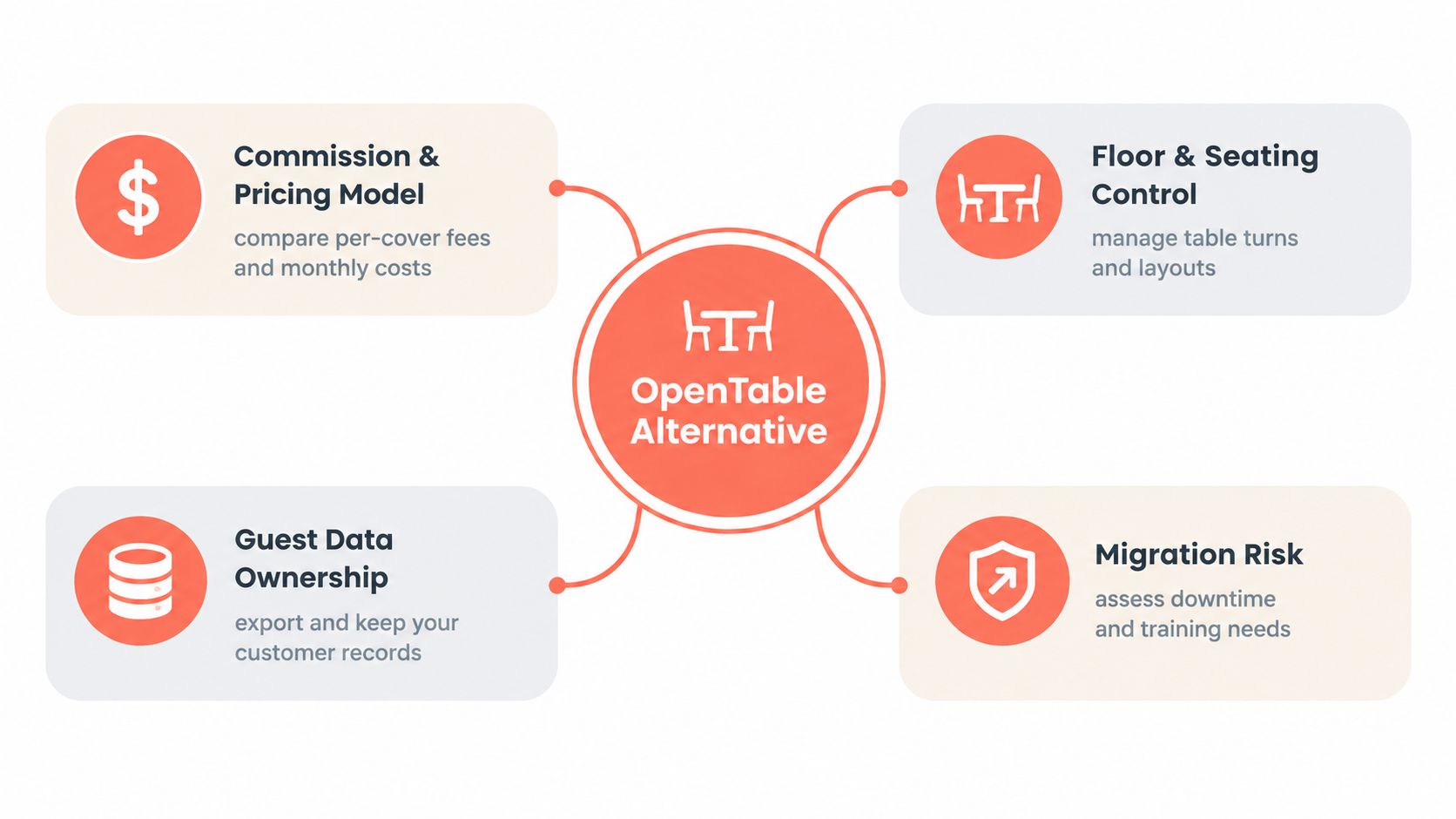
A serious OpenTable alternative should be judged on four things, not twenty feature bullets. Pricing model comes first, because a flat monthly fee and a per-cover fee behave very differently once the room fills. Floor and seating control come next, because reservations only matter if the tables are assigned well.
The four lenses that matter
Guest data ownership is the third lens. If a system captures notes, preferences, allergies, and visit history, the restaurant must be able to use that information without surrendering the guest relationship. Migration risk is the fourth lens, because a switch that creates duplicate bookings, broken links, or staff confusion costs more than it looks.
A clean way to score any vendor is to ask four questions:
- What does it cost when demand goes up? Fixed fees are easier to forecast than commissions tied to volume.
- Can the host control the floor in real time? Automatic table assignment, pacing, and waitlists matter on a busy shift.
- Can the restaurant export and use its guest records? Ownership only matters if the data can be activated.
- What breaks during a switch? Website links, QR codes, waitlists, and staff habits are usually where projects fail.
Operational truth: if the new system cuts manual work but slows the host at seating, it fails the service test.
Score the system against service reality
The scorecard has to reflect service reality. A brasserie, brunch spot, or small group should test whether the software handles uneven party sizes, fast cancellations, and walk-ins without creating a pile of manual corrections. The best system fits the host stand, because that is where covers are won or lost.
A smaller marketplace footprint can still be the better buy. If the platform seats better, recovers cancellations faster, and keeps data usable, it can outperform a louder brand. The key question is whether the software helps the dining room earn more from the same seats.
OpenTable vs TheFork vs Resy vs Formitable vs Zenchef vs 10seat
OpenTable and TheFork are marketplace-first systems, so they can bring demand but also tie part of the economics to volume. Resy focuses more on premium dining relationships and table control. Zenchef and Formitable give operators more control over direct bookings and guest communication. 10seat sits in the commission-free, direct-booking camp and focuses on seating efficiency rather than marketplace traffic.
How the platforms differ in practice
OpenTable defined the category in 1998 and the market has since grown into full operating software. Its reach is still its main strength, but that model can become expensive as volume rises. TheFork works well when marketplace visibility matters, though it still follows a commission-style logic in many cases. Resy fits tasting-menu rooms that cap covers and care about pacing, not venues chasing booking volume (SevenRooms comparison guide).
Formitable, now part of ZenchefOS, and Zenchef itself suit operators who want direct bookings, table planning, and guest communication in one place. They are built around control, not marketplace dependency. 10seat is the most focused option here for venues that want commission-free reservation management and a floor system built to improve cover efficiency.
| Platform | Pricing model | Floor tools | Best for |
|---|---|---|---|
| OpenTable | Marketplace-led, with fees tied to bookings in some plans | Solid reservation handling, broad brand recognition | Restaurants that want reach first |
| TheFork | Marketplace-led, with commission-style pricing in many cases | Reservation management, guest visibility | Venues that value discovery in Europe |
| Resy | Subscription-led with premium dining emphasis | Waitlist and guest flow tools | Fine dining rooms and premium service |
| Formitable | Direct-booking focused, now within ZenchefOS | Table planning and guest communication | Operators wanting branded reservations |
| Zenchef | Subscription-led, with direct reservation focus | Visual table planning and multi-location tools | Groups and European independents |
| 10seat | Commission-free | Capacity Engine, Smart Auto Seating, live floor control | Independent Benelux restaurants that want more usable covers |
The table only matters if it matches service reality. A brasserie, brunch spot, or small group should care more about uneven party sizes, walk-ins, and fast cancellations than about marketplace branding. If the team already has demand, paying more to route that demand through a platform is usually the wrong trade.
The Covers Math Most Comparisons Skip
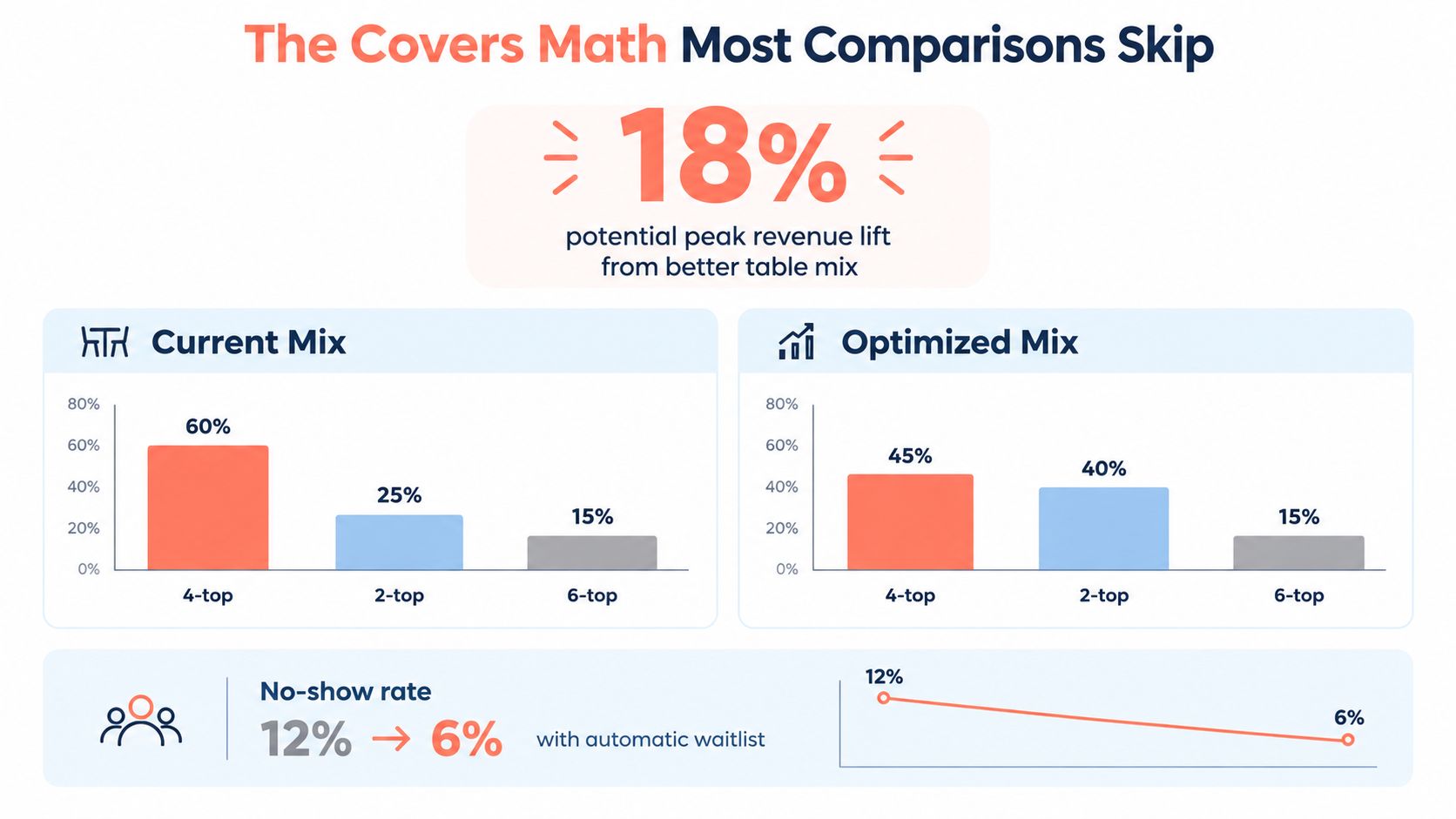
Restaurant software should be judged on covers, table mix, and turn quality. Booking volume matters less than how many seats you can sell and clear during service.
Better table mix changes the ceiling
Cornell researchers showed that a smarter table mix can raise peak revenue by an average of 14.8%. The same study found that more than 19% of the restaurants examined could improve revenue by over 20%, and another 23% could improve revenue by more than 10%. Use the Cornell table-mix study as the proof point, then look at your own floor plan. The room is not fixed, and party-size matching changes the ceiling.
That matters most in a busy dining room. If two-tops sit empty while larger tables are held too long, the restaurant loses money twice, once on the unused seat and once on the turn it never gets. Better seating logic recovers that value without adding chairs or labor.
No-shows are a seat-utilization problem
The reservation dataset cited earlier in this guide shows a 2.33% no-show rate across 3,768,761 reservations at 2,417 restaurants. It also shows that venues handling 500 to 999 bookings per month saw 3.17%. Those figures are not abstract. They point to the same operational fix every time: confirmation flows, cancellation handling, and fast table release have direct revenue impact.
A restaurant does not need perfect attendance. It needs a system that turns released tables back into covers fast enough to matter.
That is the true cost of per-cover commission. If a platform charges on top of weak table utilization, owners pay for demand they already have and still leave revenue on the floor. The real cost of per-cover commission shows why the better move is to improve the floor plan, refill cancellations quickly, and keep pacing tight. For independent Benelux venues, that is where more revenue stays in-house.
Migrating Off OpenTable Without Losing Guests or Bookings
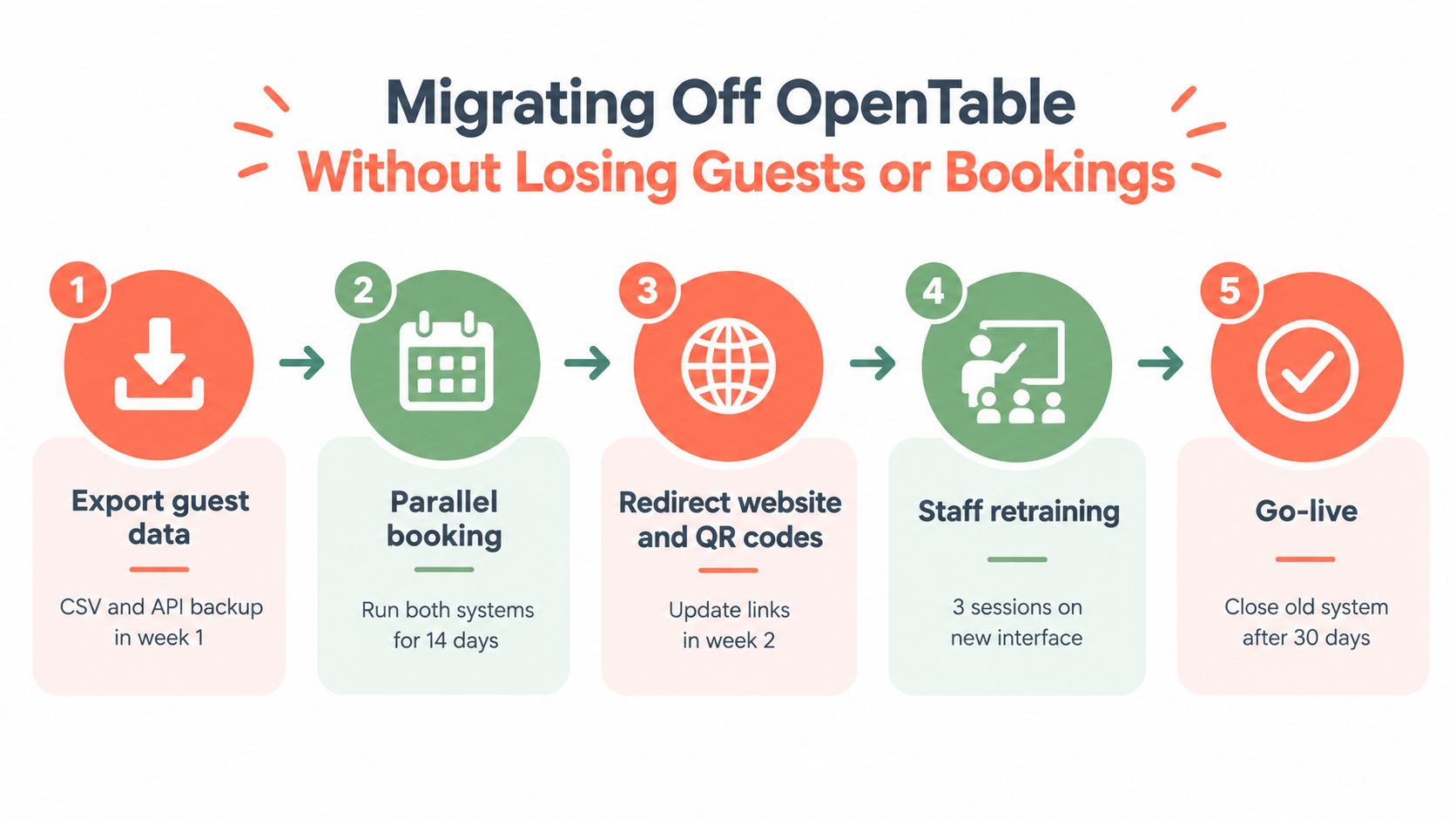
Switching systems is not a software task. It is a 30-day operations project. The restaurants that handle it well treat the move like service prep, with clear ownership, a backup plan, and a hard cutover date.
Week 1 through week 2
Start with the guest data export. Historical profiles, allergy notes, preferences, and special-occasion data need to be pulled out early, checked, and stored in a clean format. The practical question is not just whether the data exists, but whether the restaurant can use it once the new system is live.
Parallel booking should run next. Keep both systems open for a short overlap so the host team can compare outcomes and catch duplicates before they hit service. At the same time, update the website links, social links, and QR codes so new traffic stops flowing to the old path.
Most common migration mistake: the restaurant changes the software before the staff changes the habit.
Week 3 through day 30
Train the team on the new seating flow, cancellation handling, and waitlist process. One session is never enough. Hosts need repetition because they are the last line between the system and the guest.
Use a simple reconciliation routine during the overlap:
- Check reservations twice daily. Compare both systems so nothing slips through.
- Confirm direct-booking paths. Website buttons and QR codes should point to the new flow.
- Test cancellation recovery. Released tables should be visible fast enough to refill.
- Review consent and guest data use. First-party guests and marketplace guests do not always carry the same permissions.
- Close the old system only after service stabilizes. Speed is less important than continuity.
A neutral comparison should also test portability before signing anything. The key question is whether the restaurant can migrate guest profiles, preserve direct booking links, and keep reporting clean during the switch. For a more practical setup checklist, see 10seat migration guidance.
Belgian Operators and the GKS Compliance Question
Belgian restaurants need to keep compliance separate from reservation convenience. Where annual turnover from on-premise meals exceeds €25,000 excluding VAT and drinks, the GKS, or Geregistreerd Kassasysteem, requirement applies (Flemish guidance). That threshold is about meal turnover, not drink turnover, so the accountant needs to check the numbers before any software decision.
Reservation software is not the till
The certified white cash register records till operations. Reservation management and table planning should stay operationally distinct from that sales-recording process. Mixing those functions loosely creates confusion during audits and can make staff think the reservation platform is doing something it shouldn't.
Belgian operators should ask three direct questions. First, does the venue cross the threshold based on meal turnover alone. Second, does the chosen setup keep sales recording and seating logic separate. Third, can the staff use both systems without blurring the compliance line.
That separation matters because the restaurant still needs flexibility at the front door. Hosts should seat efficiently, manage waitlists, and handle no-shows without changing how the compliant till works. For a plain-language overview of reservation workflows, see this restaurant reservations guide.
If the accountant would not be comfortable explaining the flow to an inspector, the setup needs work.
This is the point where Benelux operators should stay conservative. The reservation stack can be modern, but the compliance stack must be clean. Keep the two jobs separate and the risk drops sharply.
Which Platform Fits Which Restaurant
Fine dining rooms usually need tighter guest profiles, stronger pacing, and a polished booking flow, so Resy or Zenchef often fit better than a marketplace-heavy setup. Brasseries and bistros with steady local demand usually do better with a commission-free direct-booking model, especially when the room turns quickly.
Match the tool to the service style
Brunch venues and casual spots with lots of party-size variation should care more about table assignment and waitlist handling than about marketplace traffic. Bar and lounge concepts that seat guests for a while need live floor control, not just a booking widget. Multi-location groups should look hard at reporting consistency and how painful the switch will be across sites.
For independent Benelux venues that want to keep more of the revenue they already earn, 10seat is a practical option because it focuses on seating optimization and direct reservation management rather than charging for every cover. It also helps to pair strong booking software with a fast, credible site, and a useful reference for that is hand-coded sites for eateries. The point is not to add more tools, it is to remove avoidable friction between the guest, the host, and the table.
If the room is busy, the best platform is the one that improves turns, protects margin, and keeps the team calm. For many Benelux independents, that means choosing the software that helps fill the seats already on the floor, not the one that sells the most ads around them. To see what that looks like in practice, visit 10Seat, review the product flow, and compare it against the way the dining room runs.