Multi Unit Restaurant Management: A Practical Playbook
Multi Unit Restaurant Management guide: set decision rights, write standard SOPs, track shared KPIs and run weekly reviews across every location.
Saturday service is approaching. One restaurant has a full terrace and needs another server. Another has cancellations, too much prep and a manager waiting for permission to change the booking pace. The owner-chef is answering both calls while checking whether anyone updated the supplier prices.
Multi unit restaurant management works when the group operates as a decision system, not as a collection of restaurants waiting for head-office approval. That means clear decision rights, comparable numbers and local managers who know when to act and when to escalate.
Table of Contents
- Decide What Stays Central and What Stays Local
- Set Shared Numbers So Units Compare Fairly
- Build One Standard Operating Procedure Library
- Run Daily Checks and Weekly Exception Calls
- Check GKS Compliance for Each Belgian Site
- Choose Tools by Which Decisions They Speed Up
- Start a 30-Day Pilot in One Location
Decide What Stays Central and What Stays Local
Decision rights by area
| Area | Central owner | Unit manager decides | Review cadence |
|---|---|---|---|
| Food safety and recipe specs | Group chef or operations director | Staff training schedule within the standard | Monthly audit |
| Menu prices | Group finance | Daily specials and local pricing within a set band | Quarterly |
| Labor hours | Group operations | Shift rosters within the labor budget | Weekly |
| Reservation pacing and party-size limits | Group rules | Live pacing for each service | Weekly review |
| Hiring and firing | HR policy | Final hiring decision within policy | Monthly |
| Supplier contracts | Purchasing | Daily ordering within par levels | Monthly |
The test behind each row is straightforward: centralize what must remain consistent for a guest or an inspector; delegate what depends on local conditions. Food safety requirements and signature recipe specifications aren't optional. Terrace demand, neighborhood events and the timing of walk-ins require judgment at the restaurant.
Central ownership doesn't mean every decision needs approval. Group finance can set a pricing band while the GM chooses a local special within it. Purchasing can negotiate contracts while the chef orders against agreed stock levels and delivery schedules.
Give managers boundaries, not permission queues
A manager facing a suddenly full terrace on Saturday needs authority to adjust staffing and seating. If every adjustment needs a message to the operations director, the manager carries responsibility without the power to deliver.
The opposite failure is equally expensive. A group that centralizes nothing can end up with twelve versions of the same burger, incompatible supplier substitutions and different interpretations of a guest complaint.
Practical rule: Every recurring decision needs a named owner, a boundary and an escalation route.
Growth alone won't resolve these problems. A U.S. Census Bureau study found that multi-unit establishments averaged more than twice the revenue, employee count and payroll of single-unit establishments, yet revenue per employee and average rate of return were nearly identical.
The practical lesson is to measure both restaurant performance and portfolio performance. More venues can produce a larger business without producing a more productive one. Decision rights should make successful practices transferable, rather than merely creating another approval layer.
For the coming week, group operations should list every recurring decision and mark it central or local. Where two people claim final authority, remove the duplicate ownership, not the decision itself. Then test the list against a busy Saturday: can the GM act before the queue reaches the door?
Set Shared Numbers So Units Compare Fairly
Most unfair comparisons begin with different definitions. One restaurant includes salaried managers in labor; another doesn't. One closes its sales day after midnight, while another splits the same service across accounting dates.
Use a common chart of accounts for food, beverage, paper and labor. Record the treatment of salaried managers, agree a sales cutoff and use consistent definitions for net sales, full-time equivalents and available seats.
Unit scorecard metrics
| Metric | Formula | Check | Action trigger |
|---|---|---|---|
| Revenue per employee | Net sales divided by FTE count | Weekly | Review rosters if the unit stays below its peer median for three weeks |
| Payroll as share of sales | Total payroll cost divided by net sales | Weekly | Investigate overtime and overstaffing |
| Revenue per seat | Net sales divided by seat count | Monthly | Check table layout and pacing |
| Covers per shift | Covers served divided by shifts | Daily | Adjust pacing and walk-in policy |
| No-show rate | No-shows divided by reservations | Daily | Review deposit rules |
| Staff turnover | Leavers divided by average headcount, annualized | Monthly | Review onboarding and rota fairness |
| Prime cost | (COGS plus total labor) divided by net sales | Daily | Trace variances to specific recipes, vendors or staffing decisions |
These triggers are proposed operating rules, not industry benchmarks. Define no-shows consistently as missed reservations rather than mixing reservation counts with missing guests. Keep every numerator and denominator within the same reporting period.
Read the measures together
Cornell's report on multi-unit restaurant productivity describes data-envelopment analysis, which compares multiple inputs and outputs rather than judging efficiency by sales alone, and identifies employee turnover as a potentially significant, even fatal, productivity constraint.
That principle is useful without a specialist model. Compare restaurants with similar service formats, capacity and demand. Low revenue per employee alongside weak covers suggests a different intervention from strong covers alongside excessive payroll.
For quick-service formats, Franchise Foundry's guide to managing speed and quality in QSRs provides context for balancing throughput with execution. A broader restaurant data analytics guide can help organize the reporting questions before choosing dashboard software.
Build prime cost consistently
The daily workflow recommended in QMK Consulting's restaurant benchmark guidance provides a practical sequence:
- Use the common chart of accounts.
- Record whether salaried managers count as labor.
- Import nightly net sales and product mix from the POS.
- Reconcile supplier invoices and inventory to calculate actual cost of goods sold, or COGS.
- Import total labor costs, including wages, payroll taxes, benefits and workers' compensation.
- Calculate prime cost as COGS plus total labor, divided by net sales.
- Review daily results alongside rolling seven-day and period-to-date averages.
Where inventory isn't fully reconciled, label the daily food-cost result provisional rather than presenting an estimate as actual COGS.
For planning, allow about 30 minutes for a first POS-based scorecard once a clean template exists. That's an implementation estimate, not a benchmark, and excludes fixing inconsistent exports.
The final test is operational: does the scorecard explain whether tonight needs another server, fewer simultaneous arrivals or a recipe check?
Build One Standard Operating Procedure Library
A useful SOP library captures operating judgment without pretending every dining room behaves identically. A procedure should explain what must happen, who owns it and which local adjustments remain acceptable.
A study of McDonald's operating experience, combining 14,069 stores and more than six million customer reviews over three years, found that greater local owner experience improved survival and sales growth through customer satisfaction, while excessive intensity of distant experience impaired those outcomes.
The lesson isn't to reject knowledge from other restaurants. It's to transfer practices through a controlled learning loop rather than copying the busiest venue wholesale.
Capture, separate and test
-
Capture the strongest unit's working practices. Record the pre-service huddle, cold station setup or table-turn routine in observable terms. In a Saturday-service scenario, the useful detail isn't “communicate better”; it's that the host tells the pass about delayed arrivals before releasing the next seating.
-
Separate universal standards from local adaptations. Food safety, recipe execution, service sequence and reporting belong in the shared standard. Labor deployment, menu emphasis, daypart pacing and guest greetings need room for local judgment. A neighborhood bistro may need a different arrival pattern from a city-center dining room even when both serve the same menu.
-
Pilot the practice in a comparable restaurant. For an initial test, a suggested window is two to four weeks, long enough to observe contrasting services rather than a single successful evening. The receiving manager should record friction: perhaps the table-reset routine works, but the glass storage position adds unnecessary walking.
The library needs a visible route from draft to training.
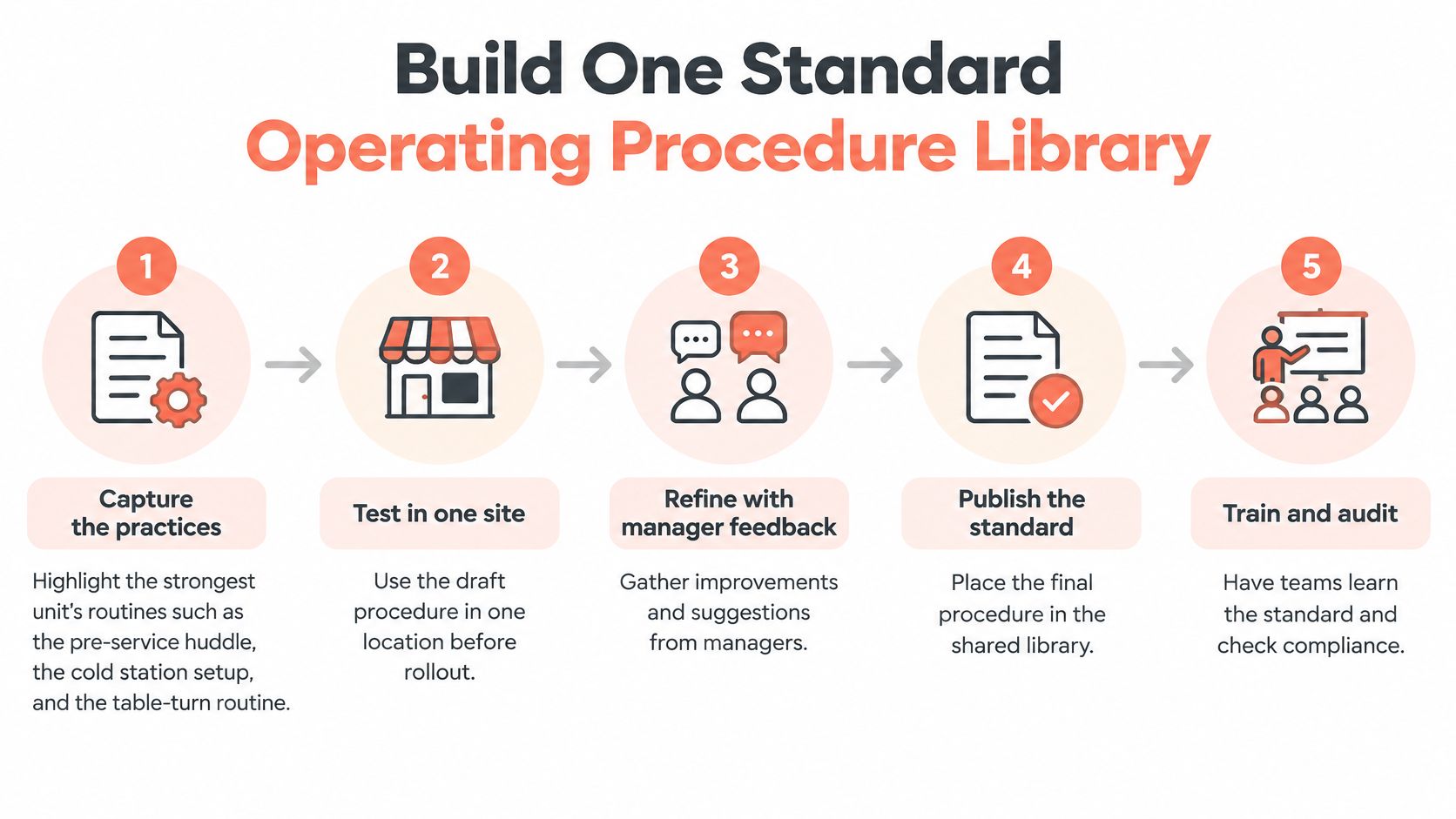
Measure before publishing
-
Compare execution before and after. Review guest satisfaction, sales, labor productivity, retention and execution defects against the receiving restaurant's baseline. A faster reset isn't an improvement if staff repeatedly miss dirty cutlery or guests feel hurried through dessert.
-
Scale only what improves performance without lowering service quality. Refine the procedure with the pilot manager, publish the approved version and train the next restaurant. Hold the rollout if gains depend on an unusually experienced supervisor who won't be present elsewhere.
Each SOP should have one page, a named owner, a version date and a review date. Include the task sequence, an observable completion standard and the exception that requires escalation. Keep background explanations separate from the checklist staff need during service.
For procedures used under pressure, VideoLearningAI's guidance on making procedures easier with job aids offers a useful way to think about short, task-focused support. A photograph of the correct cold-station setup may be more usable than another paragraph.
Standardize the required outcome. Test the method before making it mandatory everywhere.
Avoid three shortcuts: copying a high-volume city-center restaurant into a suburban or culturally different market, removing manager autonomy, and treating guest feedback as interchangeable. Comments about leisurely service mean something different at a tasting-menu restaurant than at a business-lunch venue.
Run Daily Checks and Weekly Exception Calls
A reporting routine earns its place when managers can complete it before the next service. Keep the daily check short and reserve group discussion for exceptions requiring a decision.
Staff cover still needs advance planning. Restaurant Business, reporting Bureau of Labor Statistics and National Restaurant Association figures, noted a 3.6% restaurant and accommodation quit rate in 2024, while 32% of operators still reported insufficient staffing.
Use a repeatable operating rhythm
-
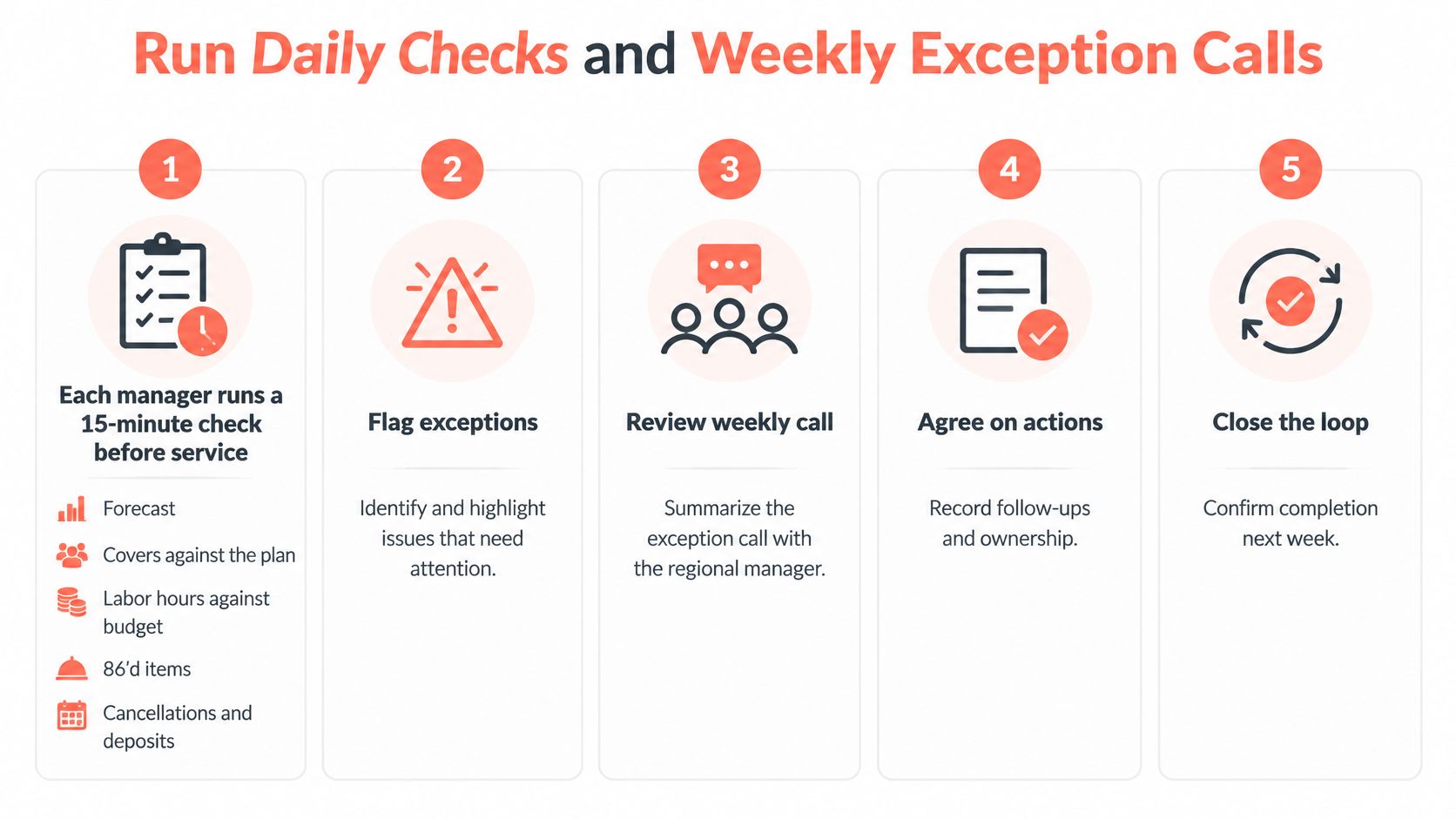
Before service, run a proposed 15-minute check. Compare forecast covers with the plan and labor hours with budget. Confirm unavailable dishes, cancellations and deposits taken. The manager should leave with an action, not a completed sheet.
-
After service, compare actuals with the forecast. Record actual covers and labor, then flag results outside the restaurant's agreed demand band. Bands should reflect the room's staffing and kitchen constraints.
-
Write one line per exception. Use a shared sheet containing what happened, the likely cause and the proposed fix. “Terrace opened after sunshine; arrivals exceeded plan; activate agreed backup cover” is more useful than “busy service.”
-
Hold a proposed 30-minute Monday exception call. Group operations reviews flagged items only. The discipline behind weekly check-ins with The OKR Hub is relevant: discuss progress, obstacles and decisions rather than reciting the dashboard.
-
Assign an owner and completion date. “Operations will investigate” isn't ownership. Name the person responsible for confirming backup availability or correcting forecast inputs.
-
Start the following call with results. Close fixes that worked and revise those that didn't.
The checklist should remain visible beside the exception log.
Agree the response before demand changes
If covers run well above forecast early in the evening, the manager should activate an agreed backup server or cook, subject to availability and employment rules. Group operations can arrange temporary shift-manager support across sites rather than leaving the same GM exposed all week.
In a 2025 survey of more than 300 multi-unit operators reported by Chain Store Age, only 28% were extremely confident in forecasting sales for scheduling. Modern Restaurant Management's account of the 2025 findings reported 72% using forecasting technology, but average forecast accuracy of only 60%.
Log forecast against actual covers for every service. Under a suggested two-week escalation rule, repeated misses trigger a review of weather, local events and bookings on hand before changing permanent rosters.
A hypothetical time-saving target is to eliminate a two-hour month-end reconstruction by resolving discrepancies daily. That isn't a claim of net savings: the daily checks also take time, and their value includes earlier corrective action.
Check GKS Compliance for Each Belgian Site
Belgium's GKS, or Geregistreerd Kassasysteem, is a certified cash-register setup incorporating a fiscal data module for registering sales and issuing VAT receipts. According to AAM Solutions' Belgian horeca guidance, the obligation generally applies when annual restaurant and catering services turnover, excluding drinks for the calculation, exceeds €25,000 excluding VAT, assessed per establishment, not across the group.
A group-wide accounting total isn't enough to establish each restaurant's position. For example, a group with three small establishments could have one above the threshold and the others below it. Each location needs its own calculation and documented status.
Keep an establishment-level compliance file
-
Calculate qualifying turnover separately. Identify annual restaurant and catering services turnover for each site, excluding drinks from the threshold calculation. Keep the supporting accounting records with the calculation.
-
Confirm the installed register setup. Record which establishments operate a certified register incorporating the fiscal data module. Keep the relevant system details accessible to finance and the local manager.
-
Check sales registration and VAT receipts. At sites subject to GKS, verify that staff follow the required registration and receipt workflow. Include cancellations, corrections and unusual transactions in staff training rather than leaving them to improvised workarounds.
-
Reassess after operational changes. Opening a restaurant, restructuring a company or moving activity between establishments should trigger a status check. None should be treated as automatically removing or preserving the obligation.
-
Request written accountant confirmation annually. Keep a clear record of the establishment, its status and any follow-up actions. A proposed annual review is a management safeguard, not a substitute for checking changes when they occur.
A shared dashboard can show turnover. It can't determine the correct tax treatment of an establishment without the relevant facts.
The distinction between qualifying turnover and the tax treatment of individual sales deserves attention. The guide to VAT on food provides useful context for keeping those questions separate.
Rules and thresholds can change. Before buying hardware or transferring activity, confirm the current position with the Belgian tax authorities or the restaurant's accountant, including the applicable certified-system requirements.
Choose Tools by Which Decisions They Speed Up
Start with the decision, not the feature list. Does the tool help a host accept a walk-in, a GM adjust tomorrow's roster or group finance identify a supplier-price change? Those are different jobs, even when a vendor puts them on the same dashboard.
A review should connect the screen to the operating action.
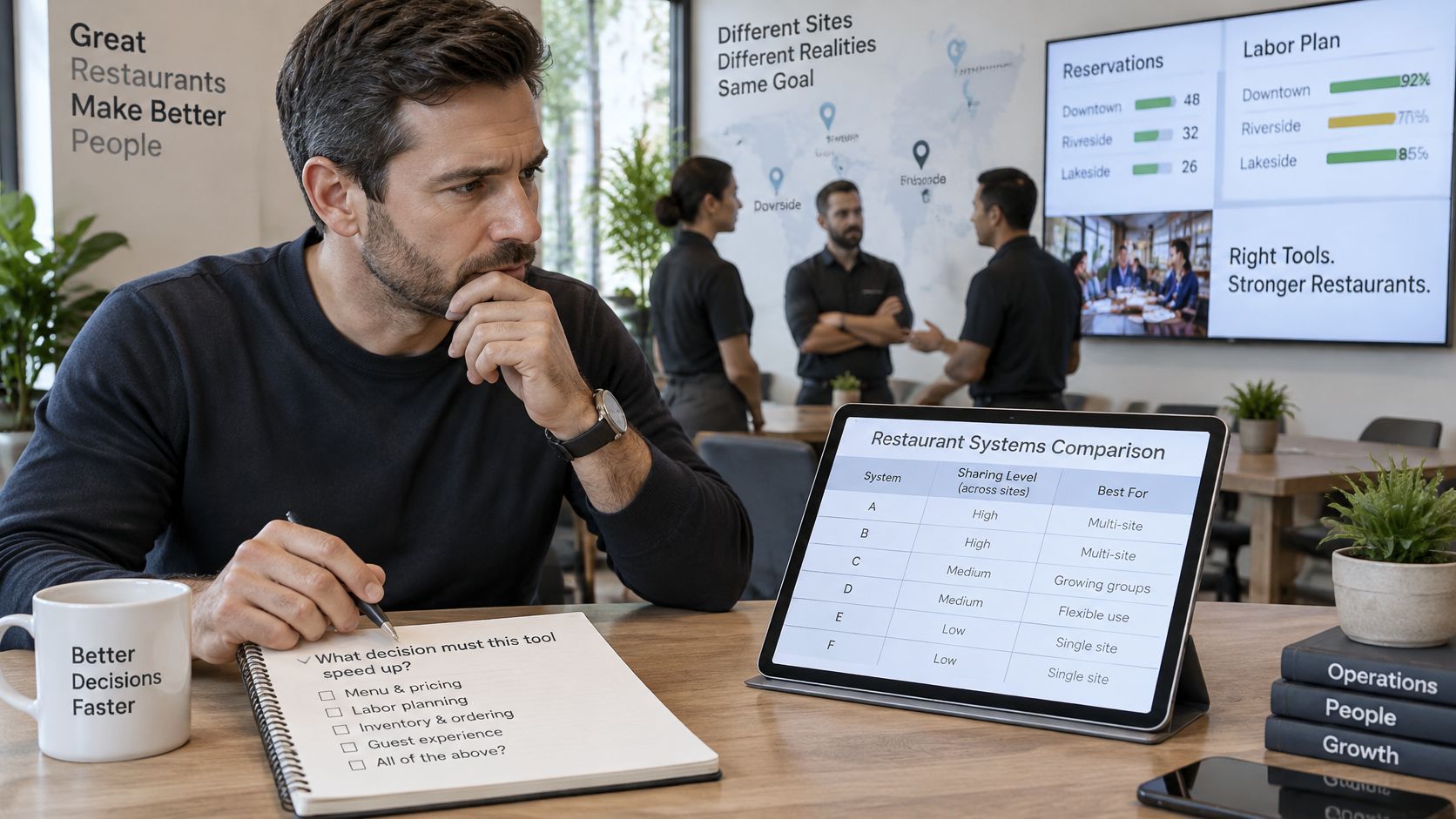
What to share across sites and what to keep local
| System | Share across group | Why | Watch for |
|---|---|---|---|
| Reservations | Yes | One availability rule and one guest history | Live pacing changes made locally without rules |
| Guest records | Yes | Shared profiles across sites | Consent and data handling agreed centrally |
| POS and sales data | Yes | One definition for prime cost | Different tax or discount settings per site |
| Labor scheduling | Partly | One labor standard with local rosters | Forecasts that ignore local events |
| Inventory and ordering | Partly | Shared par levels with local orders | Vendor price changes not reflected in costs |
| Local marketing and events | No | Demand differs by neighborhood | Brand inconsistency across sites |
Test the handoffs, not just the screens
Shared reservation rules need controlled local exceptions. A host facing a backed-up kitchen must be able to slow arrivals within agreed boundaries, while group operations retains a record of what changed.
During evaluation, test an actual workflow: a cancellation, a revised party size, a walk-in and a service-date correction. Confirm who owns failed imports and whether managers can retrieve usable exports. The restaurant management software guide can support that requirements list.
The accompanying video provides another reference for the tool review.
Compare the complete pricing model
For proposals from TheFork, OpenTable, Zenchef or Formitable, compare the quoted pricing models rather than assuming their headline prices cover identical services. Separate flat subscriptions, per-booking or per-cover charges where applicable, payment costs and optional modules.
Calculate the total at the restaurant's real booking and cover volume, including a busy month. A lower subscription doesn't necessarily mean a lower operating cost.
For a multi-site evaluation, use the product overview to frame questions about shared controls and local permissions. Software can't settle unclear authority, correct neglected inventory counts or make an unsupported staffing decision safe.
Start a 30-Day Pilot in One Location
A Saturday service is a useful stress test: bookings change, walk-ins arrive, and the kitchen may need a slower pace. Use a 30-day pilot to see whether the group's routines and tools help managers make better decisions under those conditions. Set a baseline first, so other operational changes don't muddy the comparison.
- Choose a suitable unit. Look for consistent records and a manager willing to follow the routine. The highest-sales restaurant is not automatically the best pilot.
- Write three draft SOPs. Opening, reservation pacing and deposits are practical candidates. Assign each an owner, version date and review date.
- Record a two-week baseline. Track reservations, no-shows, covers per shift and guest feedback before changing the routine.
- Run the routine for four weeks. Complete daily checks and Monday exception calls, recording forecast against actual covers.
- Compare results with the baseline. Review service quality alongside financial and capacity measures. A higher cover count is not a win if guest feedback worsens.
- Expand only when the evidence supports it. Pause rollout if a key metric or guest feedback suggests that gains came at a service cost.
10Seat's Multi-Location Management brings a restaurant group's venues into one overview with clear reporting. Multi-Location Profiles share guest profiles across locations, and group-level dashboards provide central visibility with drill-down for each restaurant.
Assess plan costs against actual monthly cover volume. This week, choose the pilot restaurant and schedule its first baseline review. Then test whether the reservation workflow, reporting and local service decisions fit the restaurant's needs.
10Seat offers reservation management for restaurants, with group visibility and shared guest profiles to support multi-location operations. Visit 10Seat to assess the fit against the pilot restaurant's workflow.