Buying a Restaurant: Step-by-Step Guide for 2026
Buying a restaurant step by step: where to find listings, how to value the business, run due diligence, finance the deal and plan the first 90 days.
The usual advice about buying a restaurant starts with finding a busy location and negotiating a good price. That's backwards. A full dining room can hide weak margins, unpaid owner labor, and a lease that becomes expensive the moment ownership changes.
The better starting point is transferable cash flow. A buyer needs to establish what the business earns without the seller's shortcuts, how many covers the existing room can realistically serve, and whether enough cash remains after staffing, rent, and debt payments.
Table of Contents
- Where to Find Restaurants for Sale and Screen Them Fast
- How to Value a Restaurant Without Trusting the Asking Price
- How to Run Financial Due Diligence Step by Step
- Check the Room, Lease and Equipment Before You Commit
- GKS Compliance for Belgian Restaurant Acquisitions
- Financing and Negotiating the Deal
- Plan the Handover and First 90 Days
- Go or No-Go Gate and Your Next Step
Where to Find Restaurants for Sale and Screen Them Fast
Follow a seven-step path: source candidates, screen listings, verify earnings, test room capacity, inspect obligations, secure financing, and organize the handover. Keep the search broad until the documents justify narrowing it.
Where to find restaurants for sale
| Source | Best for | Watch for |
|---|---|---|
| Business brokers | Full-service search and deal support | They may represent the seller, so confirm who pays them |
| Online business-for-sale marketplaces | Comparing prices and volume across many listings | Stale or inflated listings with thin detail |
| Commercial agents and landlords | Vacant units that already include a kitchen | Lease terms that may not transfer to a new operator |
| Accountants and lawyers | Deals before they reach the market | Fewer options and slower timing |
| Direct approach to owners | Off-market deals with less competition | Owners who aren't ready to sell and need patience |
| Trade press and local networks | Groups selling single units or closing concepts | Limited visibility into the true financial picture |
For a structured approach to comparing channels and building a shortlist, buyers can evaluate acquisition opportunities with Bizbe, from Bizbe, Inc.
A busy acquisition market doesn't automatically offer better prices. Aaron Allen & Associates' restaurant acquisition analysis describes how transaction counts and total deal values can move in opposite directions.
Run a short first screen
Use a 15-minute screening exercise, not a miniature valuation:
- Revenue direction: Request the three-year trend, not just the latest annual total.
- Lease runway: Establish the remaining term and whether renewal rights transfer.
- Owner dependence: Identify who cooks, schedules, buys, and manages service.
- Price plausibility: Compare the asking price with disclosed sales before investigating profit.
As a screening rule, drop listings that fail two checks unless the seller provides a credible explanation. Check the surrounding catchment separately using the restaurant location assessment guide. An attractive kitchen doesn't compensate for unsuitable local demand.
How to Value a Restaurant Without Trusting the Asking Price
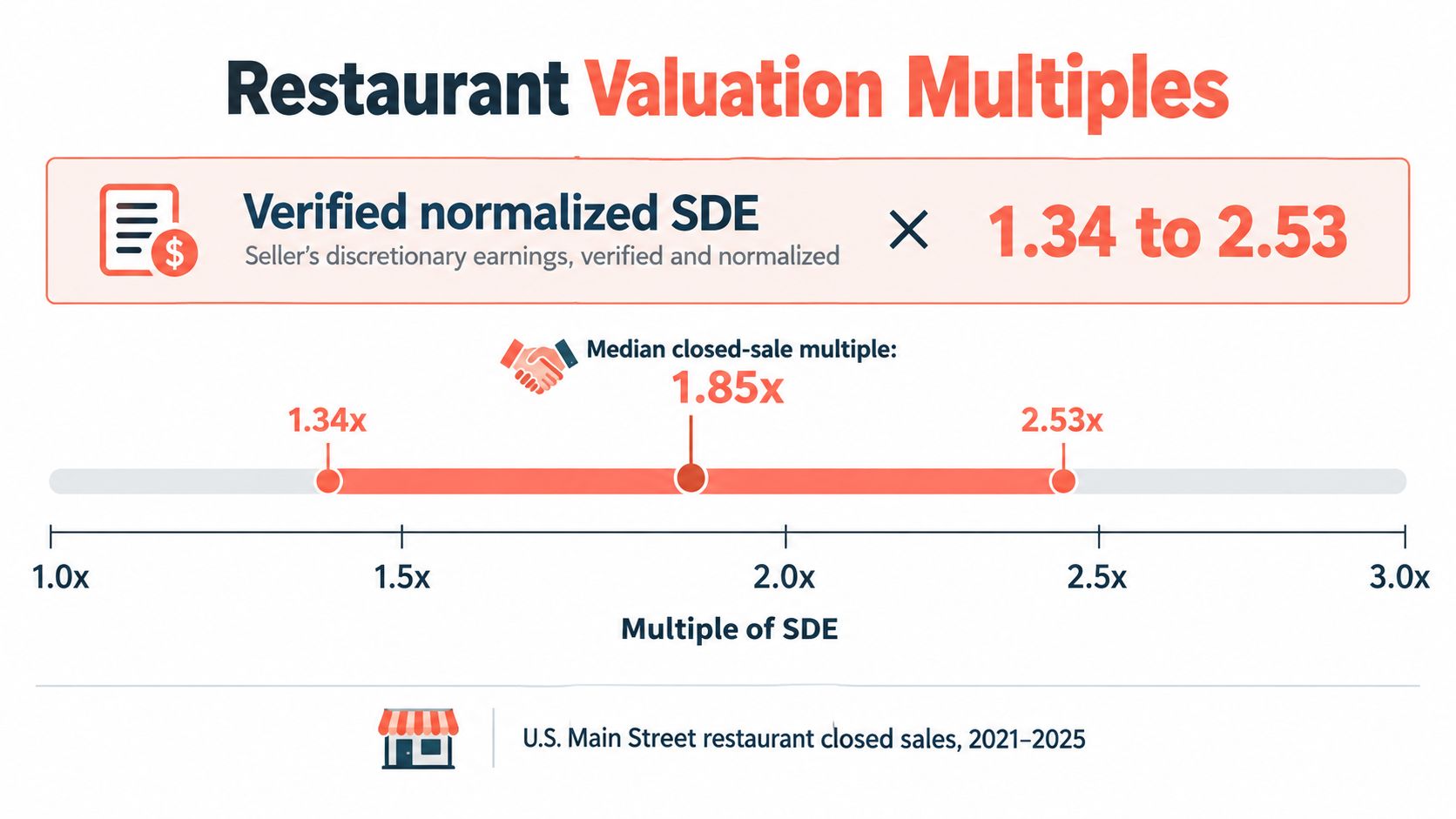
Verified normalized SDE × an appropriate transaction multiple is the starting point for an owner-operated restaurant. In U.S. Main Street restaurant transactions reported by BizBuySell for 2021–2025, the median closed-sale multiple was 1.85x SDE, with the middle half between 1.34x and 2.53x, according to AcquireCalc's restaurant valuation guide.
For a hypothetical restaurant with $150,000 in verified SDE, applying those benchmarks produces approximately $201,000 to $380,000, with $277,500 at the median. That's a negotiating range, not a conclusion about what a particular restaurant deserves.
Seller's discretionary earnings, or SDE, represents the financial benefit available to a working owner. Start with profit, reconcile owner compensation and eligible adjustments, then reject personal expenses or supposedly exceptional costs that lack evidence. Family labor that must be replaced isn't free income.
Match the method to the business
A historical analysis of announced restaurant transactions reported approximately 10x enterprise value to EBITDA and 1x enterprise value to revenue, benchmarks for larger transactions rather than automatic independent-restaurant pricing rules, in Peakstone's 2016 restaurant M&A analysis.
Valuation methods and typical ranges
| Method | Typical range | Best used when | Main risk |
|---|---|---|---|
| SDE multiple, owner-operated single site | 1.34x to 2.53x SDE, median 1.85x | The owner works in the business | Undocumented seller add-backs |
| EBITDA multiple, larger or multi-unit | About 10x EBITDA in the historical announced-deal analysis | Managers operate units without the owner | Poor comparability with a single site |
| Revenue multiple, cross-check | About 1x revenue in the same analysis | Testing whether a price warrants investigation | Ignores margins and rent |
| Asset value, kitchen, furniture, stock | Inspected replacement or liquidation value | Earnings provide little support for goodwill | Ignores goodwill and location |
For a hypothetical business earning $500,000 in EBITDA, that historical EBITDA multiple implies approximately $5 million in enterprise value before transaction adjustments. Enterprise value isn't the seller's final proceeds: cash, debt, working capital, and unpaid obligations affect the equity purchase price.
Treat U.S. benchmarks as directional for Benelux acquisitions. Reduce the valuation for owner dependence, declining trade, concentrated customers, licensing uncertainty, or equipment replacement needs.
Pricing discipline: Write down a range. A short lease or a seller who personally holds the operation together belongs near its lower end, not its upper end.
How to Run Financial Due Diligence Step by Step
A seller's spreadsheet is a claim to investigate, not evidence to accept. The objective is to reconstruct earnings from records created for different purposes, then explain every material difference.
The Foxifood restaurant acquisition guide recommends obtaining at least three years of records and using food, labor, and prime-cost benchmarks as diagnostic checks rather than universal rules.
Reconstruct earnings from the documents
-
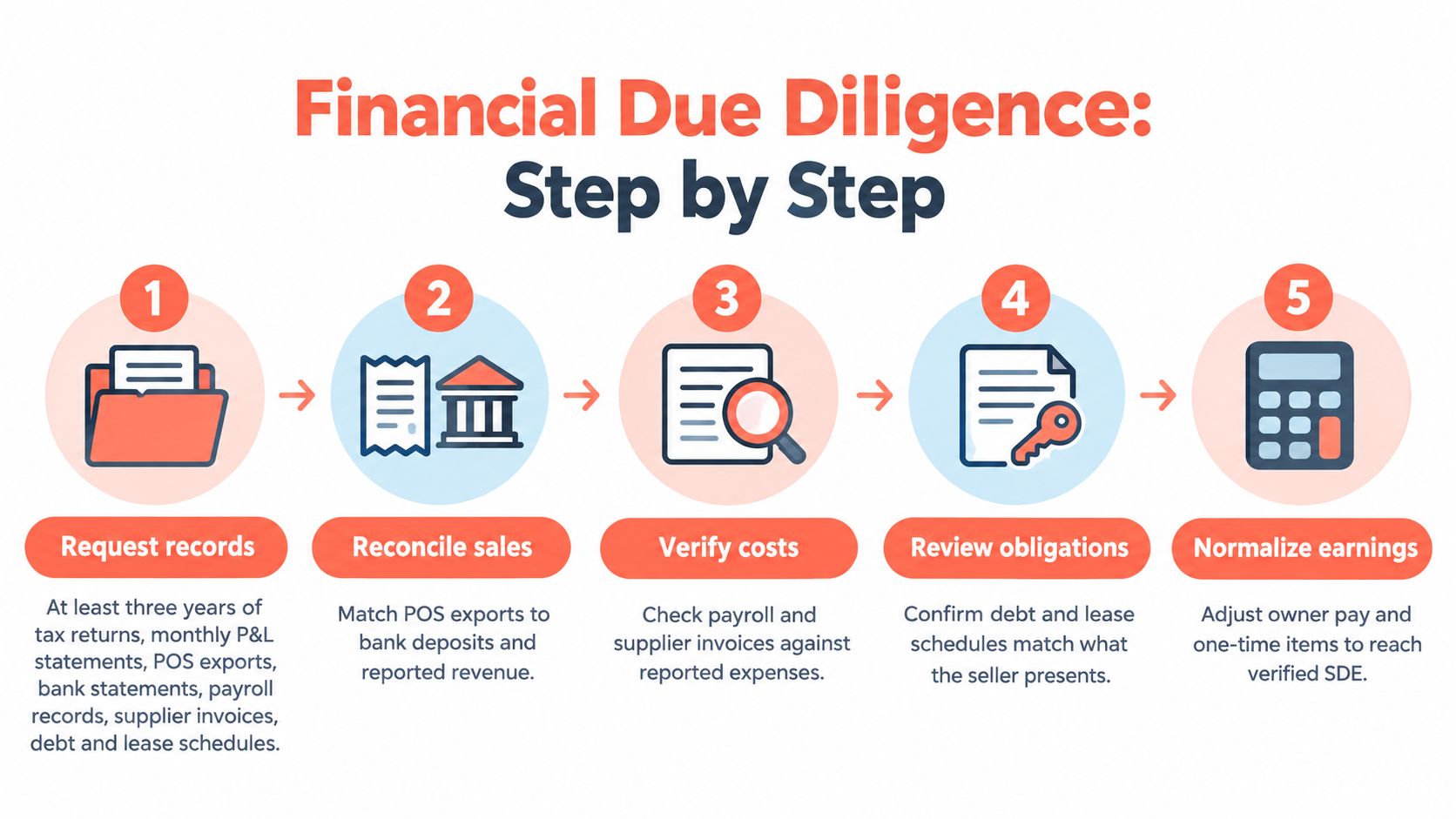
Request the underlying records. Obtain tax returns, monthly profit-and-loss statements, POS exports, bank statements, payroll records, supplier invoices, and debt and lease schedules. Annual accounts alone conceal seasonal shortages and deteriorating recent trading.
-
Reconcile reported sales. Match POS sales with card settlements, cash deposits, and tax filings month by month. Explain settlement delays, refunds, tips, and VAT treatment before treating a difference as missing revenue.
-
Rebuild SDE independently. Give every proposed add-back its own spreadsheet line and supporting document. Recurring repairs, replacement management, and genuine family-member work remain operating costs.
-
Calculate the operating ratios. Track food cost, labor cost, combined prime cost, occupancy, and normalized owner compensation. Use consistent definitions so payroll taxes or delivery sales don't disappear between versions.
-
Separate slow and peak trading. Compare revenue, labor productivity, and margins across seasons. A profitable holiday period doesn't establish that the business can fund its quiet months.
-
Investigate obligations before committing. Have an accountant and transaction attorney review working capital, unpaid taxes, gift cards, equipment leases, supplier arrears, liens, and hidden owner-related costs before money becomes non-refundable.
The process starts with records and ends with earnings that another operator could reproduce.
Use benchmarks to find questions
Screening benchmarks for a full-service restaurant
| Metric | Benchmark | Warning sign |
|---|---|---|
| Food cost | 28% to 35% of sales | Above 38% suggests waste, theft, or pricing problems |
| Labor cost | 25% to 35% of sales | Above range without supporting revenue or service economics |
| Prime cost, food plus labor | Below 65% of revenue | Above 65% limits room for rent and debt payments |
| Occupancy cost | Affordable under the downside cash-flow case | Rent rising faster than sales |
| Normalized owner pay | Market salary for the role performed | Token owner pay that hides replacement costs |
| Revenue consistency | Explainable seasonal patterns | An unusually strong year used as the baseline |
These thresholds come from the acquisition guide cited above. Menu mix, geography, opening hours, and service expectations change their interpretation: high-touch dining shouldn't be judged against a lightly staffed counter-service operation.
A high food-cost percentage should trigger invoice, purchasing, portion, and stock checks, not an immediate accusation of theft. The restaurant industry ratios guide helps distinguish a warning signal from an unsuitable comparison.
Financial verification also needs an operational explanation. Dealmaker Wealth Society's operational due diligence factors provide a useful companion check on whether people and processes can sustain the reported results.
Keep the model in a spreadsheet with evidence references beside each adjustment. An unsupported add-back stays out of the offer valuation.
Check the Room, Lease and Equipment Before You Commit
Consider a hypothetical 60-seat room, an average party size of 2.5, and two complete turns during Friday dinner. That represents 48 parties, or 120 covers; a hypothetical 10% improvement adds 12 covers per Friday, approximately 620 annually if sustained throughout the year.
That's a capacity scenario, not a sales forecast. The buyer still needs evidence of unmet demand and confirmation that the kitchen can serve the additional guests.
Start with the actual floor plan, not the advertised seat count.

Measure sellable capacity
Compare actual covers by daypart with party-size mix, arrival times, dining duration, cancellations, and no-shows. Look for tables held empty between bookings, awkward combinations, and reservation waves that overwhelm the pass.
Restaurant transaction commentary from Bennett Thrasher emphasizes unit-level earnings, traffic, labor efficiency, and margin stability. A useful capacity audit connects those measures rather than assuming that more seats automatically mean more profit.
How many additional covers could this exact room serve without adding tables, staff, or operating hours?
Validate the answer using reservation records, POS timestamps, and observed service. When the kitchen is already the bottleneck, tighter seating intervals may worsen the guest experience rather than improve earnings.
Inspect the rights and assets
Physical checks before committing
| Check | What to request | Stop signal |
|---|---|---|
| Room capacity | Reservation, POS, and floor-plan data by daypart | Table combinations or pacing cap covers with no workable remedy |
| Lease assignment | Written landlord consent terms | Refusal or unrecoverable consent costs |
| Remaining term and renewal | Complete lease and renewal options | No renewal option to support goodwill value |
| Personal guarantee | Guarantee terms and release conditions | Open-ended personal exposure |
| Rent escalations and charges | Escalation schedule, CAM charges, percentage rent | Rent increases the business can't support |
| Kitchen equipment | Independent inspection and repair estimates | Deferred spending eliminates the apparent bargain |
| Licences | Transfer status and fresh-application timing | Seller-specific licence with no workable transition |
A lease without secure renewal rights can undermine the value of the customer base. A licence held personally by the seller may require a fresh application, so the buyer shouldn't assume uninterrupted trading.
For organizing rental documentation, Matil for rental agreement processing can support the document workflow; legal interpretation and assignment approval still belong with the buyer's adviser and landlord.
The video can accompany the physical walkthrough, but the written inspection and consent documents remain essential.
Obtain the landlord's written consent terms before setting a closing date.
GKS Compliance for Belgian Restaurant Acquisitions
For a Belgian acquisition, GKS, the Geregistreerd Kassasysteem, belongs on the compliance checklist before handover. Accepting cash alone isn't a sufficient test of whether a restaurant must use GKS; the buyer's accountant should establish the applicable obligation and current registration procedure with FOD Finance.
Where GKS is required, the buyer needs a documented transition rather than a verbal assurance that the till already works.
- Identify the system. Request certification documents and the registration record showing the enterprise number associated with the installation.
- Confirm the operating entity. Establish how the register will be registered for the enterprise trading after closing.
- Preserve fiscal records. Request the fiscal export and archive, with responsibility for access throughout the applicable legal retention period.
- Check the configuration. Have the installer confirm that POS software, fiscal components, and receipt printing match the certified setup.
- Schedule registration. Include the necessary ownership and registration steps in the handover checklist before trading begins.
The buyer should also investigate any separate system used to record cash sales. Unexplained parallel records deserve the same scrutiny as unexplained bank deposits.
Treat missing certification or unresolved registration as a closing issue. Establish replacement costs, investigate potential historical exposure, and agree who bears each cost rather than assuming the purchase price includes a compliant setup.
The guide to VAT on food provides related tax context. The accountant should confirm the current GKS process and the transaction-specific responsibilities.
Financing and Negotiating the Deal
The first financing question isn't whether a bank likes the restaurant. It's whether the buyer can prove the required equity while retaining enough cash to operate after closing.
For U.S. acquisitions, Hartwell Labs' restaurant SBA lending guide states a general 10% equity contribution toward total project cost, meaning a $2 million purchase requires at least $200,000 before additional fees and working capital; lenders may seek 15% to 20% for riskier transactions, and the stated first-time acquisition floor can't be waived.
Those are U.S. financing parameters, not Benelux bank rules. A local lender should specify its equity requirement, treatment of owner-dependent income, security requirements, and valuation conditions before the buyer negotiates a binding commitment.
Budget for the valuation gap
Hartwell Labs' SBA acquisition guidance identifies an independent valuation requirement above $350,000 under the lending guidance it describes, with any excess over the appraised value requiring additional equity rather than automatic debt financing. The lender should confirm the current rule and applicable calculation for the proposed structure.
A restaurant can therefore be affordable at the asking price but unfinanceable on the available evidence. Goodwill based on a departing chef's reputation deserves particular scrutiny.
Compare funding routes in the same cash-flow model:
- Own cash and reserves: Separate purchase equity from money reserved for payroll, stock, repairs, and quiet trading.
- Bank term loan: Model repayment timing, interest, covenants, and downside headroom.
- Seller financing: Record the interest, maturity, security, default provisions, and priority behind bank debt.
- Equipment leases: Include their payments and transfer costs rather than treating leased equipment as owned assets.
Negotiate conditions, not just price
List financing, landlord consent, licences, equipment inspection, and final financial verification as express conditions in the letter of intent, each with a deadline. The transaction attorney should identify which provisions are binding and control the conditions in the definitive agreement.
Cash protection: Write the total cash requirement beside the offer price. An attractive price isn't useful if the buyer has nothing left for the first payroll.
For a U.S. asset purchase, the IRS Form 8594 instructions explain how consideration is allocated among asset classes and how that affects the buyer's tax basis and seller's gain or loss. Agree the allocation with tax advisers before signing; Benelux transactions require the corresponding local tax treatment, not a copied U.S. allocation.
Plan the Handover and First 90 Days
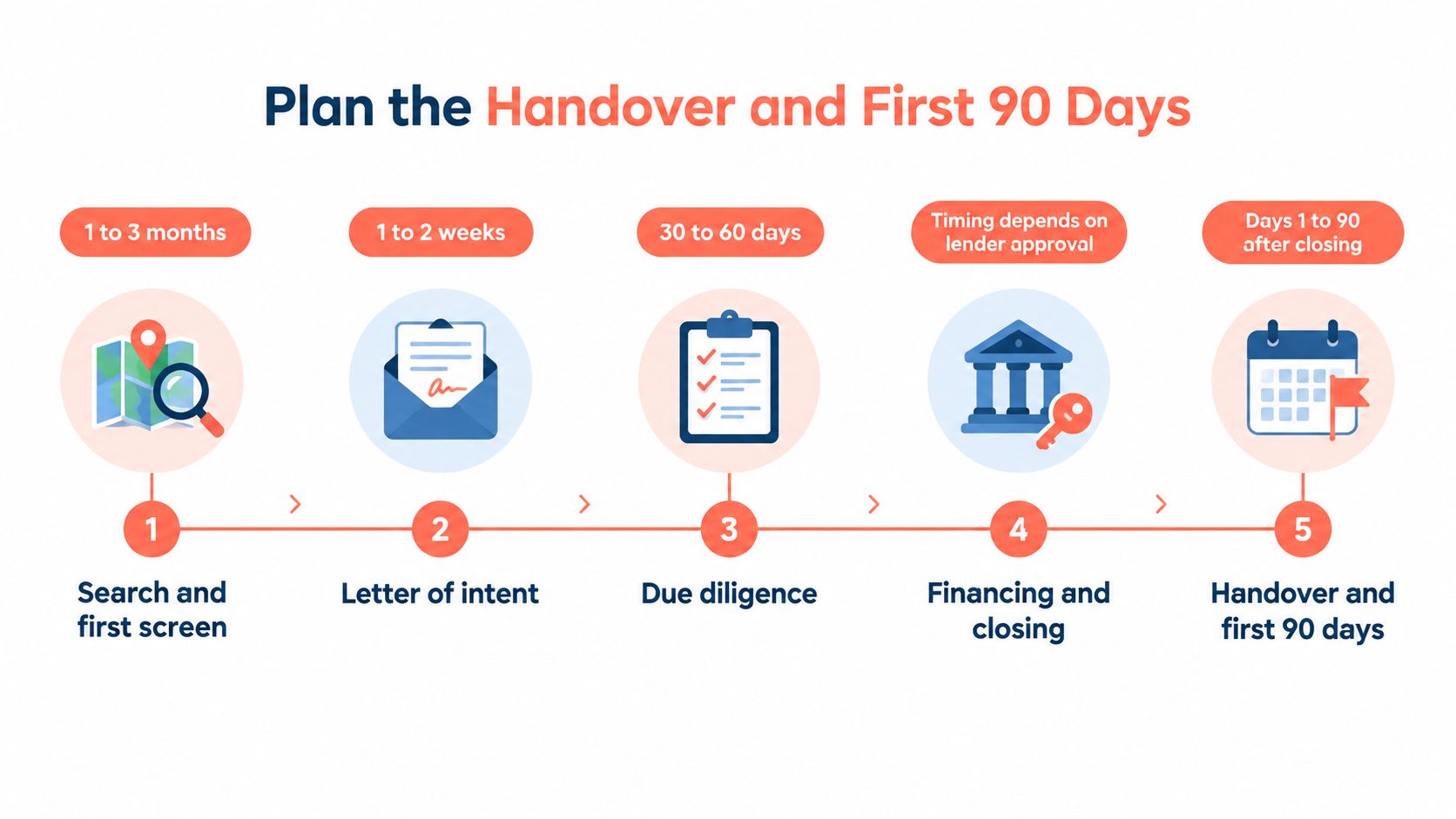
A practical acquisition schedule starts with dependencies, not an optimistic closing date. For a hypothetical planning timetable, allow one to three months for search, one to two weeks for the letter of intent, and 30 to 60 days for diligence, with financing and landlord consent running in parallel over 45 to 90 days.
Those are scheduling allowances, not promised completion times. Missing financial records, a licence application, or landlord negotiations can move the handover substantially.
Use the timeline to assign responsibility for each approval and document.
Test the ownership reset before closing
The largest surprise may be the cost of operating properly without the seller. Los Angeles Business Journal's restaurant deal coverage flags wage-and-hour exposure, manager classification, unpaid overtime, lease charges, personal guarantees, and tighter financing conditions.
Build separate cases for seller-normalized labor, fully compliant replacement staffing, and a rent or lease-renewal shock. Include the seller's actual working duties, not merely the salary shown in the accounts.
If only the seller-normalized case produces enough cash, renegotiate before closing. A forecast that depends on retaining informal arrangements isn't a reliable operating plan.
Stabilize before changing the concept
During days 1 to 30 of the proposed handover plan, meet the team, confirm managerial responsibilities, and preserve the agreed staffing model unless safety or compliance requires immediate action. Record supplier contacts, ordering routines, passwords, maintenance responsibilities, and outstanding guest commitments.
During days 31 to 60, adjust arrival pacing, table combinations, and reservation handling. Change one operational constraint at a time so the manager can distinguish a genuine improvement from a busier week.
During days 61 to 90, compare actual payroll, rent, debt service, covers, and cash against the stress cases. Keep an exception log showing what changed and who owns the response.
A hypothetical saving of 15 minutes of manual reservation entry and reconciliation each day amounts to approximately 90 hours annually, assuming daily operation. Treat that as a workflow estimate to measure, not a guaranteed saving.
Go or No-Go Gate and Your Next Step
A lower purchase price cannot fix a weak operating case. Proceed only when each gate has a documented answer and the dining room's additional cover potential has been tested against the costs required to realize it.
- Earnings support the price: Does independently verified normalized SDE justify the written valuation range?
- Capacity upside is credible: Can the current room serve more covers without staffing or equipment costs that the downside model cannot support?
- Cash survives the reset: Can compliant replacement staffing, rent, and debt all be paid under the downside model?
- Occupancy is secured: Are assignment, renewal rights, and personal-guarantee terms agreed in writing?
- Trading readiness is confirmed: Are equipment costs, licence arrangements, and applicable GKS registration resolved?
- Funding is evidenced: Is the complete cash requirement documented beside the offer?
A single no means renegotiate or walk away. Before signing the definitive agreement, get written confirmation that the relevant letter-of-intent conditions are satisfied or replaced with enforceable protections. The go-or-no-go decision should account for the same pressures together: room capacity, compliant labor, lease exposure, and financing.
Include reservation continuity in the closing checklist. 10Seat migrates a restaurant's entire reservation system in 15 minutes, with no third-party platform and no lost reservations. Most restaurants are up and running within 24 hours.
The free plan covers up to 50 covers per month. Above that, the restaurant must move to a paid plan to keep taking reservations. Compare expected monthly volume with the available plans, and check that availability, pacing, and party-size controls fit the operating case before handover.
10Seat offers reservation and table management to help the incoming operator manage availability, pacing, and the existing dining room. Visit 10Seat to arrange the reservation handover and assess the setup against the restaurant's verified capacity before closing.