Restaurant Reservation Online: A Practical Setup Guide
Learn how to launch and optimize restaurant reservation online with a step-by-step setup guide covering booking tools, channel distribution, and no-show
Friday service starts with a familiar failure. The phone rings while the host is seating a table, a booking gets scribbled into a notebook, and two walk-ins leave after hearing an uncertain wait estimate. The dining room may look full, yet the restaurant loses covers because guests can't get a clear answer quickly.
A restaurant reservation online system fixes only part of that problem. The widget is the visible piece, but the underlying work involves accurate table inventory, sensible pacing, mobile conversion, Reserve with Google distribution, reminders, and policies that protect revenue without frightening away good guests.
Table of Contents
- Why Online Reservations Are Now a Revenue Channel
- Choosing a Booking System Without the Commission Trap
- Setting Up Your Online Booking Flow
- Distributing Reservations Across Channels
- Pacing and Availability Rules That Protect the Floor
- Stopping No-Shows Without Killing Conversion
- A 30-Day Launch Checklist for Your Team
Why Online Reservations Are Now a Revenue Channel
Online booking has moved beyond convenience. By mid-2024, roughly 19% of U.S. sit-down restaurants used an online reservation or waitlist system, compared with 13% in 2022, a six-point increase in two years. A separate industry analysis counted 61,739 U.S. restaurants using at least one online reservation or waitlist solution in July 2024, up from 45,029 two years earlier, a 37% increase. The same analysis found that a small group of platforms served more than 95% of U.S. restaurants using online reservation software, showing how quickly this became standard infrastructure rather than a niche add-on. OpenTable's industry analysis provides the market context.
The guest's behavior has shifted with it. In the UK, 54% of consumers choose to make restaurant reservations online, and 72% of reservations are made by smartphone. Another UK analysis found that 56% of diners preferred a restaurant's own website, while 28% preferred an online booking system or app, with 48% of reservations processed online. Now Book It's restaurant booking statistics make the operational point clear: a booking flow has to work on a phone and has to be easy to find.
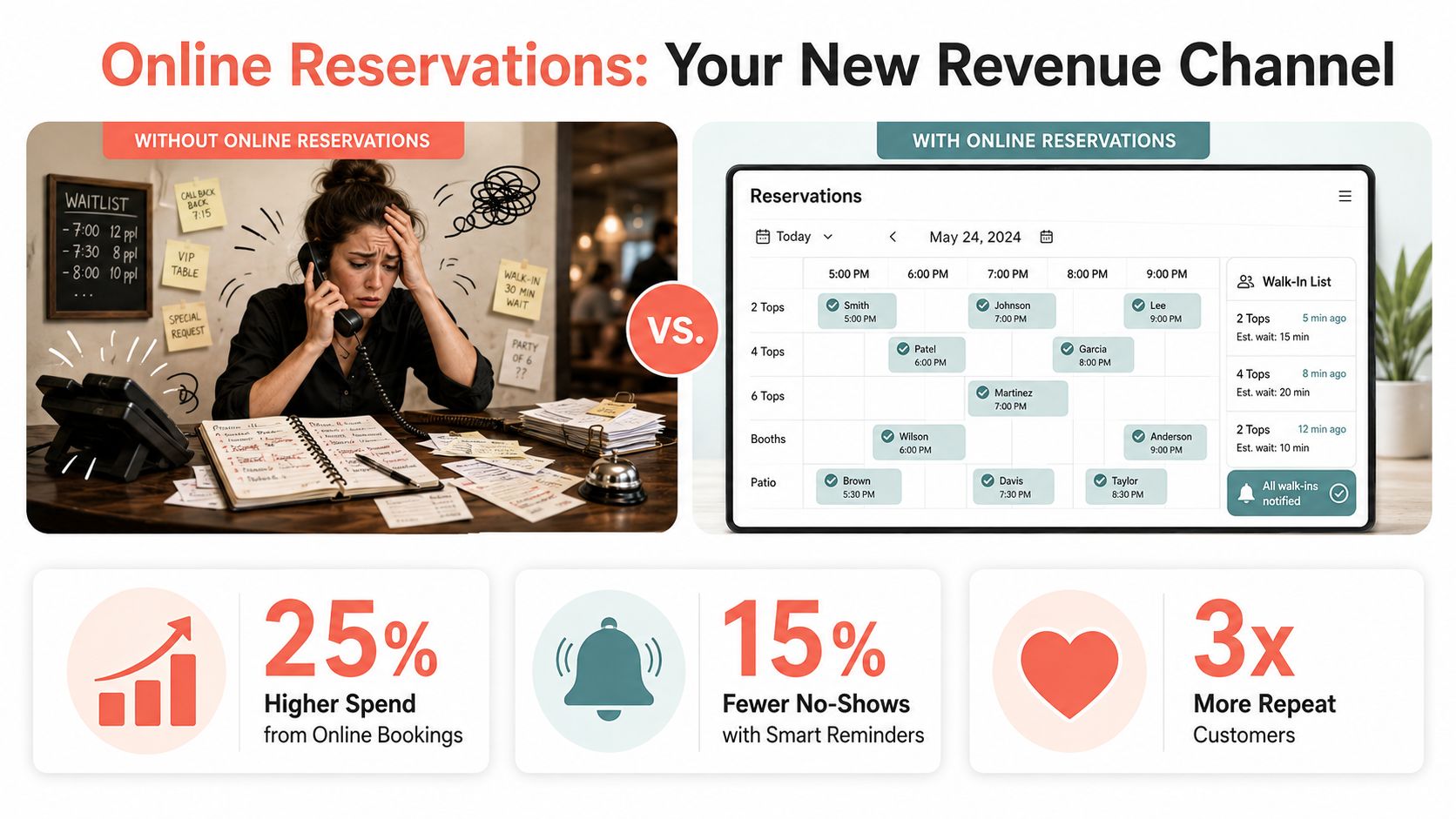
The money lost through phone friction
A phone call can still convert well because staff can offer alternatives immediately. The cost is attention. A host who spends several minutes searching availability, repeating times, and recording guest details isn't greeting arriving diners or managing the floor.
The revenue opportunity is measurable, but it must be calculated from the restaurant's own booking records. An operator can compare missed calls, abandoned enquiries, and unavailable periods against average spend, then decide whether a digital flow is recovering real demand or merely duplicating existing bookings.
Practical rule: Treat the booking path as part of the floor plan. If it doesn't show accurate availability and a clear next step, it's costing the dining room capacity.
Visibility matters too. Google can place booking actions in Search, Maps, and a restaurant's Business Profile, so a diner searching with intent may book before visiting the website. Restaurants working on local discovery can also use this practical guide to how restaurants dominate search from Netco Design LLC.
The widget is the smallest part of the setup. The revenue channel works only when the system reflects the actual room, appears where guests search, and gives the team rules that service can handle.
Choosing a Booking System Without the Commission Trap
A booking system should be judged by total acquisition cost, not by the length of its feature list. Commission platforms such as TheFork and OpenTable can provide marketplace discovery and access to diners who haven't chosen a restaurant yet. That can help a venue with quiet midweek services, but it becomes expensive when loyal guests use the platform because the direct route is unclear.
Zenchef and Formitable represent a different model, generally structured around recurring software fees rather than a charge on every seated guest. 10seat is positioned as a commission-free reservation management option for independent restaurants in the Benelux, with direct control over booking data and availability. Current market concentration and adoption make the choice less about whether online booking matters and more about which cost structure matches the restaurant's demand.
| Platform | Pricing model | Typical cost per seated cover | Best fit |
|---|---|---|---|
| TheFork | Commission and possible marketing fees | €1.50 to €2.50, depending on agreement | Restaurants seeking marketplace discovery and help on slower services |
| OpenTable | Commission-led marketplace model, with possible marketing costs | €1.50 to €2.50, depending on agreement | Restaurants prioritising a built-in diner audience |
| Zenchef | Monthly SaaS model | No per-cover commission in the stated model | Restaurants wanting direct booking infrastructure |
| Formitable | Monthly SaaS model | No per-cover commission in the stated model | Restaurants wanting recurring software costs and direct channels |
| 10seat | Commission-free reservation management | No per-cover commission | Independent Benelux operators focused on direct bookings |
A practical buying test
The right system depends on four operating facts:
- Booking volume: A high number of platform-generated covers magnifies commission costs. A low volume may make marketplace access worthwhile.
- Average check: The same per-cover charge has a different impact on a casual venue and a tasting-menu restaurant.
- Peak occupancy: A full Friday room has little reason to pay acquisition cost for guests who would book directly.
- Off-peak demand: A quiet Tuesday can justify paying for discovery if the platform adds covers.
The restaurant should also check whether staff can manage its own waitlist, release tables safely, and capture guest details without exporting them through a marketplace. A system that creates bookings but leaves the team manually reconciling the floor isn't saving much.
The cost comparison should include recovered admin time and reduced no-shows, not just software fees. The online restaurant reservation system guide gives operators another framework for comparing direct booking infrastructure with marketplace distribution.
Setting Up Your Online Booking Flow
The setup should begin with the dining room, not the website. The operator first imports the floor plan, records table counts, and defines which party sizes each table can accept. A two-top that can sometimes join another table shouldn't be treated the same as a fixed four-top, because the system needs to protect practical combinations rather than abstract seat capacity.
Service windows come next. Lunch and dinner need separate availability rules, with realistic opening and closing times, turn assumptions, and any gap required between services. The booking horizon should be long enough for planned dining but not so open that the team carries stale availability. A 14-to-30-day horizon is a sensible operating range for many restaurants, though the final setting belongs to the restaurant's booking pattern.
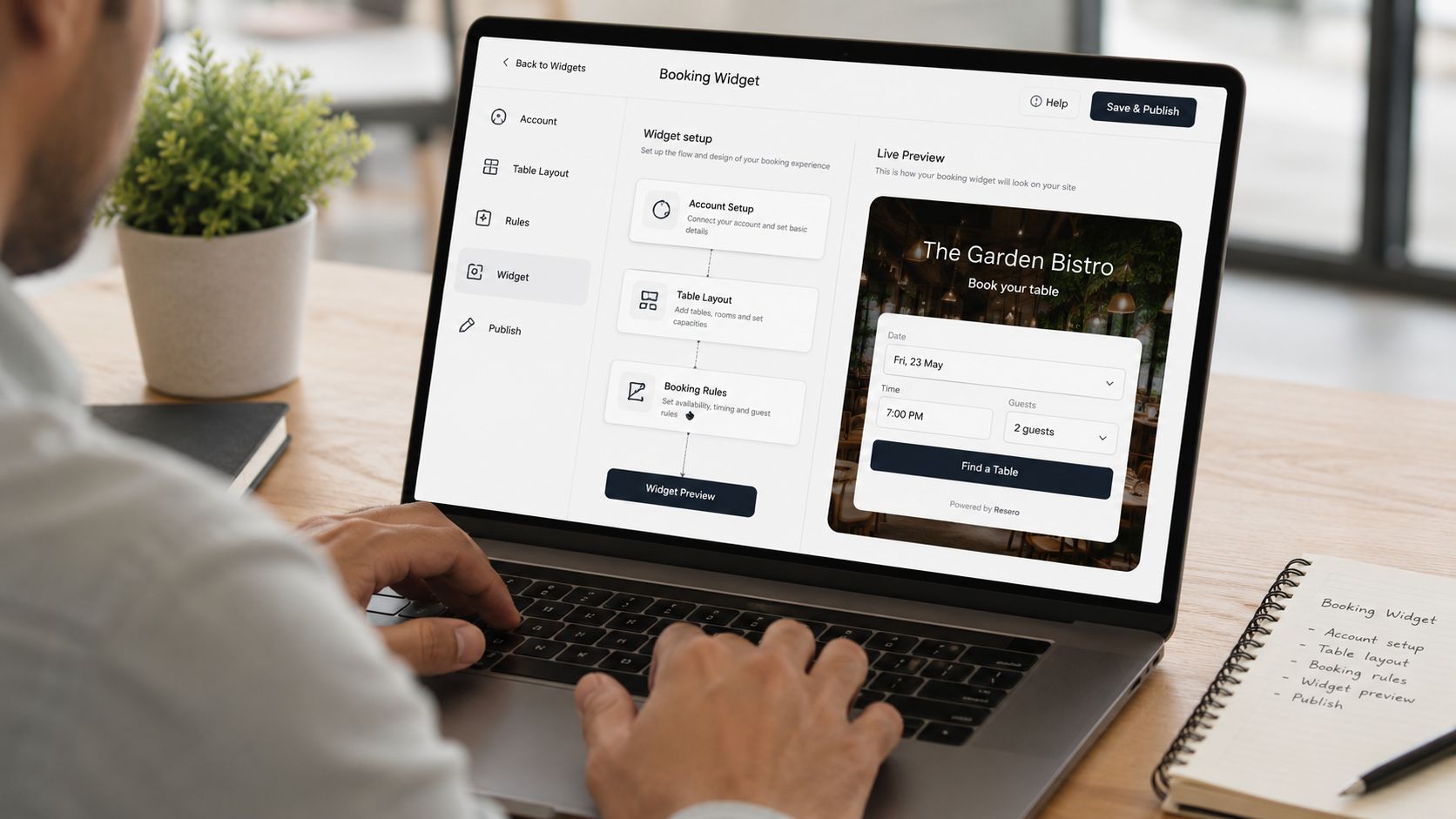
Put the booking action where decisions happen
The widget belongs in the website header, on the contact page, and on a dedicated /reserve page. A guest shouldn't have to search through the menu to find availability. The page should show date, time, party size, service notes, and a clear confirmation state without unnecessary fields.
Confirmation and reminder automations should be written in the restaurant's voice. They need the date, time, party size, address, cancellation route, and any deposit or guarantee terms. The goal isn't to send more messages. It's to remove uncertainty and make a legitimate change easier than failing to arrive.
Google Business Profile integration deserves special attention because it powers the booking action in Search and Maps, including Reserve with Google where the restaurant and provider are eligible. QR codes extend the same flow to table tents, menus, window decals, and takeaway packaging. A passer-by should be able to scan and book that evening without calling.
The video below illustrates how guests experience an online reservation flow and where the team should look for friction.
Before launch, someone should complete a real test booking from an incognito browser on desktop, mobile, and the Google surface. The test must cover an available slot, a full slot, a cancellation, and a modified party size. A booking flow that looks finished but fails on mobile is worse than no flow at all.
Distributing Reservations Across Channels
The website is important, but it isn't the only booking entrance. A 2026 diner report found that 64% of diners still call the restaurant, 55% book directly online, and 41% use a reservations app. Those figures describe overlapping behaviors, not a single exclusive channel, but they make one point unavoidable: a restaurant needs distribution across several surfaces. The DoorDash and Datalily diner report supports a multi-channel approach.
Reserve with Google deserves priority because it catches guests while they're already searching for a place, checking location, or comparing availability. The website widget handles guests who already know the restaurant. Instagram and Facebook action buttons, QR codes on menus and signage, and the phone cover the remaining intent paths.
A restaurant shouldn't guess which channel works. Each link needs a distinct tracking source or URL parameter, and staff should record phone enquiries consistently. The quarterly audit should compare initiated bookings, completed bookings, seated covers, cancellations, and no-shows by source.
| Channel | Typical conversion rate | Notes |
|---|---|---|
| Online widget | 60% to 80% | Depends on page placement, speed, and availability |
| Direct website booking | 60% to 80% | Strong for guests already familiar with the restaurant |
| Google and Maps | 50% to 70% | Captures high-intent local discovery |
| Third-party platforms | 55% to 75% | Adds marketplace reach with a different cost structure |
| Phone | 85% to 95% | Staff can immediately propose alternatives |
These conversion benchmarks come from restaurant reservation conversion rate data. They're useful for diagnosis, not as a promise. A phone channel may convert strongly when the host answers quickly, then collapse during the rush.
Test the channel, not just the page
Restaurants can borrow the discipline of A/B testing for retail growth when improving booking placement. Test one change at a time, such as a header button versus a lower-page link, and measure completed reservations rather than clicks.
Reserve with Google should be included in that review. A 2025 global booking report found that it drove 73% first-time users, while restaurants activating it recorded a median 32.3% booking increase. The report's booking trends show why the Google surface should be treated as an acquisition channel, not merely a technical integration.
Pacing and Availability Rules That Protect the Floor
An online system will accept a damaging concentration of bookings if the rules are loose. Fifteen parties at the same time may look like excellent demand at the point of booking, then overwhelm the kitchen, delay table turns, and create an unhappy room.
Start with usable table inventory, not the total number of seats. Assign each table its normal party-size range, note which tables can combine, and separate fixed areas such as a patio, chef's counter, or private dining room. The booking engine should allocate real configurations that the team can seat without improvising.
Build the service around controlled release
Time slots should reflect the restaurant's pacing. Fifteen-minute intervals give the team more control than broad half-hour blocks, particularly when the room has mixed table sizes. Party-size windows can then protect key periods, such as releasing two-tops at 19:00 and holding four-tops for a later slot when larger parties need them.
A practical ruleset includes:
- Table assignments: Map party sizes to tables the floor can use.
- Slot spacing: Use 15-minute intervals where staggered arrivals help the kitchen.
- Advance availability: Keep the booking window within a manageable planning horizon, often 30 to 45 days for operators who want control.
- Walk-in protection: Reserve a small allocation for walk-ins and priority guests. It shouldn't fall below 10% of service capacity where the restaurant relies on spontaneous traffic.
- Late release: Release held inventory at defined hours before service to fill gaps without disturbing confirmed bookings.
- Blackouts: Block private events, chef's tables, patio closures, and unusual service formats before guests can select them.
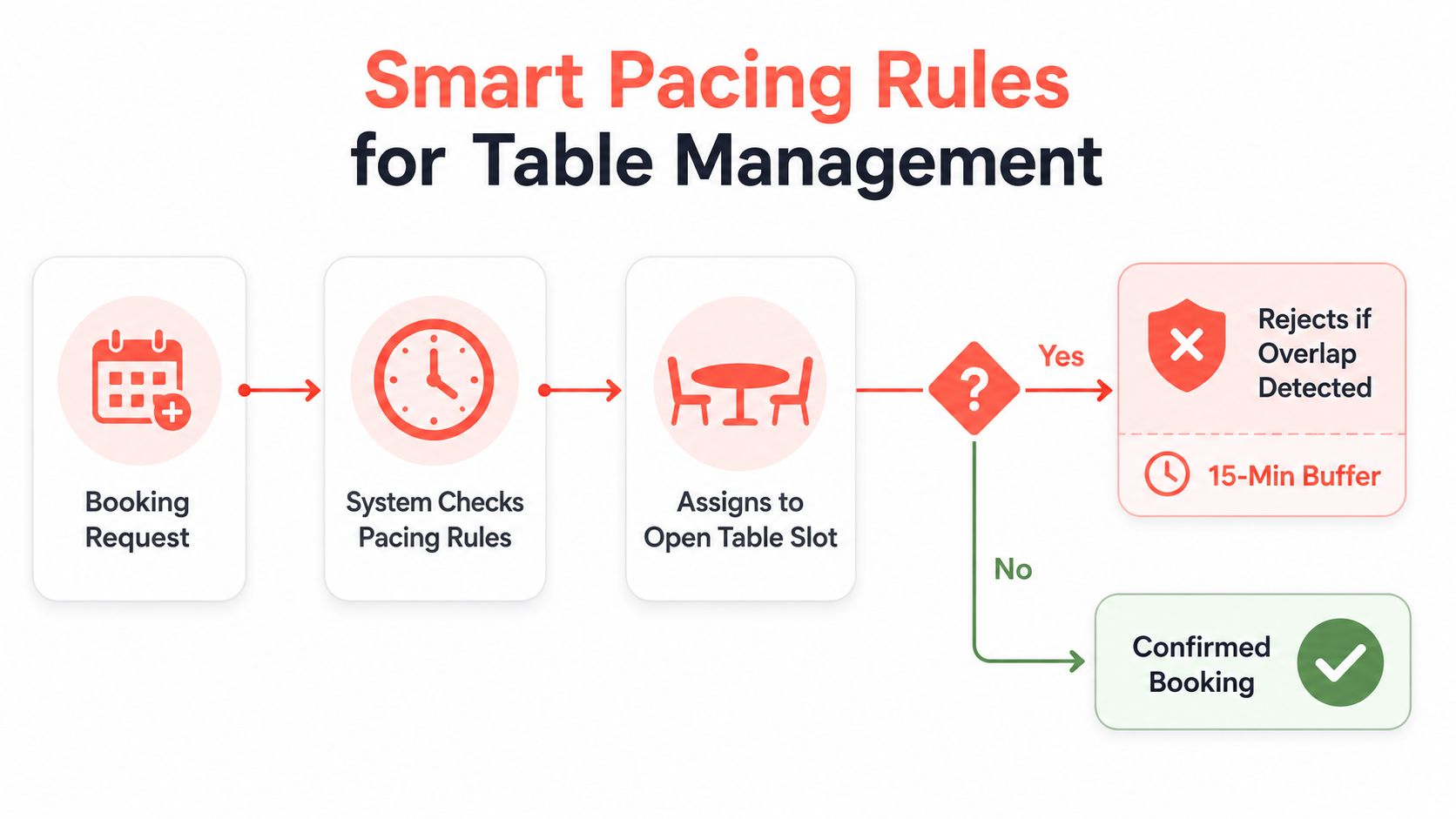
The settings need monthly review because menus, staffing, table combinations, and service formats change. A rule that worked during a quiet spring service can restrict demand during a busy summer period, while a patio closure can make old availability dangerously optimistic.
Floor manager's test: If the system's availability looks attractive online but forces the host to break the seating plan, the system is wrong. Correct the rules before adding more marketing.
Stopping No-Shows Without Killing Conversion
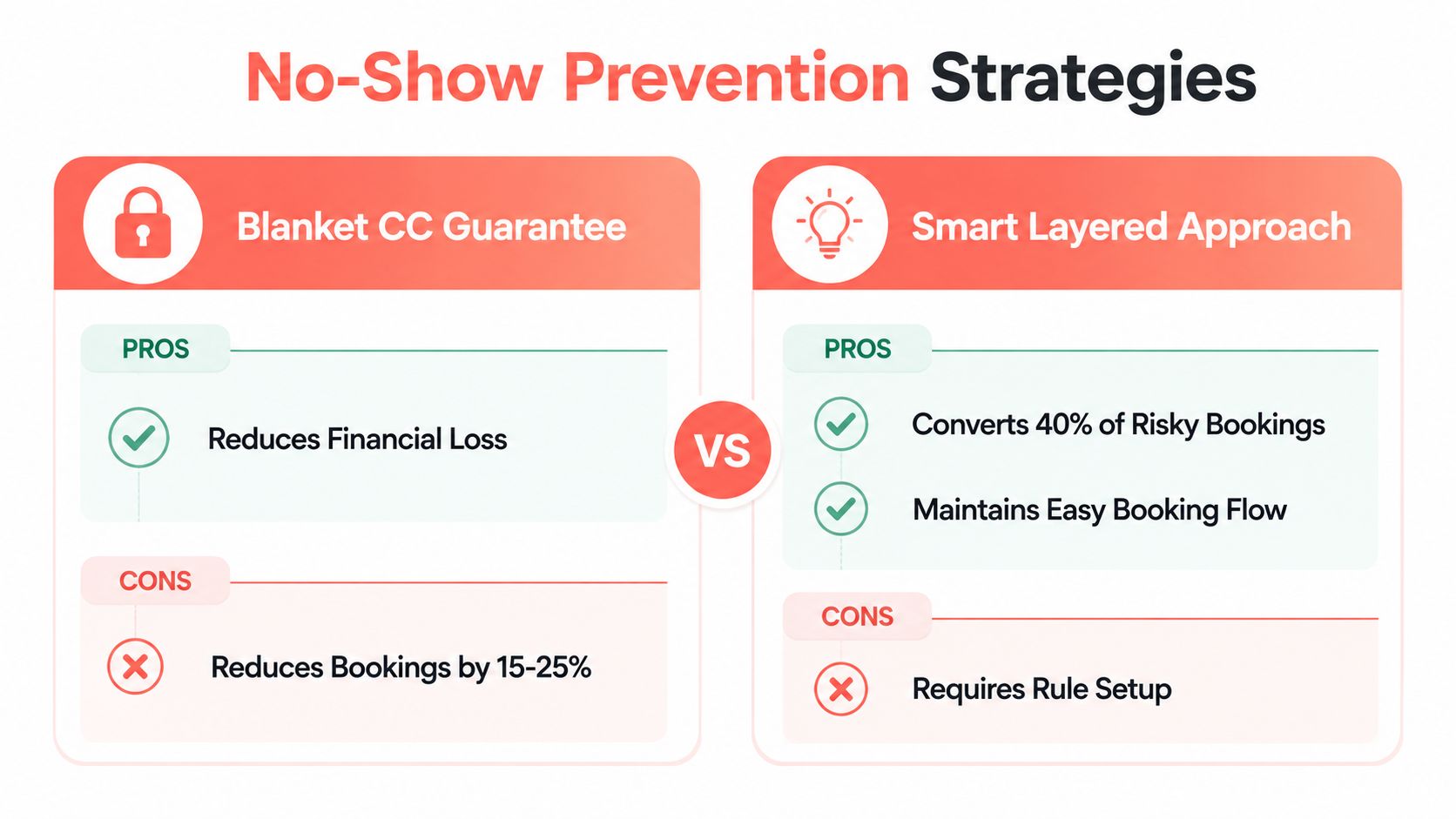
Blanket card guarantees are an understandable reaction to a bad no-show period, but they're blunt. The better policy matches protection to risk, demand, party size, and booking history.
UK hospitality research reported a 12.3% no-show rate in 2024, compared with 6% in August 2022, and estimated £17.59 billion in lost sales. Earlier reporting from the same research line found 14% of consumers admitting they had failed to honour a booking, with 18 to 34-year-olds and London diners identified as higher-risk groups. The research also estimated average losses of around £89 per no-show diner in the UK context. Zonal and CGA by NIQ's no-show research shows why the issue deserves a policy, not just occasional reminder calls.
The operating benchmark can be much lower. The 2026 Resos No-Show Index recorded a 2.33% no-show rate across 3,768,761 reservations at 2,417 restaurants, which demonstrates what disciplined confirmation, cancellation, and table-management processes can achieve. The Resos no-show benchmark is a useful reference point for weekly reporting.
Use friction only where the risk justifies it
The protection-versus-conversion trade-off is real. A 2025 dining trends report found that diners were 28% more likely to complete a reservation when no cancellation fee was shown. The same report found that card details reduced no-shows but also reduced booking conversion. It also reported that 66% of diners book on the same day, while 45% of reservations were same-day in Q3 2024, so checkout friction can hurt the most time-sensitive demand. The dining trends report gives the relevant trade-off.
Use deposits or card holds for high-risk slots, larger parties, and dates where a vacant table is hard to replace. Leave lower-risk bookings simple, then send a confirmation request and an easy cancellation route. Venues without deposits commonly see 10% to 20% no-shows, while card holds or deposits are associated with 2% to 7%, according to industry no-show benchmarks.
For broader operational ideas on how to stop appointment gaps, the useful principle is the same: make honest cancellations easy and reserve stronger controls for bookings that can materially damage the service.
Track no-shows weekly by channel and party size. Adjust thresholds quarterly, rather than rewriting the policy after one difficult Friday. The no-show reduction guide offers a practical starting point for that review.
A 30-Day Launch Checklist for Your Team
A reservation launch should be handed to a floor manager as a working schedule, with an owner's initials beside every item. The first month is for building a dependable operating system, not celebrating the widget going live.
Week one builds the foundation
The owner chooses the supplier, reviews the contract, confirms the pricing model, and checks how the system connects with the POS and floor plan. The floor manager enters opening hours, lunch and dinner services, table combinations, party-size limits, booking horizon, and blackout periods.
The first pause belongs here. A manager should make a real test booking before moving forward, then confirm that the reservation appears correctly on the floor plan and doesn't create a duplicate seatable table.
Week two makes the flow visible
The website receives a clear booking button in the header, contact page, and dedicated reservation page. The manager writes confirmation and reminder templates, checks mobile display, adds relevant page copy, and prepares a phone script that offers the same times and alternatives as the online system.
The team should test a complete booking from an incognito mobile browser before publishing the link. Rushing past this check creates avoidable failures that staff discover during service.
Week three adds demand sources
The manager completes Reserve with Google onboarding, updates the Google Business Profile, and adds booking actions to Instagram and Facebook. QR codes go onto menus, window decals, table materials, and other high-intent touchpoints. Third-party listings should be checked for duplicate availability, outdated hours, and inconsistent cancellation terms.
Every channel needs a source label. Without it, the owner can't tell whether new covers came from Google, the website, social media, QR scans, or the phone.
Week four calibrates the room
The final week isn't a victory lap. The manager reviews source mix, no-show rate, cancellations, completed bookings, and whether arrivals are clustering too tightly. Slot spacing, party caps, walk-in allocation, and late-release rules should be adjusted from observed service pressure.
One operational estimate is available for teams evaluating the labor return. A 2026 hospitality software case study claims that automated confirmations, reminders, follow-ups, and cancellation handling can reduce administrative time for managers and floor teams by up to 39.3%, while reminder systems can cut no-shows by up to 14.9%. The case study's automation claims should be treated as a benchmark to validate against the restaurant's own hours saved.
An owner who reviews those results after the first service week gets useful signals. An owner who waits for a full month gets a cleaner sample, but may leave obvious pacing or conversion failures untouched. The right sequence is simple: test early, launch carefully, measure weekly, and change one rule at a time.
10Seat offers commission-free online reservations, direct booking links, availability controls, automated confirmations and reminders, and table management for independent restaurants in the Benelux. Visit 10Seat to review the reservation flow, pricing options, and tools for turning existing floor capacity into a more controlled booking channel.