Restaurant Frame Brasserie Explained for Operators
What is a restaurant frame brasserie? Learn the service model, menu format, floorplan and how to apply the brasserie framework to your operations.
A lunch booking runs late, three walk-ins arrive together, and the dinner reservations are already filling the room. The host is checking a paper plan, servers are crossing behind one another, and the kitchen is receiving orders in uneven waves. The room may look like a brasserie, but the operation is behaving like several different restaurants at once.
That's where the restaurant frame brasserie idea becomes useful. A brasserie isn't brass fittings, tiled walls, leather banquettes, or French menu language. It's an operating framework built around broad trading hours, accessible ordering, continuous service, flexible seating, and disciplined table movement.
For owner-chefs and general managers, this distinction matters. A decorative brasserie can still lose revenue through slow resets, poor table combinations, congested aisles, and reservations that don't match kitchen capacity. A practical brasserie framework connects the menu, floor plan, reservations, walk-ins, staffing rhythm, and compliance requirements into one system.
The commercial logic is straightforward. Industry guidance says full-service restaurants typically turn tables 1.8 to 2.2 times during dinner, while increasing that to 2.5 to 3.0 turns can produce 25% to 40% more revenue from the same seats (restaurant table management guidance). That isn't a promise of automatic growth. It's a reminder that the room you already have can be worth more when pacing and seating decisions improve.
Table of Contents
- Introduction What a Brasserie Frame Really Means Today
- Understanding the Brasserie Concept From Brewery to Modern Restaurant
- How Brasserie Service and Menu Format Work in Practice
- Designing Your Brasserie Floorplan and Ambiance for Flow
- Applying the Brasserie Framework to Operations Seating and Compliance
- Real World Example What Frame Brasserie Reveals About Positioning
- Making the Brasserie Frame Work for Your Restaurant
Introduction What a Brasserie Frame Really Means Today
The room changes from lunch to dinner
At midday, the strongest brasserie operation can handle a guest who needs a quick plate, a table that wants a longer business conversation, and a walk-in who only wants a drink and something small. The kitchen stays available rather than closing between narrow service windows. The dining room remains active without forcing every guest into the same pace.
By early evening, the same floor plan needs to support a different mood. Guests may order several courses, stay longer, and expect more attention. The operator still needs to protect the kitchen from sudden demand, keep tables visible, and avoid seating a large party in a configuration that blocks smaller bookings.
That flexibility is the frame. The furniture and lighting support it, but they don't create it.
Operator's test: If the room looks French but the service only works for one fixed seating pattern, the concept is decorative rather than operational.
A brasserie framework starts with a few practical questions:
- Can the kitchen serve across more than one daypart without confusing the team?
- Can the menu offer quick decisions as well as longer meals?
- Can the host place walk-ins without damaging booked covers?
- Can staff reach the pass, bar, service stations, and tables without unnecessary crossings?
- Can the business explain clearly whether the restaurant suits a business lunch, tourist dinner, casual visit, or special occasion?
The answers determine whether the restaurant frame brasserie model is working. A strong concept gives guests choice without giving the operation chaos.
Why this model still matters
Brasseries suit urban locations because they can capture different intentions throughout the day. A guest may come for coffee, lunch, an early dinner, or a later drink, while the operator uses one room and one identity across those occasions.
The model also gives owner-chefs room to create flexible spending levels. A guest can choose a simpler dish, while another orders premium ingredients or several courses. That range only works when the menu, table plan, staffing, and reservation rules support it.
The rest of the operating question is practical: how did this format develop, and what should a modern team preserve from its original identity?
Understanding the Brasserie Concept From Brewery to Modern Restaurant
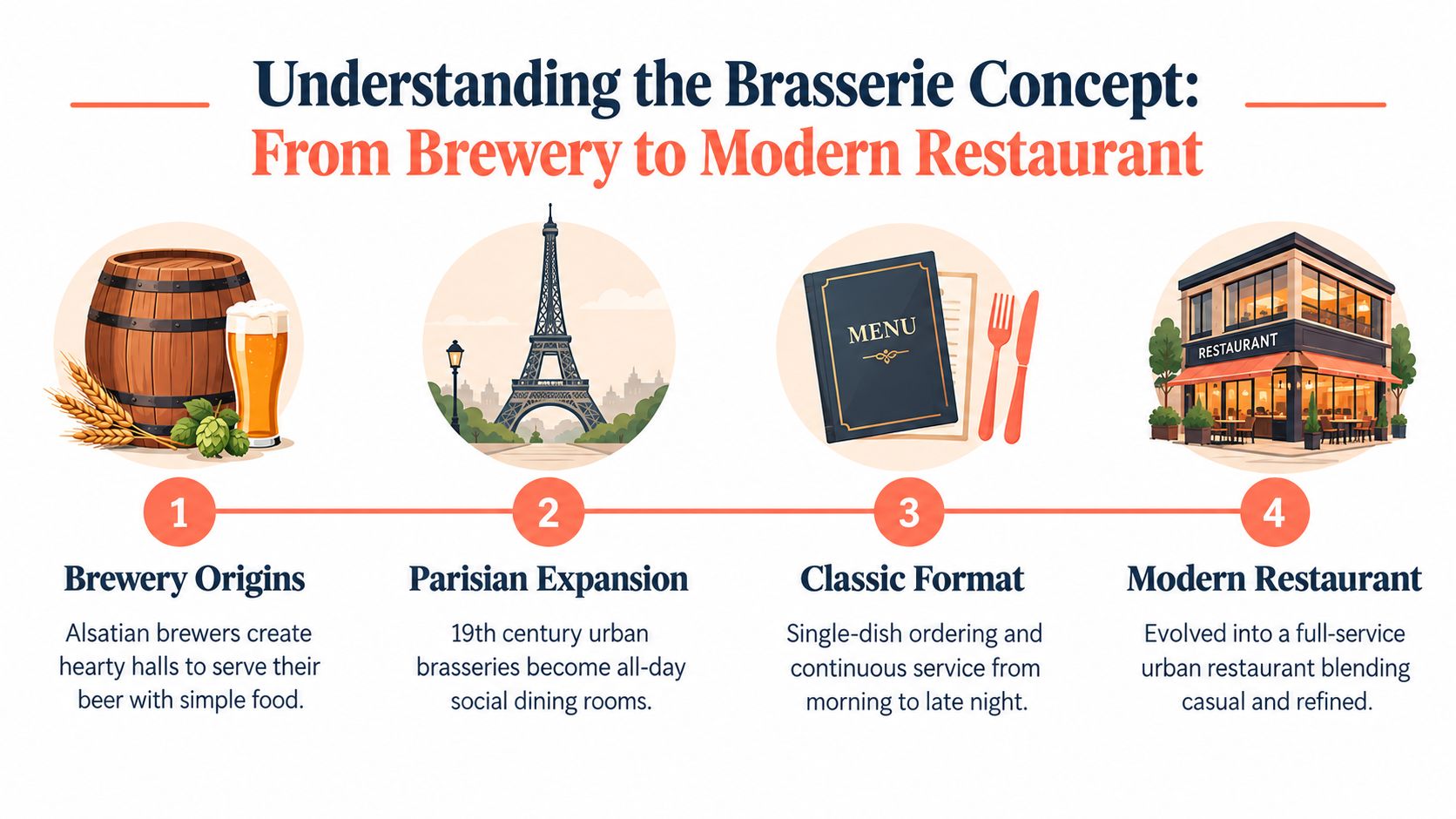
The word brasserie means “brewery.” That origin explains why the format developed differently from a formal dining room. Early brasseries were tied to beer production and beer service, with hearty food designed to accompany drinking rather than compete with fine dining.
Historical accounts trace the modern restaurant identity to 19th-century France. Alsatian brewers moved to Paris after the Franco-Prussian War of 1870–1871, and several accounts place the first Parisian brasserie in 1864, while others connect the format's emergence to Strasbourg in 1872 (history of French brasseries).
From beer hall to urban dining room
The concept spread through Paris in the late 19th century and became one of the city's recognizable dining formats during the Second Empire and after 1870. Historical descriptions note that brasseries multiplied after the war and were often opened by Alsatians (French brasserie history)).
Brasserie Bofinger, opened in 1864 by Frédéric Bofinger, is commonly cited as an early example. Its identity connects brewing, draught beer, and regional food such as sauerkraut. That combination shows the format's original promise: food could be substantial and locally grounded without requiring the ceremony of fine dining.
The modern equivalent is easy to understand through comparison. A café is often built around drinks and lighter food. A bistro usually has a more limited identity, smaller menu, or narrower service rhythm. Fine dining emphasizes sequence, precision, and a deliberately controlled experience. A brasserie sits between those patterns, with enough structure for a full restaurant service and enough flexibility for informal visits.
The operating DNA that survived
The history still matters because it explains the format's practical strengths:
- Continuous hospitality: Guests can arrive across a broader part of the day instead of only during fixed seating windows.
- Direct ordering: Single-dish ordering lets guests build a meal around appetite, time, and budget.
- Hearty accessibility: The offer can feel substantial and welcoming without adopting formal dining rituals.
- Social energy: The bar and dining room can work together, creating a room that feels active even when table demand changes.
Beer still has a natural place in that identity, especially when staff understand how to guide guests without overcomplicating the choice. A concise resource on Gold Coast craft beer etiquette offers useful context for operators building confident beer service.
The important lesson is not to copy historical décor. It's to preserve the relationship between choice, pace, hospitality, and room energy.
How Brasserie Service and Menu Format Work in Practice
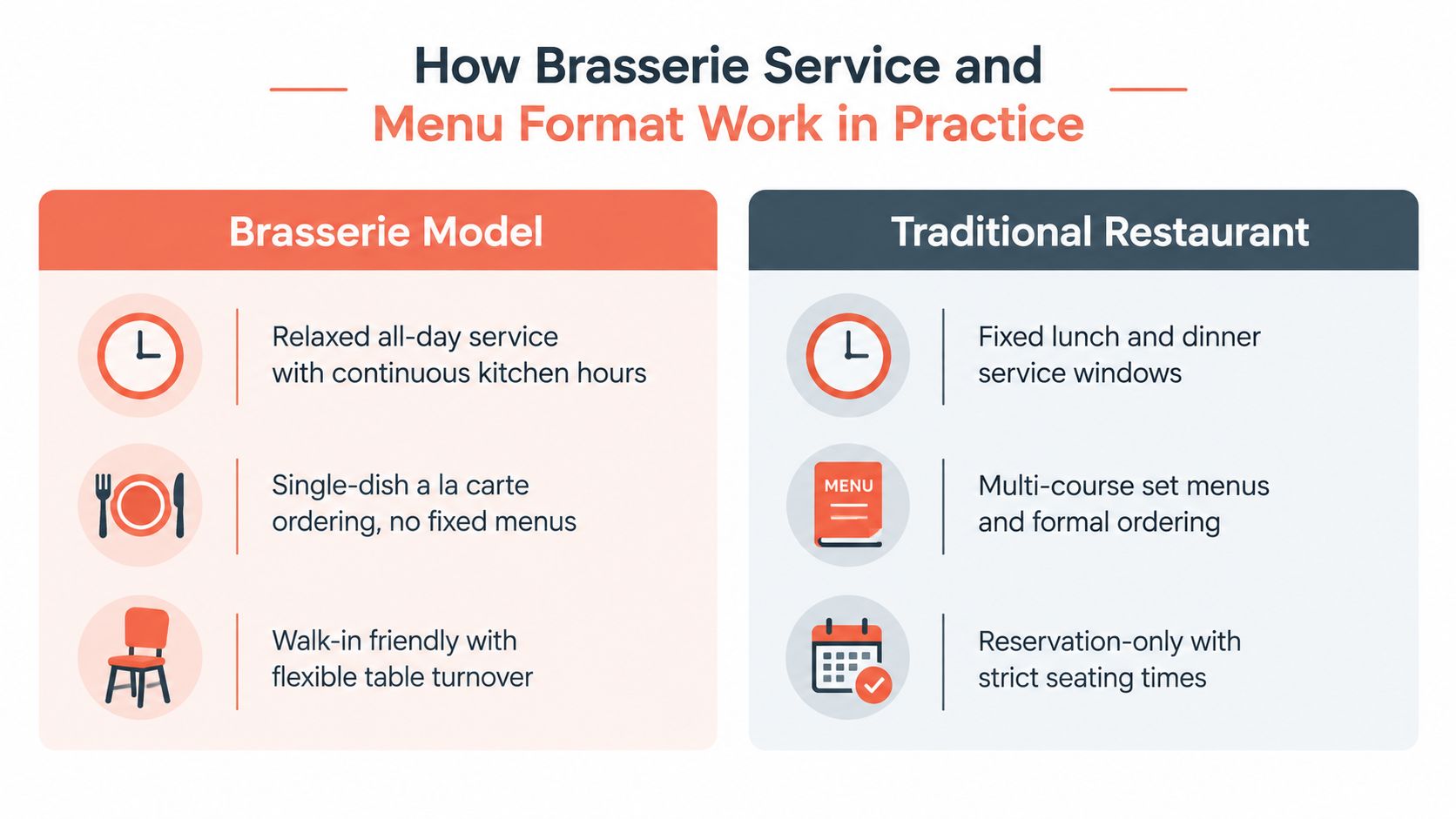
At midday, one table may need a fast main course while another settles in for several courses and drinks. A brasserie earns its place by serving both patterns without forcing the guest into a fixed schedule. The kitchen and dining room stay useful across the day, while the menu gives customers a clear route to a quick meal or a longer occasion.
Menu architecture supports different speeds
Single-dish ordering is central to the format. One guest can order a main course and leave promptly, while another adds a starter, dessert, coffee, or drinks. The menu must make both decisions feel intentional rather than like exceptions.
A useful brasserie menu separates choices by guest need:
- Fast anchors: Dishes that are easy to understand and serve efficiently at lunch.
- Classic mains: Familiar plates that give the restaurant a dependable identity.
- Premium choices: Higher-value dishes for special occasions and group spending.
- Small plates and drinks: Options for lighter visits, early arrivals, and bar-led trade.
A set menu can support certain dayparts or groups, provided it does not remove the flexibility that defines the format. Operators planning menu structure can use this guide to setting a restaurant menu as a practical reference.
The difference from a formal restaurant is operational. A traditional restaurant may concentrate demand into defined lunch and dinner windows. A brasserie spreads demand across more of the day, which can improve use of the kitchen, dining room, and fixed costs when staffing and preparation match actual daypart demand.
Space per cover changes the business model
Independent hospitality guidance commonly budgets about 1.5 to 2.0 square metres per cover for gastronomic service, compared with 1.0 to 1.5 square metres for casual dining and 0.8 to 1.0 square metres for fast-casual use (food and beverage service guidance).
The choice affects both guest comfort and earning capacity. More room per guest improves service access and atmosphere, but it leaves fewer seats on the same floorplate. The same guidance indicates that each additional 0.5 square metres per cover can reduce theoretical seat count by roughly 25% to 33% across that space. For an owner-chef, this makes floorplan efficiency part of the operating model, not a decorative decision.
| Format | Service Style | Space Per Cover | Trading Pattern |
|---|---|---|---|
| Brasserie | Relaxed, broad service with flexible ordering | About 1.5 to 2.0 m² for gastronomic service | Multiple dayparts and varied dwell times |
| Casual dining | Structured full-service experience | About 1.0 to 1.5 m² | Concentrated meal periods |
| Fast-casual | Faster ordering and limited table service | About 0.8 to 1.0 m² | High convenience and quicker visits |
The practical target is a room that protects comfort while supporting table turnover. Flexible table combinations, clear circulation, and dishes that suit different visit lengths help the same dining room serve a quick lunch, a relaxed dinner, and drinks without rebuilding the operation for each daypart.
Designing Your Brasserie Floorplan and Ambiance for Flow
During a busy brasserie service, a poor layout turns small delays into a queue. A server detours around a table, a guest pulls out a chair into the aisle, and the host loses sight of arrivals. A good floor plan makes those moments predictable and easy to handle.
Start with circulation, not furniture
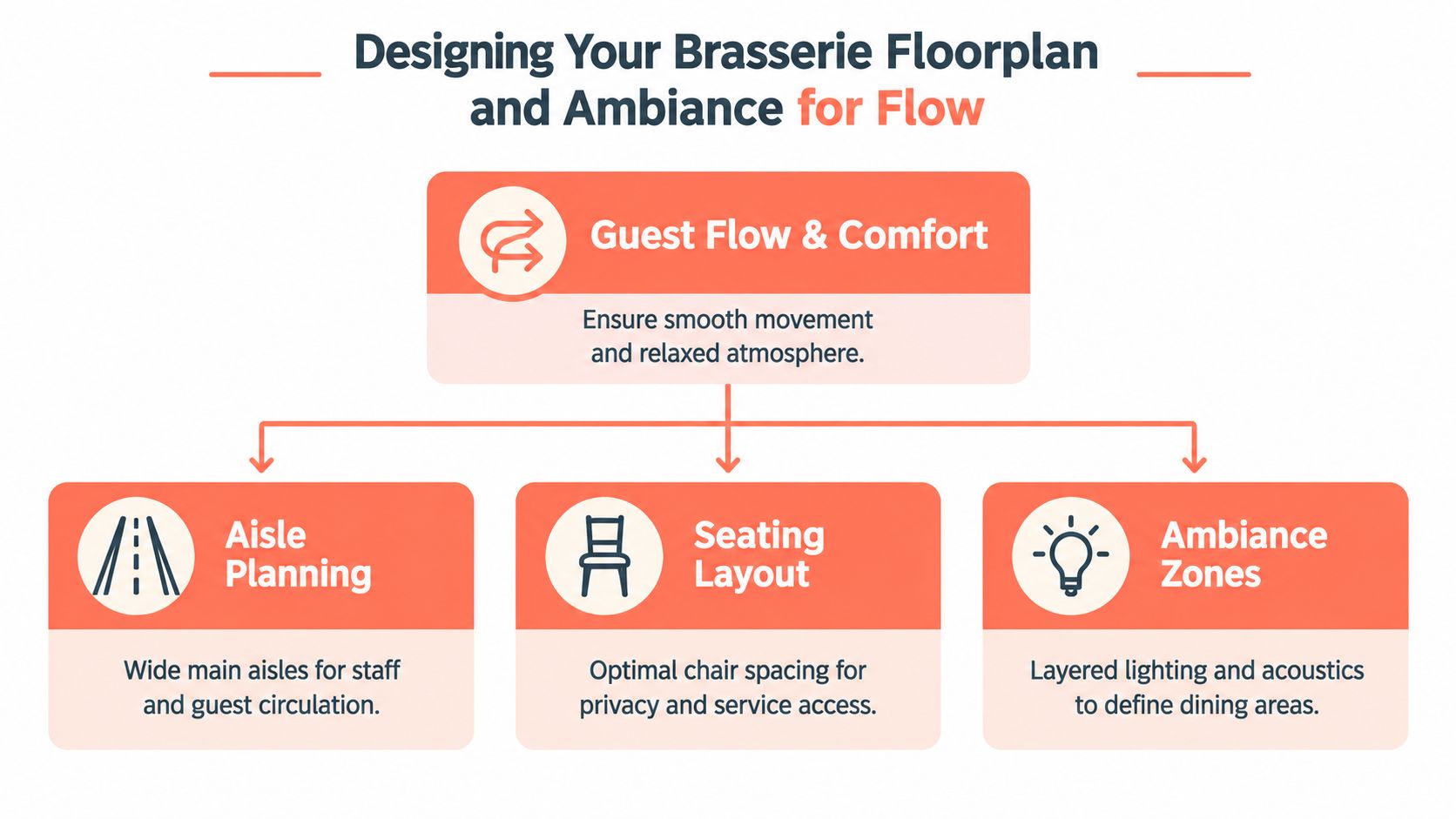
Set the routes before choosing tables. Restaurant layout guidance recommends main aisles of at least 90 centimetres, secondary aisles of 75 centimetres, and chair-to-chair spacing of 60 centimetres in casual settings. Fine dining may need 90 centimetres or more between chairs for service access and privacy, as outlined in this restaurant floor plan guide.
Treat those figures as working benchmarks, not a replacement for a site survey. A chair that fits on paper can obstruct a server carrying a tray, a guest collecting a coat, or a family using a high chair.
Keep the pass close to the dining room. Give staff a simple route through each section, with service stations positioned near the centre so servers can collect water, cutlery, condiments, and glassware without repeated crossings. One-way movement can reduce collisions during peak periods.
Practical rule: A server should not cross the full dining room to solve a small table problem.
Test the plan in operating order:
- Trace a plate from the pass to every section.
- Trace cleared plates back to the dish area.
- Mark collection points for water, cutlery, condiments, and glassware.
- Check whether the host can see arrivals, waiting guests, and open tables.
- Test large-party seating without blocking the main aisle.
Build atmosphere around working zones
Ambiance affects service as much as appearance. Lighting, acoustics, seating density, and bar placement influence guest dwell time and how clearly staff communicate.
Use distinct zones. A bar can carry more energy, banquettes can support longer meals, and smaller tables can suit couples or quicker visits. Acoustic treatment should reduce harsh noise without making the room feel silent. Lighting needs to support menu reading at lunch and create a warmer evening mood.
Outdoor extensions require the same operational discipline. Operators can compare structures in this Forever Party Rentals tent guide, then plan each added area around a service route, lighting, and a clear connection to the kitchen or bar.
For table placement, circulation, and section logic, use this restaurant floor plan layout guide. The aim is a room that feels lively because movement is controlled, not because staff are rushing around obstacles.
Applying the Brasserie Framework to Operations Seating and Compliance
A busy brasserie can look full while still losing revenue. The usual cause is a mismatch between capacity, timing, and compliance. A reservation claims more than a time slot. It claims a table configuration, a kitchen pace, a staff section, and time for the next reset.
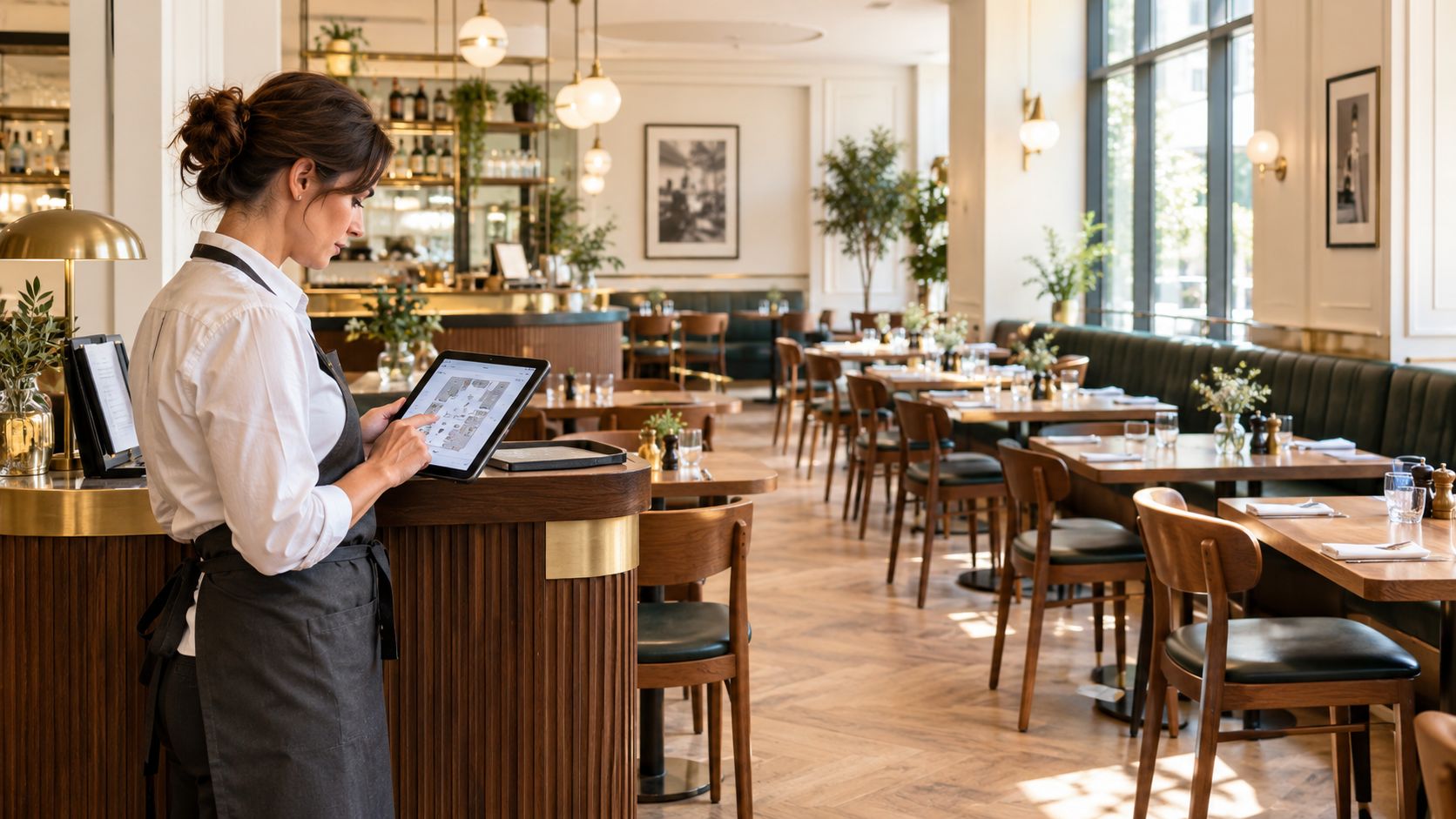
Seat the room by demand pattern
The host needs a live view of the room, not a simple count of occupied and empty tables. Mark tables available now, tables with an expected departure, tables held for reservations, and tables that can be joined or separated.
Use a clear sequence during service:
- Protect the prime configurations: Keep flexible two-tops available when the booking list contains smaller parties.
- Use larger tables deliberately: Do not seat a small walk-in at a configuration reserved for a later group unless the timing allows a full meal and reset.
- Track soon-to-turn tables: A table that has finished its main course may become available soon. A newly seated table will not.
- Hold capacity for walk-ins: All-day brasserie service needs space for guests who decide to visit without booking.
- Pace the kitchen: Seating several large parties together can lengthen ticket times and weaken the guest experience.
Table management affects the revenue produced by the seats already in the room. Full-service restaurants commonly turn dinner tables 1.8 to 2.2 times, while reaching 2.5 to 3.0 turns can mean 25% to 40% more revenue from the same seats (restaurant table management guide). Use those figures as a capacity reference, not as a reason to rush diners. Better results come from accurate seating promises, clear table ownership, quick resets, and decisions that match the kitchen's actual pace.
Manage no-shows without damaging hospitality
No-shows create a practical balance between protecting demand and keeping the brasserie easy to book. The response should reflect the cost of holding the table, the booking's demand level, and the likely opportunity for a walk-in.
A study covering 3.77 million reservations across 2,417 restaurants recorded an average no-show rate of 2.33% from August 2025 to July 2026. Earlier academic work cited in the same industry discussion reported rates ranging from 3% to 15% for a studied restaurant, with special occasions potentially producing higher rates (restaurant no-show rate data).
Confirm high-demand bookings, record occasion details, and release late tables under a written policy. Keep waiting walk-ins visible to the host so the room can respond as soon as a table is released.
A reservation platform such as 10seat can provide a live floor plan, table status, reservation timeline, walk-in creation, one-tap seating and clearing, and section management for brasserie-style service. Compare the commercial model before choosing a provider. TheFork, OpenTable, Zenchef, and Formitable can use different pricing structures, while a commission-free option can be reviewed through 10seat's product details.
Keep Belgian GKS obligations visible
Belgian operators also need to manage the Geregistreerd Kassasysteem, commonly called GKS. The original registered cash register requirement applied to restaurants with at least €25,000 annual turnover from table service and catering. A 2025 update states that from July 2025, the requirement expands to all businesses that sell on-site and accept cash payments (Belgian GKS information).
Non-compliance carries financial risk. Belgian hospitality guidance lists fines of €1,500 to €5,000 for using a registered cash system that does not meet the conditions, and first-offense fines of €50 per missing GKS receipt, capped at €500 (Belgian GKS penalty guidance).
Floor management and reservation software do not replace a compliant cash system. The operator needs both: a seating process that protects table capacity and a GKS workflow that staff can follow consistently.
Real World Example What Frame Brasserie Reveals About Positioning
Frame Brasserie shows why the word brasserie doesn't automatically mean inexpensive or casual. Public listing data points to a restaurant with strong guest engagement, but the practical question remains: who should book, and for what occasion?
TheFork lists 2,336 reviews, an overall rating of 8.6 out of 10, and an ambiance score of 8.9 (Frame Brasserie reviews on TheFork). Tripadvisor lists 1,410 reviews and a 4.1 out of 5 rating (Frame Brasserie on Tripadvisor). Those figures indicate substantial review activity and positive perceptions of the setting and service. They don't, by themselves, tell a traveler whether the restaurant is best for a business lunch, tourist dinner, hotel-adjacent convenience, or a special occasion.
Flexible spend bands, not one price promise
The menu makes the positioning clearer. Premium dishes include côte de boeuf maturée holstein at €145 and homard breton at €95, while several dishes sit in the €26 to €42 range. Simpler options such as burrata or croquetas are around €15 to €18 (Frame Brasserie menu).
That spread suggests a bifurcated model. One guest can make a relatively contained visit, while another can create an upscale dinner around premium ingredients, drinks, and longer dwell time. Calling the restaurant a brasserie therefore describes flexibility more accurately than affordability.
A brasserie can be approachable in format while still being premium in spend.
For operators, the lesson is to publish clearer occasion guidance. Menu pages and reservation flows should help guests understand whether the restaurant suits a quick weekday meal, a client lunch, a tourist evening, or a celebration. The brasserie and bistro solution reflects that operational need by treating seating and table status as part of the guest experience.
Frame Brasserie's public profile shows the opportunity. Ratings attract attention, but clear booking guidance converts mixed intent into better-fit reservations.
Making the Brasserie Frame Work for Your Restaurant
A successful brasserie frame is an operating system for the room. It does not depend on period décor or an oversized menu. It depends on alignment between service pace, seating capacity, kitchen workload, and guest expectations.
Build a daypart plan before changing the design. Give the menu clear choices for quick meals and longer occasions. Set aisles, service stations, and table combinations so staff do not cross the room unnecessarily. The host needs a live view of open, reserved, occupied, and soon-to-turn tables. Where Belgian rules apply, management also needs a compliant GKS process.
Run this short audit during the busiest service:
- Watch staff routes and note repeated crossings.
- Find tables that are difficult to combine or reset.
- Compare reserved party sizes with actual arrivals.
- Record where walk-ins wait and how quickly they reach a table.
- Check whether the menu supports both quick visits and longer stays.
- Confirm that cash and on-site transactions follow applicable GKS requirements.
The financial goal is not to rush guests. It is to remove waiting, duplicated work, and poor table allocation. Better seating discipline can increase revenue from the same seats, as industry table-management guidance explains (restaurant table management guidance). Treat table readiness as a financial control, not merely a host-stand preference.
Change one point per service. Reconfigure a problem aisle, remove a menu bottleneck, or tighten one reservation rule. Track table readiness, late seating, walk-in conversion, and complaints. Repeated small corrections create the consistency a busy brasserie needs.
10Seat provides live floor-plan visibility, reservation timeline management, walk-in seating, and table-status control without adding commission to each booking. Visit 10Seat to assess whether its tools match your service rhythm, then test one change during the next busy shift.