Restaurant Capacity Management That Fills Every Seat
Learn restaurant capacity management to unlock more covers, balance kitchen and service, and turn every shift into smarter, more profitable service.
Friday service starts with a familiar contradiction. The reservation book looks full, yet two tables sit empty because guests are late, a four-top is trapped behind a poorly timed two-top, and a walk-in party is turned away at the door. Ten minutes later, the kitchen receives several orders together, servers lose control of the room, and the dining room still hasn't produced the covers it appeared to promise.
That isn't a seat-counting problem. It's a restaurant capacity management problem, where reservations, walk-ins, table combinations, staffing, kitchen load, no-shows, and live changes must work together. A well-run system helps a restaurant get more covers from its existing floor without forcing the team to rush every table.
The practical target isn't a permanently full dining room. It's a dining room that accepts the right guests at the right times, in combinations the kitchen and service team can handle. The following approach gives owner-chefs and GMs a way to measure real utilization, pace arrivals, adjust policies by daypart, and use technology without surrendering operational judgment.
Table of Contents
- Introduction to Smarter Restaurant Capacity Management
- What Restaurant Capacity Management Really Means
- Key Metrics That Show How Full You Really Are
- Operational Strategies to Gain More Covers Without More Tables
- Technology That Automates Capacity Decisions in Real Time
- Staying Compliant While You Optimize Covers in Belgium
- Your Next Service Made More Profitable
Introduction to Smarter Restaurant Capacity Management
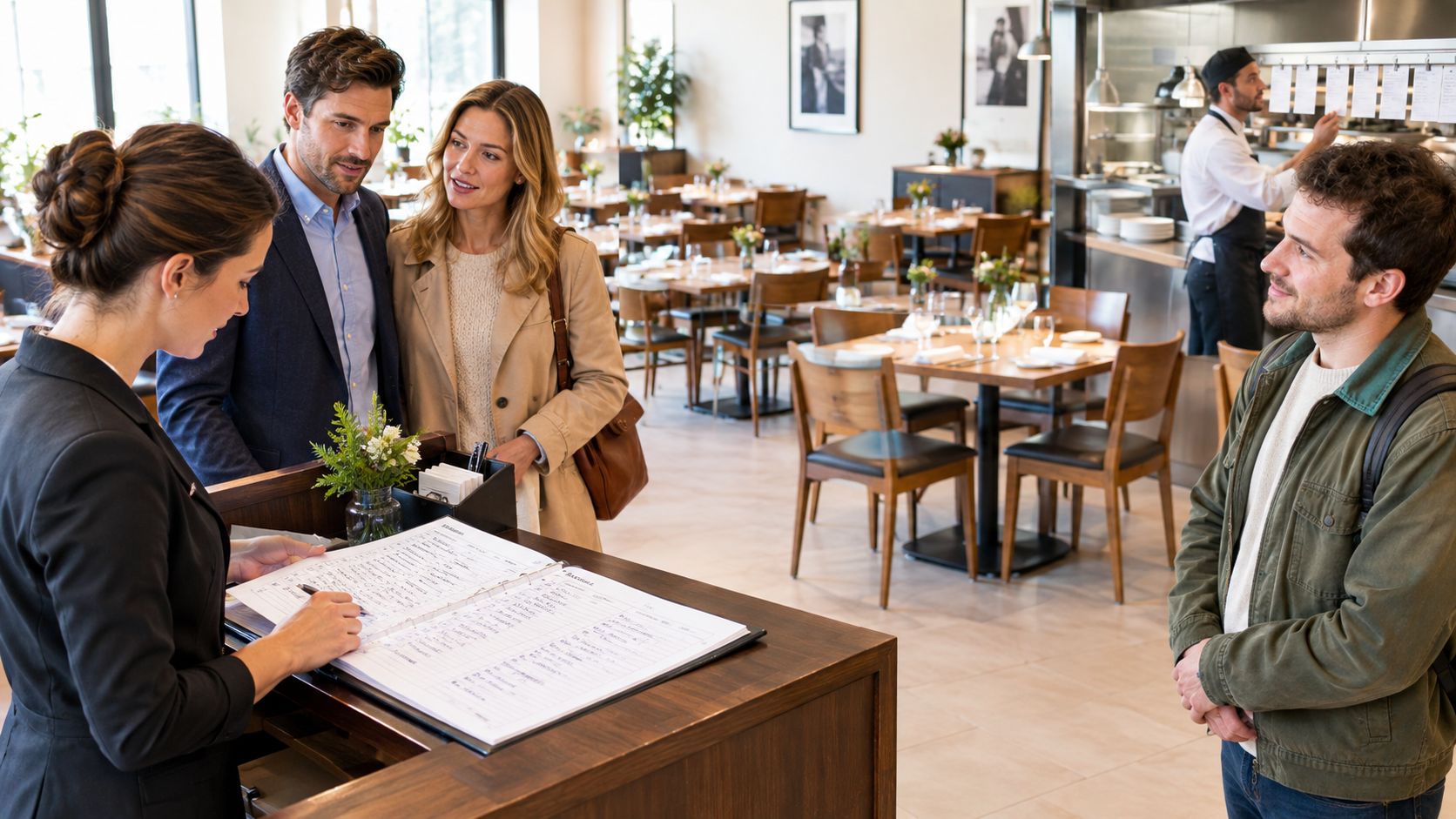
At 19:30 on a busy Friday, the host sees a full book, but the floor doesn't look full. One reservation hasn't arrived. Another party is early and waiting. A two-top is available, but the next booking is for four. The only table that could take the walk-in is being held for guests who may still be several minutes away.
The chef sees a different problem. Tickets arrive in a wave because the host has released too many tables together. The dining room had spare capacity a few minutes earlier, then the pass becomes overloaded. Guests experience the result as slow food, uneven attention, and a longer evening, even though the restaurant had enough seats on paper.
Capacity management turns that mismatch into an operating decision. It controls how many guests can arrive, where they can sit, when tables should be released, and whether the kitchen and floor team can absorb the next party. The work happens continuously, not only when the reservation book is created.
The value hidden in existing seats
A restaurant can lose covers through poor spacing, unsuitable party-size mixes, unclaimed reservations, and tables that aren't released at the right moment. Industry summaries report that about 18% of tables may sit empty during peak hours because of poor reservation spacing, a sign that an apparently weak sales period can be a sequencing problem. The figure appears in restaurant scheduling statistics, alongside average table turns of 1.5 to 2.5 for casual dining and 1.0 to 1.5 for fine dining.
The financial opportunity comes from using the same dining room more intelligently. A useful return calculation starts with three observations from one service: additional covers accepted, average spend per cover, and manager or host time removed from manual seating decisions. The exact result depends on the restaurant's prices, staffing, and demand, so a credible forecast should use its own service history rather than a generic promise.
Practical rule: A full reservation book doesn't prove that the room is being used well. Compare promised covers, seated covers, active tables, and kitchen load at the same moment.
10seat fits into this operating model as a commission-free reservation management platform for independent restaurants in the Benelux. Its role is to help map reservations to available table configurations, control pacing, and manage walk-ins while the manager remains responsible for service standards.
What Restaurant Capacity Management Really Means
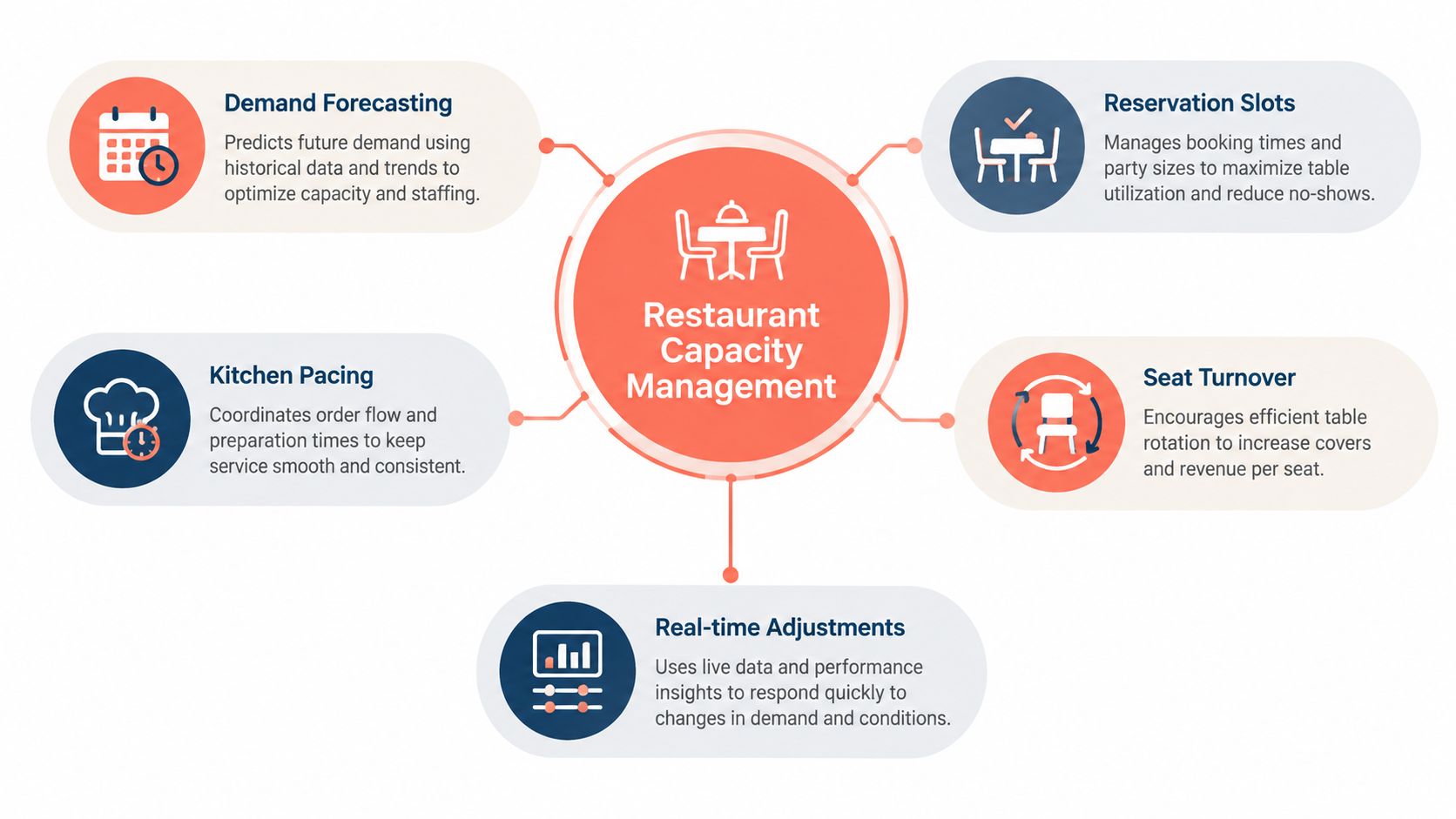
Restaurant capacity is more than the number of chairs. It's the number of guests the whole operation can serve at a given time while maintaining acceptable food quality, hospitality, and financial performance.
An air-traffic-control analogy makes the model easier to understand. A runway can physically hold aircraft, but an airport can't land every plane at once if gates, baggage handling, or controllers are already busy. A dining room works the same way. Seats are the runway, tables are the gates, servers are the controllers, and the kitchen is the system that determines whether another arrival can be handled safely.
Start with the full operating picture
First, identify physical capacity. Record seats, table sizes, sections, and combinations that can be created without damaging the floor plan. Then record service capacity, including the number of servers, cooks, bartenders, and expediters available for each service.
Next, add demand. Reservations, walk-ins, late arrivals, no-shows, cancellations, and changes all affect the live picture. A reservation at 20:00 isn't a future sale. It occupies a table configuration, consumes labor, and creates a likely order wave.
A queueing-based restaurant model found that the most profitable strategy balances service quality and cost rather than maximizing either one alone. The restaurant capacity optimization model also captures how demand changes as congestion changes. In practical terms, pacing, table release, and promotional or pricing decisions shouldn't be managed as isolated controls.
Why more seats can create a worse service
Adding tables doesn't solve a kitchen bottleneck. A simulation study of restaurant waiting times found that acceptable service levels can require different combinations of long-term table capacity and short-term server or cook capacity. The restaurant capacity simulation research shows why one resource can't be optimized alone.
A dining room that seats guests faster than the kitchen can produce meals moves the queue downstream. Guests may be seated quickly, then wait for menus, drinks, starters, or mains. The restaurant has increased occupancy while reducing the quality of the visit.
A useful live question is not, “Do we have an empty table?” It's, “Can this party be seated now, in this configuration, without creating a queue at the next bottleneck?” That question connects floor availability to labor and production reality.
Key Metrics That Show How Full You Really Are
Capacity decisions improve when the team measures the room as a flow system. Three core metrics reveal whether the issue is demand, sequencing, or execution.
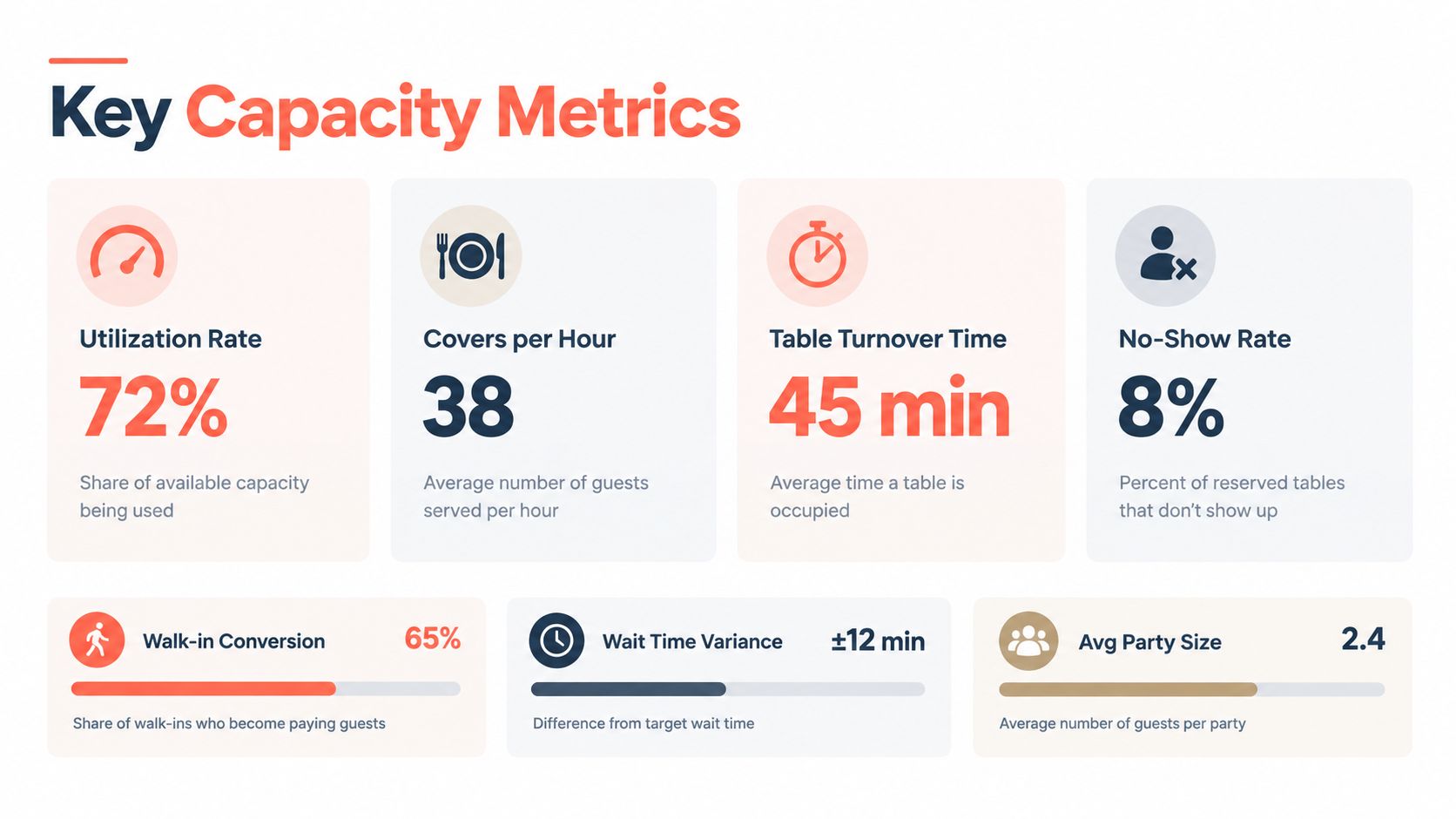
Utilization rate shows how much of the available seating capacity is occupied during a defined period. A simple version divides occupied seats by available seats, but the period matters. A dining room can look healthy across a full evening while losing meaningful capacity during its busiest window.
Covers per hour shows the pace at which guests are served. Divide covers served during the period by the number of hours in that period. This metric helps separate a quiet service from a service where guests arrived but tables remained tied up through slow clearing or delayed payment.
Table turnover rate measures covers served during a meal period divided by the number of seats in the dining room, as defined by table turnover strategies. It's a seat-utilization measure, not a demand-quality score. A higher result isn't automatically better if it comes from rushing guests or overloading the kitchen.
Core Capacity Metrics at a Glance
| Metric | How to Calculate | What It Tells You |
|---|---|---|
| Utilization rate | Occupied seats divided by available seats | Whether the room is being used during a selected period |
| Covers per hour | Covers served divided by service hours | The pace of guest production |
| Table turnover rate | Covers served during a meal period divided by dining-room seats | How effectively seats generate covers |
| No-show rate | Recorded no-shows divided by reservations | How much booked capacity may disappear |
| Walk-in conversion | Walk-in parties seated divided by walk-in parties recorded | Whether spare demand is being captured |
| Wait-time variance | Difference between promised and actual waits | Whether the queue is being managed reliably |
No-shows deserve separate attention because they remove capacity without removing the reservation from the book. A 2026 benchmark covering 3,768,761 reservations across 2,417 restaurants recorded an average no-show rate of 2.33% between August 2025 and July 2026, while industry summaries still cite baseline ranges of roughly 5% to 7% in U.S. full-service dining and 10% to 20% in broader no-mitigation scenarios. The restaurant no-show benchmark demonstrates why confirmation workflows, deposits, and live re-seating rules need to match the restaurant's own channels and dayparts.
Read the metrics together. High demand with low utilization suggests spacing or table-fit problems. High utilization with rising wait variance suggests the team is accepting more demand than the operation can process. A useful companion resource is metrics for hotels and events, which offers a broader way to think about operational measurement. For restaurant-specific analysis, teams can also use restaurant data analytics to connect reservation activity with floor performance.
Operational Strategies to Gain More Covers Without More Tables
A busy Friday can look full on the reservation book while the dining room still has unused capacity. One table is waiting for a large party, the kitchen is absorbing a cluster of orders, and the host is deciding whether a walk-in can fit. The fastest improvement usually comes from controlling the timing of arrivals, not asking staff to move faster.
A manager should coordinate four levers: arrival pacing, party-size mix, table release, and kitchen load. Capacity is a live forecast. Each new booking changes what the team can accept during the next part of service.
Pace the book instead of filling every slot
Static turn times provide a starting point, but they should not dictate every decision. A two-hour estimate may suit one table and miss the mark for another when guests order slowly, need accessibility support, or are celebrating.
Set arrival slots around the room's production rhythm. On a quiet Tuesday, the manager may open more connected availability because the kitchen can absorb arrivals gradually. On a busy Friday, protect gaps between larger parties, hold some walk-in capacity, and reduce availability when orders begin to accumulate at the pass.
The policy should change by daypart and booking source. An online reservation may need a different no-show buffer from a regular guest who books by phone. A Friday evening also needs a different overbooking tolerance from a quiet weekday, because a missing table and a late cluster create different operational problems.
Fit party sizes to the actual floor
Accepting every party size without checking table combinations creates empty seats that cannot be sold. A dining room may have spare capacity but no practical setup for a party of five. Joining small parties at large tables can cause the same problem later by blocking larger bookings.
Build availability around combinations, not only total seats. If a section contains mostly two-tops, direct smaller parties there and preserve flexible tables for larger groups. The restaurant floor plan layout guide helps managers review the relationships between tables, service paths, and usable combinations.
Make the waitlist a live sales channel
A waitlist should record party size, arrival time, contact details, and the expected wait. It should also show whether each guest accepted, declined, left, or was seated. Those outcomes reveal whether the quoted wait is credible.
A digital queue lets the host offer a table as soon as it becomes available, rather than calling parties in a fixed order that no longer fits the floor. It also limits lobby congestion, which can become another service burden.
A walk-in is not spare capacity until the host knows which table can take the party and when that table will be ready.
Before releasing another arrival slot, check five conditions:
- Kitchen load: Are tickets moving normally, or is the pass already carrying a queue?
- Server coverage: Can the assigned section absorb another table without delaying greetings?
- Table configuration: Will the booking consume a flexible combination needed later?
- Arrival reliability: Does this daypart show late arrivals or no-shows by channel?
- Recovery options: Can the restaurant narrow bookings, reseat a released table, or contact the waitlist quickly?
The Singapore restaurant payments hub provides broader context on restaurant workflows and payment processes. Payment flow affects capacity because delayed closing and unsettled checks can keep tables unavailable after guests have finished.
Set a throttle signal before service begins. If the kitchen reaches its working limit, pause or narrow arrival slots. If the room has open tables and the pass is clear, release suitable availability. The rule should be visible to the manager and simple enough for the host to follow without stopping service for a meeting.
Technology That Automates Capacity Decisions in Real Time
Manual reservation books force the host to solve the same puzzle repeatedly. Which table fits the party? Which booking should be moved? Can a walk-in fit before the next arrival? Has a late table created a new opening, or will seating it now overload the kitchen?
Static turn times answer only part of that problem. A live capacity engine evaluates tables, sections, hours, pacing rules, buffers, party sizes, and current occupancy together. It can then make a seating recommendation while leaving the manager in control of exceptions.
Manual rules versus live decisions
| Operating method | Strength | Limitation |
|---|---|---|
| Paper book or spreadsheet | Familiar and flexible | Depends heavily on one person's memory |
| Static turn-time rules | Simple to configure | Doesn't respond well to late changes or live load |
| Commission-based marketplace tools | Can support demand generation and reservations | Pricing models may include commissions or other commercial terms |
| Live capacity platform | Connects availability with floor configuration and pacing | Needs accurate table, turn, and service settings |
The comparison with TheFork, OpenTable, Zenchef, and Formitable should focus on commercial structure rather than brand judgment. Those platforms may use commission-based models, while 10seat uses a commission-free reservation management approach for independent restaurants in the Benelux.
10seat includes Smart Auto Seating, Auto Seating Puzzle, and Walk-in Squeeze. These functions are designed to map reservations to efficient table configurations, handle live walk-ins, and reduce repeated manual decisions. The publisher describes host decisions occurring in 0.5 seconds and an ability to achieve 10% to 15% more covers per busy shift, figures that should be treated as product claims and tested against the restaurant's own baseline and operating conditions.
Automate the repetitive work, retain judgment
Automation should not remove hospitality judgment. The host still decides when a guest needs special care, whether a delayed party should receive a different table, and whether a kitchen constraint makes a technically available seat unsuitable.
The system should handle repetitive calculations. It can show what is bookable, apply pacing limits, respect turn times and buffers, and suggest the most efficient table arrangement. It can also retain guest preferences, allergies, and special occasions for future service, provided the restaurant manages that information responsibly.
For restaurants that need a structured queue, digital queuing for restaurants connects walk-in capture with live availability. That prevents the host from managing names, phone numbers, table status, and estimated waits across separate notes.
A commission-free setup also changes the return calculation. If a busy shift creates additional covers, the owner should compare the value of those covers with the platform cost, then add the time saved by removing manual seating work. 10seat offers setup in five minutes, no credit card requirement, and an “On the House” plan for up to 50 covers, according to the publisher's product information. Owners can review the 10seat product details and 10seat pricing before testing the workflow against an actual service.
Staying Compliant While You Optimize Covers in Belgium
Capacity optimization must connect cleanly to compliant sales recording. A restaurant shouldn't create a faster seating process that leaves the team uncertain about how meals consumed on site are ticketed and receipted.
In Belgium, restaurant operators providing meals consumed on site must issue a VAT receipt through a Registered Cash Register System, or GKS, when annual turnover from restaurant and catering services exceeds €25,000 excluding VAT. The rule is outlined by Horeca Vlaanderen's GKS guidance.
Keep the reservation-to-POS flow clear
The reservation system should identify the booking, party size, arrival status, table, and relevant changes. Once guests are served, the point-of-sale process should record the transaction and issue the required receipt through the registered system when the rule applies.
That creates a useful operational chain:
- Reservation record: Capture the source, party size, and promised arrival.
- Seating status: Mark the party as arrived and assign the table.
- Service record: Keep orders and payment connected to the active table.
- Receipt process: Issue the VAT receipt through the GKS where required.
- End-of-service review: Compare booked, seated, cancelled, and no-show parties with POS activity.
The manager shouldn't ask hosts to interpret tax rules during a rush. The owner or accountant should define the compliant workflow before service, then train the team on the small number of actions they perform. Capacity data becomes more useful when it can be reconciled with completed transactions, but operational convenience never replaces the legal obligation to use the registered cash system when the threshold and conditions apply.
Your Next Service Made More Profitable
The next shift doesn't require a new floor plan. It requires a clearer operating limit and a short feedback loop.
Before opening the book, the owner-chef or GM should record available tables, staffing, expected demand, and the sections that can absorb larger parties. During service, the host should watch active tables, late arrivals, released tables, waitlist conversion, and the kitchen's ability to accept another wave. After close, the manager should compare promised covers with seated covers, table utilization, turnover, no-shows, and wait-time variance.
A practical checklist for tonight
- Set the capacity ceiling: Define the arrival pace the kitchen and floor can handle for each busy period.
- Protect flexible tables: Don't consume the only useful combination for a booking that could fit elsewhere.
- Review the source mix: Separate reservation, walk-in, phone, and marketplace behavior rather than applying one buffer to every guest.
- Mark live changes: Record cancellations, no-shows, late arrivals, and walk-offs while the information is fresh.
- Measure the result: Compare covers gained, service quality, table availability, and time spent managing the book.
The ROI calculation should stay grounded. The product information for 10seat states a potential 10% to 15% increase in covers per busy shift and 0.5-second seating decisions, but each restaurant should validate those figures against its own baseline. A manager can also quantify time savings by tracking how long the host spends searching for tables, rearranging bookings, and updating walk-ins before and after automation.
Manager's test: If the team can explain why the next party is being seated, which resource will handle them, and what fallback exists when plans change, capacity is under control.
10seat is designed to fill more seats with the tables already available, while giving managers control over pacing, availability, party sizes, and live floor changes. A short test across comparable services can show whether the system increases usable covers and reduces the manual work that distracts the host from guests.
10seat helps independent Benelux restaurants manage reservations, table configurations, pacing, and walk-ins through a commission-free capacity workflow. Visit 10seat to review the platform and start testing a smarter seating process for the next service.