Reservation System Good or Bad for Restaurants
Is a reservation system good or bad for your restaurant? Honest look at revenue, covers, no-shows, and how to make one actually work for you.
At 6:45 p.m., a dining room can expose the entire argument about reservation systems. A host may be staring at two open tabs left by a 6:15 no-show, while a four-top booked for 7:00 is already seated and ordering. At the same time, a walk-in couple is being quoted a 40-minute wait, even though one of those empty tables could serve them before the next booking.
The manager has minutes to decide. The no-show table can go to the walk-ins. The 7:15 booking may need a tighter seating plan. The 7:30 two-top might be moved to the bar. One reservation has cost the restaurant a cover, while the same floor plan has helped protect two others.
That's why the question “reservation system good or bad” has no universal answer. The result depends on the venue, daypart, demand pattern, no-show controls, and the discipline used during service.
Table of Contents
- A Friday Night That Shows Both Sides
- What a Reservation System Actually Does
- When a Reservation System Is Good for Your Restaurant
- When a Reservation System Is Bad for Your Restaurant
- Policies and Setup That Make Reservations Work
- Matching the System to Your Venue Type
- Your Reservation System Audit Checklist and Metrics
- A Direct Verdict and What to Do Next
A Friday Night That Shows Both Sides
A reservation list looks orderly before service starts. During service, it becomes a live operating problem.
In a 60-seat dining room, the manager isn't managing names on a screen. The manager is deciding which tables remain protected, which tables can be released, which guests are likely to arrive late, and how much pressure the kitchen can absorb in the next few minutes.
At 6:45 p.m., the two empty tables from the 6:15 booking create a dangerous illusion. They're technically unavailable because the guests might still arrive, but they're also producing no revenue. The host can't promise them to the waiting couple without checking the booking notes, the table's next assignment, and the restaurant's hold policy.
The manager releases one table to the walk-ins, then tightens the 7:15 seating plan so that a later party can take a smaller combination of tables. The 7:30 two-top moves to a bar seat, preserving the dining-room table for a larger party. The room gains flexibility, but only because someone is watching the floor in real time.
Practical rule: A reservation protects future demand, but it doesn't replace judgment during the current service.
The cost of a no-show is not limited to the missing guests. It can block a table from being offered to people already standing outside. It can distort the host's wait quote, leave servers with an uneven section, and make the kitchen's production plan less reliable.
The upside is just as tangible. The 7:00 four-top arrived when expected. The manager could prepare the table, assign the section, and pace the room around a known arrival. The walk-ins eventually got seated because the floor plan was treated as a live inventory rather than a fixed booking sheet.
That Friday night doesn't prove reservations are good or bad. It shows that the system creates value only when the restaurant uses it to manage covers, table availability, and pacing together.
What a Reservation System Actually Does
A reservation system is the operating layer that turns future demand into seated covers. A simple booking widget records a name and time. A proper restaurant system connects that booking to the floor, the waitlist, the guest record, and the decisions made during service.
The floor plan is the unit of value. Every booking has to fit a real table, a realistic dwell time, and the kitchen's capacity at that moment.
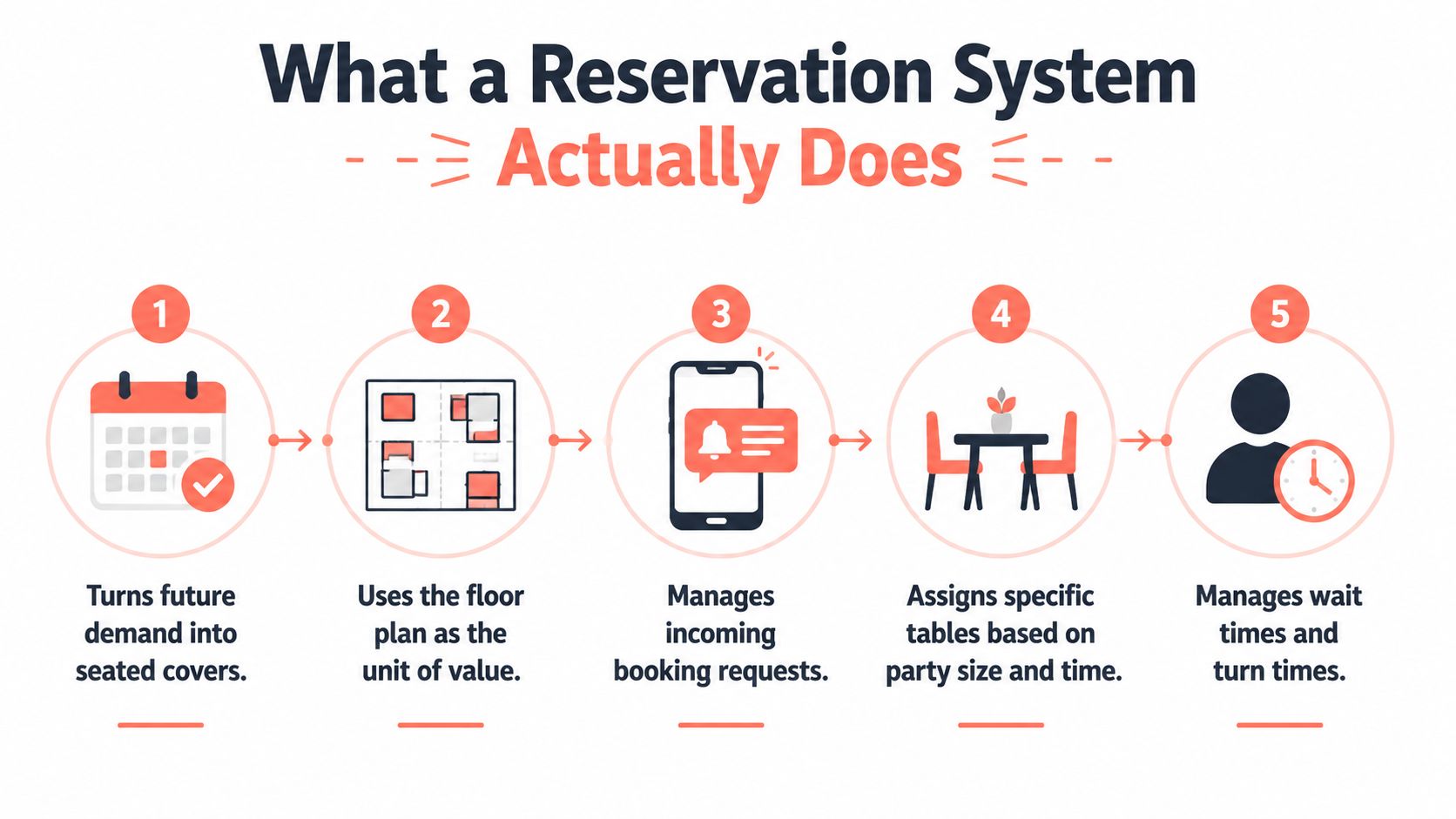
A useful system handles several connected jobs:
- Live floor control: Hosts can see whether a table is open, seated, ordering, in the main course, paying, or ready to reset. That view helps the manager release a table or slow incoming seating before the kitchen overloads.
- Pacing and inventory: The system releases time slots in controlled batches instead of allowing every available table to fill at the same moment. It can protect capacity for walk-ins, larger parties, or a later service wave.
- Party and table matching: A two-top shouldn't consume a flexible four-top when the room expects larger demand. Table combinations and party-size rules determine whether the booking produces useful covers or fragments the floor.
- Waitlist management: A waitlist records the quoted time, party size, and contact details. SMS triggers can alert guests when a table opens, while the host can release an unclaimed reservation without losing the next opportunity.
- Guest intelligence: Notes about allergies, preferences, occasions, and previous visits give the team context before the party arrives. That information matters only when staff can access it without slowing the host stand.
- No-show protection: Confirmations, reminders, deposits, and card-on-file rules help reduce the chance that a prime table stays empty.
- Reporting: Managers can compare booked covers with actual arrivals, review turn times, identify booking sources, and adjust availability based on observed behavior.
The distinction matters. A restaurant may have online bookings and still lack operational control if the booking channel doesn't understand table combinations, live seating, or pacing. Guidance on managing restaurant reservations is most useful when it starts with the floor rather than the booking form.
When a Reservation System Is Good for Your Restaurant
Reservations work best when demand is strong enough to plan, the room has identifiable peak periods, and the team actively manages the inventory. The system turns uncertain arrivals into a forecast that the chef, floor manager, and host can use.
A controlled schedule can help the restaurant close the gap between booked covers and actual seating. Toast's Q3 2024 platform data reported that 6 p.m. represented about 27% of dinner reservations, up 6% compared with Q3 2023, while bookings at 4 p.m. and 5 p.m. rose by roughly 3% and 8% respectively, as reported in restaurant reservation history and operating context. The practical lesson is that a dining room shouldn't treat every booking time as equally useful. Earlier seating can smooth the first wave and protect later capacity.
The gains come from operating levers
The reservation itself doesn't create the result. The connected function does.
| Metric | Typical Uplift | Operational Lever |
|---|---|---|
| Dinner covers | Qualitative improvement when pacing is controlled | Time-slot limits and table matching |
| Peak seating capacity | Additional capacity when turn times fall | Live floor status and faster table release |
| Average guest spend | Qualitative improvement through targeted rebooking | Guest profiles and occasion notes |
| Labor planning | More predictable staffing decisions | Forecast covers and arrival patterns |
| Walk-in conversion | More opportunities during cancellations | Waitlist alerts and auto-release rules |
A manager who sees expected arrivals can schedule labor against a realistic service curve instead of guessing from last week's sales. The kitchen can prepare mise en place for the likely cover count, while the floor manager can avoid seating every table at once.
The system also protects valuable segments. A tasting-menu restaurant may reserve prime slots for guests who accept a deposit. A theatre-adjacent brasserie may hold tables for pre-theatre arrivals, then open remaining inventory to later diners. A restaurant with strong regular traffic can use guest notes to invite suitable guests back for quieter dayparts.
Toast also reported that 72% of guests will wait up to 30 minutes for a table, according to its platform data cited in the same historical review. That gives the host useful context, but it shouldn't become permission to quote careless waits. A well-run waitlist combines a credible time estimate with a contact method and a clear table-release decision.
The system is good when it helps the manager make those decisions faster and with fewer blind spots. It's bad when the restaurant collects bookings without connecting them to table use, guest behavior, and actual service capacity.
When a Reservation System Is Bad for Your Restaurant
A reservation setup becomes harmful when it protects theoretical demand more aggressively than it serves real demand.
At 6:45 p.m., a restaurant may have nine booked four-tops. Three parties have confirmed and are holding their tables. The other bookings remain uncertain, while walk-ins look through the window and hear that the next available seating is 8:30 p.m. If the bar has empty seats and a small section remains open, the problem isn't that reservations exist. The problem is that the system and the team aren't converting available capacity into covers.
No-shows make that exposure visible. One academic review citing OpenTable-based data found that 28% of U.S. reservations made in the past year were not honored. The same review reported that diners booking through OpenTable's network were 40% less likely to no-show than guests booking through search engines, and 28% less likely than guests booking through a restaurant website, as documented in restaurant booking statistics and no-show context.
That comparison doesn't mean a marketplace automatically solves the problem. It shows that booking context, confirmation behavior, and guest commitment affect whether reserved inventory becomes occupied seats.
Where the room loses flexibility
| Symptom | Root Cause | Typical Exposure |
|---|---|---|
| Walk-ins receive late wait quotes while tables sit empty | Holds aren't released based on arrival behavior | Lost covers during the prime window |
| Large parties block flexible tables | No deposit or card-on-file protection | High-value capacity remains unavailable |
| The dining room fills in one rush | Time slots aren't paced against kitchen capacity | Slower ticket times and uneven sections |
| Slow nights feel artificially empty | The system protects too much reserved inventory | Walk-in demand is discouraged |
| Hosts stay at the screen | Floor tools aren't integrated into service habits | Less guest contact and slower decisions |
OpenTable's published model illustrates another trade-off. Its Basic plan lists $1.50 per network cover and $0.25 per website cover, or a $49 monthly flat fee, while Core and Pro list $1.00 per network cover and free website reservations. OpenTable also states that it bills only seated diners, not no-shows or cancellations, in its published reservation plan details. A commission model may be reasonable when the channel creates incremental demand, but the owner still needs to compare that cost with direct booking, guest-data ownership, and conversion quality.
The right response isn't abandoning reservations. It's correcting release rules, party-size controls, confirmation practices, and the walk-in allocation.
Policies and Setup That Make Reservations Work
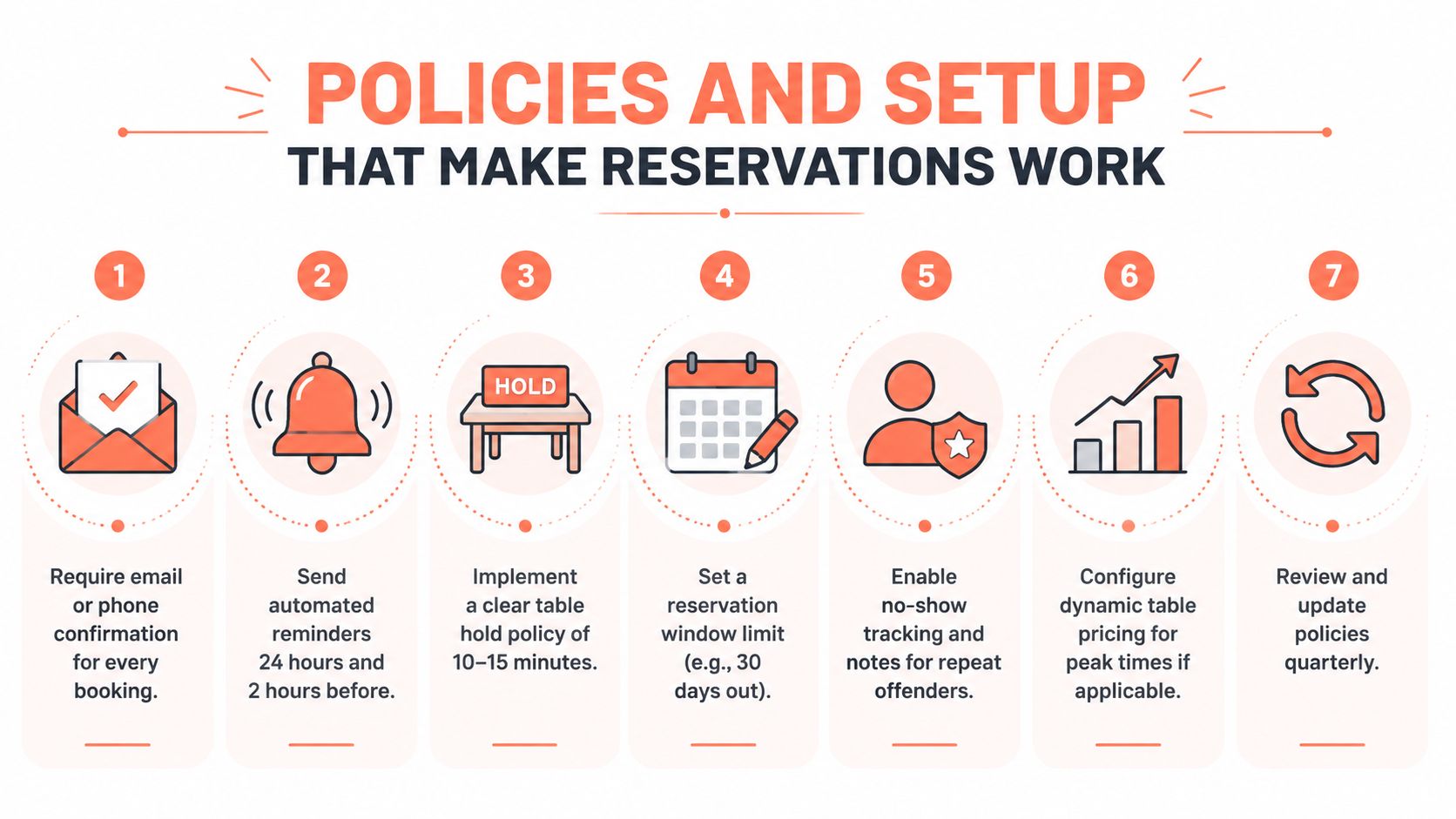
A reliable reservation setup starts with commitment. Every booking should have a reachable phone number or email address, and guests should receive an automated reminder 24 hours before seating plus another prompt two hours before seating. Unconfirmed bookings can be released 60 to 90 minutes before service, provided the restaurant clearly communicated that condition.
That sequence targets the most expensive failure, an empty table protected for a guest who never intended to arrive. Independent guidance on reducing restaurant no-shows also emphasizes confirmations, reminders, deposits, and card holds as practical controls.
Match the policy to the demand
Deposits shouldn't apply identically to every booking. They make more sense for large parties, peak slots, tasting menus, special events, or guests with a pattern of missed arrivals. The message should be direct and courteous: the restaurant is holding a high-demand table, the deposit is applied to the bill where appropriate, and the cancellation window is clear.
Card-on-file rules can protect repeat offenders without adding a deposit to every casual booking. A guest who repeatedly misses reservations should receive a note in the profile and face a firmer policy on future visits.
Pacing needs equal attention. Intervals should reflect the restaurant's real table-turn pattern, not an arbitrary booking grid. The manager should cap the number of arrivals in each interval, reserve a defined share of capacity for walk-ins and bar seating, and adjust those allocations by daypart.
Service behavior still decides the outcome
Software can't repair poor hospitality habits.
- Greet quickly: The host should acknowledge arriving guests within 30 seconds, even when finishing another task.
- Quote accurately: A wait estimate should reflect the current floor, not a hopeful guess designed to avoid an awkward conversation.
- Release deliberately: An unclaimed table should move to the next suitable party according to a documented hold policy.
- Handoff immediately: The server should know the party has arrived as soon as it sits, especially when allergies, occasions, or timing constraints are recorded.
- Review the waitlist: The host should contact suitable waiting parties as soon as a table becomes viable, not after the table has already been reset.
The video below gives a visual reference for the operating logic behind reservation control.
A policy works only when the floor team can apply it without hesitation. The manager should review missed arrivals, delayed parties, and unused tables after service, then change the rule that caused the specific failure.
Matching the System to Your Venue Type
The right reservation posture changes with the shape of demand. Fine dining, brasserie, casual full-service, and brunch venues shouldn't use identical controls.
| Venue Type | Reservation Posture | Deposit Trigger | Walk-In Allocation | Pacing Rule |
|---|---|---|---|---|
| Fine dining | Reservations form the service spine | Prime slots, tasting menus, larger parties | Small, controlled allocation | Tight arrivals matched to long dwell times |
| Brasserie | Hybrid, with protected prime hours | Large parties and high-demand windows | Visible rail for shoulder hours | Protect bar trade and stagger turns |
| Casual full-service | Smooth weekend peaks without blocking all tables | Larger parties or special occasions | Meaningful shoulder-hour allocation | Cap simultaneous arrivals |
| Brunch | Use reservations only with strong commitment controls | Peak periods, larger parties, repeat no-shows | Strong walk-in presence during unpredictable periods | Adjust by daypart and party size |
Fine dining
Fine dining benefits from advance planning because the meal occupies the table for a deliberate service period. Deposits on prime slots protect the kitchen's preparation and the dining room's limited inventory. This week, the manager should compare the promised seating duration with actual dwell time and close booking slots that consistently create a late-service compression.
Brasseries
A brasserie needs both advance demand and spontaneous trade. Reservations can cover the strongest hours, while walk-ins fill the bar and shoulder periods. A practical change this week is to create a visible walk-in allocation by service period, then stop allowing online bookings to consume every flexible two-top.
Casual full-service
Casual restaurants usually need reservations to reduce weekend lobby congestion and coordinate larger parties, not to control every seat. The manager should open fewer tightly packed arrival waves and keep capacity available for guests who decide to visit without planning far ahead.
Brunch
Brunch is the difficult case because demand can spike sharply and then fall away. Early morning periods may fill quickly, while later periods become dependent on local walk-ins. A venue that can't enforce deposits or card holds for high-demand bookings may find that reservations block more useful demand than they create. This week, the operator should test party-size caps and a clear walk-in rule for the quiet period.
The most important setting isn't the booking button. It's the relationship between table type, arrival time, guest commitment, and actual demand.
Your Reservation System Audit Checklist and Metrics
An owner or manager can run a useful audit as a monthly 30-minute ritual. The exercise should happen with the floor plan open, not from a sales report alone.
Start by checking the physical room against the digital map. Table combinations, blocked seats, service stations, and unavailable sections should match what the host sees. A system that offers a table the team can't use creates false availability before service begins.
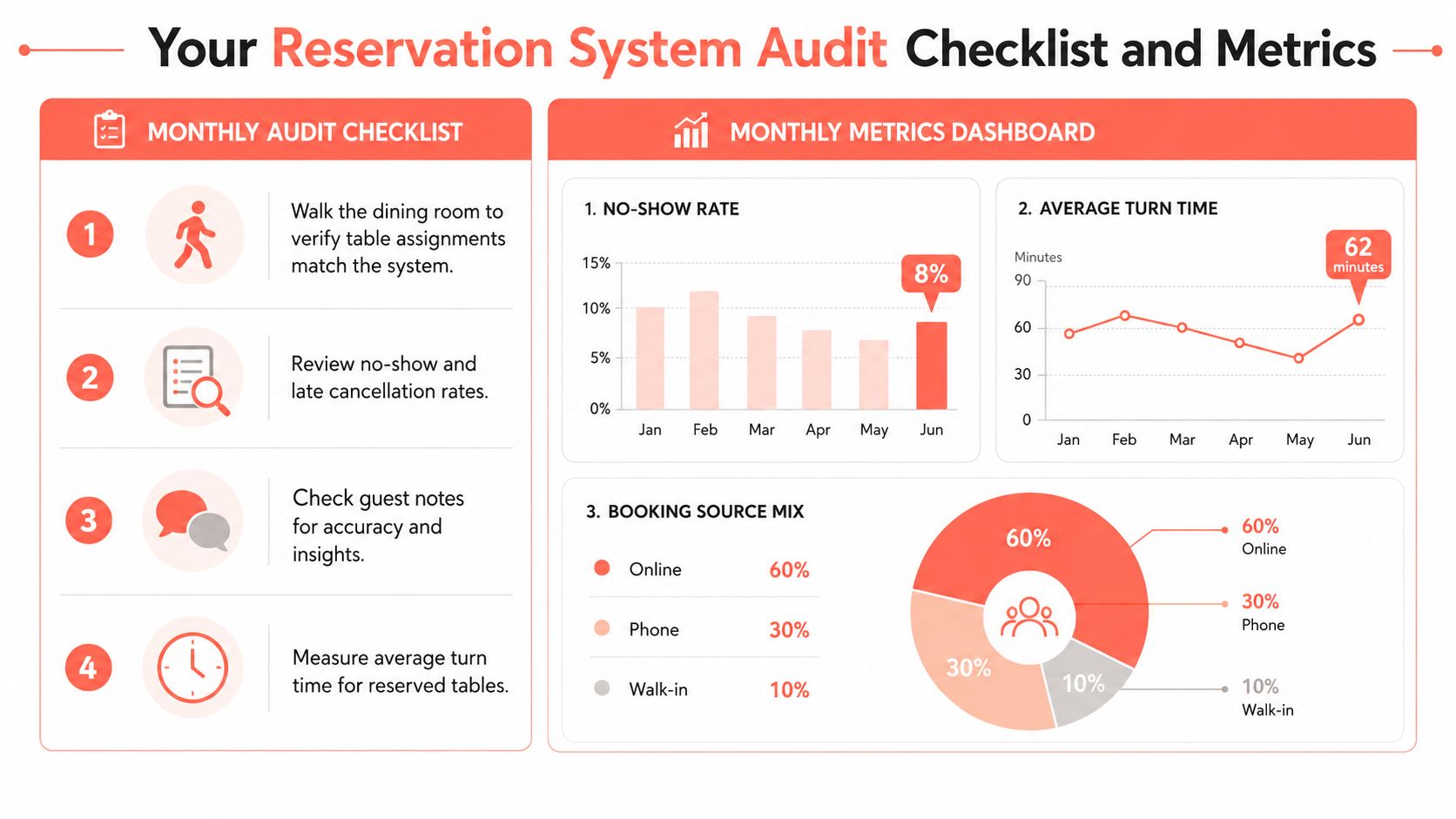
The audit should include these checks:
- Sample past bookings: Review 20 bookings and calculate no-shows as no-shows divided by eligible reservations, multiplied by 100. A published benchmark reported 2.33% across 3,768,761 eligible reservations at 2,417 restaurants, showing why each restaurant should track its own result rather than rely on generic assumptions, as explained in the no-show benchmark and calculation method.
- Check message timing: Confirm that reminders were sent at the intended intervals and that guests could confirm or cancel without calling the restaurant.
- Review enforcement: Check whether deposits, cancellation windows, card holds, and repeat-offender notes were applied consistently.
- Test the waitlist: Add a test request, review the quoted time, and confirm that the team can contact the guest when capacity opens.
- Watch the live floor: Make sure hosts can read table status and pacing without leaving the service area.
- Compare plan with reality: Measure dwell time for reserved tables and identify whether late arrivals or slow resets are creating the gap.
A small dashboard should track no-show rate, average dwell against plan, covers per available seat-hour, walk-in conversion, deposit capture rate, and guest feedback connected to smoother seating. A useful operating target is to keep no-shows under 10%, but each restaurant should set the target against its own concept, booking mix, and policy history.
The manager should also check whether the restaurant's data remains usable across channels. Booking marketplaces can support discovery, while direct bookings preserve more control over the guest relationship. The choice affects margin, branding, and the ability to recognize returning guests.
For a broader view of how table availability connects to revenue, review this guide to restaurant capacity management. If two or more dashboard metrics miss their targets for two consecutive months, the likely issue is configuration or operating discipline, not the existence of the reservation system.
A Direct Verdict and What to Do Next
The verdict depends on the room.
| Venue Type | Verdict | Primary Lever |
|---|---|---|
| Fine dining | Keep reservations as the spine of service | Deposits and precise pacing |
| Brasserie | Run a hybrid model | Prime-hour bookings with shoulder-hour walk-ins |
| Casual full-service | Use reservations to smooth weekend peaks | Party-size rules and protected walk-in capacity |
| Brunch | Use reservations only with deposits or card holds | Commitment controls and daypart pacing |
Fine dining should protect planned service. Brasseries should combine reservations with spontaneous trade. Casual restaurants should use bookings to reduce peak congestion without choking off walk-ins. Brunch operators should favor walk-ins when they can't enforce meaningful commitment rules.
The system is rarely the central problem. Policy, pacing, table mapping, and service discipline decide whether reservations produce covers or block them.
For independent Benelux operators, 10seat is one reservation and table-management option built around availability, pacing, deposits, and walk-ins rather than only the booking funnel. Visit 10seat's product page to evaluate how the platform fits the restaurant's floor and service pattern.
10Seat gives independent restaurants a reservation and table-management platform for online bookings, live floor control, guest details, confirmations, reminders, deposits, and walk-in handling. If the current setup leaves tables empty while guests wait outside, visit 10Seat and assess whether a floor-led approach fits the venue's busiest dayparts.