Online Restaurant Booking Service: A Practical Guide
Choose the right online restaurant booking service for your venue. Compare pricing models, reduce no-shows, and optimize table turns with practical advice.
Friday service starts with a full book, then the phone rings. A walk-in couple wants the last two-top, three guests are waiting at the host stand, and the kitchen is asking whether the next wave is arriving together. The reservation list says the dining room is busy, but it doesn't tell the team how to seat it without creating a bottleneck.
That's the difference between collecting bookings and managing demand. An online restaurant booking service should help the restaurant control the live floor, not place reservations on a calendar.
Table of Contents
- What an Online Restaurant Booking Service Actually Does
- Reservation Systems vs Booking Services
- Revenue Impact and Time Savings
- Setup and Integration Considerations
- Why No-Shows Are Not the Main Profit Leak
- Questions to Ask Before You Sign
- Making Your Decision
What an Online Restaurant Booking Service Actually Does
A basic booking widget gives guests a form. They choose a date, time, and party size, then receive a confirmation. That works for a small venue with a simple room, predictable seating, and someone available to manage every change manually.
A busy restaurant needs more. On a Friday night, the system should know which tables are available, which combinations can seat a party, how long each seating is expected to occupy the room, and whether accepting another booking at a particular time will overload the kitchen. It should also keep the host from making the same decision repeatedly under pressure.
The four jobs that matter
A capable service handles four operational jobs:
- Capture demand: It accepts bookings from the restaurant website, booking links, social channels, and other connected sources without forcing staff to re-enter details.
- Control availability: It updates inventory as reservations, cancellations, table changes, and walk-ins alter the floor.
- Communicate automatically: It sends confirmations, reminders, policy information, and updates so staff aren't spending service answering routine questions.
- Build useful guest records: It retains booking history and relevant preferences, helping the team recognize returning guests and prepare for special requirements.
The fourth function becomes valuable over time. A guest profile can connect a name with preferences, allergies, occasions, and previous visits, provided the restaurant collects and handles that information responsibly.
A booking widget is not floor management
A widget answers, “Can this guest request a table?” A floor-management platform answers, “Which table should seat this guest, at what time, without damaging the rest of service?”
That distinction matters most in fine dining, brasseries, and multi-zone venues. Static table rules often leave awkward gaps, reject combinations that could work, or create a late rush that the kitchen can't absorb. The right system maps bookings to the most efficient available configuration and gives the host a live view of what is happening.
The booking page also needs to fit the restaurant's demand-generation work. Restaurants building a stronger digital presence can use Sup Growth hospitality social media tips to connect social content with a direct booking path, rather than sending interested guests to a phone number and hoping someone answers.
Practical rule: If the system doesn't help the host decide where and when to seat the next party, it's an intake tool, not a complete restaurant booking operation.
Reservation Systems vs Booking Services
The terms sound interchangeable, but the commercial model can be very different.
A reservation system is software the restaurant operates. It usually provides a booking page, availability controls, table management, reminders, and guest records. The restaurant owns the direct booking relationship and manages the configuration.
A booking service can include those functions while also offering discovery through a diner marketplace or partner network. That added reach can help a venue attract guests who haven't searched for the restaurant by name. The trade-off is that the restaurant may pay for access to that demand through commissions, cover fees, or additional commercial terms.
Pricing Model Comparison
| Feature | Commission Model | Subscription Model |
|---|---|---|
| Primary charge | A fee linked to bookings or covers, sometimes combined with a fixed plan | A recurring monthly subscription, normally independent of cover volume |
| Cost pattern | Variable, rising as marketplace or partner bookings increase | More predictable, though add-ons and plan limits still need checking |
| Discovery | Often includes access to a platform audience | Usually focuses on direct website, widget, social, or search bookings |
| Guest relationship | May be mediated by the marketplace, depending on the booking source and terms | Usually gives the restaurant more direct control of guest records |
| Contract review | Check commission rules, channel definitions, cancellation treatment, and renewal terms | Check minimum terms, setup charges, add-ons, usage limits, and cancellation conditions |
| Operational control | Can be strong, but restaurants should verify whether every channel uses the same inventory rules | Often gives direct control over availability, pacing, policies, and floor configuration |
TheFork and OpenTable are relevant comparisons when discovery is a priority. Their commission-based or mixed pricing models can make sense for restaurants that need additional audience reach and are prepared to measure the acquisition cost of each booking. Zenchef and Formitable represent another comparison point, depending on the features, integrations, market, and commercial terms available to the venue.
A subscription model such as 10seat's commission-free approach is easier to forecast when most demand already comes from the restaurant's own website, social channels, repeat guests, or local search. The restaurant pays for operating capability rather than paying a percentage every time a familiar guest books directly.
The right question isn't “Which platform is cheapest?” It's “Which source of demand does the restaurant need, and what control does it need after the booking arrives?” A high-volume casual venue may value marketplace exposure. A fine-dining restaurant with strong repeat demand may value ownership of guest data and predictable costs more.
For a focused look at the operational difference between a paper diary and digital control, see this guide to reservation books for restaurants.
Revenue Impact and Time Savings
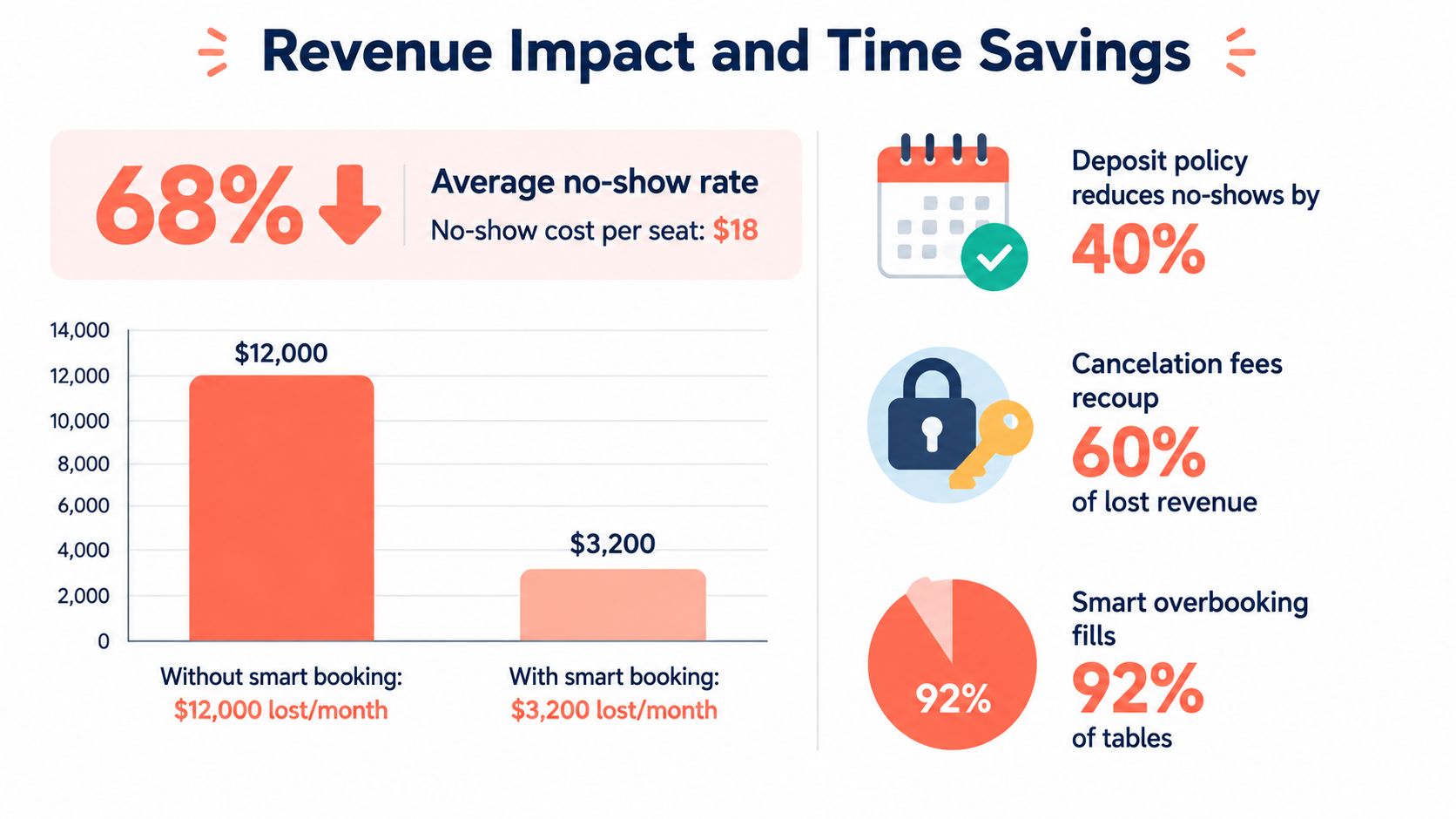
No-show management starts with a realistic baseline. The 2026 Resos No-Show Index recorded an average 2.33% no-show rate across 3,768,761 reservations at 2,417 restaurants between August 2025 and July 2026, according to the Resos no-show benchmark.
That benchmark is materially different from industry commentary that commonly places unmanaged no-shows in the 10% to 20% range, while deposit or card-hold policies can cut them roughly in half or better, as discussed in restaurant no-show policy analysis. The gap tells operators to measure their own service rather than copy a headline.
Calculate the actual loss
The calculation is simple:
- Count confirmed covers that didn't arrive.
- Multiply that number by the average contribution from an occupied cover.
- Add staff time spent calling, chasing, rebooking, and rearranging the floor.
- Compare the result with the monthly cost of the system and its payment or messaging charges.
A policy has to balance commitment with conversion. A 2012 advance-selling model found that restaurants can maximize profit by pairing a no-show penalty with a reservation discount. In one busy-night scenario where demand was about twice total capacity, the optimal no-show fee was effectively the full meal price and produced 14.5% more profit than weaker pricing, according to the queueing and advance-selling model.
A later experiment found that strict or difficult cancellation methods reduce no-show intentions but also depress booking intentions. Lenient policies and easy cancellation paths can encourage bookings and still reduce no-shows when combined with reminders and clear policy communication, as shown in the cancellation-policy study.
The biggest operational opportunity is table use. 10seat's publisher describes its Capacity Engine, Smart Auto Seating, Auto Seating Puzzle, and Walk-in Squeeze as tools designed to achieve 10% to 15% more covers per busy shift without adding tables, as explained on the table management software guide. That figure should be treated as a planning benchmark to test against the restaurant's own floor, not as a guaranteed result.
Automated confirmations and reminders also remove repetitive phone handling. The time saved depends on booking volume, message frequency, and the current workflow, so the manager should track staff minutes before and after implementation rather than accept an unsupported promise.
A proper system should also reduce the number of seating decisions that depend on memory. For a restaurant with unused capacity caused by poor table combinations, even a modest improvement in cover flow can matter more than chasing every missed reservation.
Setup and Integration Considerations
Implementation fails when the restaurant configures the booking page but ignores the service behind it. The vendor demo should focus on the live dining room, not just the guest-facing calendar.
Start with the floor and the POS
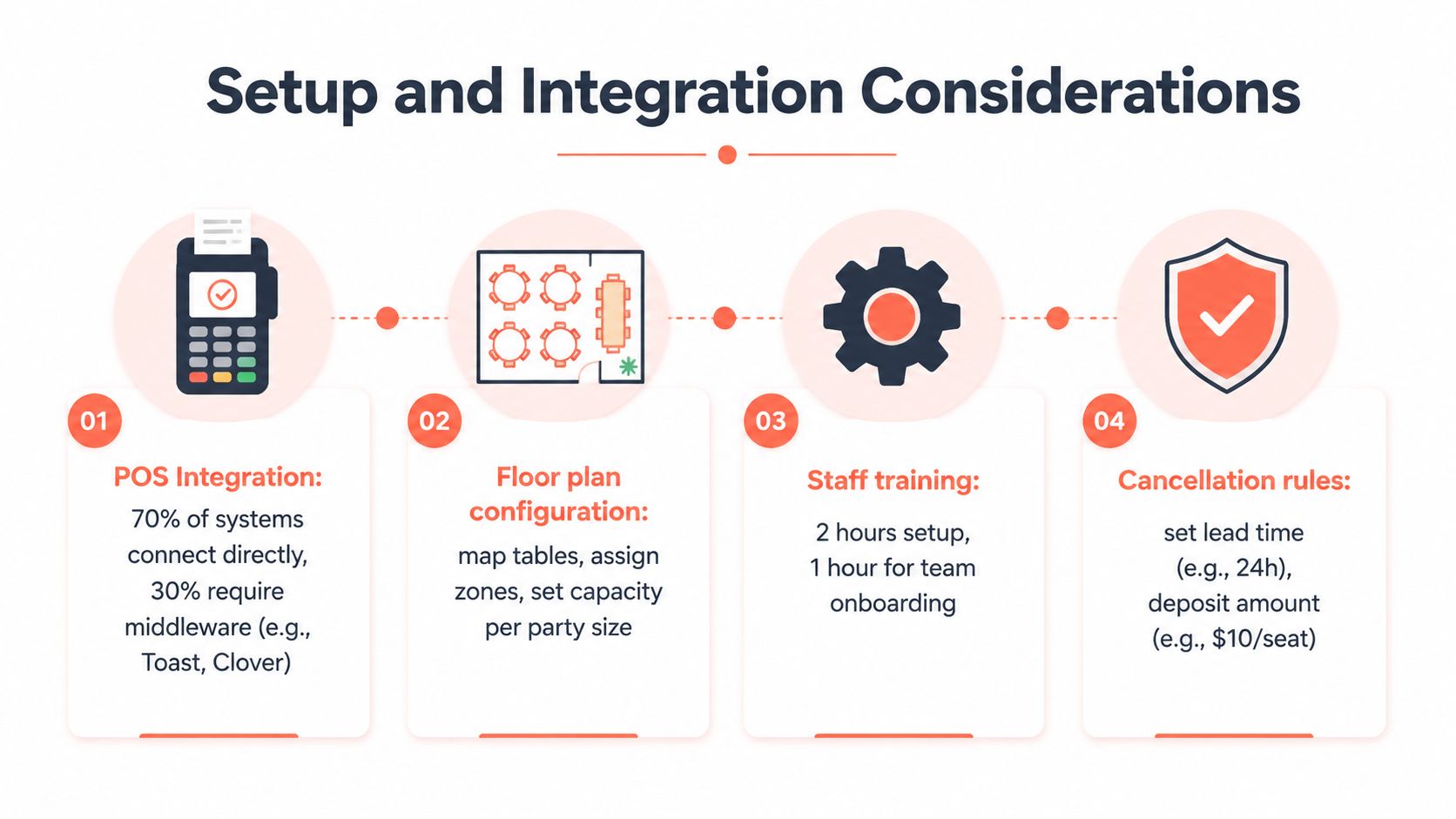
First, map the actual floor. Include table combinations, zones, terrace seating, bar seats, blocked tables, and any table that cannot be used for a particular service. Assign capacity by party size and define which combinations the host can create during a busy shift.
Then examine the POS connection. A direct integration can reduce duplicate entry and give the team a clearer relationship between the booking, the guest, and the final transaction. If the systems don't connect directly, the operator should ask whether middleware is required, which fields transfer, how quickly updates appear, and what happens when a connection fails during service.
The vendor must demonstrate a reservation moving from booking to arrival, seating, ordering, payment, and departure. A slide showing “integration available” isn't enough.
Write policies staff can execute
A cancellation policy only works if guests understand it and staff can apply it consistently. The restaurant should decide:
- Cancellation timing: When can guests cancel without a charge?
- Guarantee method: Will the venue use a card hold, deposit, or another commitment mechanism?
- Reminder sequence: Which messages go out before service, and through which channel?
- Late arrival handling: How long will the table be held, and who makes the call?
- Table release rules: When does the system return a cancelled table to live availability?
The policy should reflect booking behavior, party size, service type, and the value of the seating. A blanket rule often creates friction for reliable guests while failing to address higher-risk patterns.
Belgian GKS compliance
Belgian operators must connect reservation management with the registered cash system correctly. Under the original rules, restaurants and caterers fell within the GKS scope when annual turnover from restaurant and catering services, excluding drinks, exceeded €25,000, and the registered cash system had to issue tickets for all food and drink transactions tied to that activity, according to the Belgian GKS eligibility guidance.
The GKS 2.0 rollout extends the scope from July 2025 to businesses where products or services are sold on-site and cash payments are accepted, replacing the older hospitality-focused threshold model, according to GKS 2.0 information. A reservation system doesn't replace the registered cash system. It should pass the right operational information to the POS workflow while the restaurant confirms its tax and reporting obligations with its accountant or implementation partner.
Before signing, the manager should also ask who owns guest profiles, whether data can be exported in a usable format, and what happens to booking history after cancellation. A restaurant should never discover during a platform switch that its guest relationship is trapped in a system it no longer controls.
Why No-Shows Are Not the Main Profit Leak
A dining room can be full on the booking screen and still lose revenue at service. The operational gap appears when the reservation intake does not guide live floor control. Empty tables matter, but poor table allocation, uneven arrivals, and unsuitable party combinations often cost more than isolated no-shows.
The benchmark cited earlier recorded 2.33% average no-shows across a large reservation sample, while other industry commentary describes unmanaged rates in the 10% to 20% range. These figures describe different operating conditions, policies, markets, and measurement methods. Before imposing stricter terms on every guest, the manager needs a venue-specific breakdown.
Segment before penalizing
Booking behavior differs by party size and lead time. One dataset recorded 1.15% no-shows for bookings of 10 or more guests, compared with 2.63% for bookings of 2 to 4 guests. Another found that longer lead-time bookings were less likely to be missed than bookings made 2 to 6 days ahead. A Singapore report recorded a 13.89% return rate after cancellations, compared with 6.69% after no-shows. The restaurant no-show analysis summarizes these findings.
Use that distinction in policy. A large party booked well ahead may need a different reminder or deposit approach from a small party requesting a near-term table. Guests who cancel properly remain retention opportunities and should not receive the same treatment as guests who fail to arrive.
Punishing every guest equally is lazy yield management. The floor should respond to booking behavior, not just booking existence.
The booking service must connect reservations to the live floor. It should adjust table allocation and pacing as demand changes, hold flexible inventory for efficient combinations, release cancelled tables quickly, protect kitchen flow, and offer alternatives when the requested time does not fit current capacity. Capturing demand without those controls leaves the host team to repair the schedule manually during service.
A credit-card guarantee can support this policy. Restaurants comparing a card hold with a deposit can review what a credit card guarantee means, then select the mechanism that fits their guest mix and local rules.
Questions to Ask Before You Sign
A polished demo can hide a weak service model. The restaurant should make the supplier prove that the system works during the difficult parts of service, not only when a guest books an easy two-top.
Questions about the live floor
- Table allocation: Can the system select efficient table combinations in real time, or does it only show open time slots?
- Pacing: Can the manager set different arrival pacing for lunch, dinner, weekends, private rooms, and terrace service?
- Late arrivals: What happens when a party arrives early, arrives late, or changes its party size at the door?
- Walk-ins: Can the host add a walk-in without breaking existing table assignments?
- Waitlist control: Does the system offer a practical replacement when a cancellation appears during service?
Questions about ownership and cost
The supplier should identify every charge in writing. Ask whether setup, messaging, payment processing, extra locations, additional users, integrations, or support carry separate fees. Ask what triggers a price increase and what happens when the restaurant exceeds a plan limit.
Data ownership needs the same attention. The manager should ask:
- Who controls the guest profile and booking history?
- Can the restaurant export the data without a manual reconstruction?
- Does the export include preferences, notes, cancellations, and source information?
- What happens to the data if the contract ends?
- Which POS systems connect directly, and which require an intermediary?
Support determines whether the system is usable on a Saturday night. The vendor should explain onboarding, training, response times, emergency support, and the process for recovering from an integration failure.
Vendor test: Ask the supplier to configure one real service, add a late walk-in, combine two tables, move a reservation, and release a cancellation. If the demonstration can't handle that sequence, the restaurant hasn't seen the product it will use under pressure.
Making Your Decision
The decision comes down to three choices: commission versus subscription, discovery versus control, and basic booking versus live floor management.
A high-volume casual restaurant may benefit from TheFork or OpenTable when marketplace discovery is a central growth requirement. A fine-dining restaurant or brasserie with strong direct demand usually needs tighter control over pacing, table combinations, guest data, and service flow. Neither model is automatically right. The correct choice depends on where bookings originate and where the current operation loses capacity.
Before evaluating suppliers, the manager should:
- Audit the current booking journey from inquiry to seated guest.
- Measure actual no-shows, cancellations, late arrivals, and unused table capacity.
- Identify the three operational problems that cause the most disruption.
- Compare two or three platforms against those problems, not against feature lists.
- Review pricing, data export, integrations, support, and Belgian GKS implications where relevant.
For independent restaurants in Benelux, 10seat offers commission-free reservation management with direct online booking, live availability, guest profiles, and smart table allocation. Its commission-free reservation management is designed for restaurants that need the booking service and the floor-control layer to work together.
10seat gives independent restaurants a direct booking page or widget, real-time availability, automated confirmations, guest profiles, and table allocation tools without commission-based cover charges. Visit 10Seat to review the product and decide whether its floor-management approach fits the restaurant's next busy service.