Online Booking Schedule for Restaurants: A Practical Guide
Learn what an online booking schedule is, how it works, and how to set one up to fill more covers without the phone ringing off the hook.
A restaurant can lose a meaningful share of its best booking opportunities before the first table is even set. Forty-three percent of online restaurant reservations are made outside operating hours, according to restaurant scheduling data. A phone-first reservation process leaves those guests waiting, calling elsewhere, or abandoning the search.
An online booking schedule isn't just a calendar with green and red spaces. It's a capacity-control system that decides which tables are available, when guests can arrive, how quickly the dining room can turn, and which reservations deserve protection. Set it up properly, and Friday night fills in a controlled sequence instead of producing a crowded 7:15pm wave followed by empty tables later.
Table of Contents
- What an Online Booking Schedule Actually Does
- The Four Building Blocks of a Booking Schedule
- Commission Models and How They Shape Your Schedule
- Time Slots, Buffers, and Pacing That Work on a Friday Night
- Same-Day and After-Hours Demand Is Where the Schedule Pays Off
- Designing No-Show Controls Without Killing Demand
- First-Week Setup Checklist for Hosts and GMs
- What to Watch After You Go Live
What an Online Booking Schedule Actually Does
67% of diners prefer online or app-based booking over calling. Your booking schedule must keep taking reservations when the phone is unattended, including outside service hours. Guests should see genuine availability, choose a time, and receive confirmation without waiting for a host to call back.
The schedule is also the restaurant's capacity map. It connects the public booking page to the floor plan and applies the rules that protect each service window. If a four-top is committed, it disappears from availability. If two tables can be joined, the system offers that configuration only when the floor plan and service conditions allow it.
Three jobs sit underneath the booking page
-
Hold real-time inventory. Every table, seat count, join rule, and blocked period needs an accurate entry. Showing a table the floor cannot deliver creates a host-stand problem, not extra revenue.
-
Enforce turn-time rules. Set realistic durations for each party size and service period. A quick brasserie lunch needs different assumptions from a leisurely tasting menu. If the system gives every booking the same duration, it will release the wrong times and create avoidable gaps.
-
Route same-day demand. Cancellations, newly opened tables, and waitlist opportunities should return to inventory automatically. Hosts should not have to update every channel by hand while service is underway.
A well-built schedule distributes demand before the shift begins. An early Friday booking occupies a suitable table and time. Later guests see only combinations that still fit the room. That pacing protects the dining room from a full 7:15pm arrival wave followed by empty four-tops at 8:45pm.
The schedule should sell the capacity the dining room can serve, not every theoretical seat on the floor plan.
Owners comparing systems should test the live floor view, pacing controls, and public booking flow. A schedule your platform tour discussion gives the team a practical way to map those requirements before choosing or configuring a platform.
The Four Building Blocks of a Booking Schedule
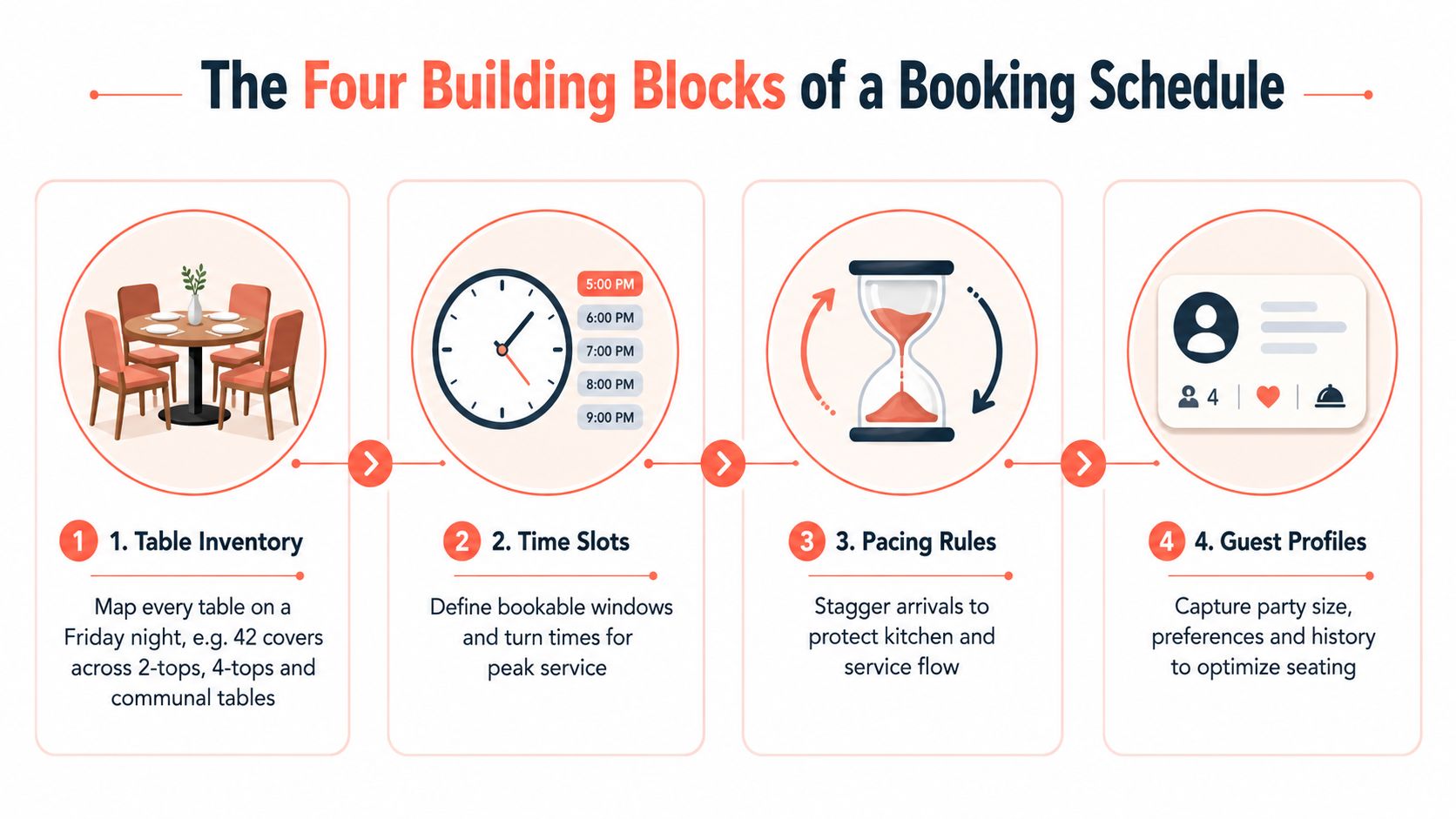
A useful schedule starts with four connected parts: table inventory, time slots, pacing rules, and guest profiles. Consider a 42-cover neighborhood bistro with 14 tables on a Friday night. Each part controls a different failure point, but none works properly in isolation.
Start with the physical room
Table inventory is the fixed pool. It includes the two-tops, four-tops, communal seats, accessible tables, and any combinations the room permits. If two four-tops can become an eight-top, that join must be defined. If a table can't be moved because it blocks a service station, it shouldn't appear as flexible inventory.
Time slots are what guests see. A bistro might expose bookings at 15-minute intervals, while a smaller dining room may use wider windows to reduce arrival clustering. The interval isn't cosmetic. It determines how many parties appear at the host stand during the same part of service.
Let pacing protect the room
Pacing rules decide how much inventory opens at each time. Without them, the 42-cover bistro might accept too many bookings at the same arrival time, even though the total reservation count looks manageable. Pacing spreads demand across the kitchen's production capacity and the floor team's ability to greet, seat, and clear tables.
Guest profiles add context. Party size, contact details, preferences, allergies, special occasions, and prior booking behavior help the schedule make better decisions. A returning guest who regularly requests a quiet table needs different notes from a large first-time party arriving at peak service.
A mistake in one block affects all four. Incorrect table sizes make the system offer impossible combinations. Loose time slots create an arrival surge. Weak pacing makes the kitchen absorb demand in bursts. Missing guest details force the host to ask the same questions repeatedly.
For teams building supporting digital experiences around hospitality, app development for tourism brands offers useful context on how booking journeys should connect customer-facing convenience with operational systems.
The skill is not entering 14 tables into software. It's matching the schedule's pacing to the room's fixed physical limits.
Commission Models and How They Shape Your Schedule
Pricing changes operating behavior. A commission-based platform charges against covers or bookings, so the restaurant has a direct financial reason to question every externally generated reservation. A commission-free system creates a different calculation. The restaurant pays a predictable fee and can focus on whether the table, time, and guest mix fit the shift.
The comparison isn't about declaring one model universally superior. The platform's commercial structure influences how aggressively inventory gets released, how promotions are used, and how carefully managers protect peak capacity.
| Factor | Commission-Based (TheFork, Zenchef, OpenTable) | Commission-Free (Formitable, 10seat) |
|---|---|---|
| Core payment logic | Cost rises with reservation activity or covers | Predictable fee independent of each cover |
| Scheduling incentive | Encourage volume and channel demand | Protect capacity and manage yield directly |
| Slow-period use | Promotions and broader availability may be attractive | Operators choose when to open or restrict inventory |
| Peak-period control | Requires careful review of acquisition cost | Easier to judge each booking by table fit and service load |
| Management question | Is the added cover worth the commission? | Is this booking worth using the available capacity? |
The names in the table represent different approaches, not a verdict. TheFork, Zenchef, and OpenTable can help restaurants reach diners through established reservation channels. Formitable and 10seat represent commission-free approaches where the restaurant retains more control over the economic relationship between availability and service capacity.
That distinction matters most on a busy Friday. Filling every slot may look productive, but a poorly paced rush can delay orders, extend dwell times, and leave later tables unused. A booking schedule should therefore protect the restaurant's service pattern, not just maximize the number of reservations displayed.
Owners should compare total contribution, not headline price. A low monthly fee can still produce weak results if the schedule releases the wrong inventory. A commission can be acceptable when it brings profitable incremental demand, but it shouldn't encourage the restaurant to trade away high-value peak capacity without measurement.
Time Slots, Buffers, and Pacing That Work on a Friday Night
A Friday schedule depends on three decisions. First, how many seats should open? Second, how long should each booking occupy its table? Third, how many arrivals can the team absorb at one time?
A 40-cover dining room provides a clear example. If the average dwell time is 90 minutes and the restaurant protects a 15-minute buffer between seatings, a table of four can support two and a half turns across the service pattern. That isn't a promise of performance. It's a planning assumption that must be checked against the restaurant's actual menu, kitchen speed, and guest behavior.
Choose the slot style that matches the format
Fixed slots such as 6:00pm, 6:15pm, and 6:30pm give the host clear arrival waves. They work well when the kitchen and floor team can handle controlled bursts. Open intervals with a turnover target offer more flexibility and can suit restaurants where bookings arrive gradually and dwell time varies.
A practical starting configuration could look like this:
- Release capacity in stages: Don't expose the entire evening's inventory at every arrival time. Keep later slots available while the first wave settles.
- Protect a service buffer: Hold a small amount of capacity for VIP requests, delayed arrivals, and guests the host needs to reseat.
- Cap the peak wave: Keep the 7:00pm to 7:30pm arrival group at 60% of covers, using the remaining capacity for earlier and later seating. This specific pacing rule is a starting template, not a universal target.
- Tighten repeat risk: If two-tops consistently no-show, reduce their spacing or apply a more protective rule to that pattern rather than restricting the entire schedule.
| Format | Avg Dwell Time | Buffer Between Tables | Realistic Turns on a Fri/Sat | Slot Style |
|---|---|---|---|---|
| Quick-service bistro | Short | Small | Moderate to high | Fixed short intervals |
| Neighborhood brasserie | Medium | Moderate | Moderate | Fixed intervals with pacing |
| Fine dining | Long | Larger | Lower | Wider slots or controlled intervals |
| Tasting-menu venue | Very long | Structured | Limited | Arrival windows |
The schedule should mirror the restaurant's actual service rhythm. Managers looking to connect booking decisions with broader operating limits can use capacity management guidance when reviewing table combinations, arrival waves, and floor constraints.
Same-Day and After-Hours Demand Is Where the Schedule Pays Off
The strongest reason to install an online booking schedule is demand that arrives when the restaurant is closed. Guests search after dinner service, before the next shift, and during hours when no host can answer. A schedule turns that intent into a confirmed booking instead of a voicemail or unanswered call.
Many online reservations happen outside operating hours, and third-party platforms account for a substantial share of bookings, as noted earlier. That combination makes 24/7 availability and a deliberate channel mix operating requirements, not optional features. Keep the direct booking path visible, but meet guests where they already search.
A voicemail does not confirm a table. It asks the guest to wait, and waiting gives another restaurant the chance to accept the booking immediately. The same problem occurs when a host returns calls after service. By then, the guest may have changed the date, chosen a competitor, or stopped looking.
The phone should support the schedule, not replace it
Regulars do not solve same-day demand. They often book further out, while a guest looking for tonight needs an immediate answer. Walk-ins can fill gaps, but depending on them leaves the dining room exposed to weather, neighborhood traffic, search behavior, and local habits.
The schedule gives guests a clear path at any hour. During service, it also protects the host's attention. Instead of repeating Saturday availability, the host can greet arrivals, update table status, adjust pacing, and handle exceptions that require judgment.
Put the booking link on the website, social profiles, confirmation messages, and QR materials. A focused last-minute restaurant reservation process lets the team treat cancellations and late demand as inventory to resell, rather than isolated phone requests. That is how the schedule helps turn an empty four-top at 8:45pm into revenue.
Designing No-Show Controls Without Killing Demand
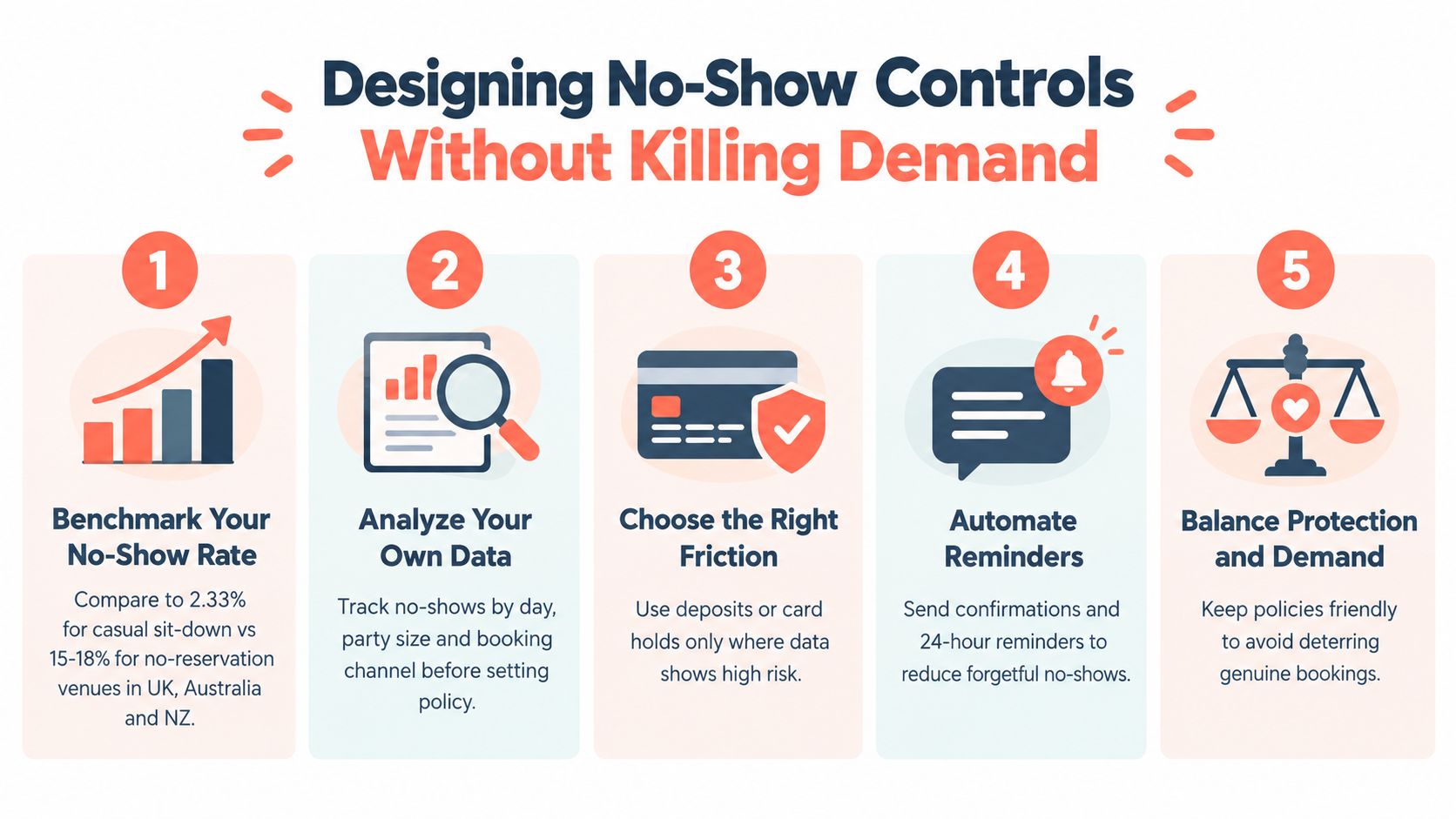
No-show policy needs evidence, not frustration. One benchmark covering 3.77 million reservations across 2,417 restaurants found an overall no-show rate of 2.33%, with higher risk among one-to-two-person parties, dinner bookings, Mondays, and reservations made two to six days ahead. By contrast, reporting for the UK, Australia, and New Zealand places common no-show rates between 15% and 18%, while the US and Canada can reach 20% in some settings. The figures come from different datasets and shouldn't be treated as interchangeable benchmarks, but they show why each restaurant needs its own channel and party-size analysis.
A blanket deposit for every guest is usually poor scheduling. It adds friction to reliable bookings and can suppress demand, while the highest-risk patterns remain hidden inside the same rule. Academic modelling also supports a more deliberate approach, combining no-show penalties with reservation incentives to align guest commitment with seat utilization, as described in this restaurant reservation advance-selling model.
Segment the protection
A better policy starts with the booking patterns that create the most damage:
- Use deposits selectively: Apply them to high-risk party sizes, premium services, or peak slots where an empty table is difficult to replace.
- Tighten peak cancellations: A Saturday 7:30pm booking can justify stricter terms than a quiet early-week table.
- Confirm automatically: Send a confirmation and reminder with a clear cancellation route. Research on policy design finds that stricter cancellation terms can reduce no-show intentions but may also reduce booking intent, so the barrier needs to be proportionate. See the practical no-show reduction playbook for reminder and cancellation workflow ideas.
- Review fairness: Clear messaging helps guests understand why a rule applies and gives reliable diners an easy way to cancel.
Quebec operators must follow specific consumer protection requirements. The rules permit a maximum no-show fee of $10 per person, apply only to parties of at least 2 people, require clear disclosure before booking, and require easy cancellation by text, online, or another technological method. Restaurants must also send a reminder or confirmation 6 to 48 hours before the reservation with a cancellation link, according to Quebec's restaurant reservation guidance.
The right test is operational. If the host spends more time chasing exceptions than serving guests, the policy is too complicated. The schedule should enforce the rule automatically, while managers review whether it protects capacity without reducing legitimate bookings. A restaurant can also use targeted no-show controls to refine deposits, confirmations, and cancellation windows by risk pattern.
First-Week Setup Checklist for Hosts and GMs
A booking system should launch as an operating process, not as a button added to the website. The first week should test the floor plan, guest journey, host workflow, and data quality before the restaurant promotes the link widely.
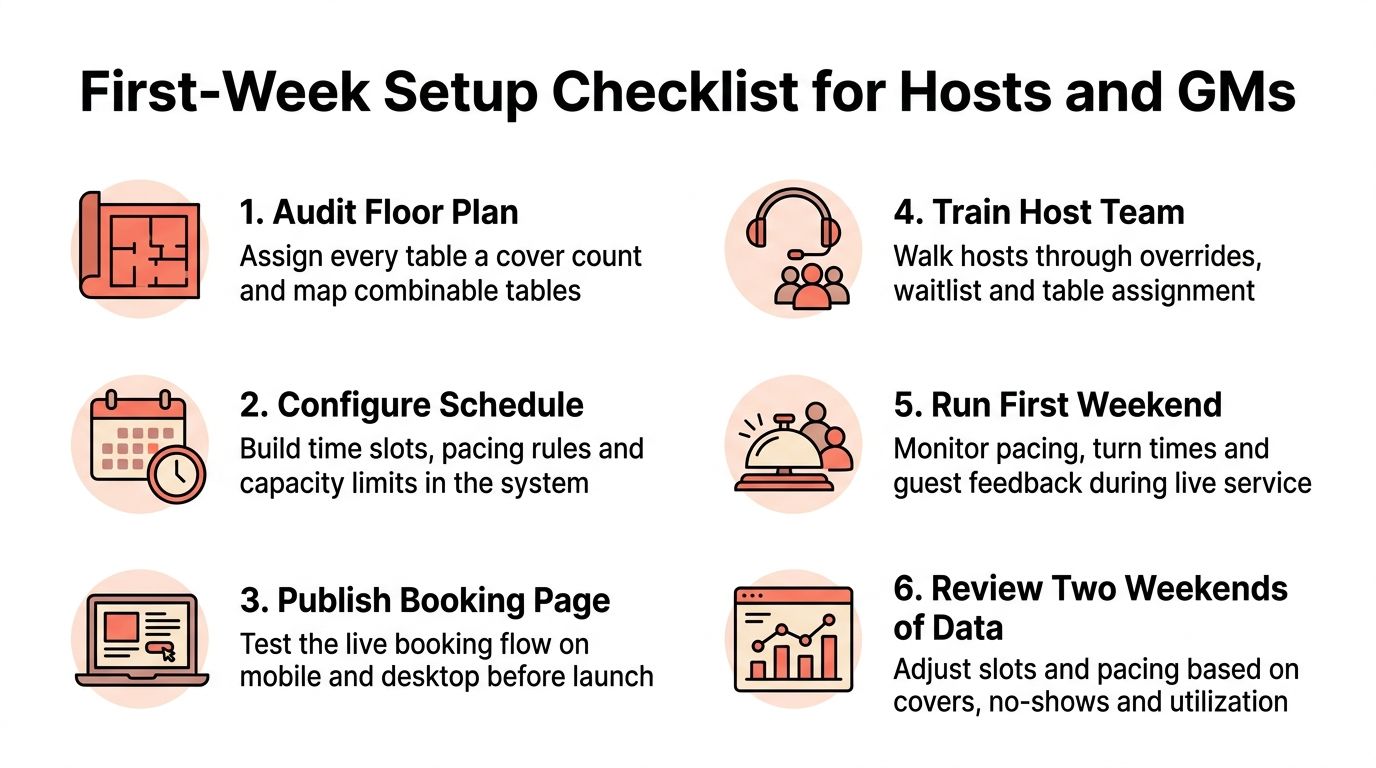
Six actions create a controlled launch
-
Audit every table. Assign each table a cover count, document which tables can join, and map existing reservation history to the floor. The purpose is to find where current pacing breaks before software exposes the same problem to more guests.
-
Configure each service window. Set turn times, party-size limits, and availability by shift. A 6:00pm Monday booking and a 7:45pm Saturday booking shouldn't inherit identical defaults.
-
Publish and test the booking page. Add useful photos, menu links, arrival information, and cancellation terms. Test the entire journey in a fresh browser on both mobile and desktop, including confirmation and cancellation.
-
Train the host on exceptions. The team needs to know the floor view, manual overrides, waitlist entry, table assignment, and the correct way to mark a table dirty so the next reservation can't be seated prematurely.
-
Soft-launch for one week. Keep the phone active while the booking widget runs. Compare online bookings with call volume each day, and record where guests still need staff help.
-
Review after two full weekends. Adjust slot intervals by 15 minutes where arrivals or turns drift, then lock the configuration before promoting the booking link through email and social channels.
Host-room test: A system isn't ready because guests can book. It's ready when the host can change a table, recover a cancellation, and protect the next seating without leaving the floor view.
The first launch week should produce questions, not perfection. Managers should ask whether the schedule reflects the actual room, whether staff can override it safely, and whether guests understand the available options without calling.
What to Watch After You Go Live
Two measures reveal whether the online booking schedule is doing useful work: cover utilization and pacing accuracy.
Cover utilization means total covers served divided by the covers made available across open slots. The aim isn't 100%. A restaurant that fills every theoretical seat may overload the kitchen, exhaust the floor team, and damage the guest experience. A realistic internal target should leave enough room for service recovery and natural demand variation.
Pacing accuracy asks whether guests are seated close to their booked time. A useful operating threshold is a 10-minute window, because a schedule that appears full but drifts 20 minutes per table can break the evening by 9pm. Track actual seated time against booked time, not just the reservation count shown in the system.
A simple Monday review
| Metric | What It Tells You | Healthy Range |
|---|---|---|
| Cover utilization | Whether released inventory converts into served covers | Below theoretical maximum, with capacity for service quality |
| Pacing accuracy | Whether arrivals and seating match the promised schedule | Within a 10-minute window |
| No-show rate by channel | Which booking sources or party patterns need protection | Restaurant-specific and reviewed by segment |
| Lead-time distribution | Whether guests book early or rely on same-day availability | Balanced against prep and purchasing needs |
| Turn-time variance | Whether dwell assumptions match actual service | Close enough to preserve later slots |
Managers should review these numbers every Monday morning during the first month, then monthly. If online guests consistently book 48 hours ahead while phone guests book on the same day, the schedule is shifting demand earlier. That can improve preparation, but the kitchen needs to understand the change before production planning falls behind.
Adjust slot intervals, buffers, and party-size limits from the evidence. Don't respond to one difficult service by closing half the schedule. A booking schedule earns its place when it fills more of the available room while keeping the host, kitchen, and floor team in control.
10Seat provides commission-free reservation management with controlled availability, party-size rules, live table management, and an instant booking page for restaurant websites, social channels, and QR links. Visit 10Seat to see how its scheduling and floor-management tools can help turn existing table capacity into a more controlled service.