Online Booking Benefits: A Restaurant Growth Guide
Discover the real online booking benefits for restaurants in 2026. Drive more reservations, reduce no-shows, and grow your business with proven strategies.

Friday prep is underway, the phone rings, and the host has to choose between answering a two-top and greeting the walk-in waiting at the door. By the time the call ends, the guest asking for 8pm has already booked somewhere else. That missed call isn't a minor service inconvenience. It can be a lost cover, a stranded table, and a weaker service plan.
The useful online booking benefits aren't limited to convenience. They come from giving guests access when staff are busy, then using the resulting data to allocate tables, manage cancellations, protect demand, and build direct relationships. A booking page is only the entry point. The P&L improves when the system behind it helps the restaurant make better decisions.
Table of Contents
- Why Reservation Access Is Now a Round-the-Clock Channel
- Treating the Dining Room as Perishable Inventory
- Turning No-Shows into Recoverable Covers
- Building Guest Profiles That Pay Back Over Time
- Direct Bookings Versus Aggregator Channels
- Market Integrity and Trusted Access
- Pacing, Multi-Channel Demand, and a Practical Setup
- Operator Checklist and Frequently Asked Questions
Why Reservation Access Is Now a Round-the-Clock Channel
The phone is still useful, but it's a poor sole channel for reservations. It depends on someone being available, forces guests to wait, and captures demand only during the hours when the restaurant can answer. A direct online booking flow lets a guest check availability and confirm a table while the team is prepping, serving, closing, or asleep.
A 2024 summary of restaurant booking behavior reported that 54% of UK consumers preferred making restaurant reservations online, while mobile devices accounted for approximately 72% of reservations overall. The same summary reported mobile booking rates of 41% in Australia and New Zealand, 39% in the UK, and 45% of consumers in a United States and Canada survey preferring mobile reservation apps.
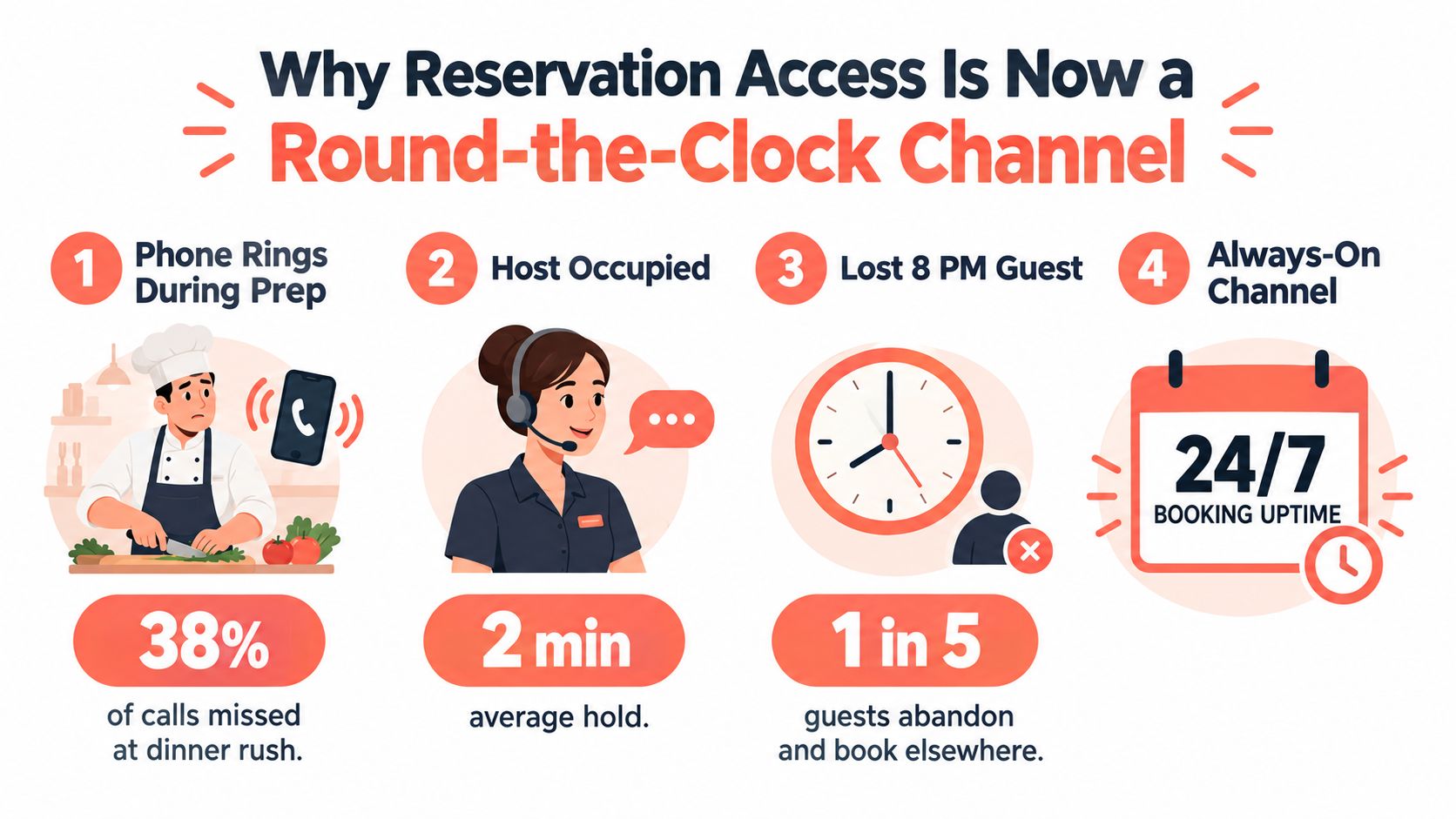
Those figures change how an operator should view a missed call. The guest may be browsing on a phone after work, checking a restaurant's social profile during a commute, or planning a meal after the dining room has closed. If the only route is a phone call, the restaurant has created a conversion barrier before the guest has even considered the menu.
Match access to the venue
Different formats benefit from always-on access in different ways:
- Fine dining: Planning-led guests can secure limited tables without waiting for the restaurant to open.
- Brunch and casual dining: Guests can act on a spontaneous decision while availability is still visible.
- Bars and lounges: Midweek openings can be exposed to guests who discover the venue outside service hours.
The booking page should appear wherever discovery happens, including the website, social profiles, QR codes, and relevant search journeys. A guest who finds a restaurant through Google dinner reservations shouldn't have to copy a phone number, wait for opening hours, and remember to call later.
Four benefits start with access
Round-the-clock reservation access creates the conditions for four practical gains:
- More reachable demand: Guests can book without adding work for the host stand.
- Cleaner capacity planning: Confirmed bookings give managers a clearer view of expected covers.
- Better cancellation control: Digital reminders and cancellation paths create opportunities to recover threatened tables.
- A usable guest record: Direct bookings can build history that supports better hospitality on later visits.
The channel doesn't guarantee growth. A badly configured booking page can expose the wrong tables, accept unsuitable party sizes, or make cancellation difficult. The first operational test is simple: can a guest find a legitimate availability slot and complete the booking in under a minute, at any hour? If not, the restaurant is still treating reservation access as a phone-window problem.
Treating the Dining Room as Perishable Inventory
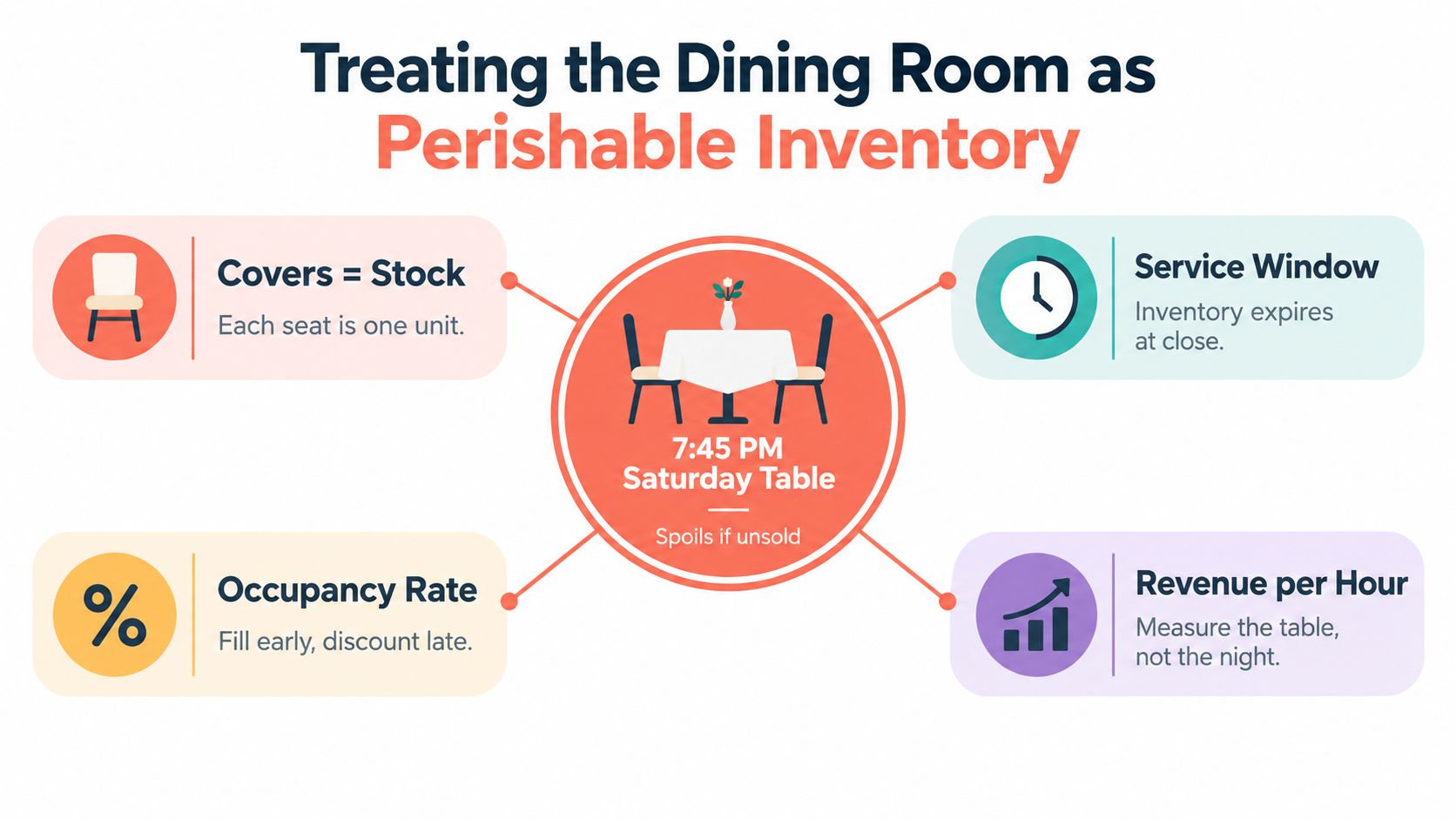
A table at 7:45pm on Saturday is inventory with an expiry time. If it remains empty during that service window, the restaurant can't store that unused table-time and sell it next week. The seat, the kitchen capacity, and the staff hours are all perishable.
Many operators still manage reservations as a calendar. They see an open slot, accept a booking, and move on. That approach misses the harder question: which booking creates the best use of a constrained table at a specific time?
The booking decision is about fit
Research using approximate dynamic programming tested reservation acceptance rules across simulations at five restaurants. Compared with naïve rules, optimized acceptance increased seat utilization by approximately 19% to 30% in medium-demand scenarios and 16% to 27% in a one-slot scenario (reservation scheduling research).
That doesn't mean every restaurant will reproduce those results. It does provide a sound operating model. A reservation should be evaluated against:
- Party size: A two-top shouldn't consume a configuration needed for a larger group during a high-demand period unless the pacing plan supports it.
- Duration: A longer meal affects whether the table can be turned for another seating.
- Table compatibility: A party should fit a suitable table without creating unusable gaps elsewhere.
- Arrival time: A booking at the edge of a service wave can affect kitchen and floor pacing.
- Future demand: A nominally open table may be more valuable later in the service.
Static seat counts answer only one question, how many seats remain. Dynamic table assignment asks whether the remaining seats can be used together, at the right time, by the right party. That distinction can fit more covers into the same service window without adding tables or staff hours, provided the restaurant also protects execution quality.
Turn the floor plan into a live control system
A capacity engine can apply pacing limits to high-demand periods, protect profitable party-size combinations, and prevent the book from filling with arrangements that look healthy on paper but leave awkward gaps. Smart auto seating can then map each online booking to an efficient table configuration instead of leaving the host to solve the puzzle during the rush.
The host still needs judgment. A system can't understand every service constraint, kitchen bottleneck, or guest preference. It can, however, surface a better starting plan and adjust it as cancellations, late arrivals, walk-ins, and table turns change the feasible floor.
Practical rule: Don't ask whether a table is available. Ask whether accepting this party, at this time, leaves the best use of the remaining dining-room capacity.
The relevant measures are therefore more precise than total reservations. Track covers by service window, unused table time, party-size mix, table compatibility, and the number of bookings that force avoidable gaps. The restaurant isn't trying to fill a calendar. It's trying to sell the most useful combination of table-time units before they expire.
Turning No-Shows into Recoverable Covers
A reservation that isn't honored costs more than the missing party. It can leave the wrong table configuration idle, disrupt the expected pacing wave, and prevent the restaurant from replacing the demand before the kitchen and floor have committed resources.
A 2026 no-show index recorded 87,953 no-shows across 3.77 million reservations at 2,417 restaurants, producing an average no-show rate of 2.33%. Bookings made two to six days ahead had the highest recorded rate at 2.67%, compared with 2.09% for same-day bookings, according to the published no-show index. Those figures describe a platform sample, so they're useful as operational benchmarks, not universal promises.
| Booking window | Recorded no-show rate | Operational implication |
|---|---|---|
| Same day | 2.09% | Confirmation activity can focus on immediate attendance and late release decisions |
| Two to six days ahead | 2.67% | Higher-risk bookings deserve earlier reminders and closer waitlist management |
Remove the reasons guests fail to cancel
A September 2025 survey of 1,500 UK adults found that 12% had failed to attend a restaurant reservation. Among those who didn't show, 60% said they forgot to cancel, 15% said contacting the restaurant was too much effort, and another 15% felt embarrassed or guilty about cancelling (restaurant technology coverage).
That behavior argues for a cancellation flow that is easy, visible, and non-judgmental. A guest who can cancel in one tap gives the restaurant a chance to release the table. A guest who feels trapped by a difficult phone call may just disappear.
The practical controls are straightforward:
- Confirmation details: Send the date, time, party size, address, and cancellation route immediately.
- Reminder prompts: Remind guests before arrival and include the cancellation action in the same message.
- Risk scoring: Use booking window, time slot, customer history, time since booking, time remaining, and relevant external events to identify threatened capacity.
- Calibrated deposits: Apply deposits or penalties selectively to high-risk windows rather than making every guest feel unwelcome.
- Waitlist backfill: Release a threatened table to the waitlist or walk-in demand at a defined cutoff.
The guide to reducing restaurant no-shows should be treated as an operational playbook, not a reason to add friction indiscriminately. A punitive policy may protect some capacity while discouraging good guests from booking. The right test is recovered covers and reduced idle table time, not the number of rules added to the checkout flow.
Use the booking book as a live forecast
Reservation data can guide staffing, purchasing, kitchen prep, and table reassignment. If a high-risk slot threatens a large table, the manager can decide whether to confirm more actively, contact the waitlist, adjust pacing, or release capacity to walk-ins.
This turns online booking from a static promise into a control system. The restaurant still needs clear policies and human judgment, but it no longer has to discover every no-show only when the party fails to arrive.
Building Guest Profiles That Pay Back Over Time
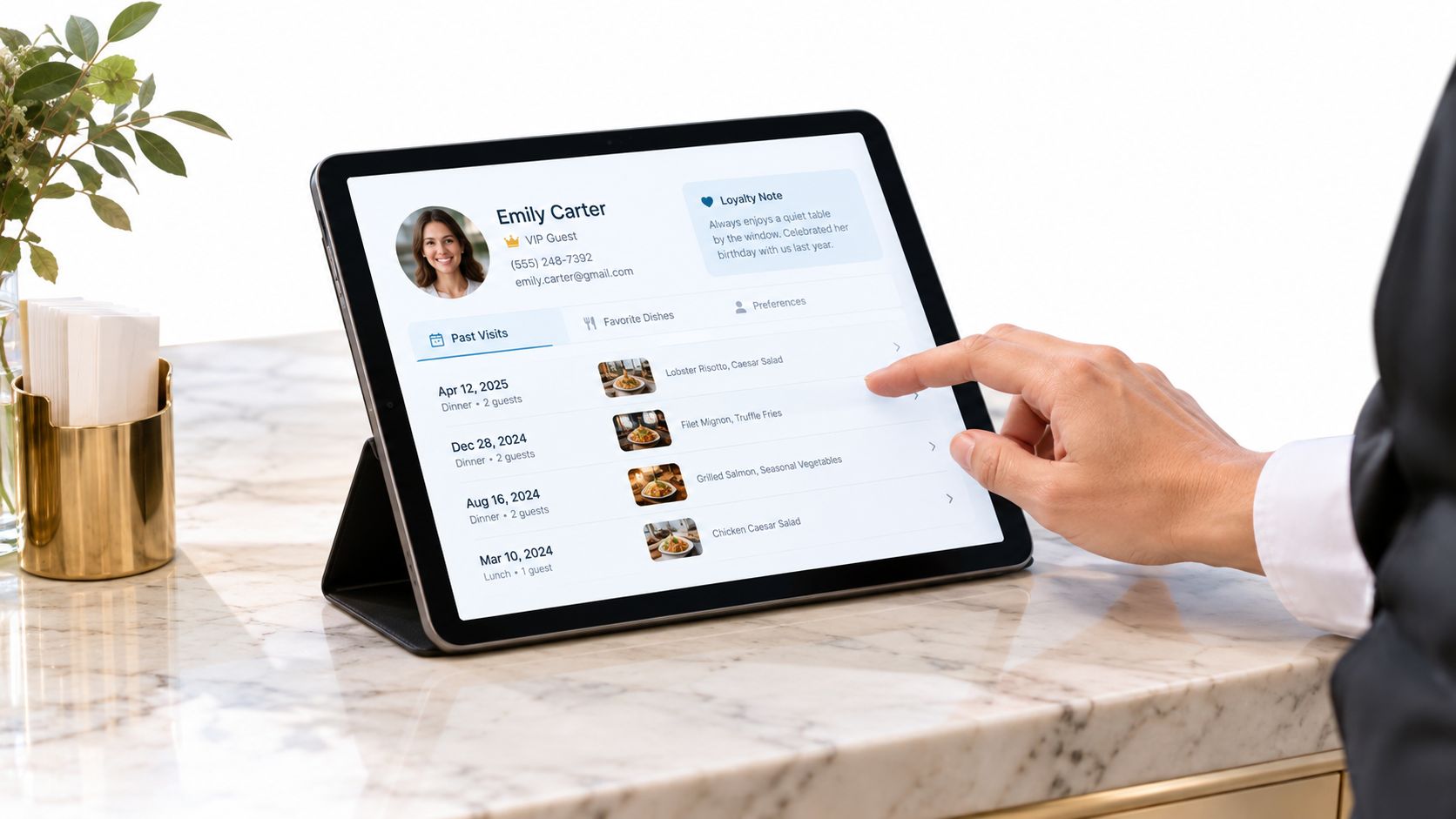
A reservation is also the first useful entry in a guest record. The value compounds when the restaurant remembers what makes the next visit easier, more personal, and more likely to happen directly.
The first booking should capture only information the floor team can use. Party size, occasion, dietary notes, allergies, and seating preference can help the host make a better decision that same evening. A long questionnaire creates friction and produces data nobody reads.
Capture service-relevant details first
Over later visits, the profile can accumulate preferences, favorite wine, recurring seating choices, and records of past issues. A host who sees a gluten allergy before seating can brief the team early. A manager who knows the table is for an anniversary can protect the experience without forcing the guest to repeat the request.
That is the difference between storing customer information and using it for hospitality. The note needs to be accurate, visible to the right staff, and relevant to service. Sensitive details should be handled carefully, with access limited to what the team needs.
Hospitality analytics guidance recommends estimating cancellation and no-show probabilities using time-slot history, customer characteristics, prior behavior, time since booking, time remaining before arrival, and external events. The reviewed literature reported restaurant no-show rates ranging from 3% to 15% in one study, rates around 20% not unusual, and a separate United States dataset in which 28% of reservations were not honored (hospitality reservations analysis).
The same profile that supports a warmer welcome can support more careful operational decisions. That doesn't justify collecting everything. It just means useful history should inform seating, confirmations, and follow-up instead of sitting unused in a database.
Give direct guests a reason to return
An aggregator may introduce a guest, but a direct booking relationship lets the restaurant recognize the guest on the next visit and communicate through an owned channel where appropriate. A focused restaurant CRM system can connect booking history with service notes without turning the reservation form into a marketing survey.
The payoff is practical: faster seating decisions, fewer repeated questions, better handling of occasions, and a more consistent experience. Those details give guests a reason to book directly again, rather than comparing the restaurant only through a third-party listing.
Direct Bookings Versus Aggregator Channels
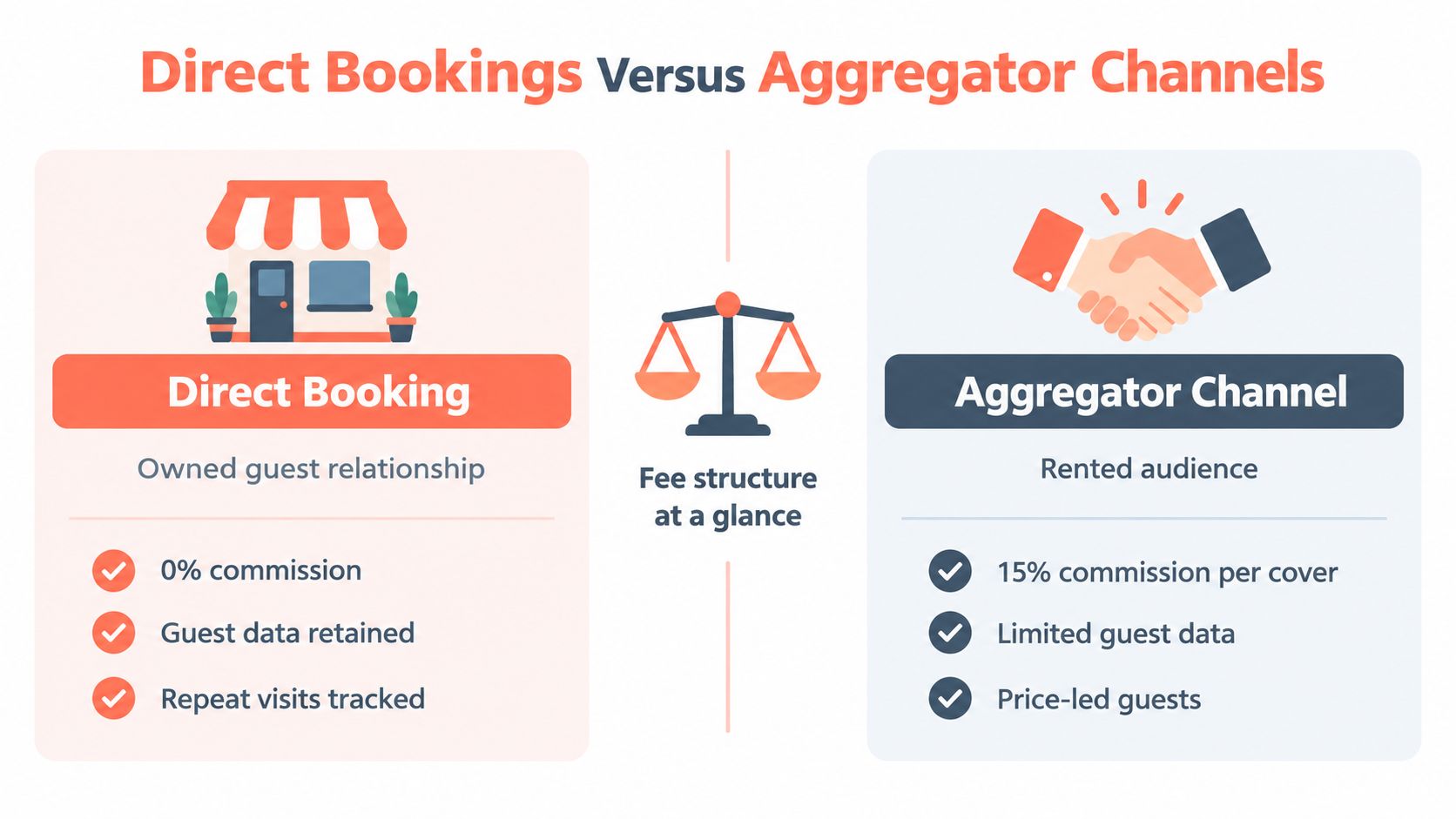
The structural difference is simple. A commission-based aggregator charges for access to its audience, while a direct booking model puts the restaurant in control of the booking page and guest relationship.
TheFork, OpenTable, Zenchef, and Formitable can each be evaluated through that pricing lens. Their commercial arrangements may differ, but the operator's question remains the same: what does each channel cost per cover, and what does the restaurant retain after the booking is complete? Aggregator visibility can be useful, especially when a venue needs awareness in a specific market or daypart. It isn't free demand.
Compare the relationship, not just the widget
| Direct booking | Aggregator channel |
|---|---|
| The restaurant owns the booking path | The restaurant rents access to an external audience |
| Guest details can remain in the restaurant's records | Guest data may be more limited by the channel |
| No per-cover commission under a no-commission model | The fee can scale with covers |
| The restaurant controls the brand experience | The guest may compare venues through the platform |
| Repeat visits can be tracked directly | The aggregator remains part of the relationship |
10seat provides a no-commission direct booking model with an instant booking page that can be used on a website, social profile, or QR code. Its free On the House plan covers up to 50 covers, making it a practical starting point for an independent venue testing direct demand without adding a per-cover charge.
The decision isn't to reject every aggregator. A restaurant with an awareness gap may use TheFork or another marketplace to reach guests who don't know the name yet. The mistake is allowing that rented audience to become the default path for people who already searched for the restaurant directly.
Make the owned channel easy to find
The direct page should appear on the restaurant website, Google Business Profile, social profiles, email signatures, and printed QR materials. Local search visibility also matters, so operators may find your GBP profile useful when keeping the restaurant's booking path and business details consistent across discovery surfaces.
The video below offers a visual comparison of direct and aggregator booking choices.
The clean rule is commercial rather than ideological: use aggregators to fill a defined awareness gap, but make direct booking the default for any guest who already knows the restaurant's name.
Market Integrity and Trusted Access
More bookings aren't automatically better. Reservations obtained through unauthorized resale, opaque charges, bots, or demand the restaurant can't operationally fulfill can damage access and trust while making the book look stronger.
Reporting on unauthorized reservation resale found that nearly two in five surveyed diners knew third-party sites charged for restaurant reservations, while 15% had personally been charged. The same reporting found that 72% worried resale sites make restaurants less accessible and 70% believed the practice increases no-shows (reporting on reservation resale and restaurant technology).
Those concerns matter most for fine dining and high-demand venues. If a guest can't tell whether a booking page is authorized, what fees apply, or whether the table can be honored, the restaurant has lost control of the access experience.
Design for legitimate demand
A trusted booking channel should make several details obvious:
- Direct ownership: Link guests to the restaurant's own booking page from the website and official profiles.
- Visible fees: State any deposit, service charge, or cancellation cost before confirmation.
- Clear terms: Explain how guests can cancel or modify a reservation without making them search for a phone number.
- Bot-resistant releases: Use controlled availability releases and monitor unusual booking behavior around scarce tables.
- Fair access: Consider guests who can't compete for one precise release time or use advanced booking tools.
Resy reported a 90% reduction in no-shows linked to bots and brokers between the prior year and July 2025 after anti-scalping measures. That is platform-reported proprietary data, not an independent industry estimate, but it illustrates the operational effect of protecting legitimate access.
A restaurant should measure authorized covers, attendance, recovered capacity, and guest satisfaction rather than raw booking volume. A full book created by resale or fraud can produce a weaker service than a smaller book made by guests who intend to arrive.
Trusted access is the benefit. Reservation volume is only an input.
For operators, integrity is part of revenue management. The restaurant controls the inventory, so it should also control how that inventory reaches guests.
Pacing, Multi-Channel Demand, and a Practical Setup
Pacing means protecting the right party sizes for the right slots so the kitchen and floor can execute. It doesn't mean filling every visible opening as quickly as possible.
A restaurant may have seats available but still lack a workable configuration for a large booking, a smooth kitchen wave, or a late table turn. Availability settings should therefore reflect table compatibility, service duration, party size, and the restaurant's ability to deliver the experience at that time.
Put one booking path wherever guests discover the venue
A single booking page can serve the website, Instagram profile, QR codes, and other direct touchpoints. That matters because guests often discover a restaurant away from the website. If the path from discovery to confirmation is short, the restaurant captures intent before the guest forgets or moves on.
A practical setup should include:
- Define service windows: Set opening hours, seating durations, closed periods, and special services.
- Set pacing rules: Protect high-demand periods from combinations that create unusable gaps.
- Control party sizes: Decide which combinations the floor can absorb at each point in service.
- Map tables intelligently: Assign online bookings to suitable configurations rather than leaving every decision to the host during the rush.
- Keep walk-ins visible: Hold or release capacity deliberately instead of treating walk-in demand as an interruption.
10seat combines a Capacity Engine, Smart Auto Seating, Auto Seating Puzzle, and Walk-in Squeeze for these operating decisions. The platform offers setup without a credit card, and the booking page can be configured in five minutes. The free On the House plan supports up to 50 covers, which gives a small venue a way to test the process before changing its wider technology stack.
The important point isn't the feature list. Each function should answer a service question. The Capacity Engine controls how much demand the restaurant can accept. Smart Auto Seating assigns efficient configurations. Auto Seating Puzzle helps solve competing table requirements. Walk-in Squeeze helps the team use remaining capacity when arrivals and cancellations change the plan.
Keep Belgian compliance separate from reservation management
Belgian operators must assess the Geregistreerd Kassasysteem, or GKS, when annual turnover from meals, excluding drinks and VAT, reaches at least €25,000, according to the Flemish government guidance summarized for restaurant operators. Beverage sales are excluded from that threshold, while meal and catering revenue is included, and the obligation applies to establishments where meals are consumed and caterers that regularly provide catering services.
Reservation software can support planning, expected covers, staffing, and table allocation. It doesn't replace the GKS, issue compliant receipts on its behalf, or remove the restaurant's responsibility to meet cash-register obligations.
Operators can review the relevant setup details on the 10seat product page and compare venue options through 10seat pricing. The right configuration is the one that improves control without forcing the dining room to work around the software.
Operator Checklist and Frequently Asked Questions
Operator checklist
- Choose direct by default: Use aggregators for targeted awareness, not every known guest.
- Design cancellation for recovery: Make cancelling easier than disappearing.
- Capture usable data: Record allergies, occasions, and preferences the floor team will use.
- Treat capacity as perishable: Evaluate party size, table fit, duration, and demand before accepting every slot.
How can no-shows fall without making guests feel unwelcome? Start with reminders and one-step cancellation. Since 60% forgot to cancel and 15% felt embarrassed to cancel, reduce friction before adding penalties.
What does GKS cover in Belgium? The threshold is €25,000 in meal turnover excluding drinks and VAT. Reservation software supports planning, but it doesn't replace the registered cash register.
The next useful action is to inspect one busy service window and identify which booking rule, cancellation step, or table configuration is costing the restaurant recoverable capacity.
10seat provides commission-free reservation management for independent restaurants, with a direct booking page, capacity controls, smart seating, reminders, and walk-in management. Visit 10Seat to test whether the current reservation flow is capturing demand and using the dining room more intelligently.