Managing a Restaurant Without Losing Your Mind
Practical guide to managing a restaurant, from staffing and service flow to margins and guest experience, written for time-poor owners and GMs.
A Friday service can look under control on paper and still be one late table away from trouble. The reservation book is full, a party of six hasn't arrived, a walk-in is waiting at the host stand, and the kitchen is calling for a re-fire while the pass fills with plates. The manager has to decide what happens next, not just check whether each role is staffed.
That's the work of managing a restaurant: making a series of connected capacity and margin decisions while guests are already in the room. A single dashboard, spreadsheet, or pre-shift ritual won't carry service on its own. The practical answer is a system that helps you control demand, labor, seating, kitchen pace, and cost as the shift changes.
Table of Contents
- The Friday Night That Tells You Everything
- The Five Levers a Manager Actually Pulls
- Labor, Turns, and the Hidden Math of the Dining Room
- Reservations, No-Shows, and Why Commission Models Matter
- Why the Best Managers Sometimes Leave Tables Empty
- Food Cost Without Breaking the Menu Promise
- Belgian Operations and the GKS Rule You Cannot Skip
- Putting the Levers Together This Week
The Friday Night That Tells You Everything
At 19:30, the floor plan says every table is accounted for. In practice, a six-top is late, a two-top has finished early, and a walk-in party is asking whether there's room. The kitchen has a re-fire on the rail, and the next wave of tickets is arriving before the current one clears. The host can see a gap; the chef can see a bottleneck; the manager has to make the two views agree.
That's why a full reservation book doesn't automatically mean a well-managed service. A late party can hold a table and disrupt pacing. A no-show can leave capacity stranded. A walk-in can be useful business, or one more order pushed into a pass that's already struggling. Each decision affects the next: seating affects labor, labor affects ticket times, and ticket times affect whether guests leave satisfied or need service recovery.
The job isn't to follow a static org chart. It's to keep the restaurant's actual capacity aligned with the demand arriving at the door. The National Restaurant Association projected that U.S. restaurant and foodservice sales would reach approximately $1.5 trillion in 2025, with 15.9 million employees and more than 200,000 net new jobs expected, underscoring why workforce planning and daily execution are core management responsibilities (National Restaurant Association's 2025 industry outlook).
A Friday service gets easier to manage when each decision has a clear owner, a visible signal, and a limit the team understands.
The sections that follow address the calls a manager faces during a shift: what to accept, where to seat, how to deploy staff, when to slow the book, and which costs a change might create. Put together, those decisions turn a Friday night from a survival exercise into a manageable system.
The Five Levers a Manager Actually Pulls
A manager doesn't run five separate departments during service. The reservation book, floor plan, team, kitchen pass, and money are connected controls. Each changes what the others can handle.
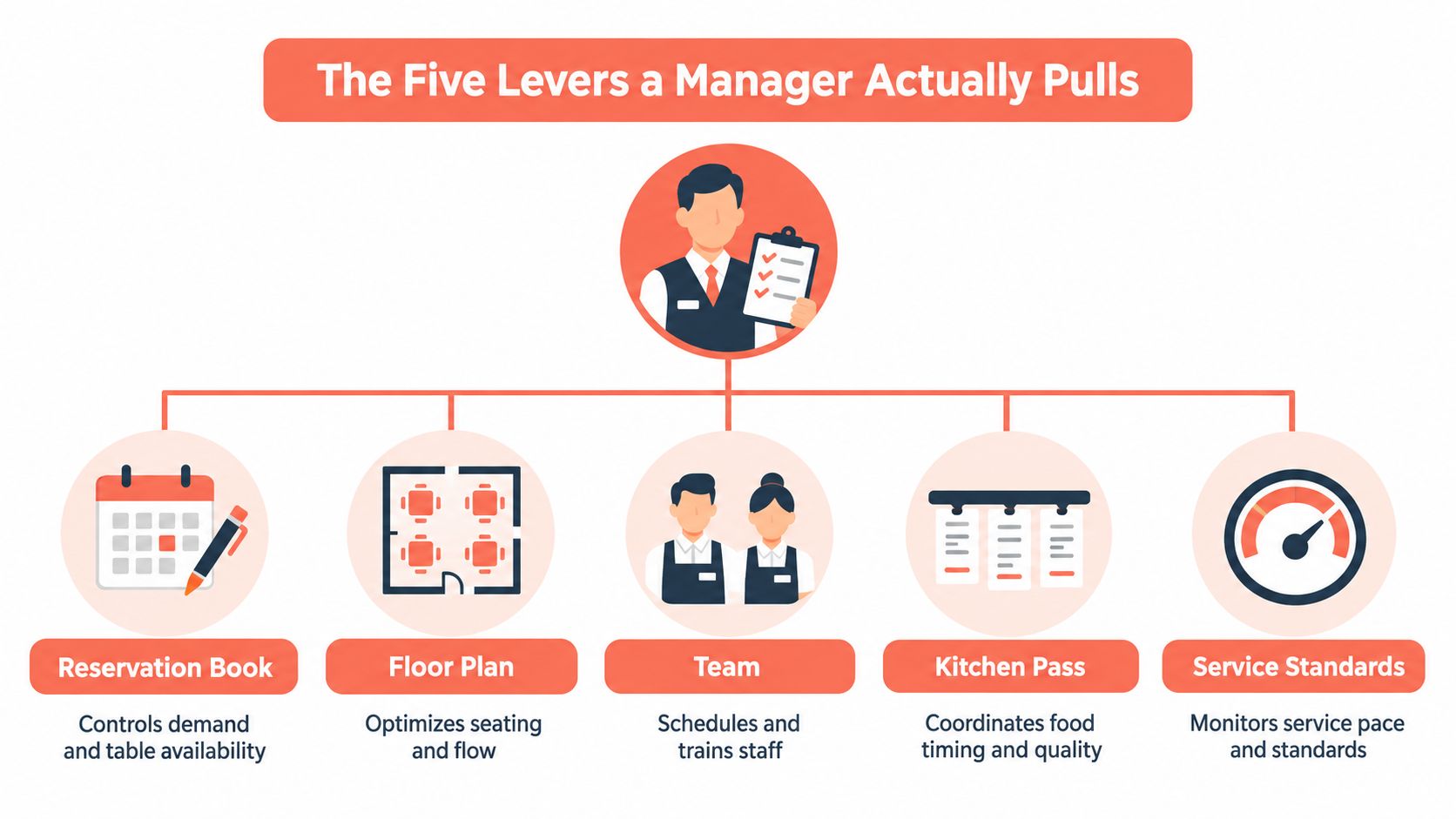
Start with the reservation book, which controls demand and expected arrival patterns. When the book slips, too many parties can land at once; a late cluster of bookings can leave the host stand, kitchen, and bar under pressure together. For example, two large parties booked close together may need separate arrival pacing even if the dining room has enough seats.
Next is the floor plan, which turns available seats into usable capacity. When it slips, the team may have empty seats that can't be combined efficiently or tables assigned in a way that blocks service flow. A two-top placed beside a server station may work on a quiet lunch, but a different table mix may be better during a busy dinner.
The team controls labor and role coverage. If it's short or poorly positioned, one station can fall behind while another has capacity to spare. A manager who sees the pass stacking up can move a trained team member to support the bottleneck instead of asking everyone to work faster.
The kitchen pass controls throughput, timing, and the final quality check. When it slips, dishes leave in the wrong sequence, remakes multiply, and the dining room has to explain delays it didn't create. The money is the scoreboard: it shows whether the shift's sales justified the labor, food, and recovery costs. A packed room isn't a win if execution turns it into waste and avoidable comps.
| Lever | What it controls | Early warning sign |
|---|---|---|
| Reservation book | Demand and table availability | Arrivals cluster beyond service capacity |
| Floor plan | Seating and movement through the room | Open seats can't be used efficiently |
| Team | Labor coverage and role execution | A station falls behind while others have capacity |
| Kitchen pass | Food timing and quality | Tickets stack up or remakes increase |
| Money | Sales against operating costs | More volume doesn't improve the shift's result |
For managers reviewing how point-of-sale tools fit into this picture, this overview of top POS options for restaurants can help frame the comparison around actual service needs rather than feature lists.
Labor, Turns, and the Hidden Math of the Dining Room
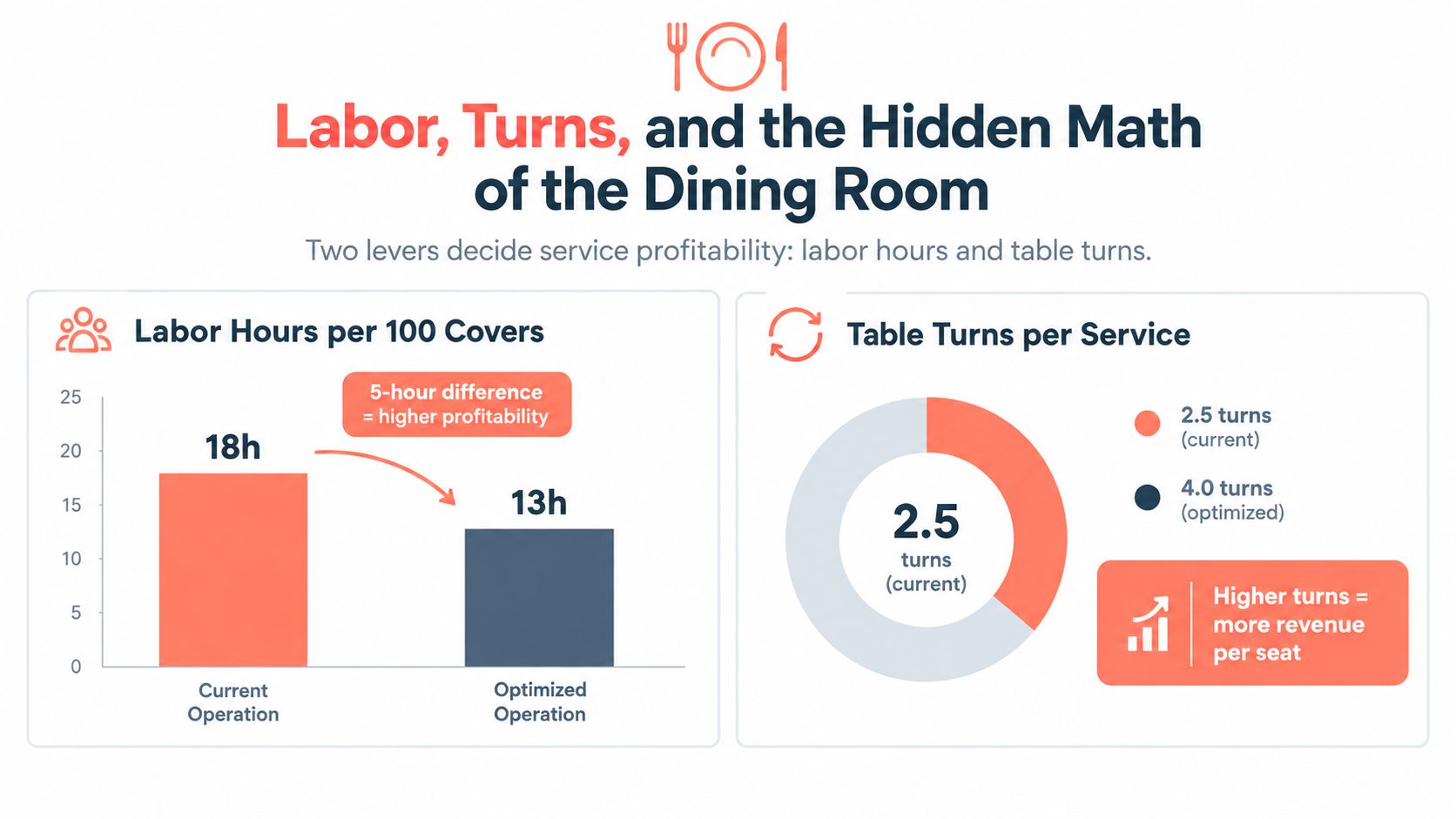
Two restaurants can serve the same number of covers and bring in similar revenue while using very different amounts of labor. One practical comparison is labor hours per 100 covers: an operation using 18 hours against one using 13 hours has a five-hour difference to investigate. That gap might come from training, layout, menu complexity, equipment, or how the team deploys labor, so it shouldn't be treated as proof that one operation needs fewer people (CDC-hosted restaurant performance material).
The same caution applies to ticket times. A daily average can look acceptable while the dinner rush is dragging. Track service in 15- or 30-minute intervals so the manager can see whether the kitchen keeps pace with the demand arriving at each point in the shift.
What to record during the shift
Use a clipboard or tablet to record orders released, orders completed, average and 90th-percentile ticket time, labor hours, remakes, and bottleneck-station utilization. The 90th percentile helps reveal the slow tail of service that an average can hide. If the pass is moving well but one constrained station keeps falling behind, the problem may be sequencing or station capacity, not the number of seats.
Table turns belong in the same conversation, but faster turns aren't always better. If a table is turned before guests are ready, the restaurant may save time and lose trust. The point is to reduce avoidable idle time while protecting the service pace the menu and team can deliver.
Before changing staffing or workflow, establish a two-to-four-week baseline. Then test one intervention at a time: resequence prep, simplify a constrained item, or move labor toward the bottleneck. A basic introduction to what a labour system is can help clarify the role of scheduling and labor records, but the useful management question remains specific: what does the team need at this station during this interval? For practical ways to review staffing costs alongside shift output, see how to reduce labor costs.
Reservations, No-Shows, and Why Commission Models Matter
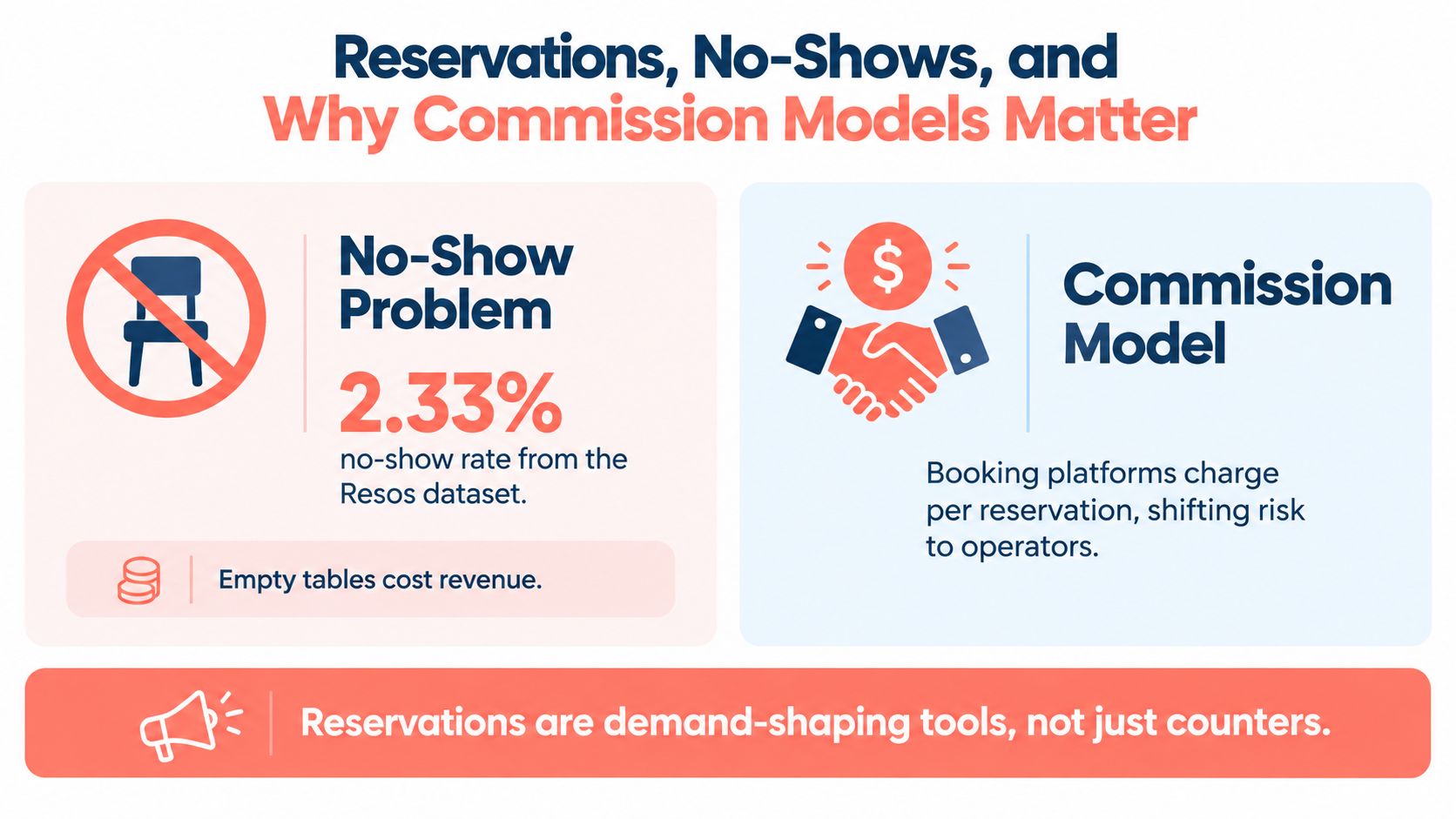
A reservation book is a way to shape demand, not just count bookings. The manager needs to know when parties will arrive, which tables they fit, and how much of the kitchen's capacity they'll use at once. If online bookings land without regard to table configuration or pacing, the room can look full while the pass falls behind.
Resos reports an average 2.33% no-show rate across 3.77 million advance reservations at 2,417 restaurants between August 2025 and July 2026. Reservations with no-show protection recorded a 0.80% no-show rate, compared with 2.47% for reservations without it, a 1.67 percentage-point gap and roughly a 68% relative reduction against the unprotected rate (Resos reservation no-show data). For a restaurant with 1,000 advance bookings, that difference represents roughly 17 fewer no-shows, before considering party size or the value of the tables that become available.
Match the booking model to the economics
A per-cover commission changes the cost of filling the room because the restaurant pays more as covers arrive through that channel. For an independent venue, that cost should be weighed against the value of the booking and the capacity it uses. TheFork, OpenTable, Zenchef, and Formitable can be compared on their pricing models and fit for the restaurant's booking mix, without assuming that one model suits every venue.
A commission-free alternative changes the calculation by separating the reservation tool's cost from the number of guests seated. 10seat offers reservation and table management with live table status and booking allocation; the 10seat product overview lays out how those functions can support pacing and floor decisions. For a closer look at how per-cover fees affect the operator's margin, see the real cost of per-cover commission.
The operational move is straightforward: set a no-show protection policy where it fits the guest experience, map online bookings to specific tables, and manage pacing yourself. The booking channel should not decide the shape of service.
Why the Best Managers Sometimes Leave Tables Empty
Filling every seat can be the wrong call when labor and recruiting costs make the extra service unprofitable. In a 2025 survey, 89% of restaurant operators reported higher labor costs and 73% expected them to keep rising. Among operators facing labor and recruiting-cost pressure, 65% responded by operating below full capacity, while 19% reduced operating hours (Restaurant365's 2025 midyear industry report).
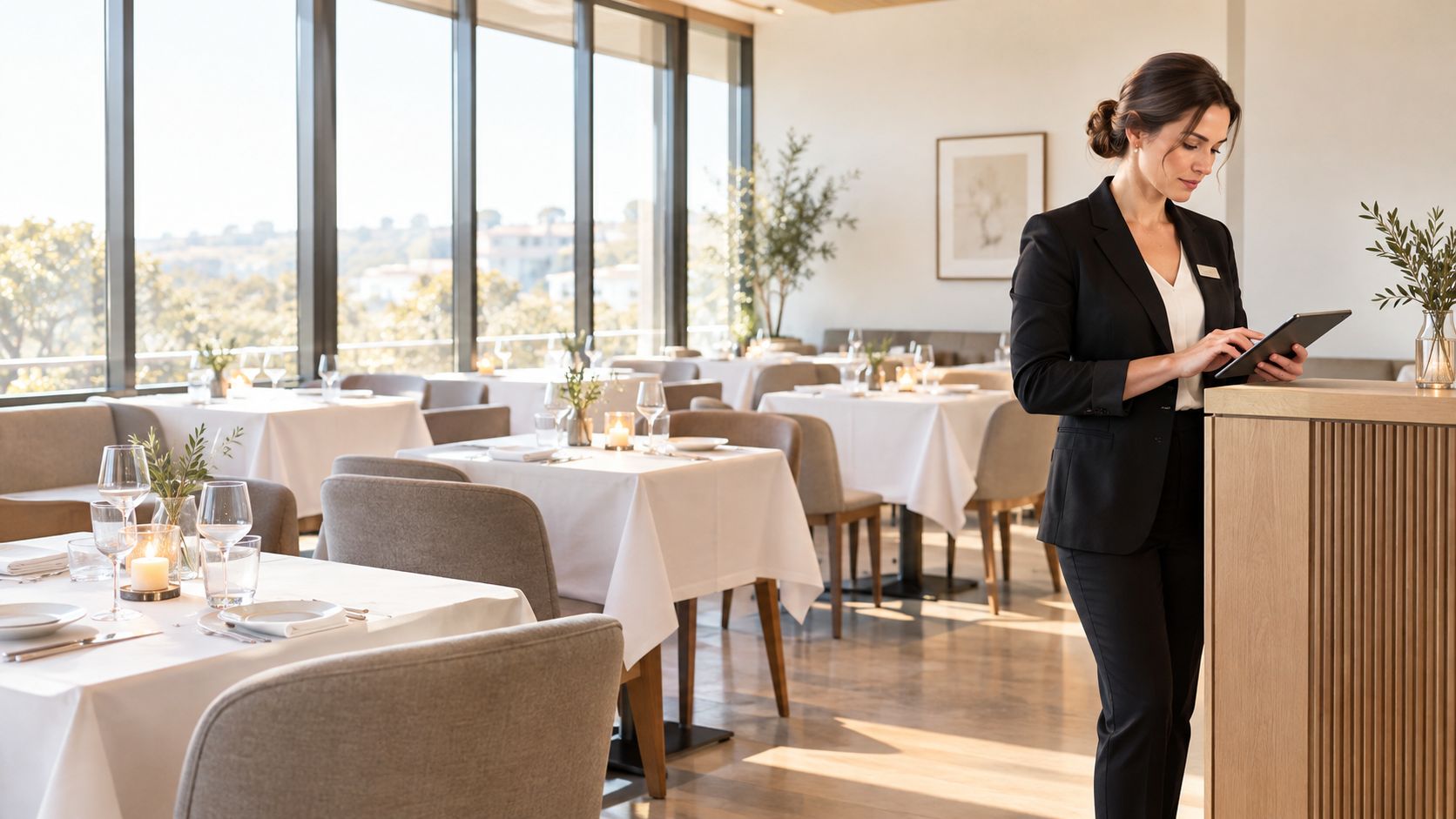
The decision isn't whether the dining room has an empty table. It's whether opening that table creates positive contribution after the extra labor, food, and potential service-recovery costs. A manager can make the call by checking demand by time slot, expected check average, staff availability, the kitchen bottleneck, likely table duration, and the marginal cost of opening another section.
Choose the service shape, not just the seat count
Consider a Friday at 19:30. The book looks full, the kitchen is already at 90% of pass capacity, and an additional booking could push ticket time to 40 minutes and trigger remakes. Those figures are a scenario for decision-making, not an industry benchmark. In that situation, holding two tables for higher-check walk-ins may protect the kitchen and the guest experience better than taking every booking.
A reservation system with capacity controls and table allocation can help a manager set availability around the floor's actual shape, rather than treat every open seat as an instruction to accept another party. The choice still belongs to the operator: the tool should make pacing and table fit easier to manage, not override the kitchen's limits.
The test is contribution, not occupancy. A cover that creates more recovery cost than contribution doesn't earn its place, even when a table is empty.
Food Cost Without Breaking the Menu Promise
Food inflation puts pressure on purchasing, but blanket cuts can damage the reason guests chose the restaurant. In a 2025 operator survey, 52% ranked food inflation as their primary challenge, compared with 31% for labor costs, and 86% put food inflation among their top concerns. 91% reported higher food costs and 90% expected costs to continue rising (FSR reporting on food inflation and restaurant operators).
The practical response is to review menu items by guest visibility, substitutability, perishability, and importance to the menu. That makes it possible to protect the dishes that define the restaurant while adjusting less visible cost drivers.
Change selectively, not across the board
- Protect signature items: Keep the ingredients and execution that guests associate with the restaurant. If a core dish needs a change, test whether the new version still delivers the promise before changing the menu.
- Redesign low-margin garnishes: A garnish can add prep time and waste without changing what guests value about the plate. Simplify it when the effect on the dish is small.
- Plan cross-utilized ingredients across dayparts: Use shared ingredients where they fit naturally, while keeping prep lists and storage clear enough to prevent confusion.
- Use controlled specials: A special can accommodate a temporary supplier change without rewriting the full menu. Make the change clear to staff so they can explain it accurately, including any allergen implications.
Food safety is part of this cost decision. For cooked time/temperature-control-for-safety foods, managers should cool from 135°F (57°C) to 70°F (21°C) within 2 hours, then to 41°F (5°C) or below within 4 additional hours, for a 6-hour maximum (FDA cooling guidance). A CDC-supported field study found that only about 65% of observed cooling events were estimated to meet the six-hour guideline, which makes clear batch ownership and temperature checks important.
Portion hot food into shallow containers, leave room for airflow, and assign someone to record temperature at checkpoints. For help connecting purchasing changes to margin rather than treating food cost as an isolated figure, see how Bookkeeping and Accounting of Florida approaches gross-margin improvement. Ingredient choices affect prep labor, waste, allergen communication, and contribution margin as well as the cost percentage on a report.
Belgian Operations and the GKS Rule You Cannot Skip
In Belgium, a Geregistreerd Kassasysteem (GKS) is required when annual turnover from restaurant and catering services exceeds €25,000 excluding VAT. The threshold calculation excludes drinks and takeaway meals. Businesses within scope must issue a VAT receipt through the registered system, which records the transactions entered into the cash register (Belgian GKS guidance).
Keep reservation management and fiscal receipts operationally separate. The reservation system manages who is expected, where a party can sit, and how the room is paced. The final sale must still pass through a compliant GKS process; a booking record isn't a fiscal receipt.
The GKS 2.0 framework is being extended from July 2025 to more businesses that sell products or services on-site and accept cash payments. The updated requirement calls for a professional registered cash system compatible with the Blackbox 2.0 fiscal module (GKS 2.0 information). Don't assume a reservation platform or standard point-of-sale setup meets that obligation. Ask the cash-register supplier whether the existing system can support the required integration.
This week: Confirm whether the threshold applies to your turnover mix, ask your supplier about GKS 2.0 compatibility, and keep booking data distinct from fiscal records.
For another practical consideration when reviewing restaurant receipts and tax handling, see this guide to VAT on food.
Putting the Levers Together This Week
A one-page shift plan is enough to start. Choose one service metric to record by 15-minute interval, sort menu items into the four categories above, set a no-show protection rule, and write down which shifts or sections should run at limited capacity. If the restaurant operates in Belgium, confirm its GKS status with the cash-register supplier.
Then choose a reservation and floor-management setup that supports the service the kitchen can deliver. For independent restaurants considering a commission-free platform, review 10seat pricing against the booking model and floor controls the operation needs.
The goal of managing a restaurant isn't to be busy. It's to make every shift a service the manager would book for themself.
10seat provides commission-free reservation and table management for independent restaurants, with tools for booking allocation, live floor management, and pacing. Visit 10Seat to see whether its setup fits the way your restaurant manages service.