I Own a Restaurant: Key Responsibilities and Decisions
I own a restaurant and need to know what to run first? Here are the five decisions that set your covers, costs and service.
Ask an owner how business is going, and the answer often comes as a story about covers, complaints and rising costs. Ask for a number, and the story can stop. That gap between the problem an owner feels and the one they measure is where margin leaks.
The old claim that nine in ten restaurants fail in their first year sets the wrong expectation. The U.S. Bureau of Labor Statistics reports that 59.3% of accommodation and food-service establishments opened in March 2020 were still operating five years later. Staying open is common; the harder task is turning the room's capacity into profit.
Say “I own a restaurant” to a supplier and the conversation may turn to prices. For an owner, the useful questions are measurable: how many covers did you seat, how quickly did tables turn, how many labour hours did you pay for, how much food went to waste, and what did each cover contribute? Choose one figure to check this week, then connect it to the cost or capacity decision it can change.
Table of Contents
- The Five Decisions Every Restaurant Owner Manages
- Reservations and No-Shows That Cost You Covers
- Table Turns and Seating Choices That Add Covers
- Staffing the Floor and Kitchen Without Overstaffing
- Controlling Food Cost and Waste
- Belgian GKS Compliance for Your Cash Register
- Pick One Fix and Measure It This Month
The Five Decisions Every Restaurant Owner Manages
Owning a restaurant is less about the cooking than about five linked decisions. How many guests you book. How fast each table turns. How many people you put on the rota. How much food you buy and then bin. What you charge for each cover. None of these sits in isolation, and moving one always moves another.
A full book with a short-staffed kitchen loses covers exactly the way an empty room does. A menu priced against last year's food cost gives away margin on every plate. The pressure arrives from both directions, and the Popmenu State of the Plate 2025 survey puts numbers on it: 85% of operators said they were competing more fiercely for every guest, 82% were actively reducing expenses, more than 70% named food costs as a challenge and the mid-50% named labour.
| Responsibility | Decision you own | Metric to check each week |
|---|---|---|
| Reservations | Booking limits, party sizes and deposits | Booked versus seated covers |
| Table turns | Seat time and table assignment | Turns per table per service |
| Staffing | Shift levels matched to forecast covers | Labour cost as a percentage of sales |
| Food cost and waste | Purchasing, prep and portioning | Waste cost as a percentage of food sales |
| Pricing and margin | Menu prices and dish mix | Average check and contribution per cover |
Most owners can name all five problems without hesitating. Very few can put a number on them. A 30-minute review at the same time every week, five figures on one sheet, is enough to see exactly where covers and margin leak.
One cost that hides inside the food line is pest activity. Dry stores, dish pits and waste areas are where rodents and cockroaches establish themselves, and the guidance on IPM for Southeast Texas restaurants sets out the inspection and monitoring routine that stops an infestation becoming a stock write-off. Treat it the way you treat the waste log: a fixed weekly check, not a panic call.
Start with the row where a number already looks wrong to you. The rest of this guide takes the rows one at a time, beginning with reservations, the point where a seat is first lost.
Reservations and No-Shows That Cost You Covers
The most expensive seat in your dining room is the one that was booked and never filled, because you already paid for the staff and the mise en place.
A Bloom Intelligence analysis of reservation data found that 3.7% of advance reservations ended in no-shows and another 15% were cancelled, which means 18.7% of booked tables never seated a guest. Across the same dataset, more than 23,000 no-shows represented about $3.9 million in missed bookings at an average seated reservation value of roughly $165.
Put that against your own book. Cutting no-shows by one percentage point across 1,000 monthly reservations recovers around 10 covers, and at a $165 average check that's roughly $1,650 a month before food and labour costs. That's one point, not a transformation.
Practical rule: those figures come from one reservation and POS-linked commercial dataset. They're an operating benchmark, not an industry law. Measure your own no-show rate for four weeks before you set a target, or you'll be fixing a number that isn't yours.
The five-step booking routine
- Take a deposit for large parties and peak weekend slots, so a booking carries a cost for the guest who breaks it.
- Send a confirmation message 24 hours ahead asking the guest to confirm or cancel, which converts silent drift into a decision you can act on.
- Publish a cancellation window and hold to it, because a rule nobody enforces teaches guests that bookings are optional.
- Release unconfirmed tables 30 minutes before service and let the waitlist take them.
- Cap party sizes at the busiest times so one large booking doesn't block two smaller, higher-value tables.
Here's how the reminder and deposit side looks in practice, from booking to seated table.
Then run a 20-minute booking review every week and split no-shows and cancellations by daypart. Friday dinner and Sunday brunch usually fail for different reasons, and only the split tells you which one to fix. For message wording and timing, this guide to how to reduce no-show rates covers the scripts.
Table Turns and Seating Choices That Add Covers
Capacity is limited by seat time at peak, not by the number of rectangles on your floor plan. A room can look full at 20:00 and still be underused for the hour that matters most.
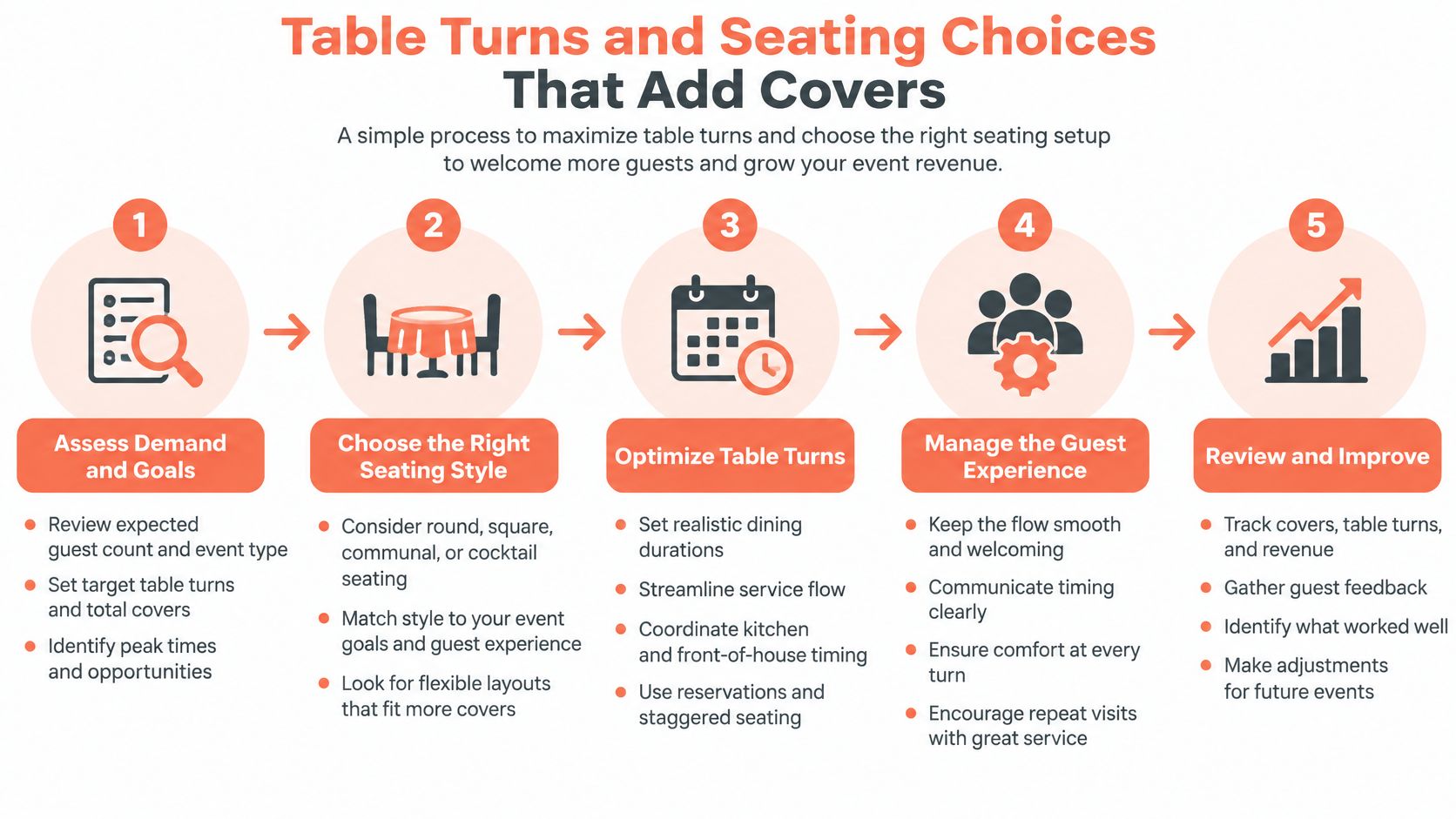
Turn targets have to match what you're selling. The Metrobi guide to table turnover puts fine dining at about 1 to 1.5 turns per dinner and faster full-service formats at about 2 to 3, and the gap is course pacing, not effort.
| Service format | Typical turns per dinner | What usually limits turns |
|---|---|---|
| Fine dining | About 1 to 1.5 | Course pacing and long seat time |
| Faster full-service format | About 2 to 3 | Kitchen throughput and table reset speed |
How to calculate turns per daypart
Calculate turns separately for each service as parties served divided by available tables. A worked example from the same analysis shows why the average lies: a 20-table dining room serving 90 parties over a four-hour dinner produces 4.5 turns per table, and that single figure can hide a severe bottleneck between 19:30 and 20:30. Your own number may look healthy while one hour carries all the damage.
The stages to time
Track each stage, not the whole meal. Reservation arrival to seating. Seated to order taken. Order to food served. Food finished to payment. Payment to table reset. Compare the actual cycle with the service model you think you're running.
Shortening every guest's meal is the wrong fix, and guests notice it before the numbers do. Remove the idle gaps between stages and keep the experience where it is.
Match party sizes to efficient table combinations, protect kitchen pacing, and release tables on a predictable schedule rather than when a server gets a moment. If you only measure one thing this week, measure the gap between payment and table reset. It's usually the cheapest minute in the building to recover.
Staffing the Floor and Kitchen Without Overstaffing
Labour is your least flexible cost once the shift has started, and it is rising for most operators: in Restaurant365's midyear industry survey, 89% of operators reported that labour costs had increased. The rota should follow booked covers, not habit or last month's schedule.
Build the rota from booked covers
- Pull booked covers for every service in the coming week from the reservation book.
- Convert covers into tables and seats using the average seat time for each daypart.
- Set server and cook levels by covers band so staffing follows a clear rule.
- Assign one flexible person to the busiest service, ready to work where the queue forms.
- Review actual covers on Monday and adjust the next rota to match what happened.
For example, a Saturday with 120 booked covers across two seatings of 60 might call for four servers, two cooks on the line and one flexible person. If bookings fall to 80, the second seating has only 20 covers. Dropping one server and moving one cook to prep can reduce scheduled hours, while keeping the flexible person on call protects service if demand shifts. Check the Monday review for signs that the lower staffing level slowed service or cost covers.
The trade-off is straightforward: fewer scheduled hours can reduce labour cost, but too few people can slow service and put pressure on the team. Set a minimum crew for peak periods, then adjust the remaining shifts to booked demand. A covers-based rota is easier to review when reservations and staffing assumptions are recorded together. See the guide to reducing restaurant labour costs for more on setting covers bands.
After each shift, compare scheduled staffing with booked and actual covers. Did the rota match the demand you had? Check that against hours worked before changing next week's schedule.
Controlling Food Cost and Waste
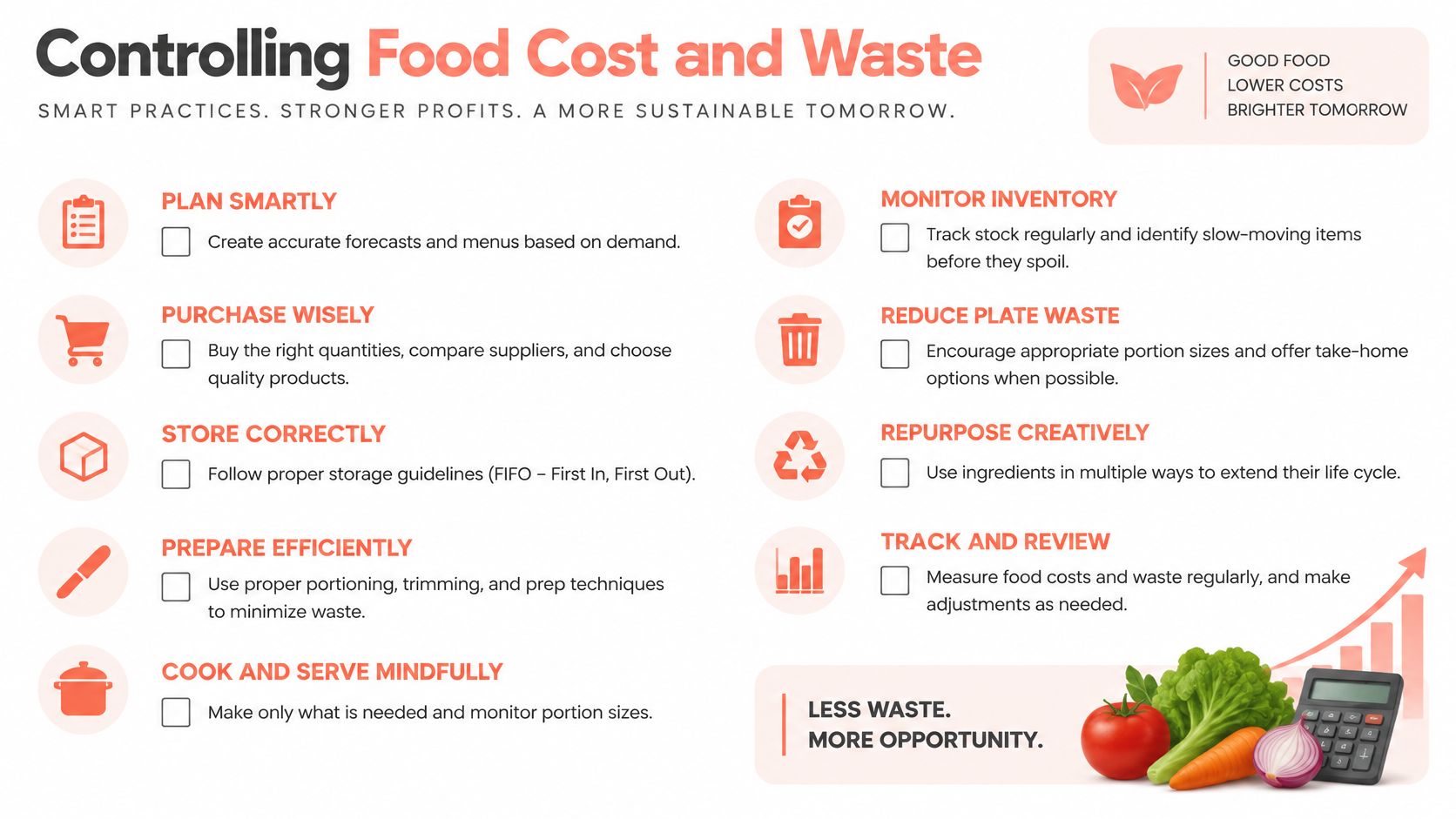
Waste control is a profit program, not a sustainability gesture. A cross-country analysis of 114 restaurants published by Champions 12.3 found participating sites cut kitchen food waste by an average of 26% within one year, with a return of about $7 for every $1 invested. Implementation costs averaged just 0.4% of annual food sales, and the programs saved more than two cents per dollar of cost of goods sold.
The waste log that pays for itself
- Record every discard with ingredient, weight or cost, cause and station.
- Review the log every Monday against covers and sales mix so patterns show up.
- Adjust par levels and batch sizes for the dishes that waste most.
- Set tomorrow's prep from the booking forecast, preparing for expected party volume rather than an average night.
- Apply first in, first out to every delivery, and check that the oldest stock is at the front where staff reach.
The log takes about five minutes per service once the team knows the categories. Don't cut prep so hard that you turn guests away at peak. Availability is revenue you're protecting, and a sold-out dish at 20:30 costs more than a portion of trim.
Rank dishes by contribution, not popularity
Calculate contribution per cover as average check minus food and beverage cost per cover, then sort the menu by that figure instead of by units sold. A dish selling 30 times a week at a €4 contribution adds €120; a dish selling 60 times a week at €1 adds €60. The popular one is the weaker earner.
Review prices after each waste cycle rather than once a year, and test one change for two weeks before rolling it out. Fuel belongs on the same cost sheet, so if you're renegotiating supply or adding patio heaters for the shoulder season, find a commercial propane supplier who quotes against your consumption and not per cylinder. For the purchasing side of the log, the restaurant inventory management guide covers par levels and ordering rhythms.
Belgian GKS Compliance for Your Cash Register
If you run a restaurant in Belgium, a GKS (Geregistreerd Kassasysteem) becomes mandatory once annual turnover from restaurant and catering services exceeds €25,000, excluding VAT, as Viseeon's hospitality accounting guidance sets out. The threshold counts meals eaten on the premises and catering services. It excludes drinks, takeaway meals and ordinary food sales, so track dine-in and catering turnover separately from your drinks and takeaway revenue.
Cross the threshold and the transactions covered by the rule must run through the registered system, with a GKS receipt issued for each. The setup is more than an ordinary terminal: according to UniPage's GKS documentation, it requires a certified cash register, a fiscal data module and a personal VAT signing card, recording transactions in a fraud-resistant format for the tax administration.
Check your cash workflow, receipt process and staff permissions against that architecture before you cross the line, not after. Review qualifying turnover every month so the switch happens on time.
Pick One Fix and Measure It This Month
Which number from the first table looks worst? Record a two-week baseline before changing anything. Without it, a good weekend can look like a fix.
Change one thing and measure for two weeks. Keep it only if the number improves. Start with a low-cost test, such as a deposit rule, a clear cancellation window or a Monday staffing review. Check the result against the same measure you recorded this week.
10Seat can help if bookings or seating are the bottleneck. Most restaurants are up and running within 24 hours, and the free plan covers up to 50 covers per month; after that, a paid plan is required to keep taking reservations. Restaurants using 10Seat see 30% more reservations, 40% fewer no-shows and 10-15% more covers per shift. These are reported results, not guaranteed outcomes, so compare them with your own baseline. See the 10Seat pricing page for plan details.
If your booking log shows tables that went unfilled, track that measure over the next four weeks. Review 10Seat and set up a booking page before your next weekend service.