Hospitality Booking Software: A Practical 2026 Buyer's Guide
Compare hospitality booking software in 2026. Pricing models, features, and clear recommendations for restaurants, bars, and multi-location operators.
In 2026, the average recorded restaurant no-show rate is 2.33%, and the right platform can recover meaningful revenue by reducing it. That figure makes hospitality booking software a revenue-control decision, not merely an online calendar purchase.
A reservation platform earns its place when it helps a restaurant seat the right table, protect the kitchen's pacing, recognize returning guests, and recover cancelled demand without adding work at the host stand. The strongest buying question is simple: what does the software cost per seated cover, and how quickly does it improve service control?
The online restaurant reservation system market is estimated at USD 2.68 billion in 2026 and projected to reach USD 6.46 billion by 2035, at a projected compound annual growth rate of 10.3%. Cloud deployments represent about 61% of the market, compared with roughly 39% for on-premises systems, according to market data on online restaurant reservation systems. For an independent restaurant, that growth matters only if the chosen platform fits the floor plan and produces a defensible cost per seated guest.
| Platform type | Commercial model | Operational strength | Main risk |
|---|---|---|---|
| Flat-fee system | Monthly subscription | Predictable budgeting and direct ownership | May offer less marketplace reach |
| Per-cover system | Fee linked to bookings or seated guests | Can reduce upfront commitment | Cost rises with volume |
| Marketplace platform | Commission, subscription, or both | Consumer discovery and network demand | Margin and guest ownership require close review |
| Enterprise hospitality platform | Higher subscription or tailored pricing | Multi-property data and advanced guest tools | Complexity can exceed an independent operator's needs |
Table of Contents
- Why Hospitality Booking Software Is Now an Operations Layer
- Core Features Every Operator Should Evaluate
- Comparing OpenTable, Resy, SevenRooms, TheFork, Zenchef, Formitable, and 10seat
- Pricing Models and Total Cost per Seated Cover
- Implementation Timeline and Time to Value
- Best Fit by Hospitality Format
- Clear Recommendations by Operator Type
- Buyer Checklist and Belgian Compliance Notes
Why Hospitality Booking Software Is Now an Operations Layer
Friday service starts before the first table sits down. The host has a walk-in couple waiting by the bar, a six-top celebrating an anniversary, a VIP who emailed the chef directly, and a group that has already moved its reservation three times.
A basic guest list can record those names. It can't tell the host whether the six-top should occupy a flexible combination of smaller tables, whether the VIP needs a quiet corner, or whether the delayed group has created a gap that can be filled without damaging the next turn. A useful platform connects those decisions to the floor plan through drag-and-drop table mapping, live availability, and seating rules.
The host needs more than confirmation emails. An automated waitlist can capture the walk-in couple, rank parties by fit, and alert them when a suitable table opens. A guest profile can show the anniversary note and seating preference without forcing the manager to search through old messages. Real-time channel synchronisation prevents a website, booking link, social profile, and partner channel from selling the same inventory twice.
The floor plan becomes the operating model
During service, table configuration affects server sections, course pacing, prep forecasts, and the number of covers the kitchen can absorb at a given time. A floor-plan-first system lets a manager protect a large table for the right party, hold a seat for a late arrival, or combine tables without relying on memory and handwritten notes.
The practical value is control. The system should show what can be seated now, what can be seated after a planned turn, and which booking would create pressure on the pass. This is why a reservation platform belongs beside the POS and host stand, not isolated in an office.
Practical rule: If the platform can't explain why a table is available, it isn't giving the floor manager enough control.
The 2.33% average recorded no-show rate reported in the 2026 Resos No-Show Index represents 87,953 recorded no-shows from 3,768,761 reservations across 2,417 restaurants, covering August 2025 through July 2026. The benchmark is documented in the Resos No-Show Index. A missed booking, duplicated reservation, or poorly managed cancellation affects revenue immediately, particularly in a tightly paced dining room.
The wider venue-operations perspective also applies beyond restaurants. Teams evaluating guest journeys, access, and engagement can use this strategic guide to fan experience for a broader view of how digital touchpoints should support live service. The principle is the same: the booking layer should help staff act, not merely store information.
Core Features Every Operator Should Evaluate
A feature list is a poor buying method. Each capability should answer a service problem, and every additional fee should be tested against seated covers, saved labour, and reduced leakage.
Start with the floor plan. The system should support drag-and-drop table changes, combinations, table holds, pacing rules, and clear turn times. A flat guest list fails on a busy night because it ignores the physical constraints of the room.
The next filters are reservation and waitlist control. Look for a single view of online bookings, phone bookings, walk-ins, cancellations, and table status. A waitlist should capture party size, timing, contact permission, and seating fit, then help staff fill an opening without making several calls.
Guest data should stay operational
An independent restaurant doesn't need a sprawling CRM before it needs usable notes. Guest profiles should retain visit history, allergies, preferences, special occasions, and service warnings. Tags matter because a host can act on “quiet table,” “birthday,” or “high chair” immediately, while an attractive database that requires several screens slows service.
Channel distribution is another decision filter. Website booking pages, social links, QR codes, and marketplace inventory must draw from the same availability. Without real-time synchronisation, a successful campaign can create an overbooked section and force the host to solve a software failure in front of guests.
POS and PMS integrations should be tested with actual workflows. The restaurant needs to know whether seated covers, spend, table duration, and guest identity can move between systems without double entry. A hotel restaurant should also confirm how restaurant reservations connect with the property management system, payment records, and guest profile.
Protect revenue before adding complexity
Automated confirmations, reminders, deposits, cancellation policies, and no-show fees should be configurable by service, party size, and demand period. The platform should also support reporting on covers, cancellations, no-shows, table turns, revenue per available seat, and server performance.
The 10seat features overview is a useful reference point for assessing floor management, reservation handling, and walk-in workflows. The important test remains practical: can a manager understand the next seating decision in seconds, and can the system show whether that decision produced profitable service?
Comparing OpenTable, Resy, SevenRooms, TheFork, Zenchef, Formitable, and 10seat
The category has meaningful differences in price structure, distribution, and operating depth. Published 2026 comparisons place restaurant reservation systems from free tiers to roughly USD 899 per month, with flat monthly fees, per-cover fees, and marketplace commissions all in use. Examples include OpenTable at USD 39 to 449 per month plus USD 0.25 to 1.00 or more per cover, Resy at USD 289 to 459 per month with no per-cover fee, and SevenRooms at USD 500 or more per month for enterprise and hotel groups, as reported in this restaurant reservation system comparison guide.
The table separates known commercial structures from areas that require a live demo. Not every platform publishes identical terms for every market, and operators should request a written quote based on their own channels and cover volume.
Hospitality Booking Software Platform Comparison (2026)
| Platform | Pricing Model | Channel Model | Floor-Plan Depth | Guest Profiles | Best Fit |
|---|---|---|---|---|---|
| OpenTable | Subscription plus per-cover charges in cited comparisons | Large consumer marketplace and direct channels | Confirm configuration depth by venue | Guest information and booking history, verify scope | Restaurants that value network discovery |
| Resy | Published comparison pricing of USD 289 to 459 per month, no per-cover fee | Consumer network and direct booking | Strong reservation workflow, verify table-rule detail | Guest tools, verify required profile fields | Venues seeking consumer pull with subscription pricing |
| SevenRooms | USD 500 or more per month for enterprise and hotel groups in cited comparison | Direct, marketing, and hospitality distribution | Deep operational and multi-property potential | Advanced guest and marketing orientation | Groups and venues needing broader guest operations |
| TheFork | Marketplace-led model, terms vary by agreement | Consumer marketplace and direct channels | Confirm floor-plan and pacing controls | Marketplace-linked guest data, verify ownership | Operators prioritising marketplace demand |
| Zenchef | Subscription structure varies by plan and market | Direct and European channels | Confirm floor-plan depth during demo | Guest notes and history, verify plan limits | European independent restaurants |
| Formitable | Subscription or market-specific commercial structure | Direct booking and European distribution | Confirm table-combination and turn rules | Guest information, verify export and permissions | European restaurants focused on simple booking |
| 10seat | Commission-free reservation management positioning | Direct website, booking link, social, and QR channels | Floor-plan-first reservation and live table management | Preferences, allergies, occasions, and visit context | Benelux independents focused on margin and floor control |
OpenTable and Resy can make sense when consumer network reach fills demand that the restaurant couldn't otherwise capture. Their value should be measured against the cost of each seated cover, not the number of people who discover the venue.
SevenRooms is built for operators that need deeper guest, marketing, and multi-property workflows. That depth can be appropriate for a group, but an independent restaurant should reject modules that staff won't use. TheFork is marketplace-led, so commission exposure and guest-data terms deserve close attention. A comparison such as 10seat versus TheFork helps frame the distinction between demand acquisition and commission-free control.
Zenchef and Formitable suit European operators that want direct booking and regional familiarity, with exact floor-plan and integration depth requiring confirmation for the relevant plan. 10seat is positioned around commission-free reservation management, floor-plan control, and direct channels for independent Benelux restaurants.
Operators assessing booking workflows outside restaurants can also consult this Virtual Tour Easy booking guide for a useful comparison of booking-path design. The same purchasing discipline applies, the customer should complete a booking quickly and staff should retain clean inventory control.
Pricing Models and Total Cost per Seated Cover
Three commercial models dominate the buying decision.
Flat monthly subscriptions provide predictable budgeting. They suit venues with steady demand because the software bill doesn't rise with every seated guest. Per-cover fees reduce the fixed commitment but become more expensive as the dining room fills. Marketplace commissions can generate demand, but the restaurant pays for that demand whenever a booking converts under the platform's terms.
The correct calculation is:
Monthly cost ÷ seated covers = true cost per cover
That formula should include subscription charges, per-cover fees, marketplace commissions, paid placements, SMS bundles, payment costs, deposit-handling fees, and POS integrations. Comparing only the headline subscription hides the actual unit economics.
Pricing Models Compared
| Model | Typical Cost | Fine Dining, 220 covers per night | Brunch, 180 covers per Saturday | Multi-Location, 500 covers per day | Best Fit |
|---|---|---|---|---|---|
| Flat monthly fee | Predictable recurring subscription | Strong when demand is consistent | Strong when Saturday volume is reliable | Strong if pricing stays predictable per location | Established venues protecting margin |
| Per-cover fee | Charge linked to bookings or seated guests | Review carefully as volume rises | Can work during uneven demand | Often difficult to forecast across sites | Seasonal or lower-volume operators |
| Marketplace commission | Commission on marketplace-generated bookings | Worth testing only when incremental demand is clear | Useful when discovery is the constraint | Risky when commission scales across locations | Restaurants buying external demand |
A fine-dining room doing 220 covers per night, a brunch venue peaking at 180 Saturday covers, or a group averaging 500 daily covers should all calculate costs from actual seated demand, not capacity alone. The relevant threshold is the point at which recurring fees become cheaper than paying for every cover. Industry comparisons indicate that flat-fee platforms such as Zenchef and 10seat can become more economical than commission structures once a venue has roughly 40 booked covers per service, but the exact result depends on contract terms, channel mix, and included features.
A no-show guarantee or deposit-handling charge can change the result. If a platform reduces lost seats but adds a fee per protected booking, that charge belongs in the same calculation. The restaurant should ask for scenarios covering direct bookings, marketplace bookings, cancellations, no-shows, SMS use, and integration costs.
10seat pricing details should be compared with each alternative using the same monthly seated-cover assumptions. The strongest commercial model is the one that leaves management with predictable costs and a clear reason for every paid channel.
Implementation Timeline and Time to Value
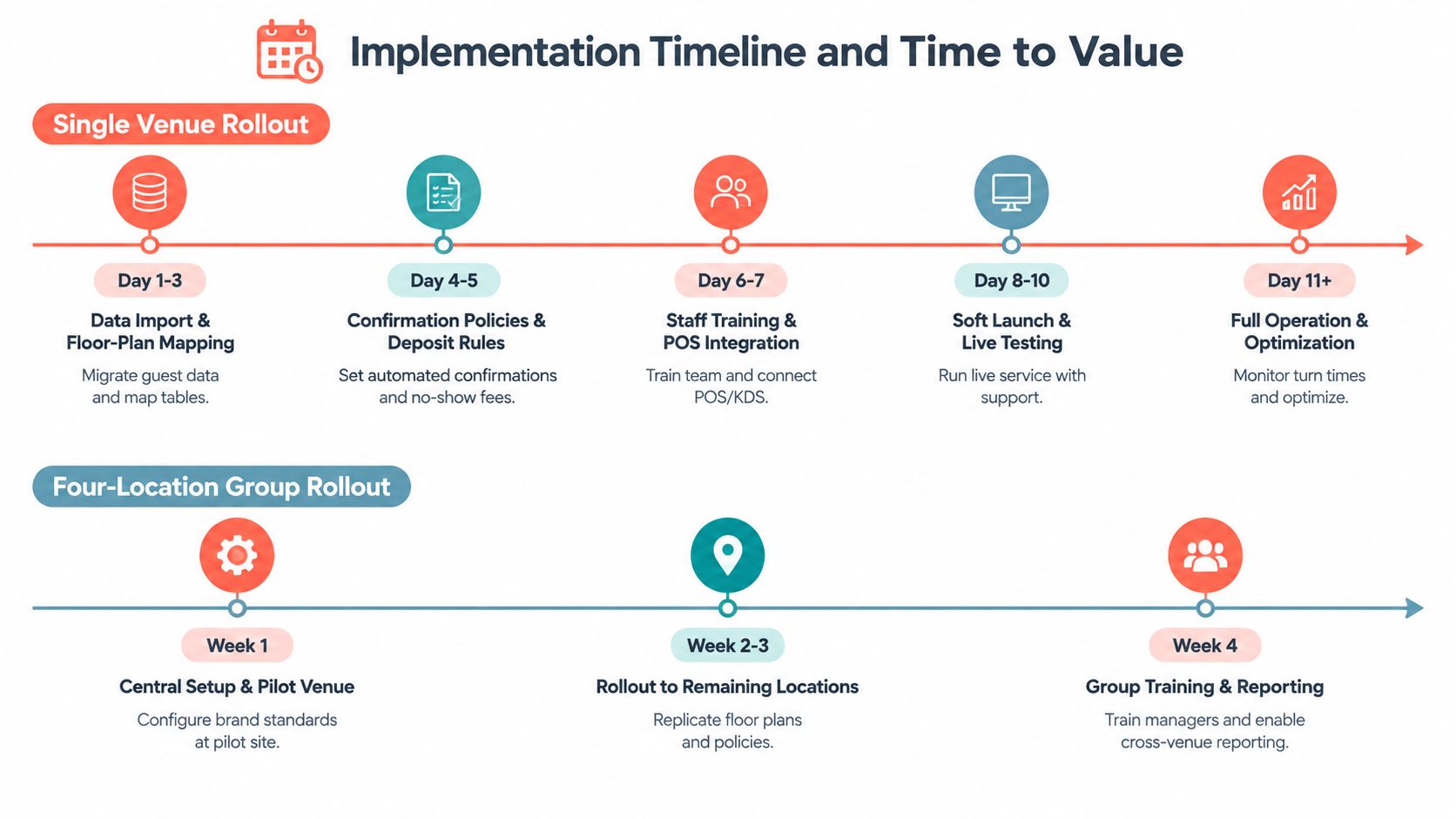
Implementation fails when the team treats it as a software installation rather than a service redesign. A single venue can move quickly if the floor plan, guest data, policies, and integrations are prepared before the first live booking.
Single-location rollout
- Days 1 to 3, data and floor plan: Import guest records, clean duplicates, map tables, define combinations, and set service periods.
- Days 4 to 5, policies: Configure confirmations, deposit rules, cancellation windows, no-show handling, and waitlist permissions.
- Days 6 to 8, training and testing: Train hosts and managers on tablets and the host stand, then test POS connections, booking links, and walk-in entry.
- Days 9 to 10, soft launch: Run live service with manual backups, check table assignments, and record hold-time issues.
- Days 11 to 30, optimisation: Review turn data, seating errors, cancellation recovery, and pacing decisions before changing rules.
Time to value should be defined precisely. It arrives when a manager can pull accurate per-cover revenue by section and use that information to change service decisions.
Four-location rollout
A small group needs standardisation before speed. The first two weeks should establish shared floor-plan templates, naming conventions, role permissions, cancellation policies, and reporting definitions. Weeks three and four can add brand-specific overlays for each venue without losing group-level consistency.
Week five should focus on centralised manager training. Weeks six through eight should use phased go-lives, with weekly revenue audits comparing booking source, seated covers, cancellations, and table performance.
The most common delays are custom API work, legacy POS synchronisation, and guest-profile migration from spreadsheets. Those issues should be assigned an owner and deadline before the contract is signed.
Best Fit by Hospitality Format
The right platform depends on the room, the service rhythm, and the source of demand. A fine-dining operator needs different controls from a brunch venue that fills quickly through walk-ins and social discovery.
Best Platform Fit by Hospitality Format
| Format | Top Picks | Must-Have Features | Nice-to-Have Features | Watch Out For |
|---|---|---|---|---|
| Fine dining | SevenRooms, 10seat, Zenchef | Table-level holds, pacing, VIP tags, deposits, discreet notes | Guest marketing, upsells, advanced segmentation | Paying for network reach that doesn't match the concept |
| Brunch and high-volume casual | Resy, OpenTable, 10seat, Formitable | Fast booking, waitlist automation, SMS confirmations, group seating | Marketplace campaigns, automated promotions | Per-cover costs during peak services |
| Multi-location groups | SevenRooms, 10seat, Zenchef | Central reporting, role-based access, shared guest data, inventory controls | Brand-level overrides and cross-venue marketing | Separate venue setups that create administration |
Fine dining requires table-level control because the room's value lies in pacing and experience, not raw reservation count. The demo should show how staff create holds, protect a quiet table, tag an anniversary, and manage a late party without losing the next seating.
Brunch and casual operators should test booking speed on a phone, waitlist automation, SMS confirmation workflows, and large-party seating. Resy and OpenTable remain relevant where consumer pull matters. A commission-free platform or Formitable may protect margin when the venue already creates its own demand.
Multi-location groups should insist on centralised reporting, role-based permissions, shared inventory rules, and consolidated guest data. SevenRooms and 10seat can suit operators seeking broader multi-property visibility, while separate per-restaurant administration on a marketplace platform can increase management overhead.
Guest engagement tools can extend beyond reservations. A restaurant assessing loyalty, promotions, or QR-led interaction may find BonusQR for restaurants useful as a complementary reference. It should still confirm whether guest data flows cleanly into the reservation and service record.
Clear Recommendations by Operator Type
Fine-dining independents should start with a commission-free, flat-fee structure that supports notes, tags, deposits, and tight floor-plan control. 10seat, SevenRooms, and Zenchef belong on that shortlist for operators whose main goal is to manage their own demand and protect the room's pacing. OpenTable remains defensible when its network reach produces enough incremental seated covers to justify the per-cover cost, but that case should be proven through source-level reporting.
Brunch and high-volume single venues need speed rather than an elaborate guest database. The useful test is whether a host can take a booking, place a walk-in on the waitlist, send a confirmation, and reassign a table without leaving the floor view. 10seat, Resy, and TheFork can fit this profile, while heavier CRM-led systems may add cost without improving the Saturday rush.
Multi-location groups need centralised inventory, role-based permissions, consolidated reporting, and predictable per-location pricing. 10seat, SevenRooms, and Zenchef are more suitable starting points than commission-heavy aggregators when costs must remain forecastable across venues. The group should also verify whether guest records can be shared appropriately while allowing each location to maintain its own floor plan and service rules.
| Operator Type | Top Pick | Strong Alternatives | Key Selection Criteria |
|---|---|---|---|
| Fine-dining independent | 10seat | SevenRooms, Zenchef, OpenTable when network demand pays back | Floor control, deposits, tags, direct-booking ownership |
| Brunch or high-volume single venue | 10seat | Resy, TheFork, Formitable | Fast booking, walk-ins, waitlist speed, peak-service economics |
| Multi-location group | 10seat | SevenRooms, Zenchef, OpenTable | Central reporting, permissions, inventory, predictable pricing |
The commission-free angle matters most when the restaurant already has demand through its website, social channels, QR codes, regular guests, and local reputation. A buyer can review the recommended operating model on the 10seat product page, then compare its monthly cost with the actual seated-cover volume rather than judging software by feature count.
Buyer Checklist and Belgian Compliance Notes
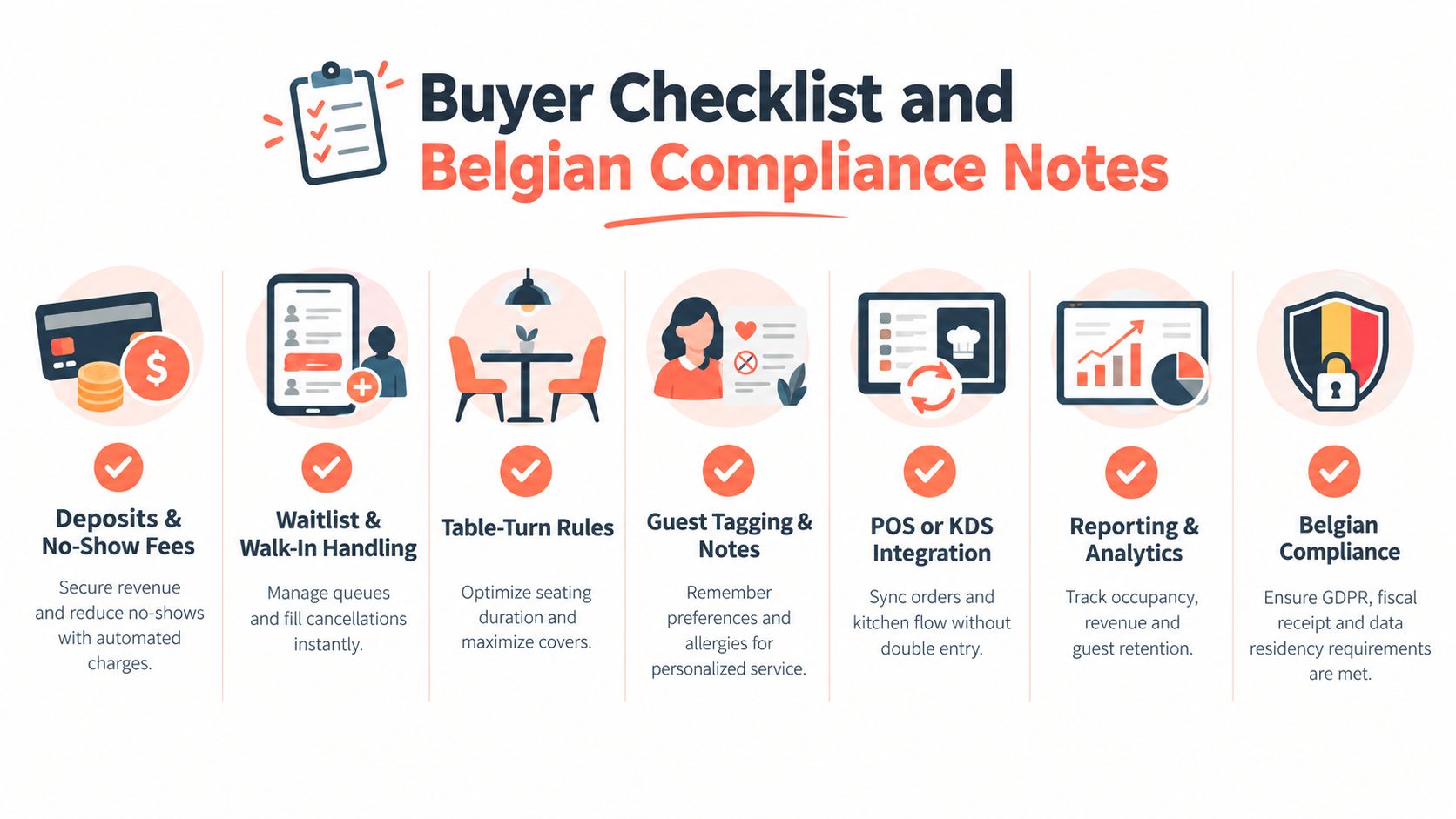
A vendor demo should reproduce a busy service, not a quiet calendar review. The manager should ask the salesperson to demonstrate each of the following with real restaurant scenarios:
- Deposits and no-show fees: Can policies vary by service, party size, or demand period?
- Waitlist and walk-ins: Can staff fill a cancellation quickly and track guests who are already on site?
- Table-turn rules: Can the system protect pacing without blocking every flexible seating option?
- Guest tags and notes: Can staff find allergies, preferences, and occasions at the moment of seating?
- POS or KDS integration: Can covers, spend, and table activity move without duplicate entry?
- Reporting: Can managers review covers, no-shows, revenue per available seat, and section performance?
- Role-based access: Can hosts, managers, and owners see only the controls relevant to their work?
- Mobile management: Can a manager change availability and monitor service from the floor?
Belgian operators should treat the GKS, or Geregistreerd Kassasysteem, as a first-class selection criterion. Belgian guidance says restaurants serving meals on-site and exceeding €25,000 in annual restaurant and catering turnover, excluding drinks and VAT, must issue fiscal receipts through a registered cash register system, while businesses below that threshold don't have to use GKS for the restaurant and catering portion. Take-away-only operations without on-site meal service fall outside that obligation, according to Belgian GKS guidance.
The rule expanded from July 2025 to businesses where products or services are sold on-site and cash payments are accepted, as described by the official GKS 2.0 information site. The booking platform should support certified black-box logging, signed event-journal exports, and fiscal-module compatibility where required. Several global platforms may not provide those functions natively, so each vendor must confirm compatibility and provide the certification certificate date before contract signing.
10seat offers commission-free reservation management for independent restaurants in the Benelux, with online booking, live floor control, guest profiles, and walk-in handling in one workflow. Visit 10Seat to compare the product with the restaurant's actual floor plan, seated-cover volume, and Belgian compliance requirements before choosing a platform.