Best Restaurant Reservation App: 7 Top Picks
Compare the best restaurant reservation app options for seating, waitlists, pricing, and venue fit, with practical advice for choosing and implementing one.
A busy service can expose the weaknesses in a reservation system within minutes. The book looks full, but the available tables don't line up with party sizes. A walk-in queue grows beside a dining room with short gaps, while the host manually decides whether moving one party will create a better layout or a kitchen bottleneck. Confirmations, cancellations, and no-show disputes add more work after the doors open.
The best restaurant reservation app depends on the problem limiting the venue. That may be floor-plan yield, marketplace demand, waitlist control, first-party guest data, prepaid experiences, or POS integration. The comparison below weighs seating optimization, waitlist and messaging tools, pricing models, venue fit, implementation effort, and ownership of guest relationships.
10seat reports 10–15% more covers on busy shifts without adding tables. Operators should validate that opportunity against their own cover count, table mix, pacing rules, and service pattern. Belgian restaurants also need to assess how reservation and payment workflows interact with GKS compliance, because a booking platform doesn't replace kassasysteem obligations.
Table of Contents
- 1. 10seat
- 2. OpenTable for Restaurants
- 3. Resy
- 4. SevenRooms
- 5. Tock
- 6. Yelp Guest Manager
- 7. SpotOn Reserve
- Top 7 Restaurant Reservation Apps, Feature Comparison
- Choose the App That Fixes Your Costliest Bottleneck
1. 10seat
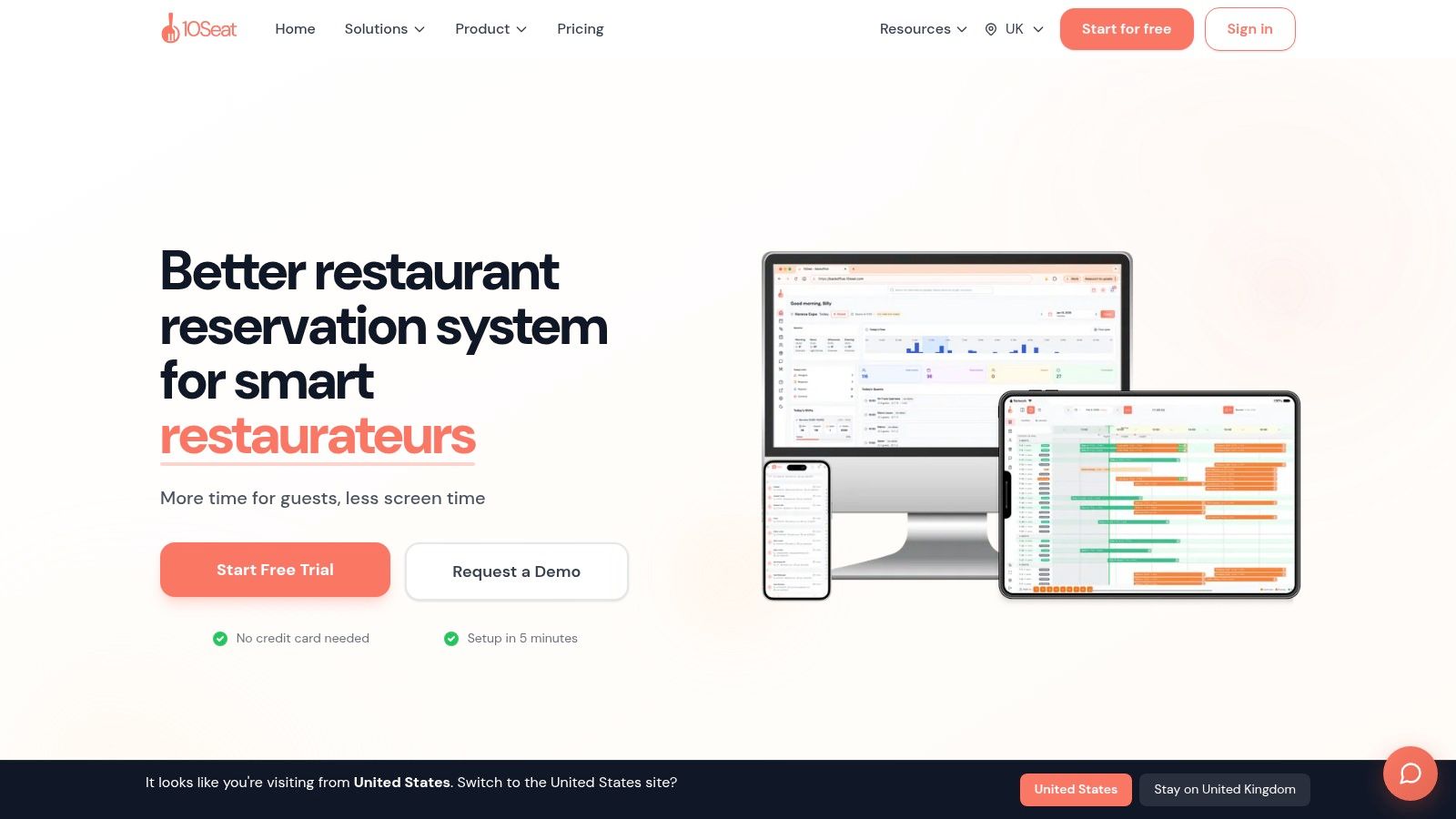
10seat targets a specific service problem: fitting more covers into the existing floor plan without adding tables or forcing the host to make constant manual adjustments. Its Capacity Engine combines Capacity Booster™, Smart Auto Seating, Auto Seating Puzzle, and Walk-in Squeeze to match party sizes with table configurations and identify short gaps that might otherwise remain unused.
10seat positions its Capacity Engine as aiming for 10–15% more covers per busy shift. Customers report up to 30% more reservations and 40% fewer no-shows. These figures come from 10seat's own product positioning, so operators should test them during real service rather than treat them as guaranteed outcomes. Compare cover count, unused gaps, no-shows, and host intervention time before and after implementation.
Practical rule: A reservation tool earns its place when it improves the floor during service, not only when it produces a polished booking page.
Where 10seat fits best
Online bookings map directly to the most efficient table layout. Smart Auto Seating reduces host decisions, while the focused Host app is designed for rapid seating, including a reported 0.5-second seating workflow. Walk-in Squeeze surfaces short openings, helping staff turn awkward gaps into viable covers.
Guest profiles can record preferences, allergies, and special occasions, giving the team useful context without requiring a search through separate notes. Setup is designed to require little effort, with five-minute setup, no credit card requirement, a free “On the House” plan for up to 50 covers per month, and advertised migration from other systems in 15 minutes. Each onboarding claim should be checked against the venue's floor-plan complexity and integrations.
The platform fits fine dining, brasseries, casual restaurants, brunch venues, bars with seating, and multi-location groups focused on owned bookings. The trade-off is configuration time and the need for staff to trust automated seating rules. Restaurants requiring deep POS or third-party integrations should confirm compatibility before switching. Detailed paid pricing requires checking the 10seat pricing and product options.
2. OpenTable for Restaurants
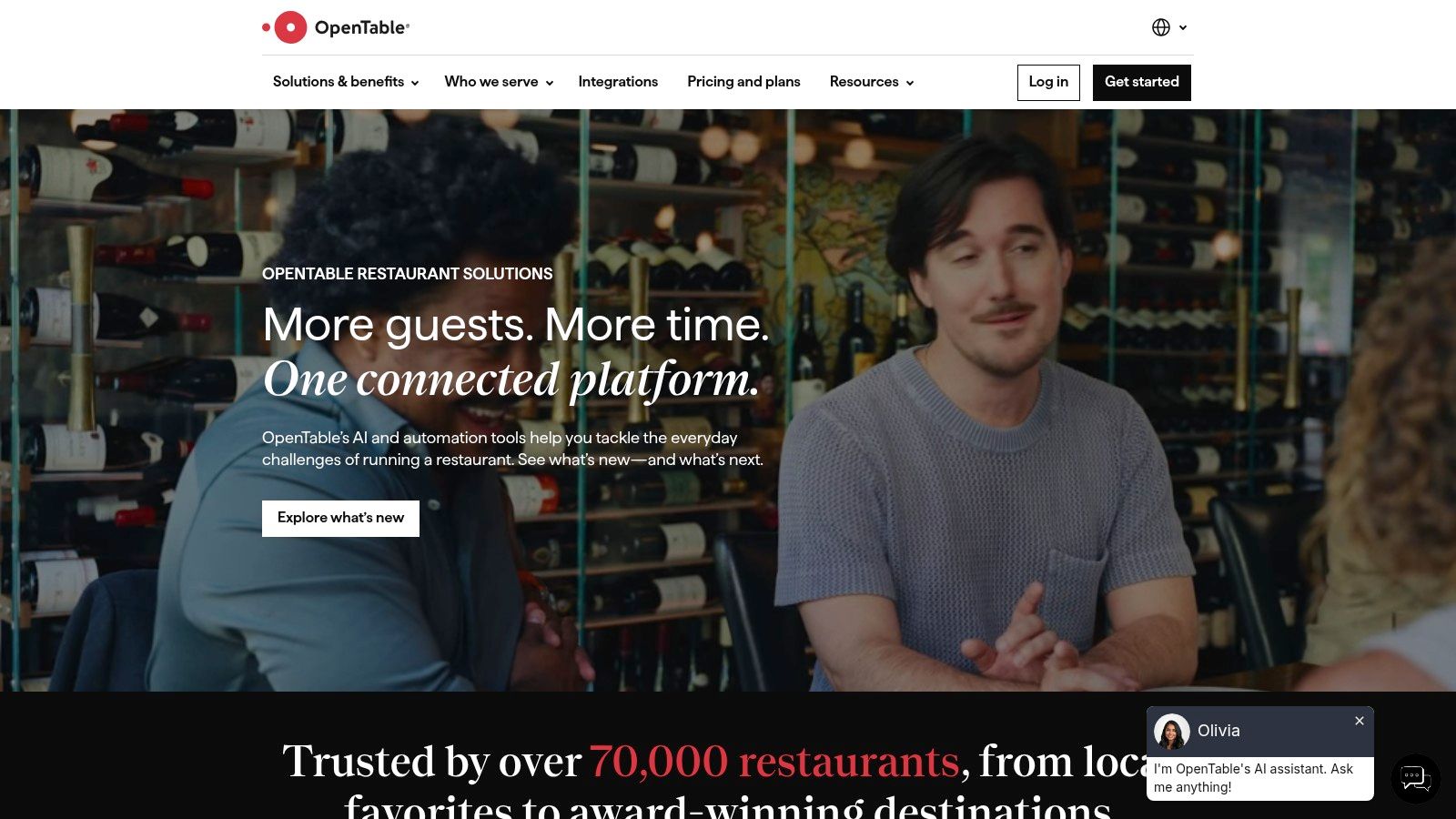
OpenTable is the strongest fit when the main problem is diner discovery rather than a lack of internal booking control. Its marketplace gives restaurants visibility among guests actively searching for tables, while the restaurant platform handles floor plans, waitlists, guest communications, experiences, and customer management.
The operational stack includes Smart Assign, customizable floor plans, access rules, waitlist tools, prepaid experiences, guest profiles, automated tags, and email campaigns on higher plans. For a venue in a competitive dining market, that combination can reduce the need to stitch together a marketplace, reservation diary, waitlist tool, and guest database.
The trade-off is the pricing model. OpenTable's marketplace can involve ongoing network cover fees, and prepaid experiences carry service fees. An annual contract is standard, which may not suit a restaurant that wants month-to-month flexibility. The right question isn't whether OpenTable fills tables. It's whether the additional covers sourced through the network justify the ongoing acquisition cost compared with direct bookings.
OpenTable works best when the marketplace is a meaningful source of demand. It's less compelling when most guests already arrive through the restaurant's own website, regular-customer base, or local search presence.
The platform also deserves a review of how reservation data, table status, and guest spend move into the floor system. Confirmation consistency matters because diners can experience a booking as complete while the restaurant sees a different operational state. Operators comparing systems can use this restaurant reservation system guide to frame the difference between marketplace reach and owned capacity management.
OpenTable is a substantial system, so implementation should include floor-plan configuration, staff training, cancellation rules, access controls, and a clear review of the contract's cover and experience fees.
3. Resy
ResyOS is aimed at restaurants where brand positioning and hospitality control matter as much as basic booking volume. Its strongest natural fit is the urban or fine-dining venue whose guests already recognize Resy and expect access, waitlist communication, and a polished reservation experience.
The platform combines reservation, table, and waitlist management with mobile waitlist handling, two-way messaging, automated SMS workflows, guest data tools, and POS integrations such as Toast. That connection between guest preferences, spend information, and service can help a premium restaurant prepare for repeat diners without relying on scattered staff notes.
Resy's waitlist workflow is particularly relevant during a busy shift. A host can communicate remotely with guests, manage openings, and use reminders to reduce the friction around late arrivals and cancellations. That doesn't eliminate no-shows, but it gives the team a more structured way to manage demand before a table becomes irrecoverably empty.
The operational compromise
Public pricing isn't fully disclosed online, so plans are sales-quoted. That makes comparison harder for an independent operator who wants to calculate total annual cost before investing staff time in a demonstration. Some operators also report a learning curve or interface friction, which means a host should test the live workflow rather than approving the system from a manager-only presentation.
Resy's value depends heavily on venue fit. A premium restaurant in a major food city may benefit from the diner-side recognition and positioning. A smaller venue with strong direct demand may care more about floor-plan optimization, owned guest relationships, or predictable subscription economics. The online booking site comparison offers a useful way to separate discovery value from operational value.
Resy should be tested with real party sizes, the actual floor plan, a representative waitlist, and the venue's POS. The deciding factor is whether staff can manage the door faster without losing the hospitality detail that justifies the restaurant's positioning.
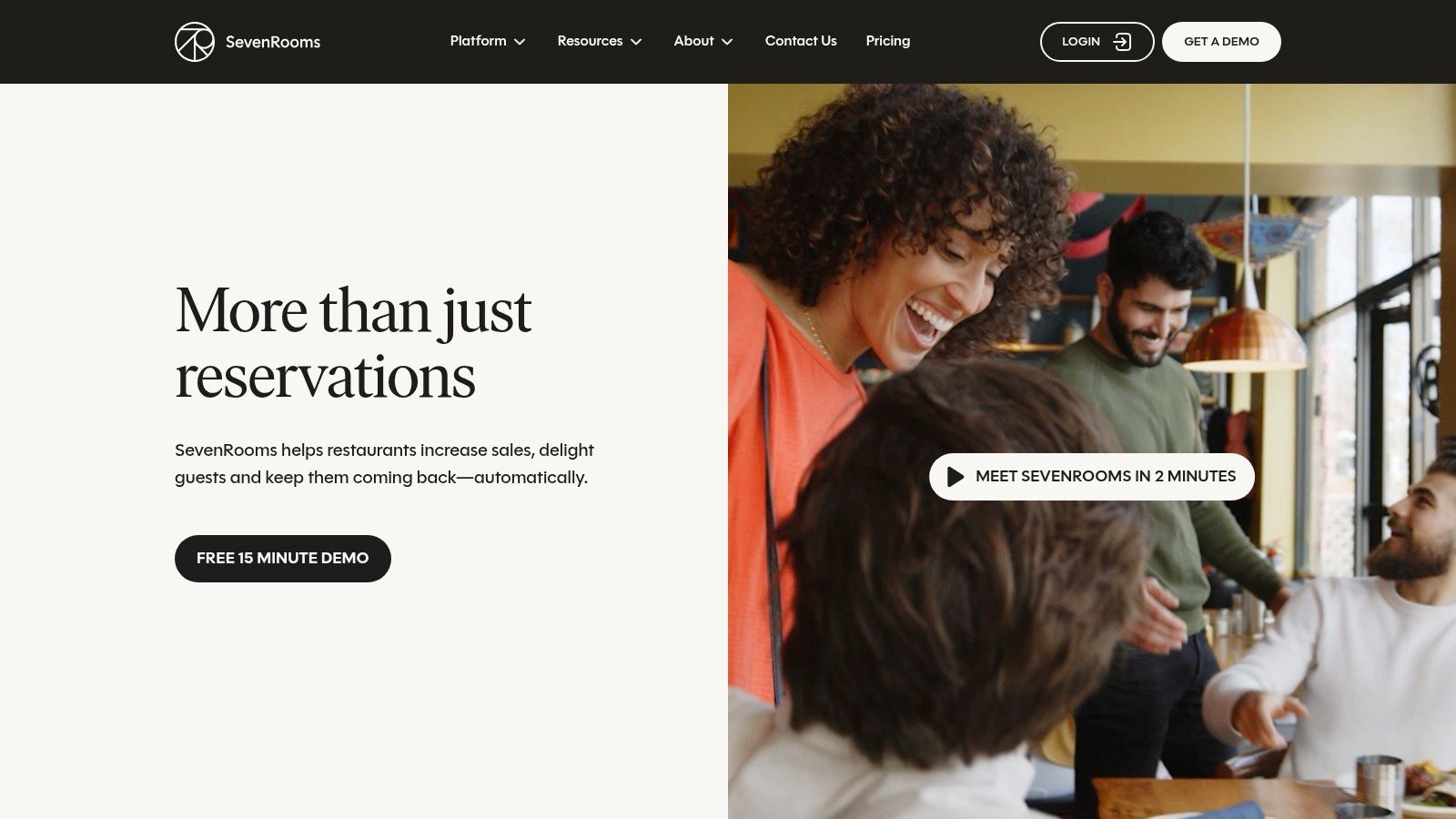
4. SevenRooms
SevenRooms solves a different problem: the restaurant has demand, but its guest relationships are fragmented across venues, booking channels, events, feedback, and marketing tools. The platform combines reservations, waitlists, table management, pacing, guest profiles, segmentation, campaigns, events, ticketing, and reputation management.
Its first-party CRM is the central advantage. A restaurant can build richer profiles, group guests by behavior or preference, and automate campaigns designed to bring diners back through direct channels. For a multi-venue operator, that can be more valuable than a consumer marketplace because the business retains a clearer relationship with the guest across locations.
The platform also supports more than basic table booking. Its integration ecosystem includes 100+ integrations, and optional Voice AI can answer calls and book automatically. Those tools may reduce pressure on the phone and front-of-house team, but they also increase the importance of implementation discipline. Guest data fields, consent practices, outlet permissions, pacing rules, and campaign ownership need clear management.
A CRM only improves retention when the restaurant maintains accurate profiles and gives the service team useful information at the right moment.
SevenRooms typically carries a higher monthly cost than basic reservation tools, and its public site emphasizes sales quotes rather than posted list prices. That makes it a strategic platform decision, not an impulse purchase for a single venue with straightforward reservations.
The best fit is a multi-location group, hotel food-and-beverage operation, or experience-led restaurant that can justify marketing automation and deeper guest intelligence. A small independent restaurant may find that it is buying more CRM capability than the team can actively use. The evaluation should therefore focus on measurable management work, such as campaign creation, guest recovery, cross-venue recognition, and reporting, rather than the number of modules available.
5. Tock
Tock is the clearest choice when a reservation is really a ticket, deposit, or prepaid experience. Chef's counters, tasting menus, wineries, pop-ups, and seasonal concepts often need more protection than a standard à-la-carte booking can provide. Tock handles reservations, events, experiences, ticketing, deposits, and prepayment in one workflow.
That financial commitment changes the operating model. The restaurant can define an experience, attach a deposit or payment requirement, control inventory, and use customizable floor plans and service management tools around the booking. Guest data, reporting, POS integrations, and high-touch support add the operational layer behind the ticket.
Prepayment can protect high-demand inventory, but it also changes the guest relationship. Some diners accept a ticketed model readily, while others expect the flexibility of a conventional reservation. The restaurant should decide whether its menu, demand pattern, and cancellation policy support that level of commitment before adopting the platform.
Where Tock earns its cost
Experience and prepayment fees apply, and payment processing fees still apply on top of platform fees. The correct calculation therefore includes the platform charge, transaction cost, payment cost, refund handling, and staff time spent managing exceptions. A deposit policy also needs to be communicated clearly at booking and reinforced in confirmation messages.
Tock is less naturally suited to a neighborhood restaurant whose main issue is fitting two-top gaps around walk-ins. That venue may need better capacity allocation rather than ticketing infrastructure. Operators should also define what happens when a guest cancels, transfers a booking, changes a dietary requirement, or arrives late. A useful explanation of reservation financial commitments appears in this guide to credit card guarantees.
Tock is strongest when protecting a scarce, high-value seat matters more than maximizing casual discovery. It should be tested against the restaurant's actual experience calendar and payment workflow, not only its reservation screen.
6. Yelp Guest Manager
Yelp Guest Manager is designed around front-of-house control connected to consumer discovery. It combines reservations, online waitlists, table and floor management, two-way SMS, booking links, social calls to action, and optional kiosk-based self check-in.
That makes it particularly useful for casual restaurants where the queue at the door is as important as the reservation book. Staff can manage walk-ins, communicate wait times, and keep booking links available across Yelp, Maps, social channels, and other surfaces. The optional Yelp Kiosk can support self check-in, while guaranteed seating area selection gives guests more control in some workflows.
The platform positions bookings without per-cover fees, which can be attractive for a restaurant that wants discovery exposure without a bill that grows with every seated guest. Pricing varies by plan and isn't always fully itemized publicly, and advertising upsells can add cost. Those items should be separated from the reservation software decision during procurement.
The useful question for a busy casual venue is not whether the app has the longest feature list. It's whether the host can clear the queue, update guests, and protect table availability without leaving the door.
Yelp's consumer reach is most valuable where diners actively use the platform to choose restaurants. A venue with little Yelp demand may gain more from direct booking links and stronger floor-plan logic elsewhere. The team should measure booking source, waitlist conversion, staff messaging time, and the number of walk-ins lost because the queue was managed manually.
Yelp Guest Manager is a practical option for small teams that need a combined waitlist and host toolkit. It's less compelling for fine dining operators seeking deep guest CRM, complex pacing, or advanced multi-venue marketing.
7. SpotOn Reserve
SpotOn Reserve addresses the operator who wants reservations, deposits, guest data, and table management tied closely to the POS. Online bookings can arrive through Google, the restaurant website, and social channels, with automated confirmations and reminders. The host app supports table management and predictive wait times, while POS synchronization keeps operational data closer to the payment workflow.
Its commercial model is a simple flat monthly fee with no per-cover fees. That predictability can help an owner compare reservation costs against covers without estimating marketplace acquisition charges for every booking. Optional deposits, experiences, and ticketed events extend the platform beyond basic reservations.
The main limitation is ecosystem dependence. SpotOn Reserve offers its best value when the restaurant already uses, or is prepared to adopt, SpotOn POS. Setup fees apply, and the platform has a smaller consumer marketplace than OpenTable or Resy, so the restaurant relies more heavily on owned channels and Google for demand.
The POS decision
POS integration should be judged by what staff can do during service, not by the word “integration” on a sales sheet. The team should confirm whether table status updates in both directions, whether guest spend reaches the right profile, how deposits are reconciled, and what happens when a reservation changes after the check has opened.
SpotOn Reserve is a strong candidate for operators prioritizing predictable fees and a connected technology stack. It's a weaker fit for a restaurant that wants the broadest diner discovery network or the freedom to change POS systems soon. The SpotOn Reserve platform should be tested with the actual POS configuration, floor plan, deposit policy, and host workflow.
A clean integration can save staff from re-entering booking details. It can't compensate for poor table definitions, unclear pacing rules, or a service model that the software hasn't been configured to reflect.
Top 7 Restaurant Reservation Apps, Feature Comparison
| Product | Implementation complexity | Resource requirements | Expected outcomes | Ideal use cases | Key advantages |
|---|---|---|---|---|---|
| 10Seat | Low to medium, fast onboarding (5‑min), quick migration advertised (~15 min); some initial seating rule configuration | Minimal hardware; Host app + AI assistant; free tier (≤50 covers/mo); verify POS/third‑party compatibility | Reported +10–15% covers on busy shifts, up to +30% reservations, -40% no‑shows | Fine dining, brasseries, casual/brunch spots, bars with seating, multi‑location groups seeking yield | Automated Capacity Engine, monetizes walk‑ins/gaps, fast setup, focused Host UX |
| OpenTable for Restaurants | Medium, standard onboarding, profile setup; often annual contracts | Ongoing network/cover fees for marketplace bookings; POS integrations and staff training | Increased diner acquisition and bookings from large consumer marketplace | Restaurants prioritizing discovery and high-volume guest acquisition | Large marketplace reach, mature floor/waitlist ops, experiences/ticketing |
| Resy (ResyOS) | Medium, sales‑quoted plans; some learning curve reported in UI | POS integrations recommended (e.g., Toast); staff training for workflows | Strong premium positioning, reduced no‑show friction, richer guest data | Urban and fine‑dining venues prioritizing hospitality and control | Recognized diner brand, robust waitlist/messaging, POS integrations |
| SevenRooms | Medium to high, modular setup, sales‑quoted pricing, configuration for CRM/automation | Higher monthly cost typical; marketing resources and integrations for full value | Deeper first‑party guest data, increased repeat visits, automated marketing | Multi‑venue operators, experience‑driven concepts, loyalty/marketing focused groups | Powerful CRM and segmentation, marketing automation, broad integrations |
| Tock | Medium, setup for ticketing/deposit workflows and event management | Payment processing and prepayment fees; operations for prepaid events | Protects inventory and revenue, lowers no‑show risk for high‑demand services | Prepaid chef's counters, tastings, wineries, seasonal or reservation‑heavy concepts | Native ticketing/experiences, strong deposit workflows, suited to high‑demand events |
| Yelp Guest Manager | Low to medium, integrated with Yelp business profile; optional kiosk setup | Ads upsells optional; basic FOH tools and two‑way SMS; minimal hardware for kiosk | Increased local discovery/bookings from Yelp/Maps exposure; practical FOH improvements | Small teams, local restaurants seeking multi‑channel exposure without per‑cover fees | Large consumer reach (Yelp/Maps), no per‑cover fee positioning, simple FOH tools |
| SpotOn Reserve | Low to medium, straightforward when paired with SpotOn POS; setup fees may apply | Flat monthly fee (no per‑cover fees); best value with SpotOn POS adoption | Cost control, POS‑synced reservations and guest data, predictable billing | Operators using or adopting SpotOn POS, cost‑sensitive restaurants | Flat‑fee pricing, tight POS integration, deposits and experiences support |
Choose the App That Fixes Your Costliest Bottleneck
The right system is the one that fixes the most expensive operational constraint, not the one with the most impressive feature list. A restaurant losing covers because tables sit unused between larger bookings needs a different tool from a tasting-menu venue protecting prepaid inventory or a group building one guest relationship across several locations.
10seat is the strongest fit when maximizing existing seating capacity, handling walk-ins, and avoiding per-cover economics are priorities. Its reported 10–15% busy-shift cover opportunity should be tested against actual service data, including current covers, short gaps, no-shows, and host decision time. Operators can review the 10seat product before requesting a workflow demonstration.
OpenTable or Resy make more sense when marketplace reach and diner brand recognition materially influence bookings. SevenRooms suits operators that can justify a higher-cost platform through first-party CRM, multi-venue marketing, and structured guest retention. Tock is the specialist choice for deposits, ticketing, and prepaid experiences that protect revenue. Yelp Guest Manager fits restaurants where discovery, queue management, and practical host tools are central. SpotOn Reserve is appropriate when tight POS integration and flat-fee reservations matter more than marketplace scale.
The comparison should include the full cost of operation, not only the advertised subscription.
- Current covers: Record covers by service and channel before evaluating projected gains.
- No-shows and cancellations: Track the revenue and staff time lost through unfilled bookings.
- Unused short slots: Identify gaps that could be seated without disrupting kitchen pacing.
- Staff minutes: Measure time spent seating, texting, calling, changing tables, and reconciling systems.
- Commercial terms: Compare marketplace fees, payment fees, setup costs, contract length, and cancellation terms.
- Data ownership: Confirm who controls guest profiles, export rights, consent records, and marketing access.
Restaurant reservation software adoption reached 19% of sit-down restaurants in the United States by mid-2024, up from 13% in 2022, according to Bistrochat's restaurant reservation market snapshot. The category is becoming operating infrastructure, so migration effort and reliability at the door deserve as much attention as booking conversion.
Belgian operators need a final compliance review. From July 2025, GKS 2.0 extends to all businesses where products or services are sold on-site and cash payments are accepted, according to the official GKS 2.0 information. A registered cash system is mandatory when annual turnover from restaurant and catering services exceeds €25,000 excluding VAT, while businesses below that threshold still need to issue a VAT receipt for meals and related drinks consumed on-site, as explained by Horeca Vlaanderen.
Belgian restaurants using older systems also need to plan around transition deadlines. The tolerance period ends on 31 March 2026, with stricter enforcement beginning in April 2026, and cash registers purchased from 1 January 2022 must transition no later than 1 January 2029, according to Belgian hospitality cash-register guidance. A reservation platform can support the workflow, but it doesn't remove the need to verify the kassasysteem, receipts, payments, and reporting with an accountant or compliance adviser.
For broader small-business technology planning, this Business Loan Warrior tech guide provides additional context. The practical next step is to shortlist two platforms, request a workflow demonstration using the restaurant's actual floor plan, and compare the projected service-time and cover impact before signing.
10seat helps independent restaurants manage online reservations, optimize existing tables, and handle walk-ins without adding manual work or per-cover pressure. Visit 10seat to test the platform against the dining room's real service pattern and identify where unused capacity can become additional covers.